1) If the demand for light bulbs increases, producer surplus in the market for light bulbs
a.increases.
b.decreases.
c.remains the same.
d.may increase, decrease, or remain the same.
2) Which of the following conditions is characteristic of a monopolistically competitive
firm in short-run equilibrium?
a.P = AR
b.MR = MC
c.P > MC
d.All of the above are correct.
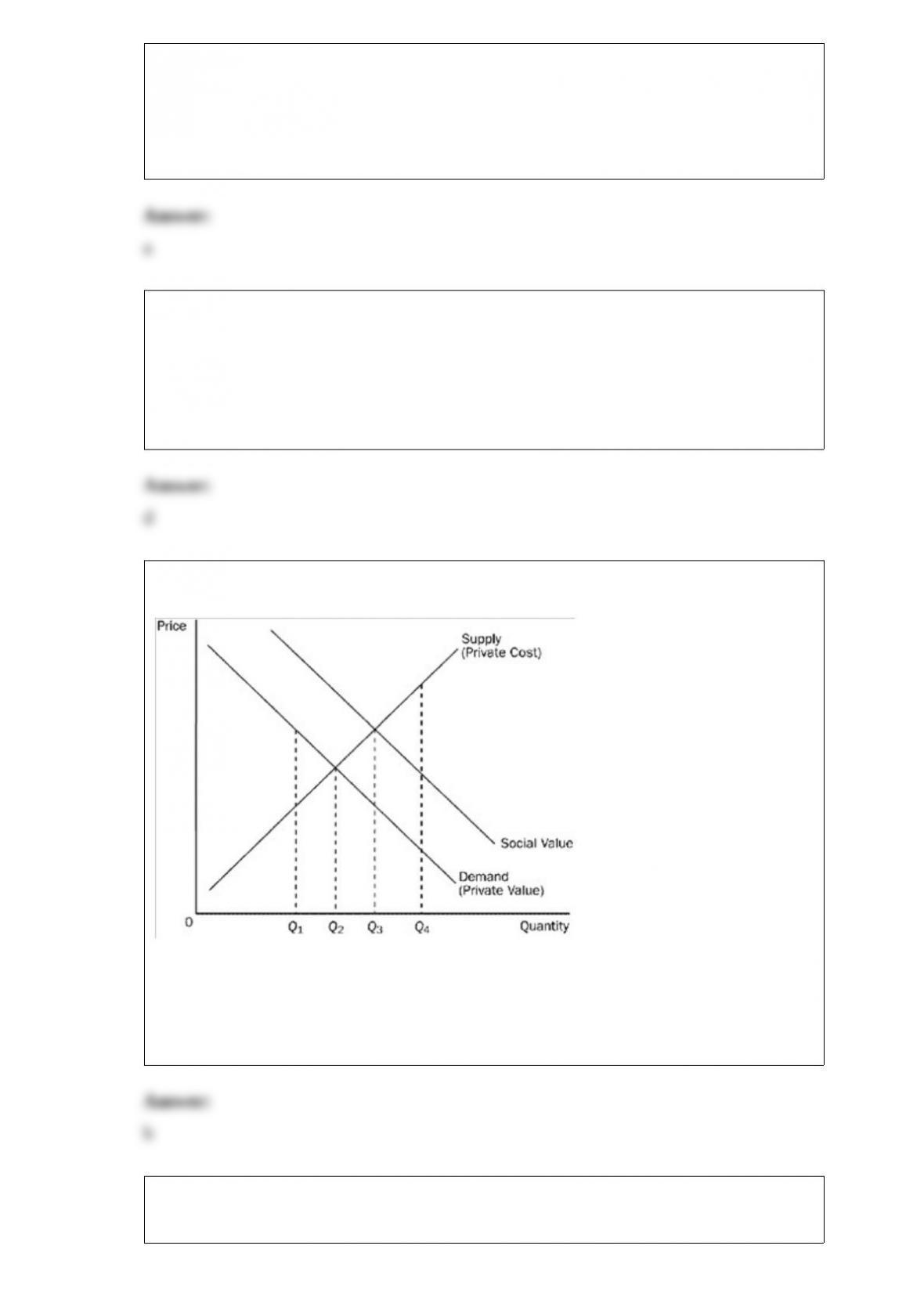
3) Figure 10-7
To internalize the externality in this market, the government should
a.impose a tax on this product.
b.provide a subsidy for this product.
c.forbid production.
d.produce the product itself.
4) Economists use the word equality to describe a situation in which
a.each member of society has the same income.
b.each member of society has access to abundant quantities of goods and services,
regardless of his or her income.
c.society is getting the maximum benefits from its scarce resources.
d.society’s resources are used efficiently.
5) In a 2012 Wall Street Journal column, economists Edward Prescott and Lee Ohanian
claimed that, in order to promote faster economic growth, the government should
a.increase tax rates on individuals with high incomes, and leave tax rates on other
individuals unchanged.
b.equalize tax rates on all individuals, regardless of how much they earn.
c.decrease tax rates on income and increase tax rates on consumption.
d.increase the after-tax benefits to successful entrepreneurship and risk-taking.
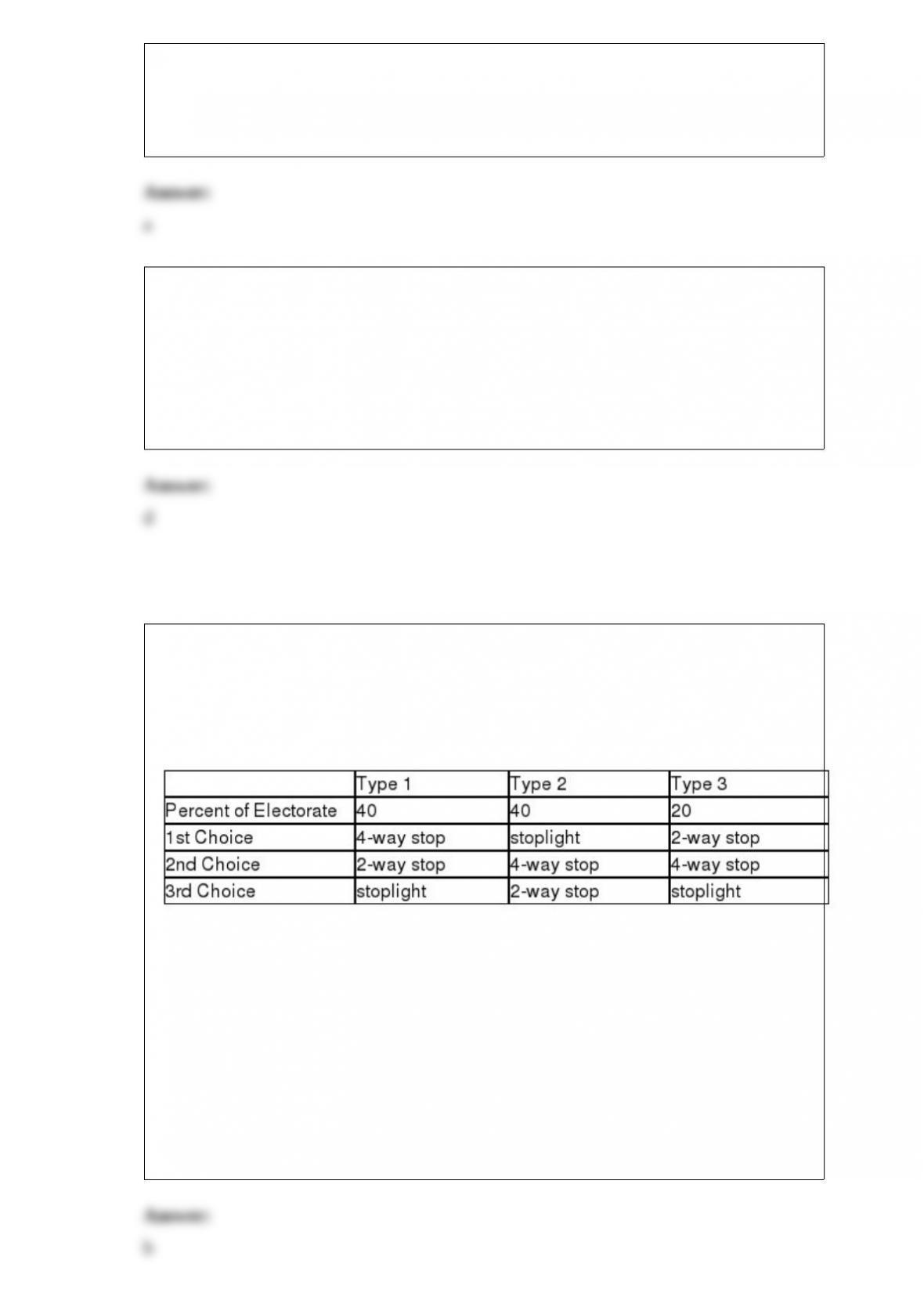
6) Table 22-7
Suppose that residents of a town are asked to vote on the best way to improve the safety
of an intersection. The three choices are: a stoplight, a 4-way stop, and a 2-way stop.
The voters are divided into three groups based on their preferences.
Voter Type
Refer to Table 22-7. Which of the following statements is correct regarding the
Condorcet paradox and the results of pairwise voting on how to improve the safety of
the intersection?
a.The paradox implies that pairwise voting never produces transitive preferences, and
so the voting in the town fails to produce transitive preferences.
b.The paradox implies that pairwise voting sometimes (but not always) fails to produce
transitive preferences, but the voting in the town does produce transitive preferences.
c.The paradox implies that pairwise voting sometimes (but not always) fails to produce
transitive preferences, and the voting in the town fails to produce transitive preferences.
d.The paradox implies that pairwise voting always produces transitive preferences, and
so the voting in the town produces transitive preferences.
7) If the government were to intervene in a market economy and fix the price of visiting
a health care provider below the market price, then we would expect, relative to the
market outcome,
a.an increase in the number of visits people want to make and an increase in the number
of visits health care providers want to provide.
b.an increase in the number of visits people want to make and a decrease in the number
of visits health care providers want to provide.
c.a decrease in the number of visits people want to make and an increase in the number
of visits health care providers want to provide.
d.a decrease in the number of visits people want to make and a decrease in the number
of visits health care providers want to provide.
8) If a major union goes on strike, then the country would be operating inside its
production possibilities frontier.
a.True
b.False
9) One should be especially wary of the national-security argument for restricting trade
when that argument is made by
a.representatives of industry.
b.representatives of the defense establishment.
c.members of households.
d.foreign government officials.
10) A decrease in quantity supplied
a.results in a movement downward and to the left along a fixed supply curve.
b.results in a movement upward and to the right along a fixed supply curve.
c.shifts the supply curve to the left.
d.shifts the supply curve to the right.
11) The temptation of imperfectly-monitored workers to shirk their responsibilities is
a.an example of the moral hazard problem.
b.an example of the adverse selection problem.
c.an example of screening.
d.an example of signaling.
12) In which of the following circumstances would a buyer be indifferent about buying
a good?
a.The amount of consumer surplus the buyer would experience as a result of buying the
good is zero.
b.The price of the good is equal to the buyer’s willingness to pay for the good.
c.The price of the good is equal to the value the buyer places on the good.
d.All of the above are correct.
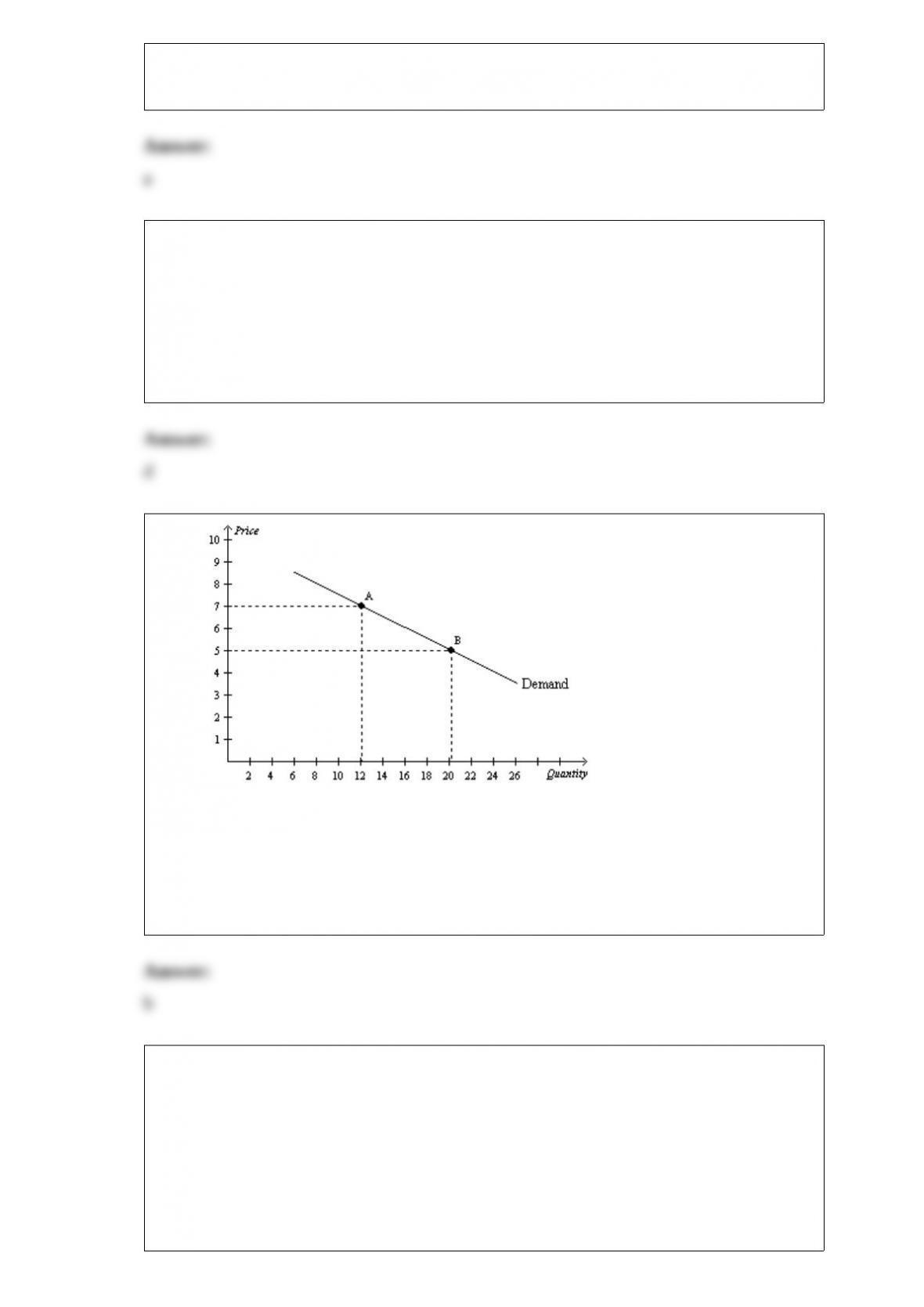
13)
Between point A and point B, the slope is equal to
a.-1/4, and the is equal to 2/3.
b.-1/4, and the is equal to 3/2.
c.-3/2, and the is equal to 1/4.
d.-2/3, and the is equal to 3/2.
14) The market for diamond rings is closely linked to the market for high-quality
diamonds. If a large quantity of high- quality diamonds enters the market, then the
a.supply curve for diamond rings will shift right, which will create a shortage at the
current price. Price will increase, which will decrease quantity demanded and increase
quantity supplied. The new market equilibrium will be at a higher price and higher
quantity.
b.supply curve for diamond rings will shift right, which will create a surplus at the
current price. Price will decrease, which will increase quantity demanded and decrease
quantity supplied. The new market equilibrium will be at a lower price and higher
quantity.
c.demand curve for diamond rings will shift right, which will create a shortage at the
current price. Price will increase, which will decrease quantity demanded and increase
quantity supplied. The new market equilibrium will be at a higher price and higher
quantity.
d.demand curve for diamond rings will shift right, which will create a surplus at the
current price. Price will decrease, which will increase quantity demanded and decrease
quantity supplied. The new market equilibrium will be at a lower price and higher
quantity.
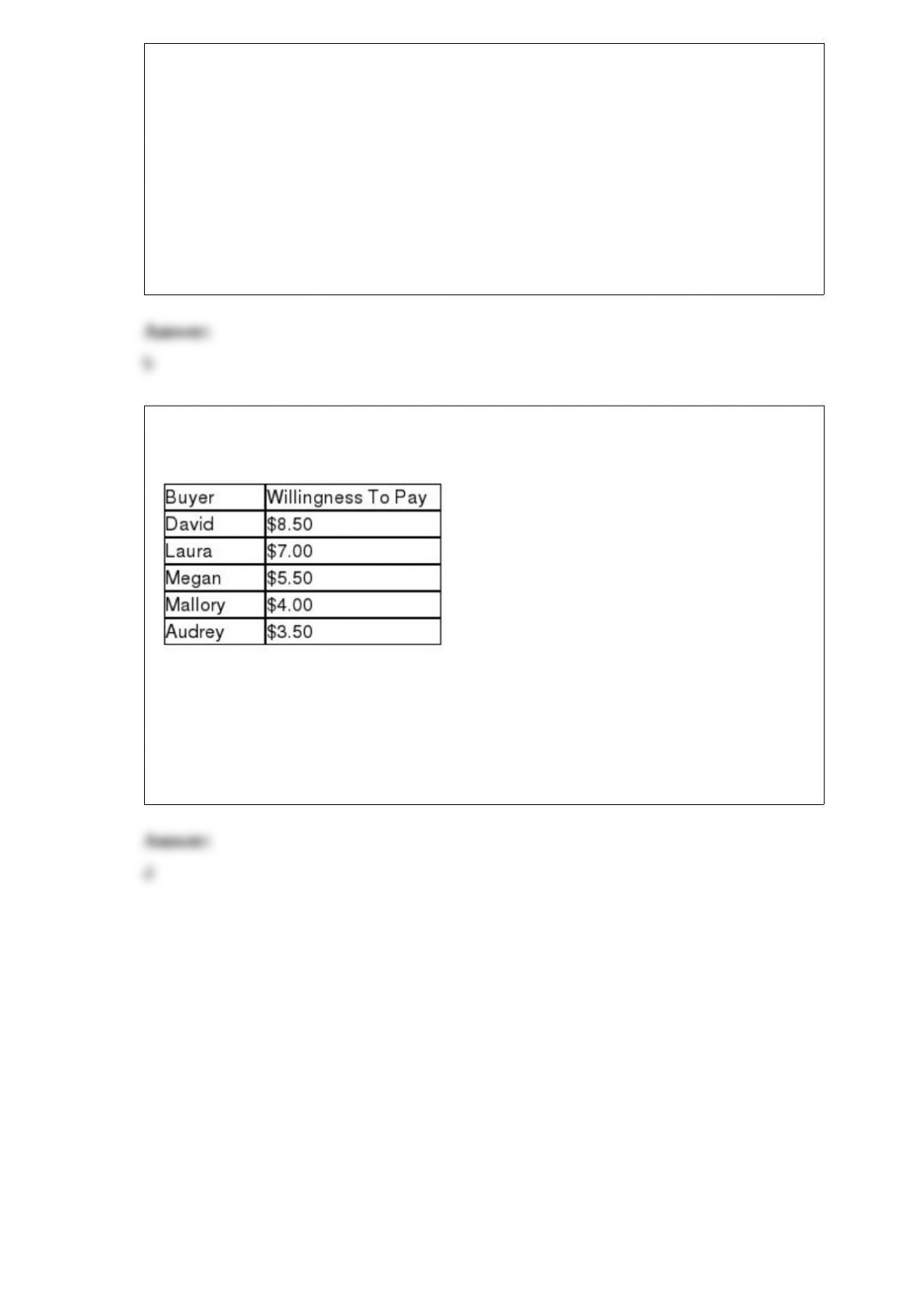
15) Table 7-2
This table refers to five possible buyers’ willingness to pay for a case of Vanilla Coke.
Which of the following is not true?
a.At a price of $9.00, no buyer is willing to purchase Vanilla Coke.
b.At a price of $5.50, Megan is indifferent between buying a case of Vanilla Coke and
not buying one.
c.At a price of $4.00, total consumer surplus in the market will be $9.00.
d.All of the above are correct.