
To maintain its target exchange rate for the yuan, China had to sell yuan and buy dollars
and other currencies.
A) True
B) False
If banks decide to hold some of their excess reserves instead of lending them all out:
A) the money multiplier will be less than 1 divided by the required reserve ratio.
B) a loan of $1 will lead to a change in the money supply by a multiple amount equal to
1 divided by the required reserve ratio.
C) the money multiplier becomes 1 divided by the excess reserves.
D) depositors will have to borrow more to increase the money supply.
In 2002, the French adopted the British pound as their national currency.
A) True
B) False
Human capital refers to:
A) changes in inventories.
B) workers’ education or training.
C) funds available for investment spending.
D) spending on physical capital, such as machines that aid workers.
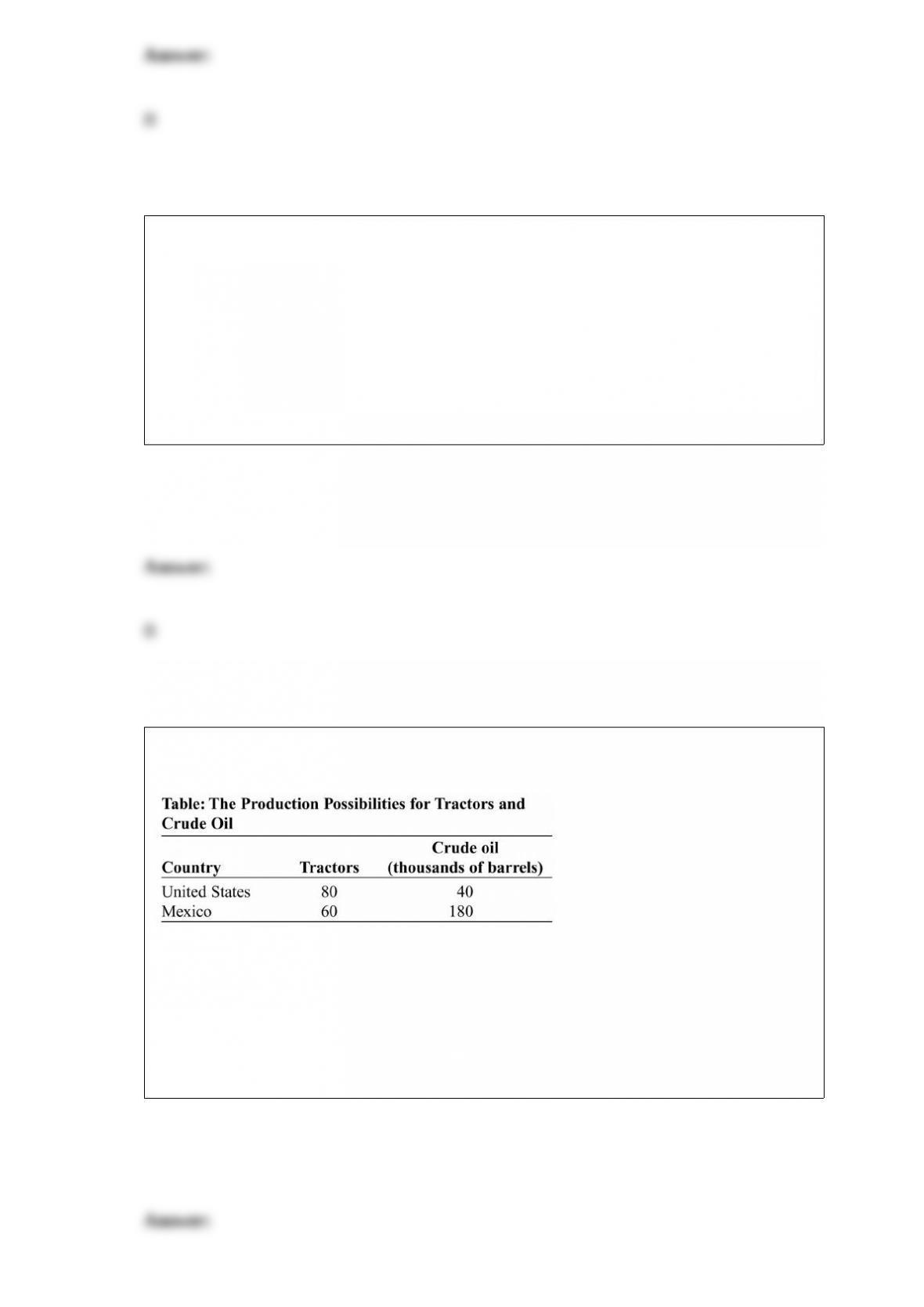
Look at the table The Production Possibilities for Tractors and Crude Oil. Both the
United States and Mexico will gain from trade if one tractor trades for _____ barrels of
crude oil.
A) 5,000
B) 4,000
C) 1,000
D) 200

Unanticipated inflation:
A) increases the value of money.
B) decreases uncertainty about the future.
C) reduces the real value of debt.
D) helps lenders.
According to the efficient markets hypothesis, if you are trying to find out what a stock
is really worth, you should:
A) look up the current stock price.
B) study past trends in the stock price.
C) study the underlying determinants of the company’s future profits.
D) examine its recent price changes.

The main idea behind monetarism is that:
A) the aggregate output will be even greater than potential output if the money supply
grows at a constant rate.
B) the aggregate price level will increase proportionally if the money supply grows at a
constant rate.
C) the government budget will have a deficit if the government spending grows at a
constant rate.
D) the aggregate output will grow steadily at a constant rate if the money supply also
grows at a constant rate.
After 2000 the market for mortgage-backed securities grew rapidly because economists
claimed they had a model that could predict the risk associated with them.
A) True
B) False
In a single year, Argentina can raise 100 tons of beef or produce 1,000 boxes of tulips.
In the same growing season, Venezuela can raise 50 tons of beef or produce 750 boxes
of tulips. When the two countries begin trading beef for tulips, we expect the price of
beef in Venezuela:
A) to fall.

B) to rise.
C) to remain at the autarky price.
D) to be 15 boxes of tulips.
The U.S. dollar in your pocket today is best described as:
A) commodity money.
B) near-money.
C) fiat money.
D) commodity-backed money.
According to current estimates of Okun’s law, if the output gap is 3%, the natural rate of
unemployment is 4%, and the expected rate of inflation is 5%, then the unemployment
rate is:
A) 3.5%.
B) 3%.
C) 2.5%.
D) 1.5%.

Which of the following is (are) source(s) of funds for Facebook’s investment spending?
I. investors who purchase shares of stock in the company
II. borrowing from savers
A) I only
B) II only
C) both I and II
D) neither I nor II
According to a Keynesian economist, a recessionary gap should be fixed with:
A) a monetary rule.
B) supply-side tax increases to balance the budget.
C) decreases in government spending.
D) discretionary fiscal policy.

You are planning to study eight hours this week for your economics final and are
considering studying a ninth hour. You should:
A) compare the benefits of one more hour of study with the cost of one less hour of
sleep.
B) compare the benefits of one more hour of study with the cost of one less hour of
studying calculus.
C) compare the benefits of one more hour of study with the cost of one less hour of
work at your part-time job.
D) make your decision based on the cost of the next best alternative use of your time
compared to the benefit of one more hour of study.
Over the past several years, consumers have had an increasing interest in getting
tattoos. This means that the _____ for tattoos has _____.
A) quantity demanded; increased
B) demand; decreased
C) demand; increased
D) quantity demanded; decreased

If the U.S. dollar were replaced with a “new dollar” at an exchange rate of 1 new dollar
for 4 old dollars, then an hourly wage of $12 would become an hourly wage of 3 new
dollars.
A) True
B) False
After a great holiday season when it opened its doors for business regularly at 6 A.M., a
local retail store decides to continue to open at 6 A.M., even though many customers
plan on arriving later to do their shopping. Such a plan by the retail store is:
A) efficient, since it worked previously.
B) inefficient, since most customers will revert to their normal shopping behavior after
the holidays are over.
C) efficient, since it means that workers do not have to change their hours.
D) most likely to lead to lower operating costs for the store.
Suppose that an economy is in an inflationary gap in the short run. In the long run:
A) the economy’s self-correcting mechanism will restore GDP to its potential level.

B) inflation will spiral unless the government takes dramatic fiscal measures.
C) sustained inflation will reduce the value of money.
D) fiscal and monetary policies may lower prices, but output will remain higher than
potential level.
In 2005, Airbus Co. purchased raw materials worth $400 million to manufacture
airplanes for a total value of $900 million. In that year, Airbus Co. sold airplanes for a
total value of $800 million. During 2005, Airbus Co. registered inventory investment
of:
A) $900 million.
B) $500 million.
C) $400 million.
D) $100 million.
Keynes argued that the surest way to bring the economy out of the Great Depression
was to:
A) keep the economy in a liquidity trap until antitrust policy could be enforced.
B) use expansionary fiscal policy.
C) increase taxes and spend less.
D) leave the economy alone, and flexible wages and prices would eventually lead to
increases in income and employment.
The price index in a given year is the cost of the market basket in that year _____ the
cost of the market basket in the base year times 100.
A) divided by
B) times
C) minus
D) plus
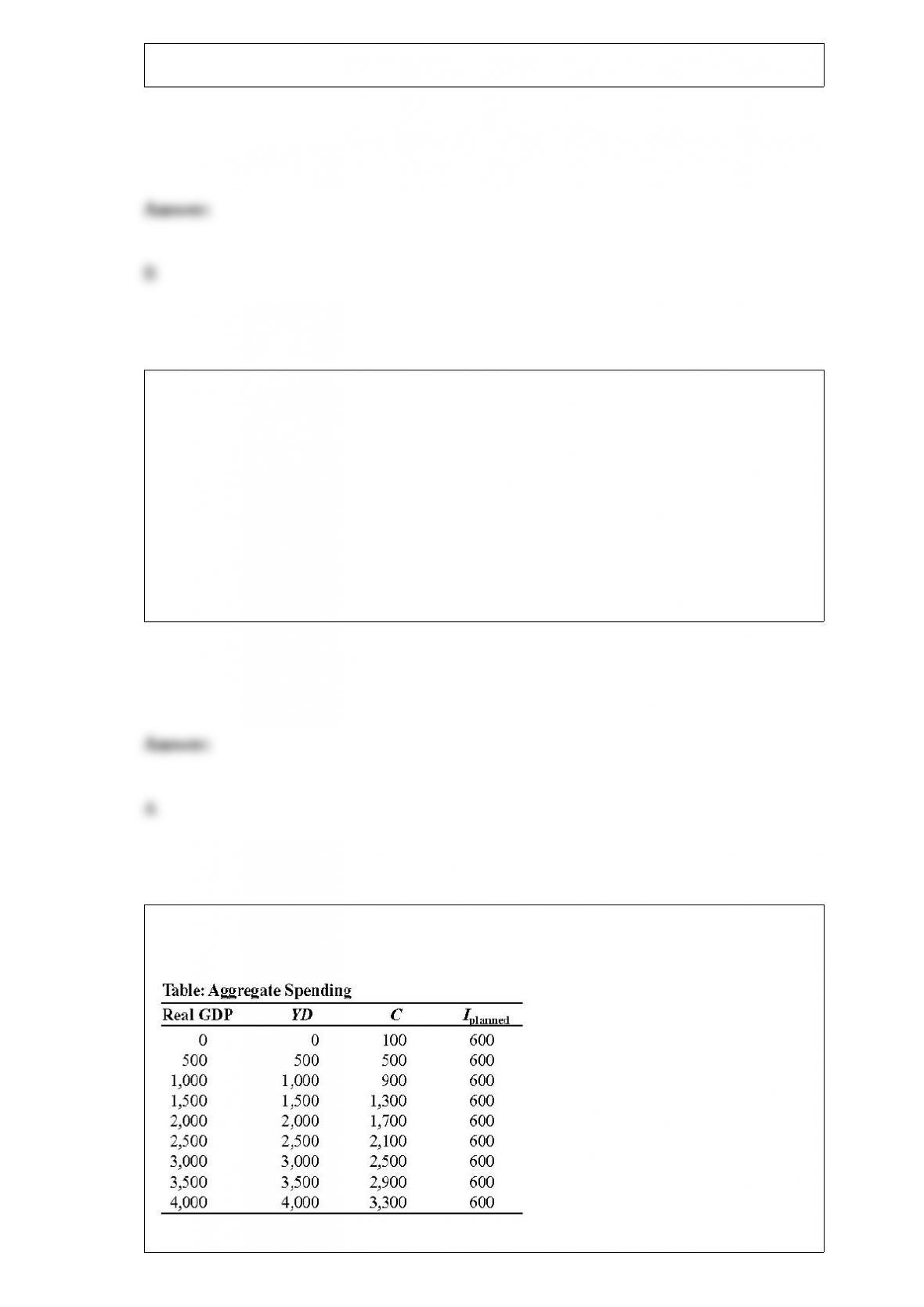
Suppose the economy has no government spending and no foreign trade. With no taxes
and transfers, real GDP equals disposable income (YD). The data in the accompanying
table show consumption spending (C) and planned investment (IPlanned).
a. What is the marginal propensity to consume in this economy?
b. At what level of real GDP will the economy find its income”expenditure equilibrium?
You decide to join the economics club, but this means you can’t join the accounting club
because it meets at the same time. This statement best represents this economic concept:
A) The real cost of something is what you must give up to get it.
B) “How much” is a decision at the margin.
C) People usually exploit opportunities to make themselves better off.
D) There are gains from trade.
If the government spends an extra $5 billion on goods and services, GDP will:
A) go up by $5 billion.
B) remain unchanged.
C) increase by less than $5 billion.

D) increase by more than $5 billion.
Which of the following will shift the AD curve to the right?
A) an increase in wealth
B) pessimism about the economy
C) a supply shock
D) a decrease in productivity
According to Jeff Sachs of Columbia University, Africa is politically unstable because
Africa is poor and not the other way around.
A) True
B) False
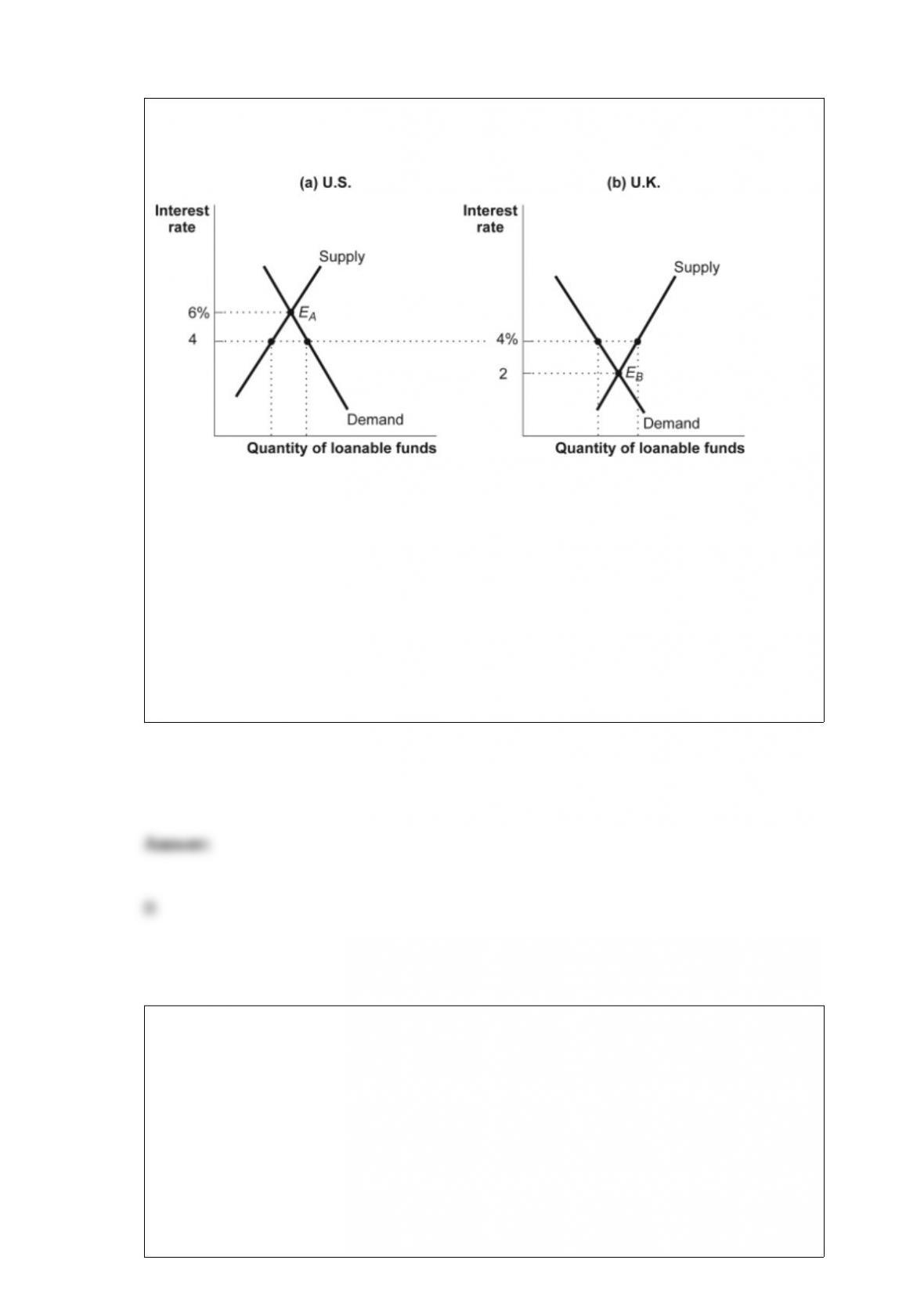
Figure: International Capital Flows
Look at the figure International Capital Flows. At an interest rate of 4%, the excess of
loanable funds supplied by _____ lenders will be exported to _____ borrowers.
A) U.S.; British
B) British; U.S.
C) U.S. or British; British or U.S.
D) U.S.; worldwide
Financial regulation was not adequate to deal with the 2008 financial crisis because:
A) before 2008 banks were very small and could be effectively regulated by the states.
B) up until the 2008 crisis, the market had worked very well in preventing banking
crises, so there was very little need for bank regulation.
C) the role of shadow banks had become very important, but shadow banks were not
subject to banking regulation at the time of the 2008 crisis.

D) the Supreme Court had ruled that the regulatory powers of the Federal Reserve were
unconstitutional and prohibited the Fed from using its regulatory powers.
In an economy with no taxes or imports, if the marginal propensity to consume
increases, the marginal propensity to save will decrease.
A) True
B) False