
If government regulators force a natural monopoly to produce where price equals
marginal cost, the monopoly will earn
a. a “fair return”
b. positive economic profit
c. zero economic profit
d. negative economic profit
e. greater economic profit than if it were unregulated
The purpose of social insurance is to
a. encourage charitable donations
b. provide money to the poor
c. provide in-kind aid to the poor
d. redistribute income for the old to the young
e. supplement the incomes of those who have worked but are now retired, temporarily
unemployed, or disabled
A net importer of assets must have a
a. current account deficit
b. capital account deficit
c. current account surplus
d. capital account surplus
e. balance of deficit trade
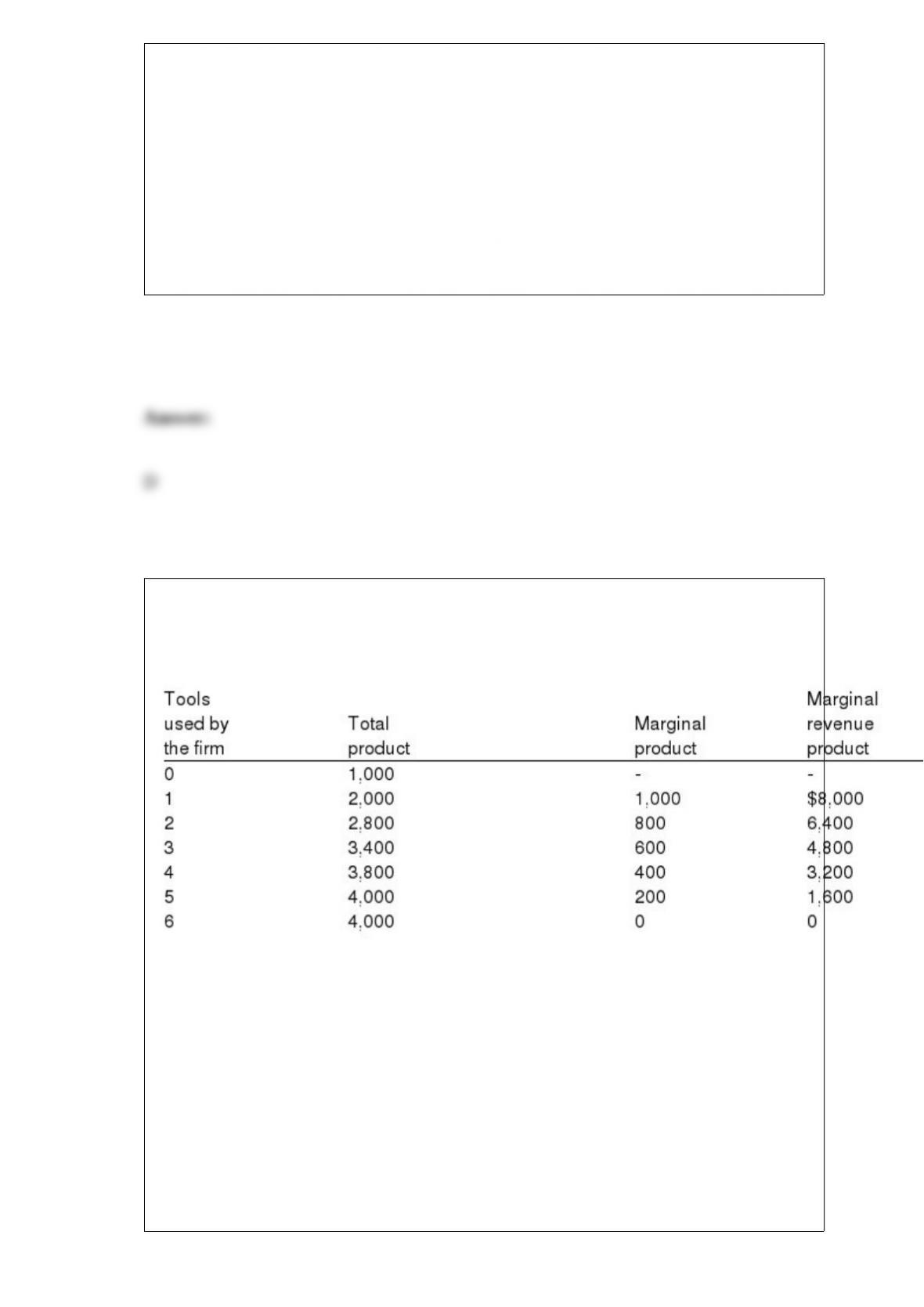
Exhibit 13-3
Exhibit 13-3 gives data on the number of tools a certain firm buys to use in its
production process. Assume that the tools are expected to last indefinitely, that
operating expenses are negligible, and that the price of the firm’s output is expected to
remain constant in the future. At an interest rate of 10 percent, the firm in Exhibit 13-3
should select
a. the maximum number of tools available because price does not decrease as output
increases
b. the minimum number of tools available because price does not increase as output
increases
c. three tools
d. four tools
e. five tools
Which of the following is a characteristic of pure capitalism?
a. all resources are owned communally
b. economic activity is coordinated by government decision makers
c. the price system is used to guide resources to their highest-valued uses
d. centralized economic planning is used to answer the basic economic questions
e. individual choices are reflected only through collective decisions
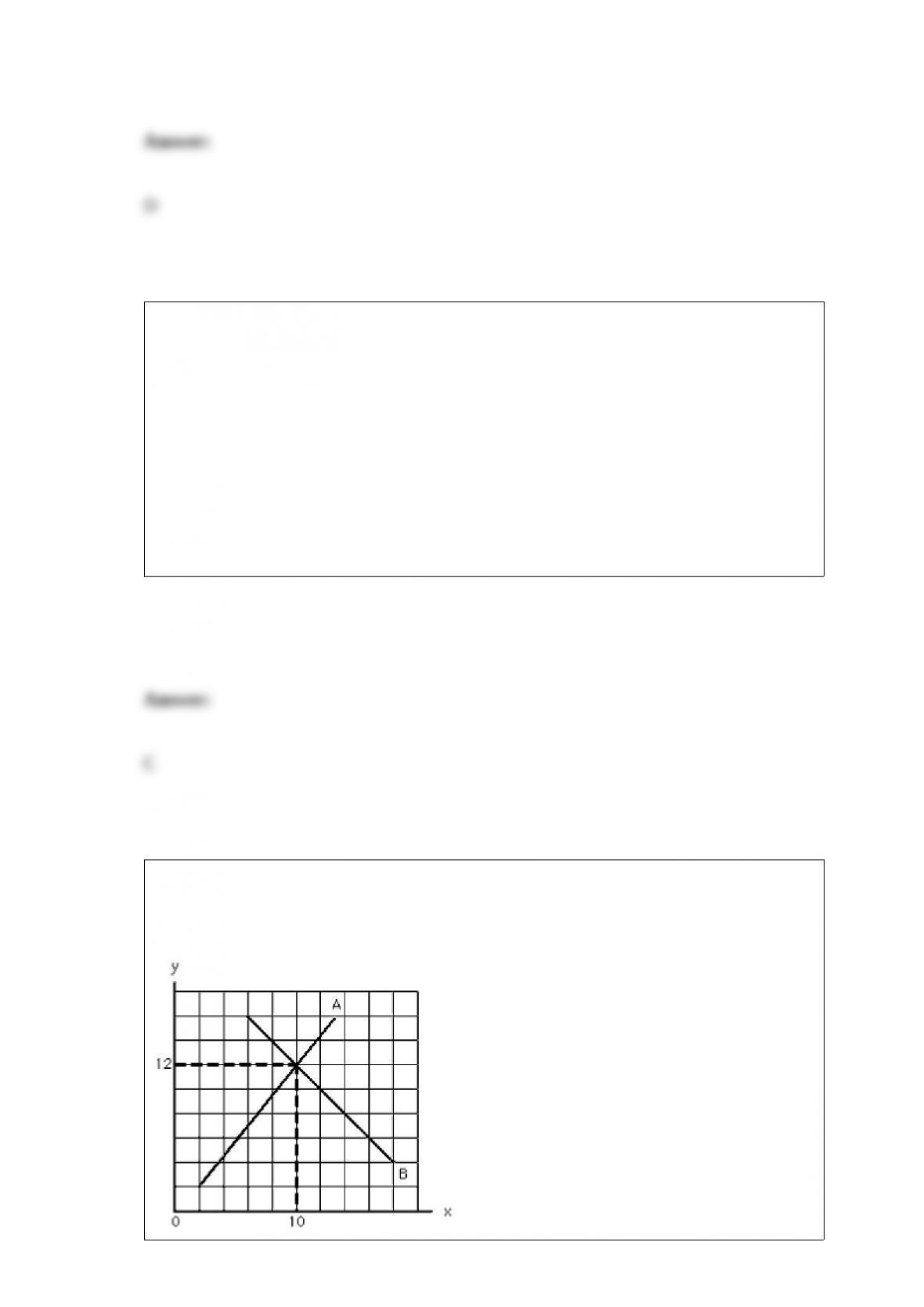
Exhibit 1-2
In Exhibit 1-2, when x is less than 10, the
a. value of y is larger on curve A than on curve B
b. value of y is smaller on curve A than on curve B
c. value of y is the same on curve A as on curve B
d. slope of line A is negative
e. slope of line B is positive
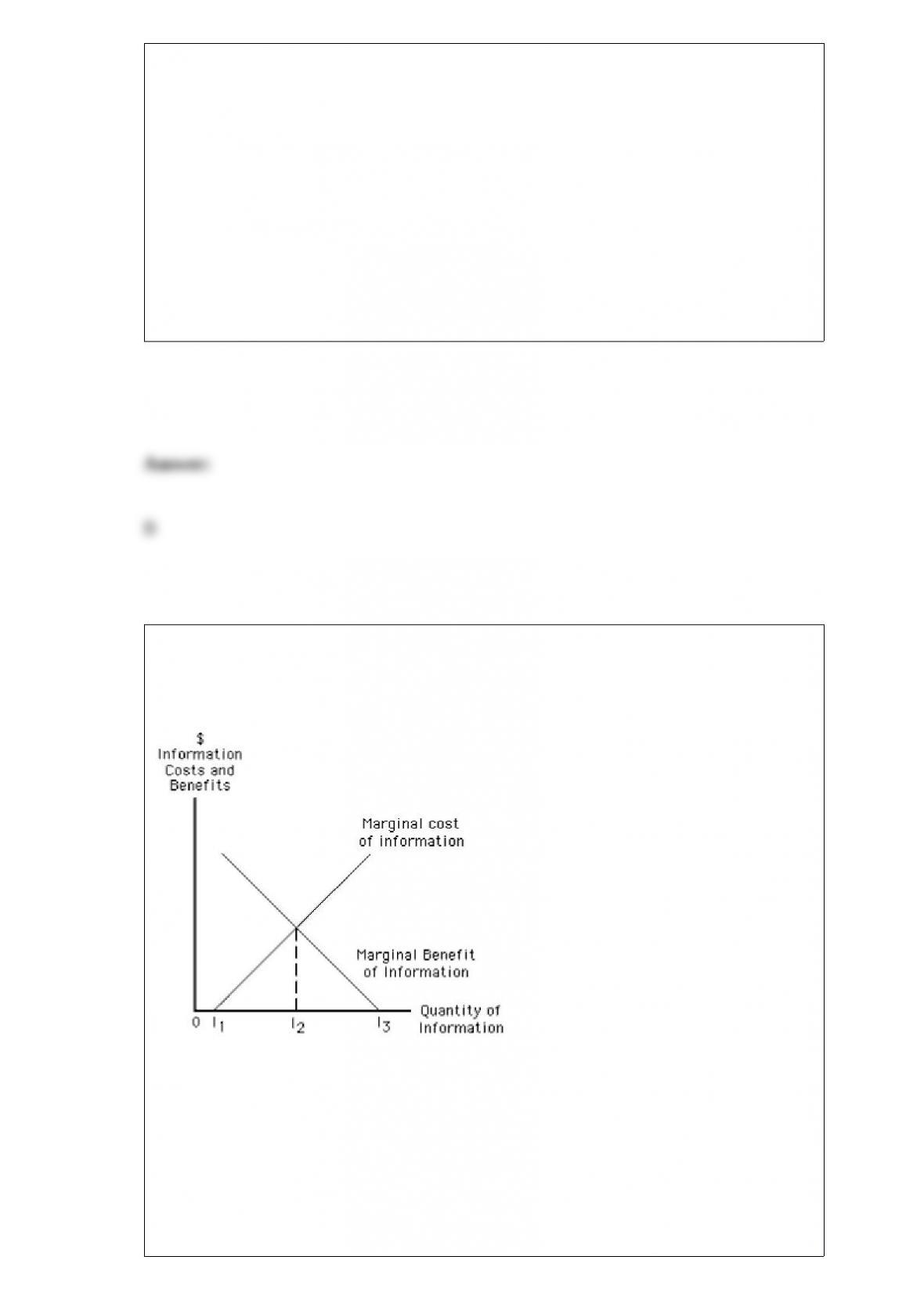
Exhibit 14-2
In Exhibit 14-2, the optimal level of search is
a. I1
b. I2
c. I3

d. 0
e. not shown
Securities exchanges pay no attention to hedge funds.
a. True
b. False
In the United States, dumping is
a. encouraged because it lowers prices for consumers
b. prohibited by the Trade Agreement Act of 1979
c. discouraged by domestic consumers who benefit from the lower price
d. encouraged because it encourages competition
e. encouraged because it promotes expenditure on R&D
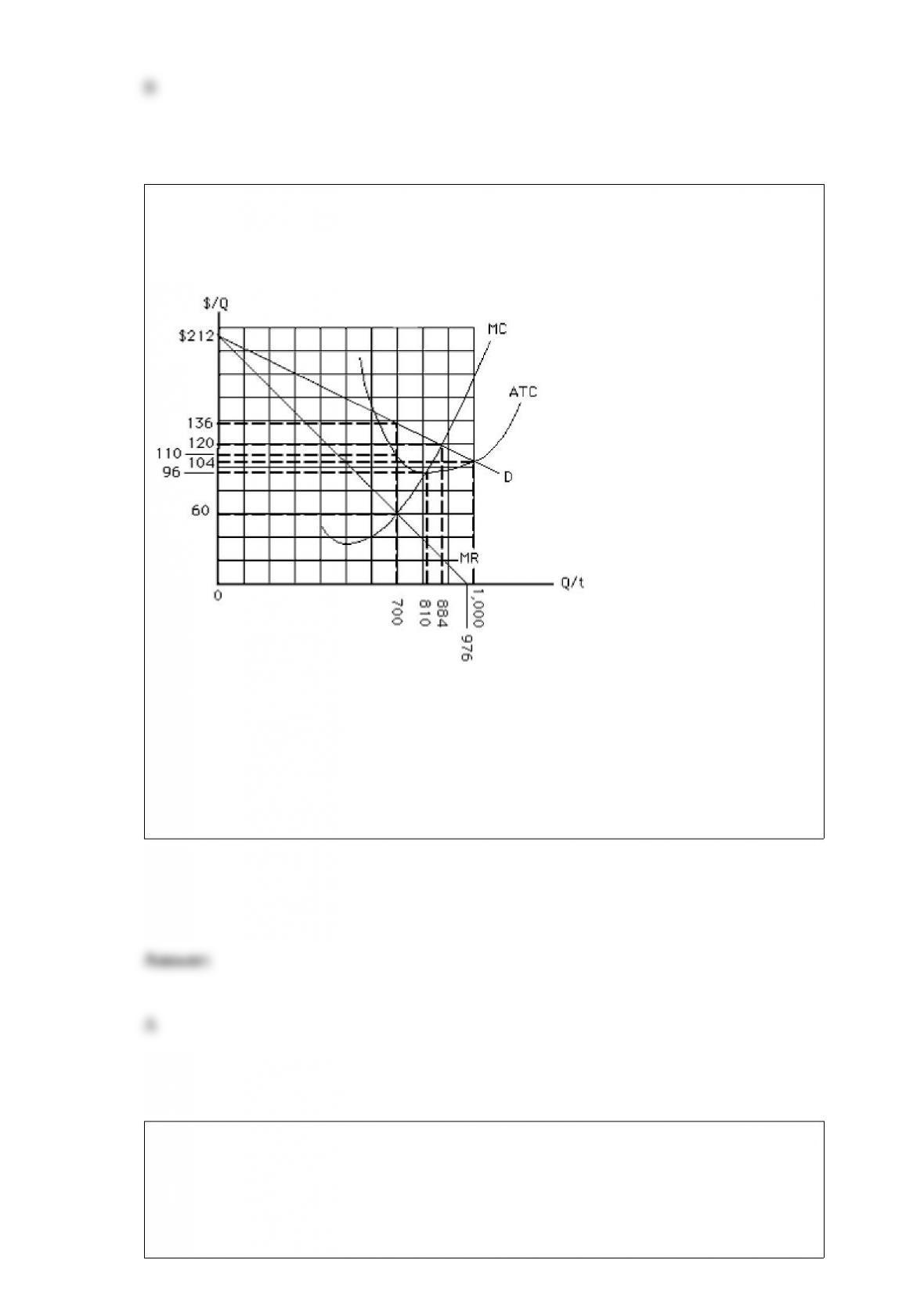
Exhibit 9-11
In Exhibit 9-11, for a monopolist that does not price discriminate, consumer surplus at
the profit-maximizing level of output is
a. the area under the demand curve bounded above a price of $136
b. the area under the demand curve bounded by average total cost of $110
c. the area under the marginal revenue curve bounded by a marginal revenue of $60
d. $0
e. equal to total consumer expenditure
Suppose the new doctor you found in the yellow pages turns out to be a charlatan. This
is an example of
a. natural selection

b. moral hazard
c. hidden actions
d. external costs
e. hidden characteristics
For a perfectly competitive firm, price is identical to marginal revenue at every
quantity.
a. True
b. False
A payment over and above that necessary to call forth a resource is called
a. profit
b. rent
c. taxes
d. salary
e. welfare

A meditation class meets on the second floor of a building; the first floor is a nightclub.
The loud music from the club disturbs the classes. The club could be soundproofed for a
cost of $5,000 or move at a cost of $8,000. The class can’t soundproof enough to
overcome the music, but could be moved for $4,000. According to Coase,
a. the club should be soundproofed so both businesses can stay open
b. the club should be soundproofed because it is the one generating the externality
c. the club should move rather than be soundproofed because eliminating an externality
is better than compensating for it
d. the class should move because it can eliminate the externality at a lower cost than can
the nightclub
e. whichever business has been there longer has the overriding property right; the other
should adjust
If a good is offered to a rational individual for free, she will
a. accept unlimited quantities of the good each time period
b. stop consuming it when its marginal utility begins to increase
c. stop consuming it when its marginal utility begins to diminish
d. stop consuming it when its marginal utility equals zero
e. stop consuming it when its total utility equals zero
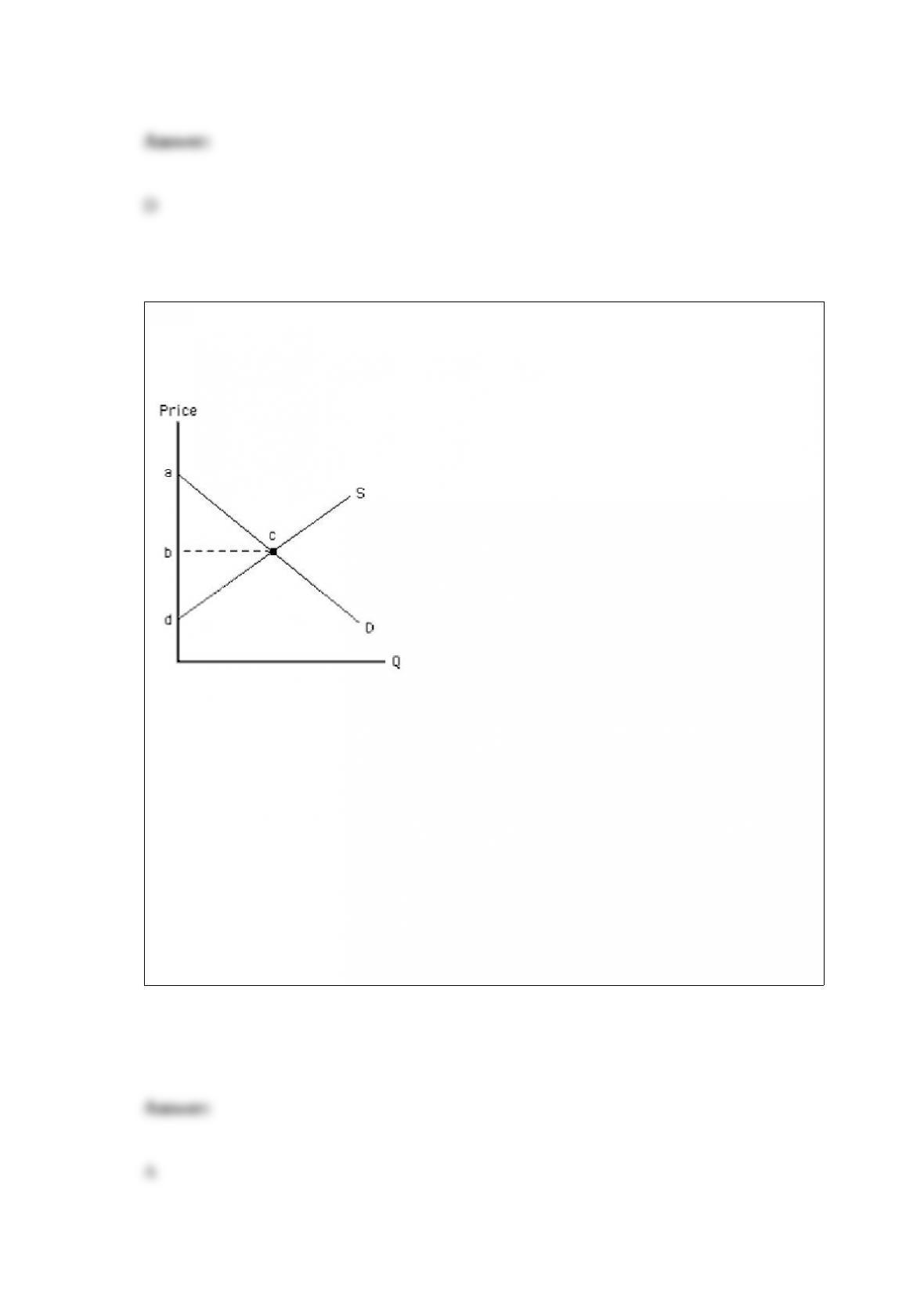
Exhibit 6-14
In Exhibit 6-14, consumer surplus at a price of $2 is the difference between what
consumers are willing to
a. pay for a quantity of goods and what they actually pay, represented by triangle abc
b. pay for a quantity of goods and what they actually pay, represented by triangle dcb
c. pay for a quantity of goods and what they actually pay, represented by triangle adc
d. receive for a good and what they actually get, represented by triangle abc
e. receive for a good and what they actually get, represented by triangle dcb

Don’s Pasture Apple Cider Company buys four inputs: apples, glass bottles, apple
presses, and computers for record keeping. If the company decides to become more
vertically integrated, it will
a. probably start growing apples next
b. probably start making glass bottles next
c. probably start making apple presses next
d. probably start making computers next
e. have to grow apples and make glass bottles, apple presses, and computers
Which of the following does not describe the World Bank?
a. an economic development institution
b. affiliated with the United Nations
c. offers low-fee checking accounts to anyone in the world
d. estimates output per capita figures
e. uses output per capital figures to classify economies
A good that is both rival and exclusive is called

a. a private good
b. a public good
c. a quasi-private good
d. an external good
e. an open access good
Using the Lorenz curve, the degree of income inequality is measured by
a. The line connecting all points for which a given percentage of families receives
exactly the cumulative percentage of income
b. the distance of the Lorenz curve from the line of perfect equality
c. the flat diagonal line that applies to a perfectly elastic demand curve
d. the number of times the Lorenz curve crosses the line of perfect equality
e. is derived by dividing the number of people below the poverty line by the total
population
If marginal product is negative, total product must be negative.
a. True
b. False
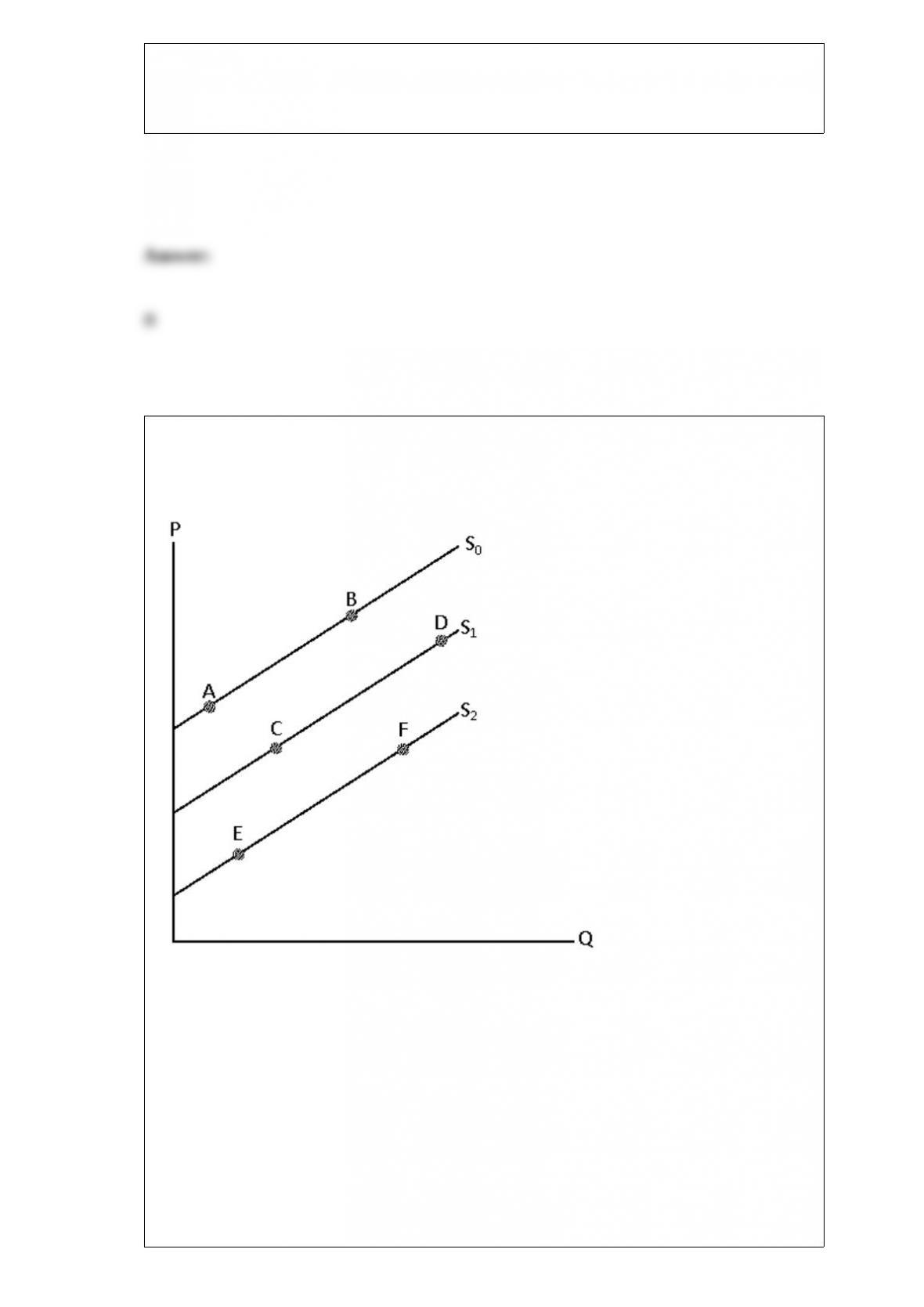
Exhibit 4-2
Consider Exhibit 4-2. Which of the following represents an increase in supply?
a. a movement from C to D
b. a movement from D to B
c. a movement from D to E
d. a movement from F to E
e. none of the above represents an increase in the quantity supplied

If the price of labor increases, employers will hire more labor because it is more
valuable.
a. True
b. False
The production possibilities frontier represents all desirable combinations of outputs.
a. True
b. False
If a cartel can earn a profit, it will increase production as long as
a. MR > MC

b. MR > ATC
c. MC > MR
d. MR < AR
e. MR > AVC
Which of the following would cause both the equilibrium price and equilibrium
quantity of cookies to decrease?
a. a rise in the price of milk (a complement)
b. a rise in consumer incomes
c. a rise in the price of cookie dough
d. a drop in the price of cookie dough
e. a rise in the price of crackers (a substitute)
Regional trading bloc agreements
a. are not considered trade restrictions
b. are required by World Trade Organization rules

c. exist primarily in Russia, Africa, and South America
d. require all nations in a specified region to trade only with other countries in the same
geographic area
e. make special trade deals between countries in that region and discriminate against
countries outside the region
Taxes collected on the basis of the benefits-received principle
a. provide the states with their main sources of revenue
b. tend to redistribute income from rich to poor
c. collect the same total amount from each individual
d. connect the revenue side of the budget with the spending side of the budget
e. make it possible for government to spend money on activities that markets can’t
provide
Which of the following is true in both perfect competition and monopoly?
a. Firms produce a differentiated product.
b. Firms cannot earn economic profit in the long run.
c. Individual firms have no ability to control the price of their output but must accept

the market price.
d. Firms go out of business in the long run if total revenue cannot cover total cost.
e. Firms can earn economic profit in the long run.
The adverse selection problem is most likely in which of the following occupations?
a. waiter/waitress
b. barber
c. college professor
d. supermarket cashier
e. tightrope walker
U.S. consumers would be better off if they bought only U.S.-produced goods.
a. True
b. False