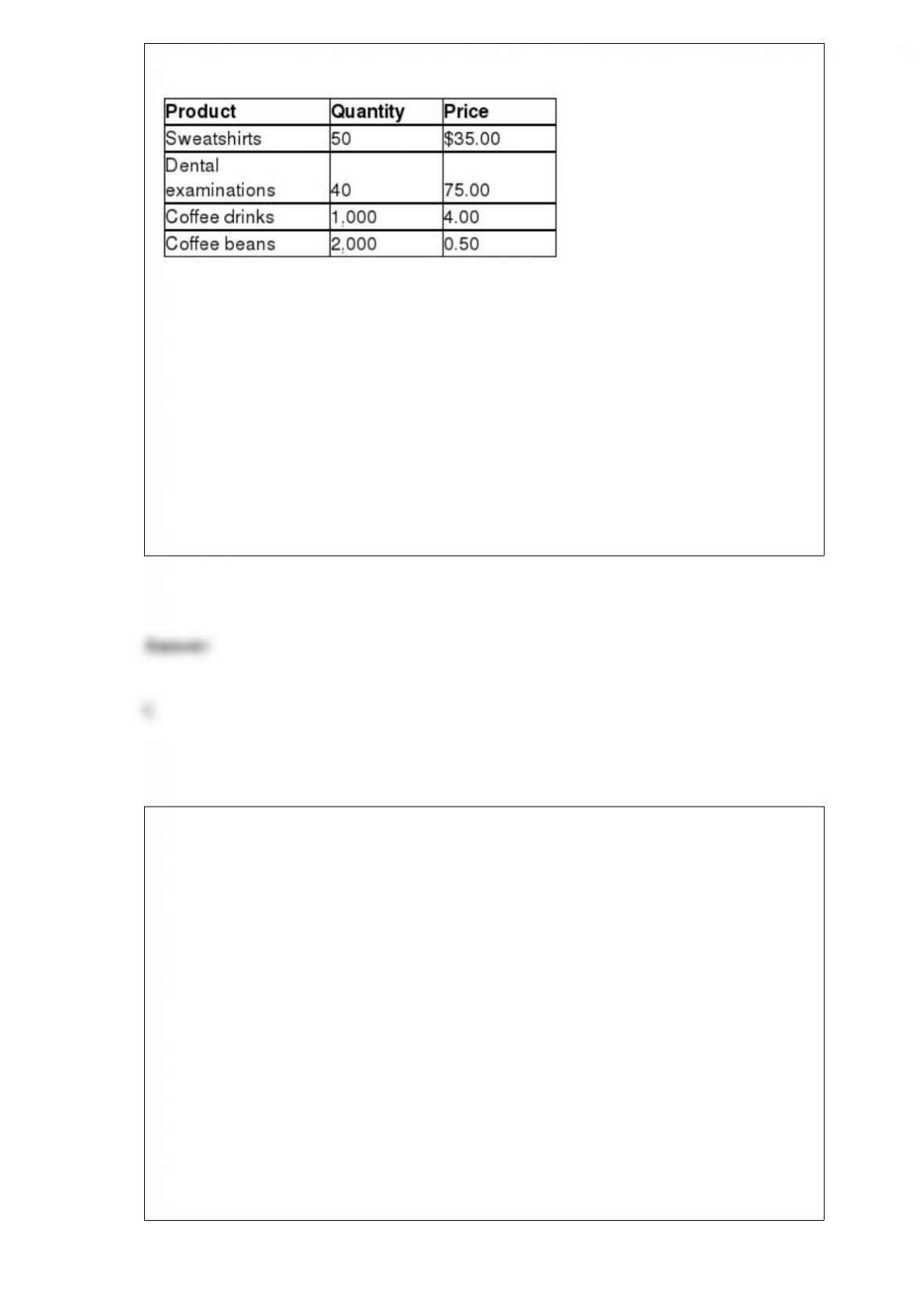
Table 8-1
Refer to Table 8-1. Suppose that a simple economy produces only four goods and
services: sweatshirts, dental examinations, coffee drinks, and coffee beans. Assume all
of the coffee beans are used in the production of the coffee drinks. Using the
information in the above table, nominal GDP for this simple economy equals
A) 3,090 units.
B) $7,250.
C) $8,750.
D) $9,750.
Scenario 1-1
Suppose a t-shirt manufacturer currently sells 5,000 t-shirts per week and makes a profit
of $10,000 per week. A manager at the plant observes, “Although the last 400 t-shirts
we produced and sold increased our revenue by $4,000 and our costs by $4,800, we are
still making an overall profit of $10,000 per week so I think we’re on the right track. We
are producing the optimal number of t-shirts.”
Refer to Scenario 1-1. Using marginal analysis terminology, what is another economic
term for the incremental revenue received from the sale of the last 400 t-shirts?
A) gross earnings
B) marginal revenue
C) sales revenue
D) gross profit

The present value of $475 received 3 years in the future would be calculated as which
of the following when the interest rate is 6 percent?
A) 475/(1.6)3
B) 475/(1.06)3
C) 475 1.6 3
D) 3.06/475
Which of the following is not an advantage to a country of choosing to fix its exchange
rate against a major currency, rather than choosing a floating exchange rate?
A) Pegging allows the country more flexibility in conducting monetary policy.
B) Pegging helps avoid inflation in imported goods caused by currency depreciation for
countries with significant levels of imports.
C) Pegging insures that interest payments stemming from foreign loans do not fluctuate
with the value of the currency.
D) Pegging reduces the uncertainty caused by currency fluctuations and thereby
simplifies business planning.

On average, jobs at small firms pay ________ wages than jobs at large firms and are
________ likely to offer fringe benefits such as health insurance and retirement
accounts.
A) higher; more
B) lower; more
C) higher; less
D) lower; less
According to the text, there are three ways the government can help increase the
accumulation of knowledge capital. What are they?
A) protecting intellectual property rights, subsidizing research and development, and
subsidizing education
B) increasing taxes on firms, eliminating patents, and increasing the minimum wage
C) encouraging the use of trade secrets, expanding student loan programs, and
increasing the minimum wage
D) reducing taxes on capital, increasing Social Security payments, and lowering the
exchange rate
Your roommate is having trouble grasping how monetary policy works. Which of the
following explanations could you use to correctly describe the mechanism by which the
Fed can affect the economy through monetary policy? Increasing the money supply
A) lowers the interest rate, and firms increase investment spending.
B) causes people to spend more because they know prices will rise in the future.
C) raises the interest rate and consumers decrease spending on durable goods.
D) lowers the interest rate, raises the value of the dollar, lowers the prices of exports,
and raises net exports.
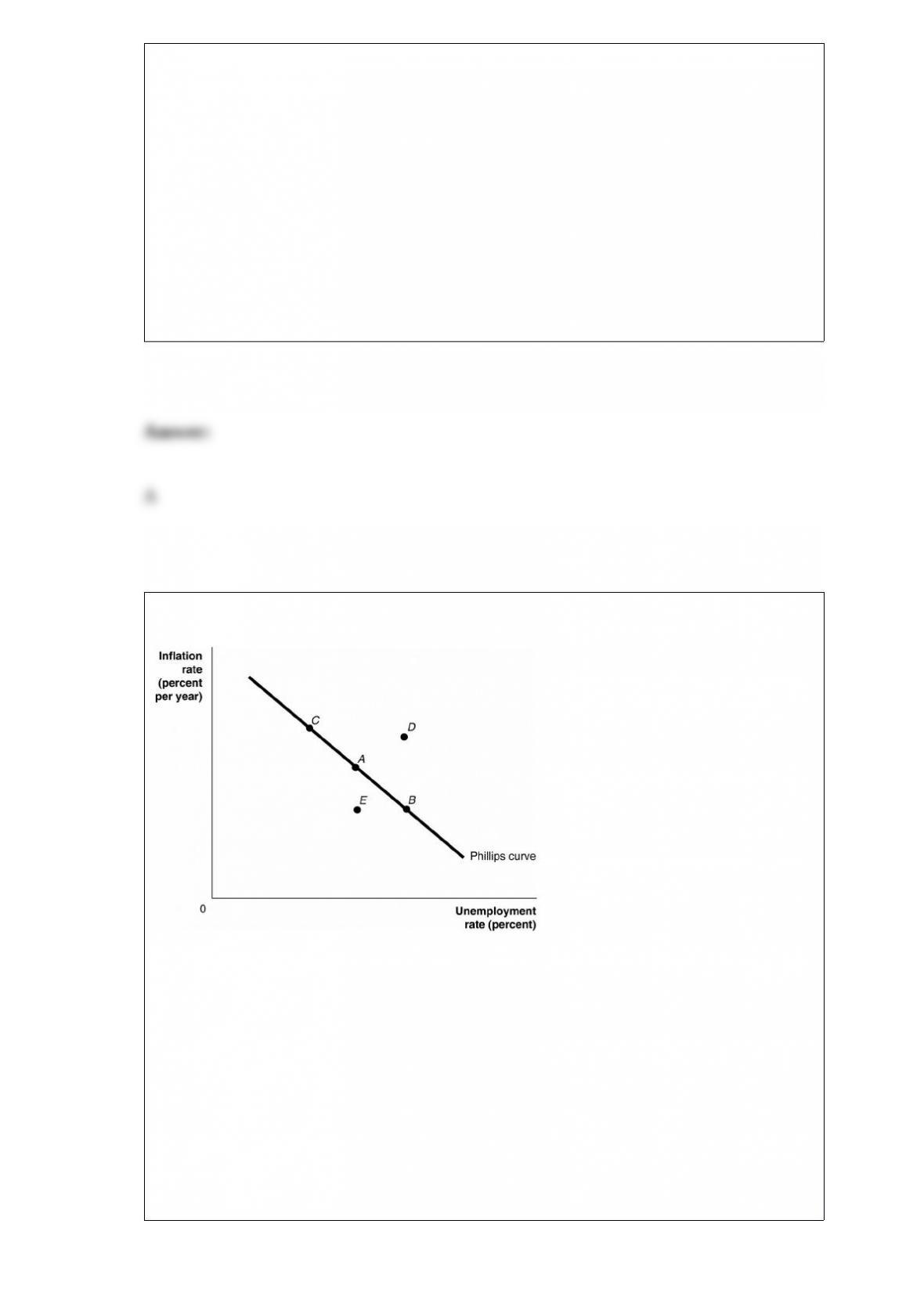
Figure 17-1
Refer to Figure 17-1. What should the Federal Reserve do if it wants to move from
point A to point B in the short-run Phillips curve depicted in the figure above?
A) buy treasury bills
B) sell treasury bills
C) lower the discount rate
D) increase the money supply
E) lower taxes

If the implied exchange rate between Big Mac prices in the United States and the
Philippines is 68 pesos per dollar, but the actual exchange rate between the United
States and the Philippines is 43 pesos per dollar, which of the following would you
expect to see?
A) a depreciation of the dollar
B) a decrease in the demand for Philippine pesos
C) a decrease in the demand for dollars
D) an appreciation of the Philippine pesos
European governments removed many restrictions on flows of capital into and out of
Europe in the ________. This policy increased both U.S. investment in European stocks
and bonds and European investment in U.S. stocks and bonds.
A) 1950s and 1960s
B) 1960s and 1970s
C) 1970s and 1980s
D) 1980s and 1990s

When deflation occurs,
A) the real interest rate is greater than the nominal interest rate.
B) the nominal interest rate is greater than the real interest rate.
C) the nominal interest rate is equal to the real interest rate and inflation is negative.
D) the nominal interest rate is equal to the real interest rate and inflation is positive.
The real power within the Federal Reserve lies with the
A) Federal Reserve District banks.
B) Board of Governors.
C) Council of Economic Advisors.
D) Council of Monetary Advisors.
Jack was unemployed two weeks ago but just started a new job. As a result of this
increase in the number of employed workers, which of the following occurred?
A) The labor force participation rate increased.
B) The unemployment rate increased.

C) The labor force participation rate decreased.
D) The unemployment rate decreased.
Suppose that in a market for used cars, there are good used cars and bad used cars
(lemons). Consumers are willing to pay as much as $6,000 for a good used car but only
$1,000 for a lemon. Sellers of good used cars value their cars at $5,000 each and sellers
of lemons value their cars at $800 each. Buyers cannot tell if a used car is reliable or is
a lemon. Based on this information, what is the likely outcome in the market for used
cars?
A) Both good used cars and lemons will sell for $4,500 each.
B) Only lemons will sell, for $800 each.
C) Both good used cars and lemons will sell for $1,000 each.
D) Most used cars offered for sale will be lemons.
The difference between the ________ for a good and the ________ is called consumer
surplus.
A) highest price a consumer is willing to pay; lowest price a consumer is willing to pay
B) lowest price a consumer is willing to pay; price the consumer actually pays
C) highest price a consumer is willing to pay; price the consumer actually pays
D) price the consumer actually pays; actual cost to the producer

Which of the following best describes the “wealth effect”?
A) When the price level falls, the real value of household wealth falls.
B) When the price level falls, the nominal value of household wealth falls.
C) When the price level falls, the nominal value of household wealth rises.
D) When the price level falls, the real value of household wealth rises.
Human capital refers to
A) the money people have.
B) the machines workers have to work with.
C) the accumulated skills and training workers have.
D) the wealth people have.

An increase in Social Security payments will
A) increase consumption spending.
B) increase investment spending.
C) increase government spending.
D) increase export spending.
Which of the following correctly describes the automatic mechanism through which the
economy adjusts to long-run equilibrium?
A) the leftward shift of the short-run aggregate supply curve that occurs after a
recession
B) the rightward shift of the short-run aggregate supply curve that occurs after a
recession
C) the leftward shift of the aggregate demand curve that occurs after a recession
D) the rightward shift of the aggregate demand curve that occurs after a recession