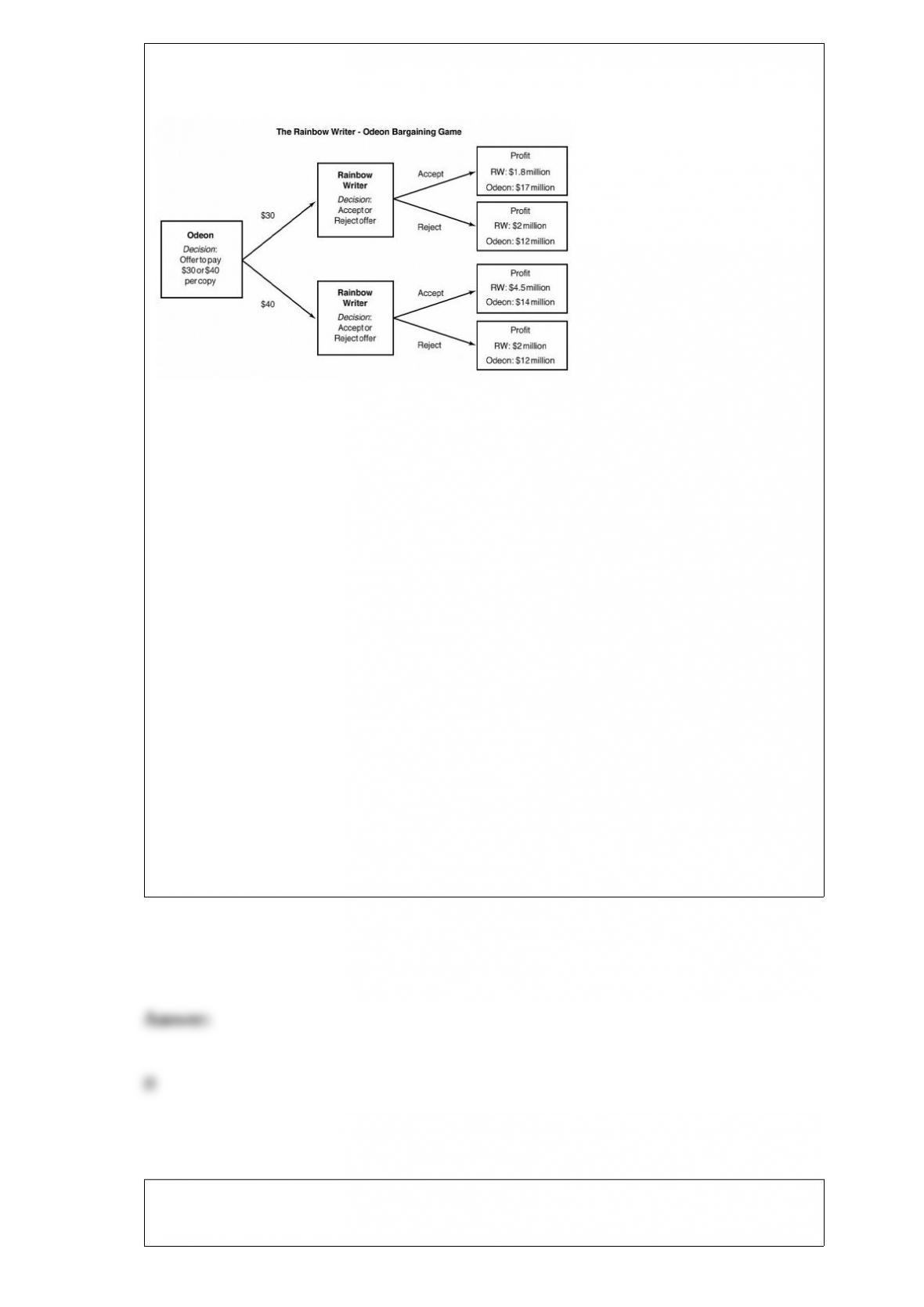
Figure 14-3
Rainbow Writer (RW) is a small online company selling a highly rated software
package for printing color labels directly onto CDs. The firm currently earns a profit of
$2 million per year selling its package exclusively on its Web site. Odeon, the producer
of the most popular software package for editing and burning CDs and DVDs has
expressed interest in bundling Rainbow Writer’s product into its own package. Odeon
expects that bundling would further boost its sales and allow it to sell the new bundled
product at a higher price, thus raising its profits beyond its current profit of $12 million.
Figure 14.3 shows the decision tree for the Rainbow Writer-Odeon bargaining game.
Refer to Figure 14-3. What is the equilibrium outcome in this game and is this a
subgame-perfect equilibrium?
A) Odeon’s offer of $40 per copy of the software package is accepted and this is a
subgame-perfect equilibrium.
B) In the equilibrium, Odeon offers $40 per copy of the software package and is
accepted but this is not a subgame-perfect equilibrium.
C) In the equilibrium, Odeon offers $30 per copy of the software package and is
rejected, and this is a subgame-perfect equilibrium.
D) There is no equilibrium in this game.
Table 15-3
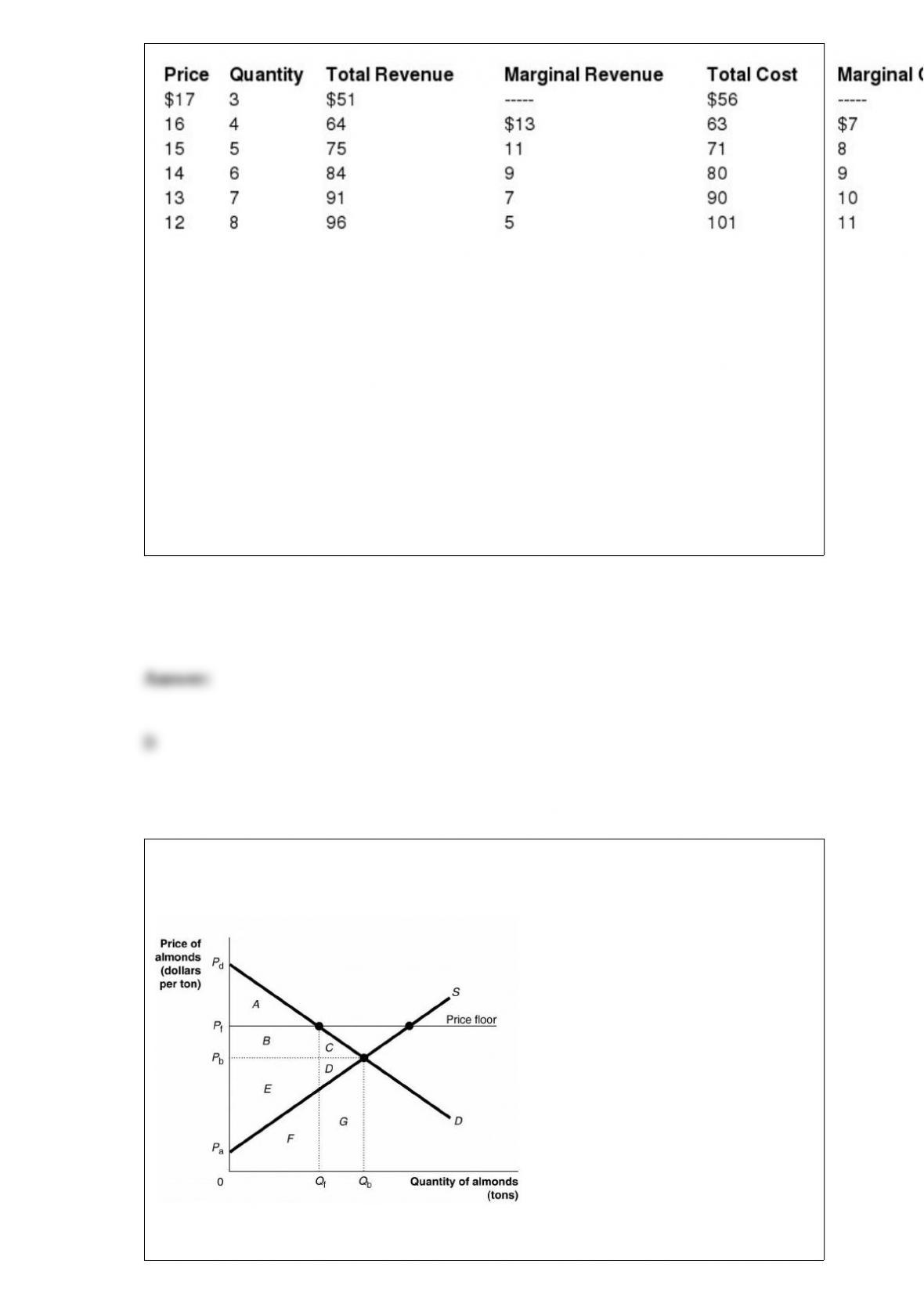
Assume Table 15-3 gives the monthly demand and costs for subscriptions to basic cable
for Comcast, a cable television monopoly in Philadelphia.
Refer to Table 15-3. If Comcast wants to maximize its profits, what price (P) should it
charge and how many cable subscriptions per month (Q) should it sell?
A) P = $12; Q = 8
B) P = $14; Q = 6
C) P = $16; Q = 4
D) P = $15: Q = 5
Figure 4-6
Figure 4-6 shows the demand and supply curves for the almond market. The
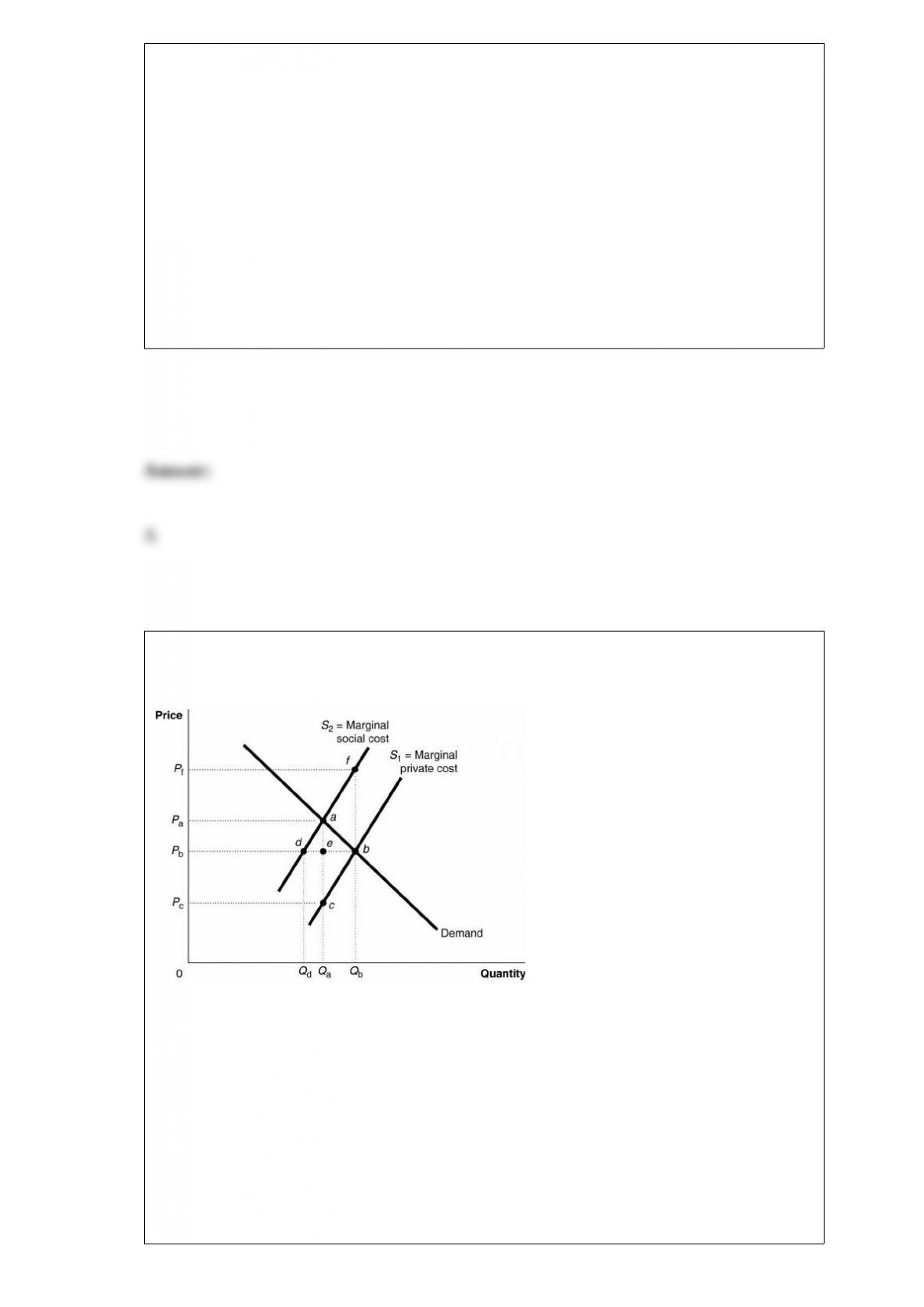
government believes that the equilibrium price is too low and tries to help almond
growers by setting a price floor at Pf.
Refer to Figure 4-6. What area represents the portion of consumer surplus that has been
transferred to producer surplus as a result of the price floor?
A) B
B) B + C
C) B + E
D) E
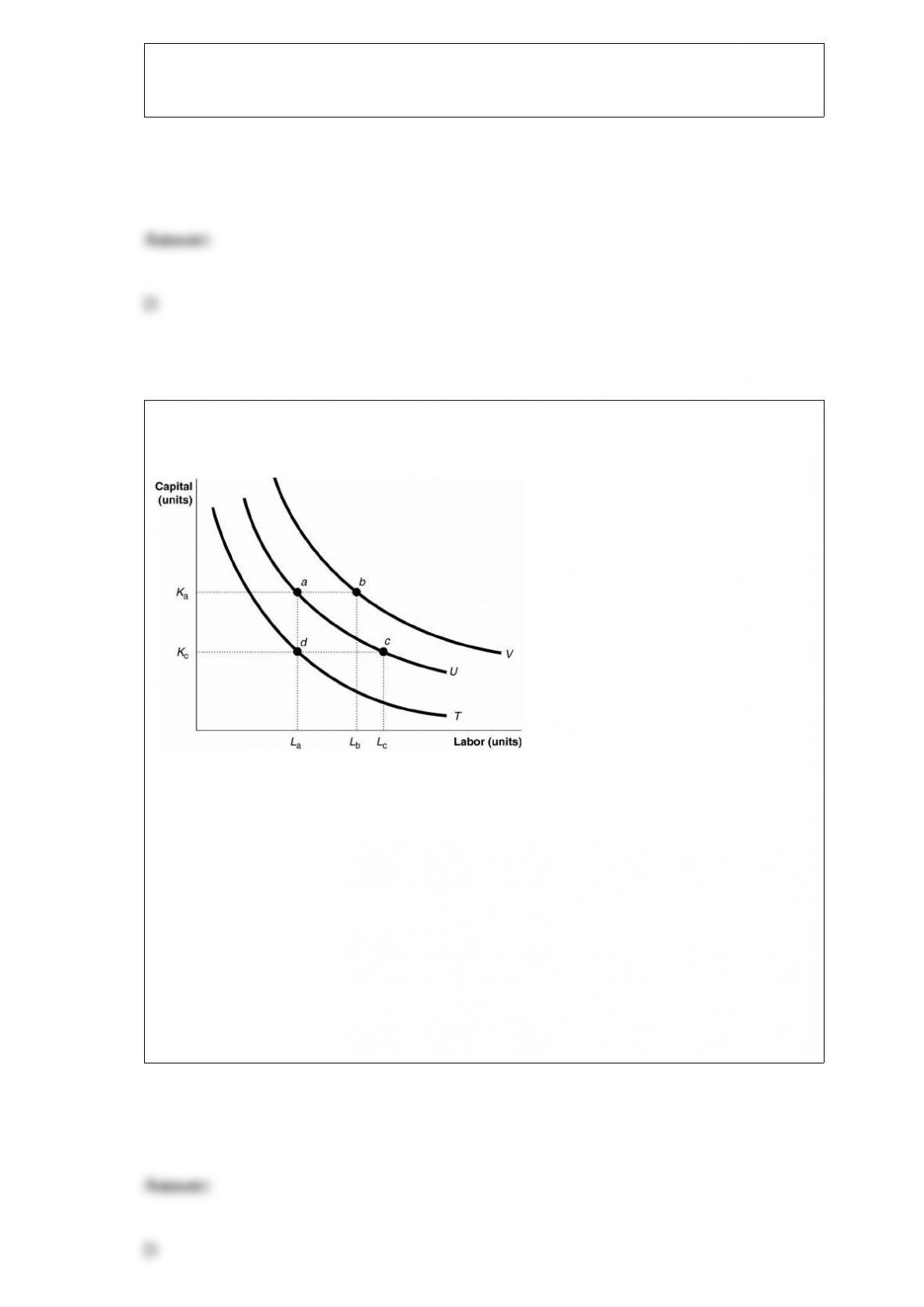
Figure 5-2
Figure 5-2 shows a market with a negative externality.
Refer to Figure 5-2. The true marginal cost of the last unit produced is represented by
the price
A) Pa.
B) Pb.
C) Pc.
D) Pf.
Figure 11-12
Refer to Figure 11-12. Which of the following statements about the input combinations
shown in the diagram is false?
A) The firm produces a higher output level when it uses input combination b compared
to input combination a.
B) The firm produces a lower output level when it uses input combination d compared
to input combination a.
C) The firm produces the same output level when it uses input combination a or c.
D) The firm incurs the same total cost when it uses input combination a or c to produce
a given quantity of output.
A monopolistically competitive firm maximizes profit in the short run by producing
where
A) price is less than marginal cost.
B) price is less than marginal revenue.
C) price is less than average revenue.
D) price is greater than marginal cost.
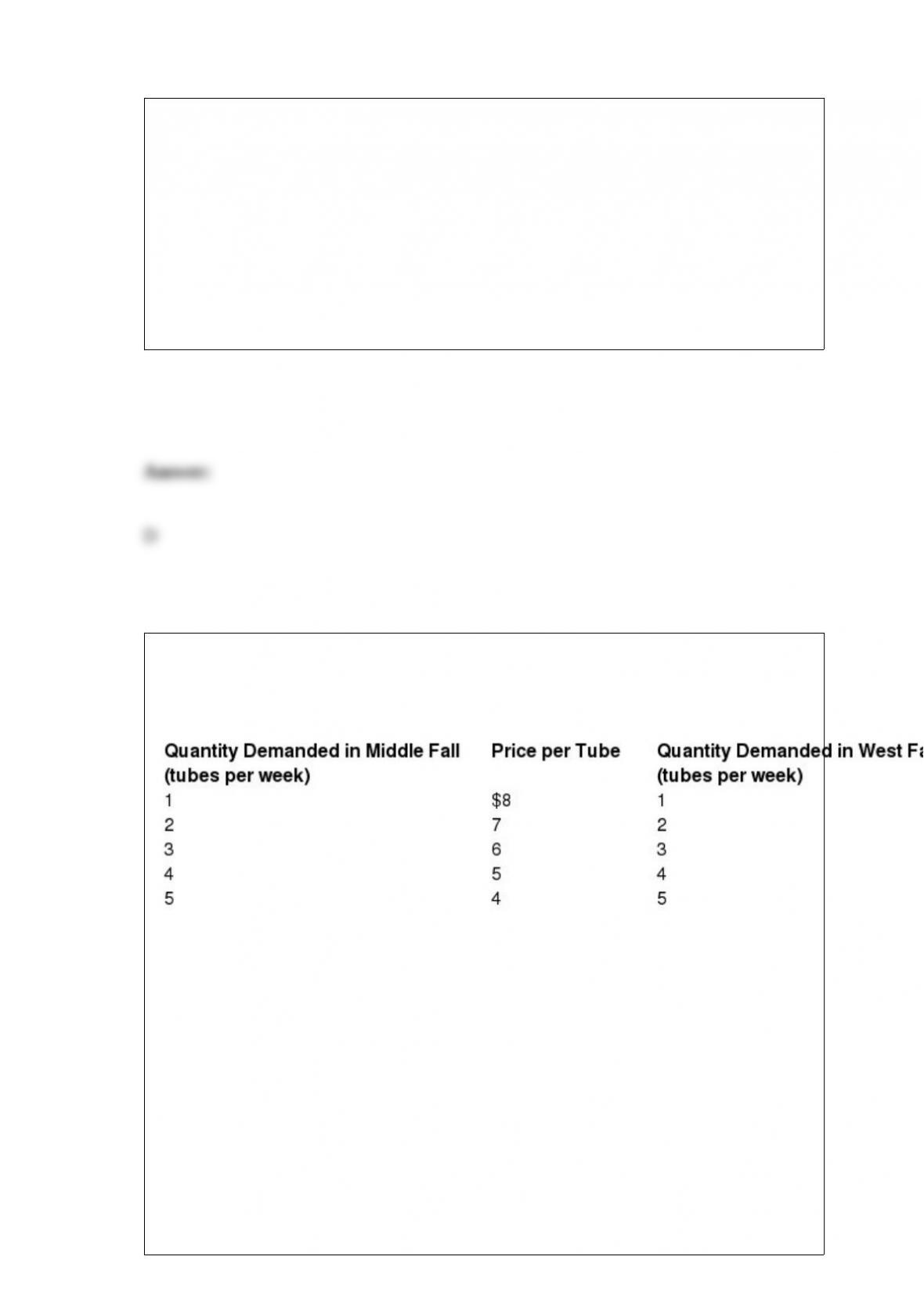
Table 16-2
Neem Products sells its Ayurvedic Neem toothpaste in two completely isolated markets
with demand schedules as shown in Table 16-2. The average cost of production is
constant at $2 per tube.
Refer to Table 16-2. How many tubes of toothpaste will Neem sell in Middle Fall and
at what price?
A) Q = 2 units; P = $7
B) Q = 3 units; P = $6
C) Q = 4 units; P = $5
D) Q = 5 units; P = $4

The Clayton Act is an antitrust law that was passed to
A) outlaw monopolization.
B) address loopholes in the Sherman Act.
C) prohibit charging buyers different prices if the result would reduce competition.
D) toughen restrictions on mergers by prohibiting mergers that reduce competition.
Marginal revenue product for a perfectly competitive seller is equal to
A) the output price multiplied by the total product of labor.
B) the output price multiplied by the number workers hired.
C) the change in total revenue that results from hiring another worker.
D) the marginal cost of production.
Economic models do all of the following except
A) answer economic questions.
B) portray reality in all its minute details.
C) make economic ideas explicit and concrete for use by decision makers.
D) simplify some aspect of economic life.
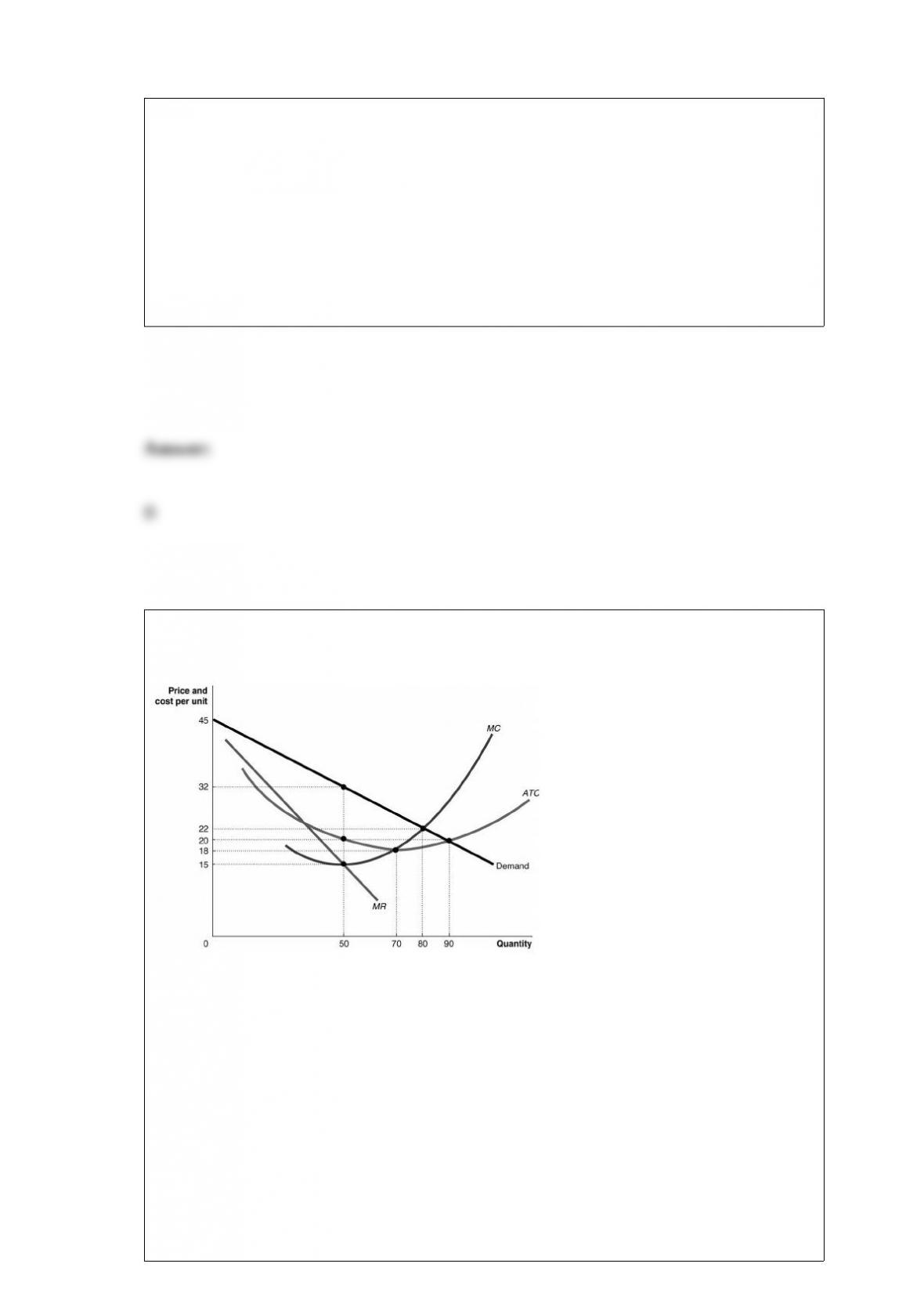
Figure 15-7
Refer to Figure 15-7. Use the figure above to answer the following questions.
a. What is the profit-maximizing quantity and what price will the monopolist charge?
b. What is the total revenue at the profit-maximizing output level?
c. What is the total cost at the profit-maximizing output level?
d. What is the profit?
e. What is the profit per unit (average profit) at the profit-maximizing output level?
f. If this industry was organized as a perfectly competitive industry, what would be the
profit-maximizing price and quantity?
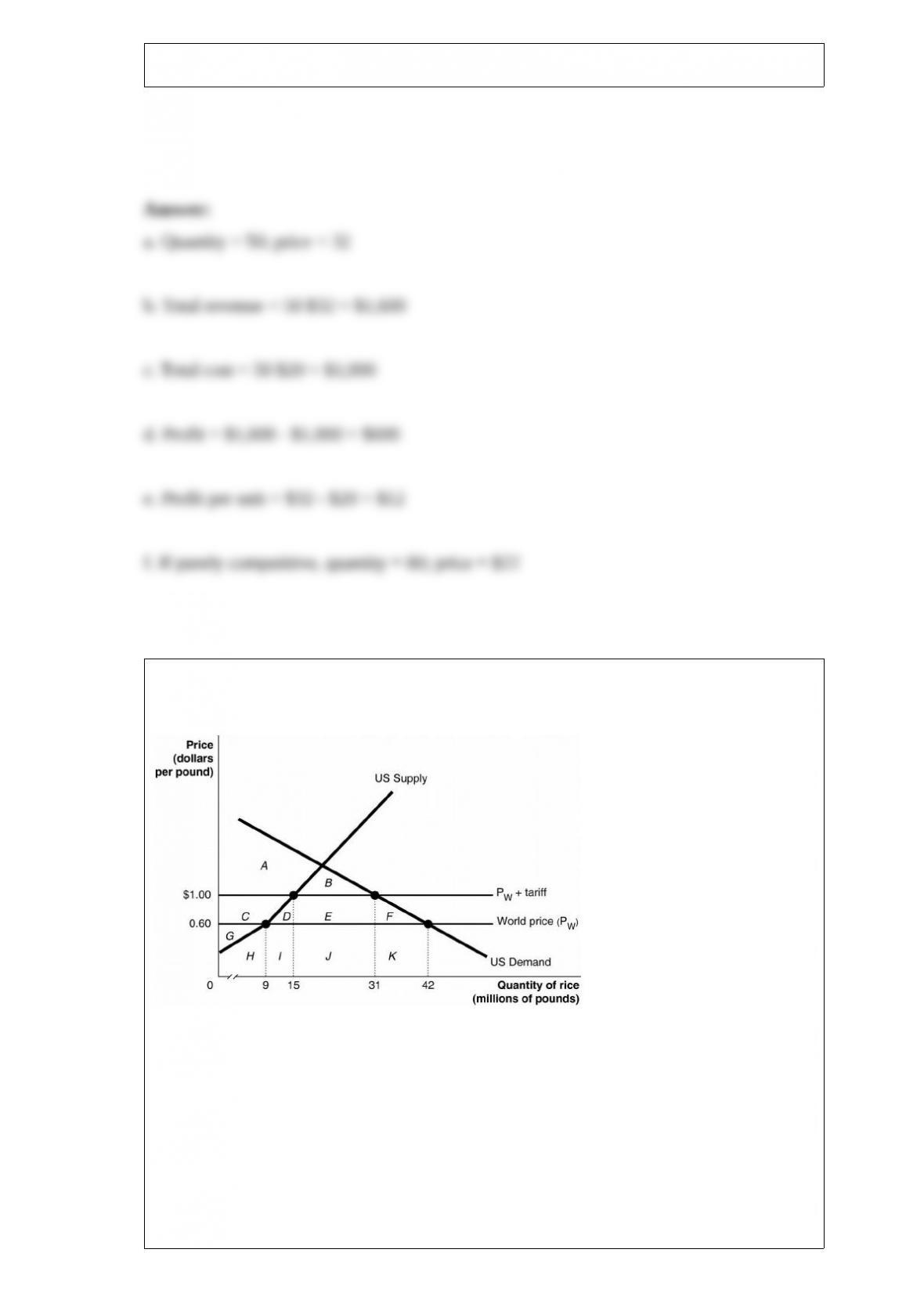
Figure 9-2
Suppose the U.S. government imposes a $0.40 per pound tariff on rice imports. Figure
9-2 shows the impact of this tariff.
Refer to Figure 9-2. Without the tariff in place, the United States produces
A) 9 million pounds of rice.
B) 15 million pounds of rice.
C) 31 million pounds of rice.

D) 42 million pounds of rice.
Which of the following undermines a firm’s ability to engage in price discrimination?
A) the seller’s market power
B) the inability to prevent resale of the product from one market segment to another
C) buyers having different elasticities of demand for the product
D) the seller’s ability to segment the total market
What is the dominant strategy in the prisoner’s dilemma?
A) Each prisoner confesses because this is the rational action to pursue.
B) Do nothing in the hope that the other prisoner will also do nothing.
C) Do not confess because the other prisoner will most likely confess.
D) There is no dominant strategy.
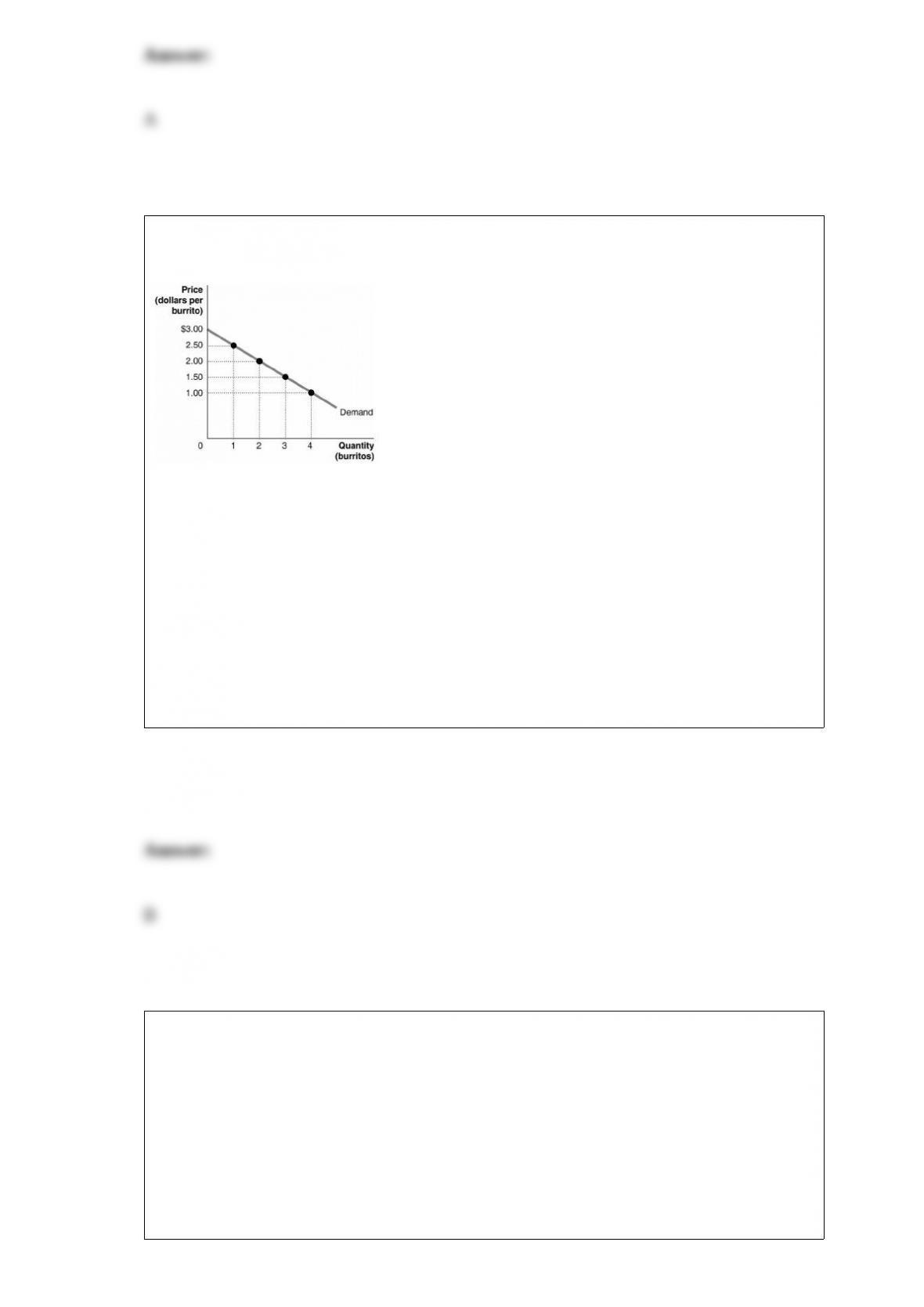
Figure 4-1
Figure 4-1 shows Arnold’s demand curve for burritos.
Refer to Figure 4-1. Arnold’s marginal benefit from consuming the fourth burrito is
A) $0.
B) $1.00.
C) $2.50.
D) $3.00.
Congress has divided the authority to police mergers between the Antitrust Division of
the U.S. Department of Justice (AD) and the Federal Trade Commission (FTC). How is
this authority divided?
A) The AD decides whether proposed horizontal mergers will be challenged; the FTC
decides whether proposed vertical mergers will be challenged.
B) Both the AD and the FTC are responsible for merger policy.

C) The AD always renders its opinion on any proposed merger first. If the AD approves
the merger, the case then goes to the FTC for final approval. If the AD disallows the
merger, the decision stands and the FTC does not become involved.
D) The AD establishes the guidelines that are used to evaluate proposed mergers; the
FTC uses these guidelines to decide whether a proposed merger will be allowed to take
place.
If a perfectly competitive firm raises the price it charges to consumers, which of the
following is the most likely outcome?
A) The firm’s revenue will not change because some consumers will refuse to pay the
higher price.
B) The firm will not sell any output.
C) The firm’s total revenue will increase only if the demand for its product is inelastic.
D) The firm’s total revenue will increase only if the demand for its product is elastic.
In the long run
A) the firm’s fixed costs are greater than its fixed costs in the short run.
B) all of the firm’s costs are explicit costs; there are no implicit costs of production.
C) the firm is more profitable than it is in the short run.

D) all of the firm’s costs are variable costs.
Which of the following must be present to reach a private solution to an externality
problem?
A) A majority of the parties affected by the externality must agree to a solution.
B) The transaction costs to negotiate a solution must be relatively low.
C) The total number of people, creators of the problem and those affected, must be
relatively large to justify negotiating a solution.
D) The government must approve the solution for it to be a legal solution.
One important difference between the political process and the market process is that
A) the political process results in collective actions in which not everyone is required to
participate, while in the market process individuals are obliged to participate.
B) the political process results in collective actions in which everyone is obliged to
participate, while in the market process individuals are free to participate or not.
C) the political process results in collective actions that maximize economic surplus,
while the market process may lead to efficiency losses.
D) the political process results in collective actions in which everyone is made better

off, while the market process results in actions that favor some groups only.
Two of the firms involved in the accounting scandals of the early 2000s were
A) Arthur Anderson and NBC.
B) Western Digital and General Motors.
C) WorldCom and Enron.
D) DuPont and Lehman Brothers.
Which of the following is a characteristic of an oligopolistic market structure?
A) There are few dominant sellers.
B) Each firm sells a unique product.
C) It is easy for new firms to enter the industry.
D) Each firm need not react to the actions of rivals.
Whenever a firm can charge a price greater than marginal cost
A) the firm must be a monopolist.
B) there is some loss of economic efficiency.
C) consumers have the ability to choose a close substitute.
D) the firm will earn economic profits.
Table 14-2
Table 14-2 shows the payoff matrix for Wal-Mart and Target from every combination of
pricing strategies for the popular PlayStation 3. At the start of the game each firm
charges a low price and each earns a profit of $7,000.
Refer to Table 14-2. Suppose Wal-Mart and Target both advertise that they will match
the lowest price offered by any competitor. What is the purpose of such a strategy?
A) to signal to each other not to charge below the current low price
B) to signal to each other that they will not hesitate to initiate a price war
C) to signal to each other that they intend to charge the high price

D) to signal to each other to share the market equally
Suppose a hurricane decreased the supply of oranges so that the price of oranges rose
from $120 a ton to $180 a ton and quantity sold decreased from 800 tons to 240 tons.
What is the absolute value of the price elasticity of demand?
A) 0.11
B) 0.37
C) 2.69
D) 9.33
Figure 4-3
Figure 4-3 shows the market for tiger shrimp. The market is initially in equilibrium at a
price of $15 and a quantity of 80. Now suppose producers decide to cut output to 40in
order to raise the price to $18.
Refer to Figure 4-3. At the equilibrium price of $15 consumers are willing to buy
80pounds of tiger shrimp. Is this an economically efficient quantity?
A) No, the marginal benefit of the 80th unit exceeds the marginal cost of the 80th unit.
B) Yes, because marginal cost is zero at the 80th unit.
C) Yes, because $15 is the price where the marginal benefit is equal to the marginal
cost.
D) No, the marginal cost of the 80th unit exceeds the marginal benefit of the 80th unit.
Economists agree that a monopolistically competitive market structure
A) lowers consumer utility because consumers pay a price higher than the marginal cost
of production.
B) is detrimental to society because it leads to a waste of scarce resources.
C) benefits consumers because firms produce products that appeal to a wide range of
consumer tastes.
D) can eliminate any excess capacity if all firms in the industry devote more funds to
differentiating their products.
Laura’s Pizza Place incurs $800,000 per year in explicit costs and $100,000 in implicit
costs. The restaurant earns $1.3 million in revenues and has $5 million in net worth.
Based on this information, what is economic profit for Laura’s Pizza Place?
A) $200,000
B) $400,000
C) $500,000
D) $2.8 million
Figure 10-5

Refer to Figure 10-5. Suppose the price of pizza increases while the price of hamburger
remains constant. Then, the consumer’s
A) indifference curve becomes more concave away from the origin.
B) indifference curve becomes straighter.
C) budget constraint moves inward toward the origin on the pizza axis while the
hamburger intercept remains the same.
D) budget constraint moves outward away from the origin on the pizza axis while the
hamburger intercept remains the same.
Brand management refers to
A) picking a brand name for a new product that will attract attention.
B) the efforts to maintain the differentiation of a product over time.
C) efforts to reduce the cost of production.
D) selling the right to use a brand name in a particular market.
How can changes over time of the average height of the people in a country help to
indicate the standard of living in a country?
A negative externality is an example of market failure. The root of the problem lies in
the definition and enforcement of property rights. Explain.
How can improvements in health increase a country’s total income?

What is meant by the term “free market”?
Are sellers who practice arbitrage taking advantage of buyers?
Cigars are becoming increasingly popular in the United States, and a growing number
of cigar manufacturers in the Caribbean and Central America have begun producing and
exporting cigars to the U.S. market. How has this affected the equilibrium price and
quantity of cigars?
Both the perfectly competitive firm and the monopolistically competitive firm produce
at the output where marginal revenue equals marginal cost (MR = MC) but only the
perfectly competitive firm achieves allocative efficiency. Explain why this is the case.
What is meant by “tax incidence”?
What is meant by the term opportunity cost?
What is an isoquant? What is the slope of an isoquant?
What is a production possibilities frontier? What do points along the frontier represent?
What do points inside and outside the frontier represent?
What is the difference between the poverty line and the poverty rate?
Briefly explain the command-and-control approach in dealing with an externality such
as pollution. Give an example of the U.S. government using the command-and-control
approach to deal with the pollution problem.
What is voluntary exchange?
What is a marginal cost?
Nearly a quarter of China’s 1.3 billion people are under the age of 15. How will this
affect high school enrollment over the next fifteen years? The labor market over the
next fifteen years?
A firm’s labor demand curve is also its marginal revenue product curve. For both the
perfectly competitive firm and the output price maker, the labor demand curve slopes
downwards. However, there is a difference in the reasons why the labor demand curve
slopes downwards. What is this difference?
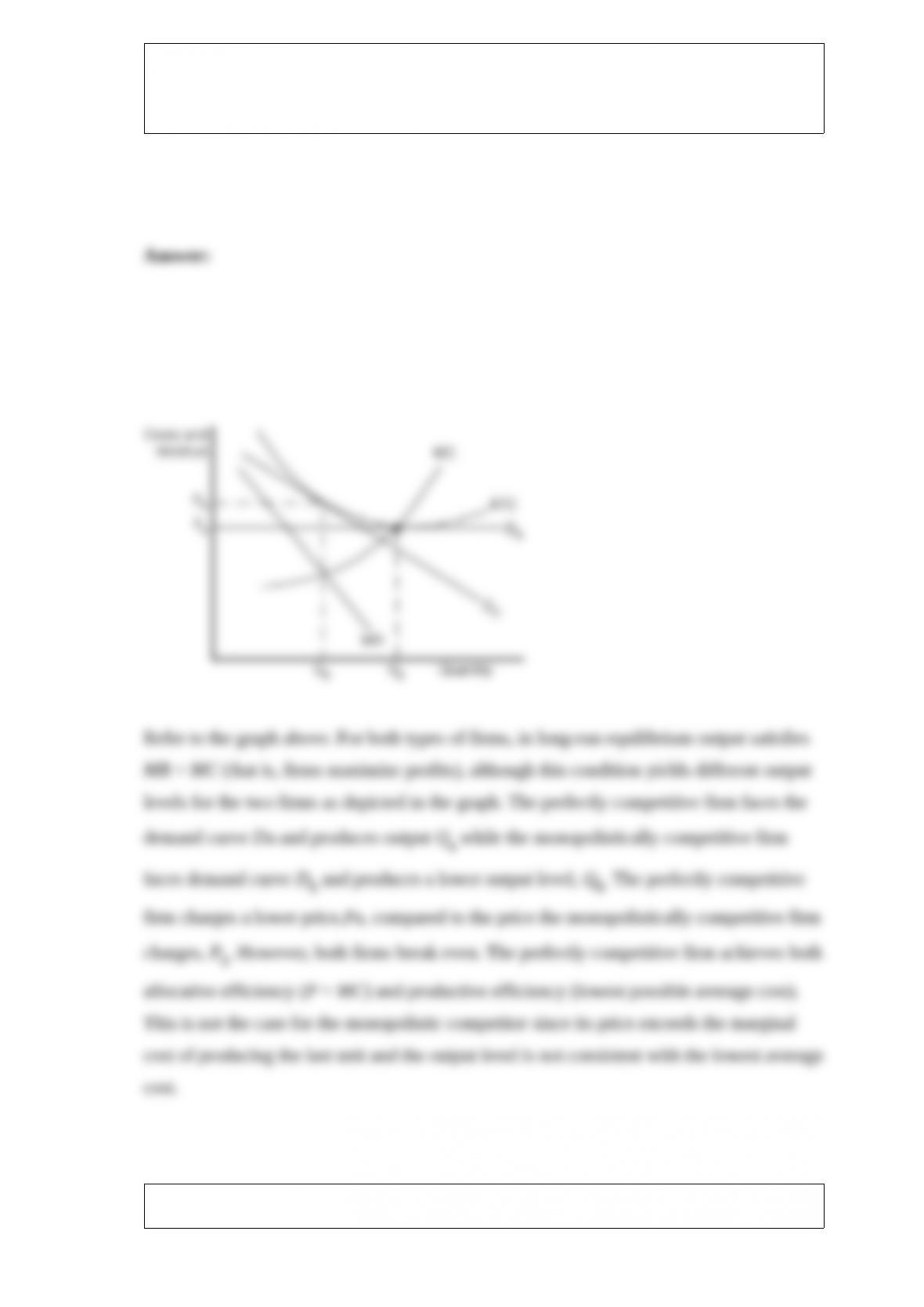
Explain the similarities and differences between the long-run equilibrium for a perfectly
competitive firm and a monopolistically competitive firm. Illustrate your answer with a
graph demonstrating the long run equilibrium for the two types of firms.
What is dumping? Who benefits and who loses from dumping?

What is the difference between scarcity and a shortage?