
Differentiating products to suit customers’ tastes is a form of price discrimination.
Answer:
Producer surplus is the difference between the highest price someone is willing to pay
and the price he actually pays.
Answer:
A monopolistically competitive industry that earns economic profits in the short run
will face a more elastic demand curve in the long run.
Answer:
Entrepreneurs who earn arbitrage profit are able to do so by extracting the total
consumer surplus from buyers.
Answer:

Foreign portfolio investment occurs when an individual or firm buys stock or bonds
issued in another country.
Answer:
Economic costs include implicit costs but not explicit costs.
Answer:
If the population increases and input prices increase, the equilibrium price of a product
will definitely increase.
Answer:
Residential investment includes spending by firms on office buildings.
Answer:

Price ceilings are illegal in the United States.
Answer:
If speculators believe a currency is soon going to be revalued, they will increase their
demand for that currency.
Answer:
For the Coase theorem to work there must be clear assignment of property rights.
Answer:
The U.S. economy has been more stable since 1950.
Answer:

The division of the burden of a tax between buyers and sellers in a market is called tax
incidence.
Answer:
Suppose the absolute value of the price elasticity of demand for basketball game tickets
on your campus is greater than 1. Increasing ticket prices will increase the total revenue
from ticket sales.
Answer:
If a monopolist’s price is $50 at the output where marginal revenue equals marginal cost
and average total cost is $43, then the average profit is $7.
Answer:
A black market is a market where buying and selling take place
A) at prices that violate government price regulations.
B) in non-licensed shops and warehouses.
C) after regular office hours.
D) on foreign soil.

Answer:
Scenario 1-4 Suppose a cigar manufacturer currently sells 1,500 cigars per week and
makes a profit of $3,000 per week. The plant foreman observes, “Although the last 500
cell cigars we produced and sold increased our revenue by $7,500 and our costs by
$7,000, we are only making an overall profit of $3,000 per week so I think we need to
cut back on production.”
Using marginal analysis terminology, what is another economic term for the
incremental cost of producing the last 500 cigars?
A) marginal cost
B) operating cost
C) explicit cost
D) Any of the above terms are correct.
Answer:
According to Porter’s Five Competitive Forces Model, which kinds of products are most
likely to limit the ability of firms in an industry to raise prices?
A) differentiated products that target a small subsegment of the industry
B) substitutable products produced by firms in different industries
C) similar products produced by similar industries in low-cost countries
D) complementary products produced by different firms in the same industry
Answer:
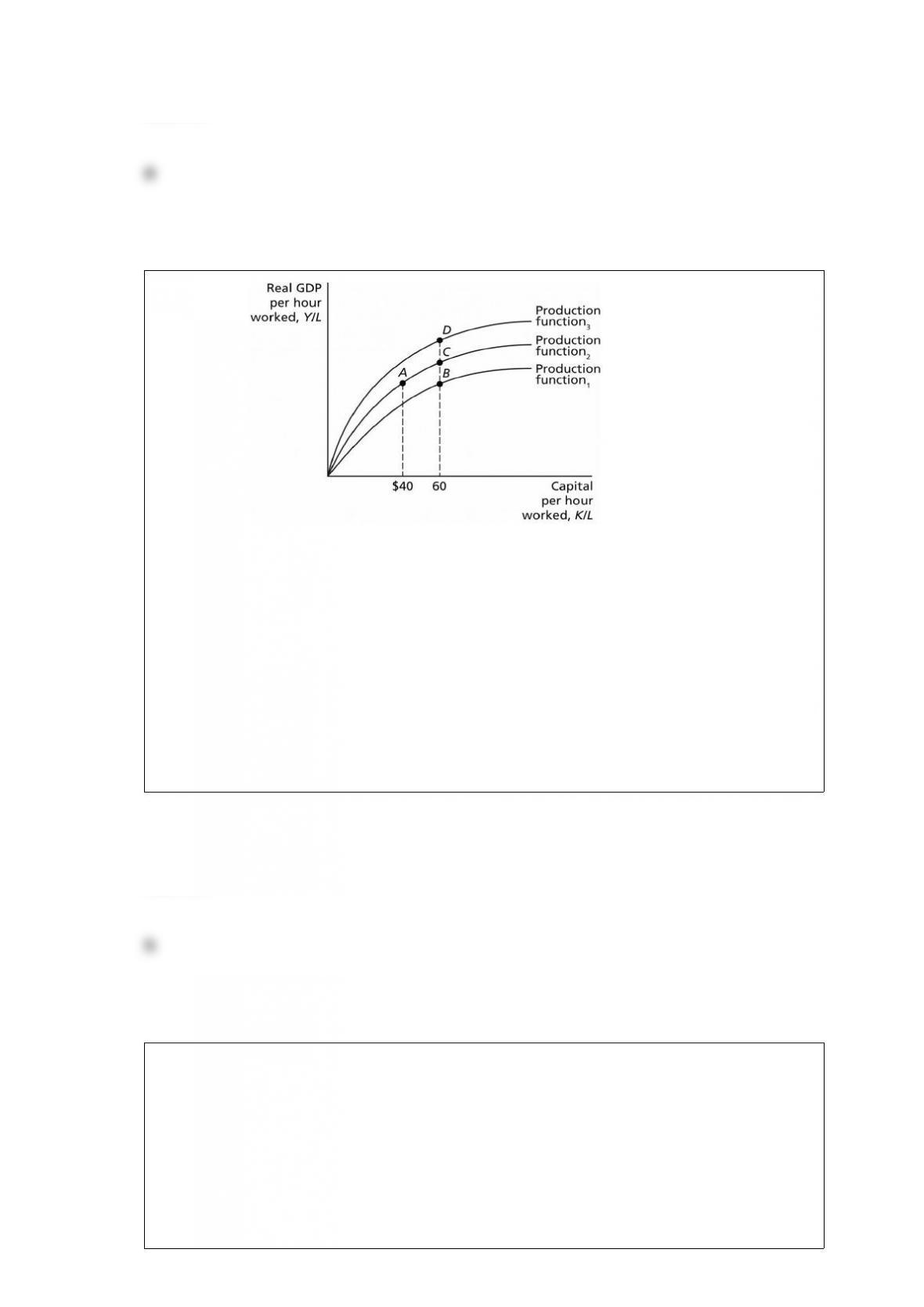
Figure 11-1
Using the per-worker production function in the figure above, the largest changes in an
economy’s standard of living would be achieved by a movement from
A) A to B to C.
B) B to C to D.
C) C to B to A.
D) D to C to B.
Answer:
Imagine that you borrow $1,000 for one year and at the end of the year you repay the
$1,000 plus $100 of interest. If the inflation rate was 7%, what was the real interest rate
you paid?
A) 17 percent
B) 10 percent

C) 7 percent
D) 3 percent
Answer:
As a form of business, a partnership
A) has limited liability.
B) has only one owner.
C) cannot issue stock.
D) has the most government rules and regulations affecting it.
Answer:
The five most important variables that determine the level of consumption are
A) disposable income, wealth, expected future income, price level, and interest rate.
B) wealth, savings account balances, checking account balances, stock portfolio
balances, and bond portfolio balances.
C) government purchases, interest rates, income, taxes, and transfers.
D) government purchases, saving account balances, wealth, interest rates, portfolio
balances.
Answer:

Suppose when the price of hybrid automobiles rises, consumers buy fewer hybrid
automobiles. This implies that
A) there is a positive relationship between hybrid automobile prices and quantities
purchased by consumers.
B) there is a negative relationship between hybrid automobile prices and quantities
purchased by consumers.
C) there is a direct relationship between hybrid automobile prices and quantities
purchased by consumers.
D) there is a one-to-one relationship between hybrid automobile prices and quantities
purchased by consumers.
Answer:
In recent years online bookseller Amazon.com has lowered its profits by offering some
of its customers free shipping and building more warehouses to hold its inventories.
Which of the following explains Amazon.com’s actions?
A) Amazon.com feared government regulation if its profits were too high.
B) Amazon.com took these actions to deter entry into its market by new online
booksellers.
C) Amazon.com took these actions to compete more effectively with existing online
booksellers.
D) Amazon.com was forced to take these actions because of the bargaining power of its
suppliers.
Answer:

Jeremy is thinking of starting up a small business selling NASCAR memorabilia. He is
considering setting up his business as a sole proprietorship. What is one disadvantage to
Jeremy of setting up his business as a sole proprietorship?
A) As a sole proprietor, Jeremy would be taxed twice.
B) As a sole proprietor, Jeremy would not have control of the business.
C) As a sole proprietor, Jeremy would face unlimited liability.
D) As a sole proprietor, Jeremy would be subject to significant rules and regulations.
Answer:
Article Summary. Based on resale prices for tickets for the 2013 Super Bowl in New
Orleans, face-value prices for the most expensive tickets to the 2014 game are
expected to more than double, with significant price increases for lesser-valued
tickets as well. Evidence indicates that sports teams are more interested in
maximizing attendance instead of ticket revenue, since greater attendance means
more spending on items such as parking and concessions. Higher ticket prices in
secondary markets seem to verify that teams are charging less than they could be
if their goal was to maximize ticket revenue. Source: Patrick Rishe, “Super Bowl
XLVIII Pricing: A Lesson In Demand Elasticity,” Forbes, September 19, 2013.
The idea that sports teams could charge more for tickets and still increase revenue
indicates that tickets are being priced in the ________ portion of their demand curve.
A) elastic
B) inelastic
C) unit elastic
D) perfectly elastic
Answer:

In 2010, Hooverville consumed 205,000 tons of sugar. In 2011, sugar consumption rose
to 245,000 tons. Calculate the percentage change in sugar consumption.
A) 8.37%
B) 11.95%
C) 19.51%
D) 26.33%
Answer:
If a typical firm in a perfectly competitive industry is earning profits, then
A) all firms will continue to earn profits.
B) new firms will enter in the long run causing market supply to decrease, market price
to rise and profits to increase.
C) new firms will enter in the long run causing market supply to increase, market price
to fall and profits to decrease.
D) the number of firms in the industry will remain constant in the long run.
Answer:
The long-run aggregate supply curve
A) has a negative slope.
B) has a steep but positive slope.
C) is horizontal.
D) is vertical.
Answer:
Discuss the role of product differentiation and advertising in monopolistic competition.
Answer:
What is a Lorenz curve and what is a Gini coefficient?
Answer:
What is the difference between a “change in demand” and a “change in quantity
demanded”?
Answer:
Two key consequences of asymmetric information are adverse selection and moral
hazard. Define each concept, provide one example of each and explain how the two
concepts Differ.
Answer:
What is asymmetric information?

Answer:
Should countries specialize in producing goods and services based on having a
comparative advantage or an absolute advantage? Why?
Answer:
How can increases in a country’s total income improve health?
Answer:
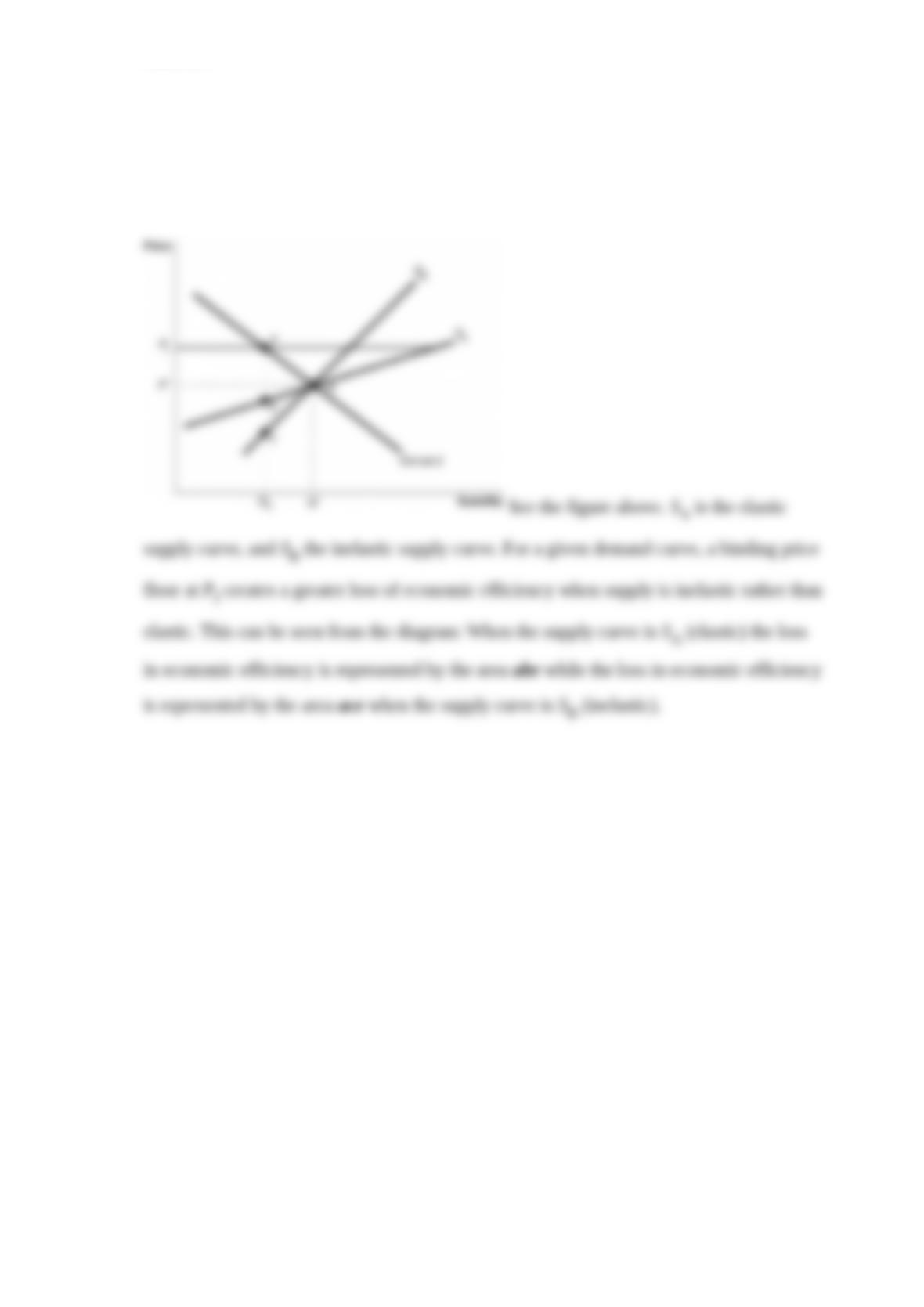
For a given demand curve, will there be a greater loss of economic efficiency from a
binding price floor when supply is elastic or inelastic? Illustrate your answer with a
demand and supply graph. In your graph you must show two supply curves, one elastic
and the other inelastic.
Answer: