You own a business that answers telephone calls for physicians after their offices close.
You have an incentive to substitute capital for labor if the
A) price of capital increases.
B) price of labor decreases.
C) price of labor increases.
D) marginal product of labor increases.
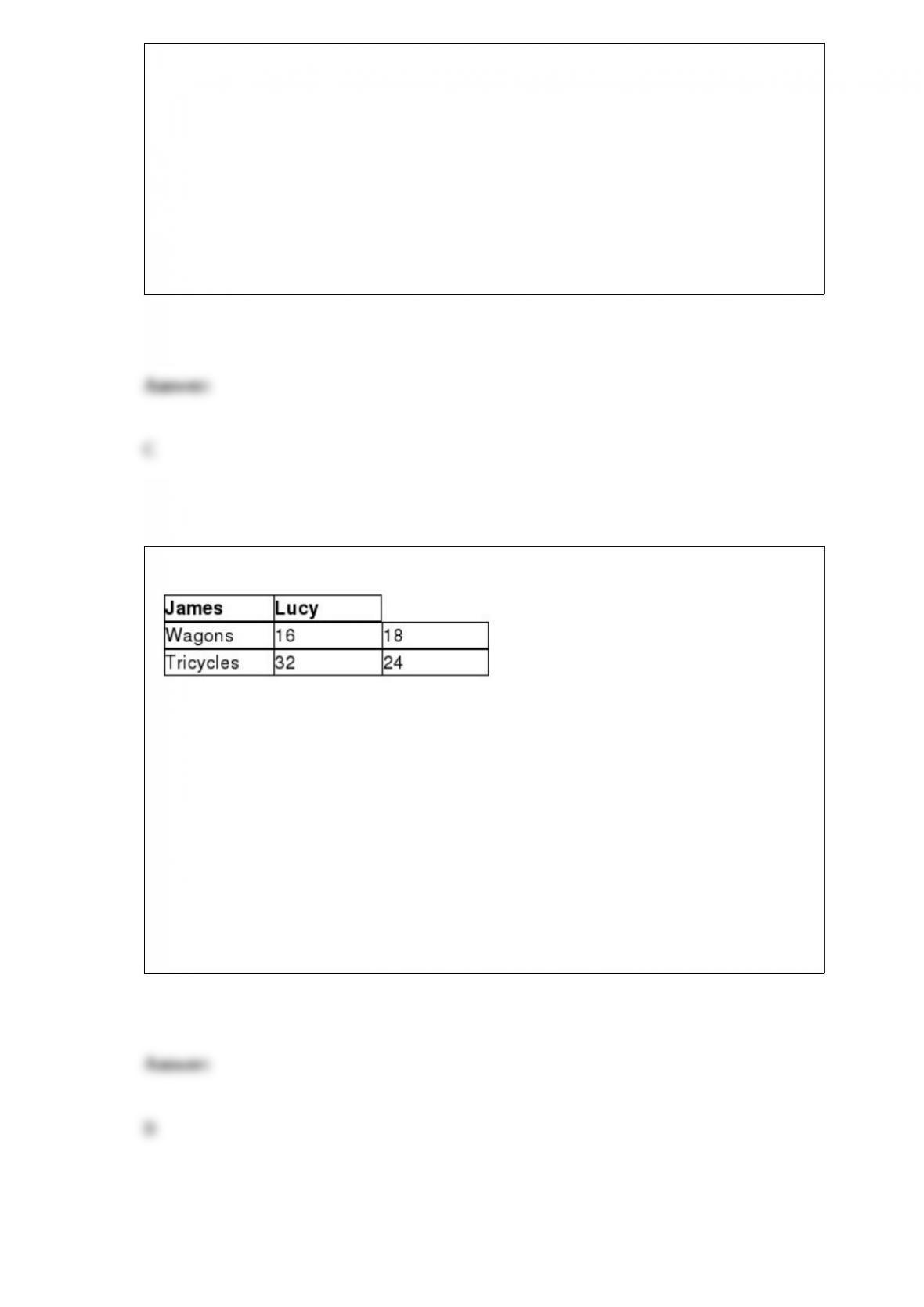
Table 2-17
Table 2-17 shows the output per week of two people, James and Lucy. They can either
devote their time to making wagons or making tricycles.
What is James’s opportunity cost of making a tricycle?
A) 2 tricycles
B) 1/2 of a wagon
C) 1/2 of a tricycle
D) 3/4 of a wagon

Long-run equilibrium under monopolistic competition and perfect competition is
similar in that
A) firms produce at the minimum point of their average cost curves.
B) price equals marginal cost.
C) firms break even.
D) price equals marginal revenue.
Marginal analysis involves undertaking an activity
A) until its marginal costs start declining.
B) only when its marginal benefits are positive.
C) until its marginal benefits equal marginal costs.
D) only if its marginal costs are greater than its marginal benefits.
What is the difference between a public franchise and a public enterprise?
A) A public franchise grants a firm the right to be the sole legal provider of a good or
service. A public enterprise refers to a service that is provided directly to consumers
through the government.

B) A public enterprise grants a firm the right to be the sole legal provider of a good or
service. A public franchise refers to a service that is provided directly to consumers
through the government.
C) A public enterprise is owned by the public through its holdings of shares of stock in
the enterprise. A public franchise is a firm owned by the government.
D) Both refer to a service provided directly to consumers through the government, but
“public franchise” is a term more commonly used in the United States while “public
enterprise” is more commonly used in European countries.
Some factors that allow firms to make economic profits are beyond its control. All but
one of the following is an uncontrollable factor. Which factor is controllable?
A) input prices
B) consumer tastes
C) chance events
D) product differentiation
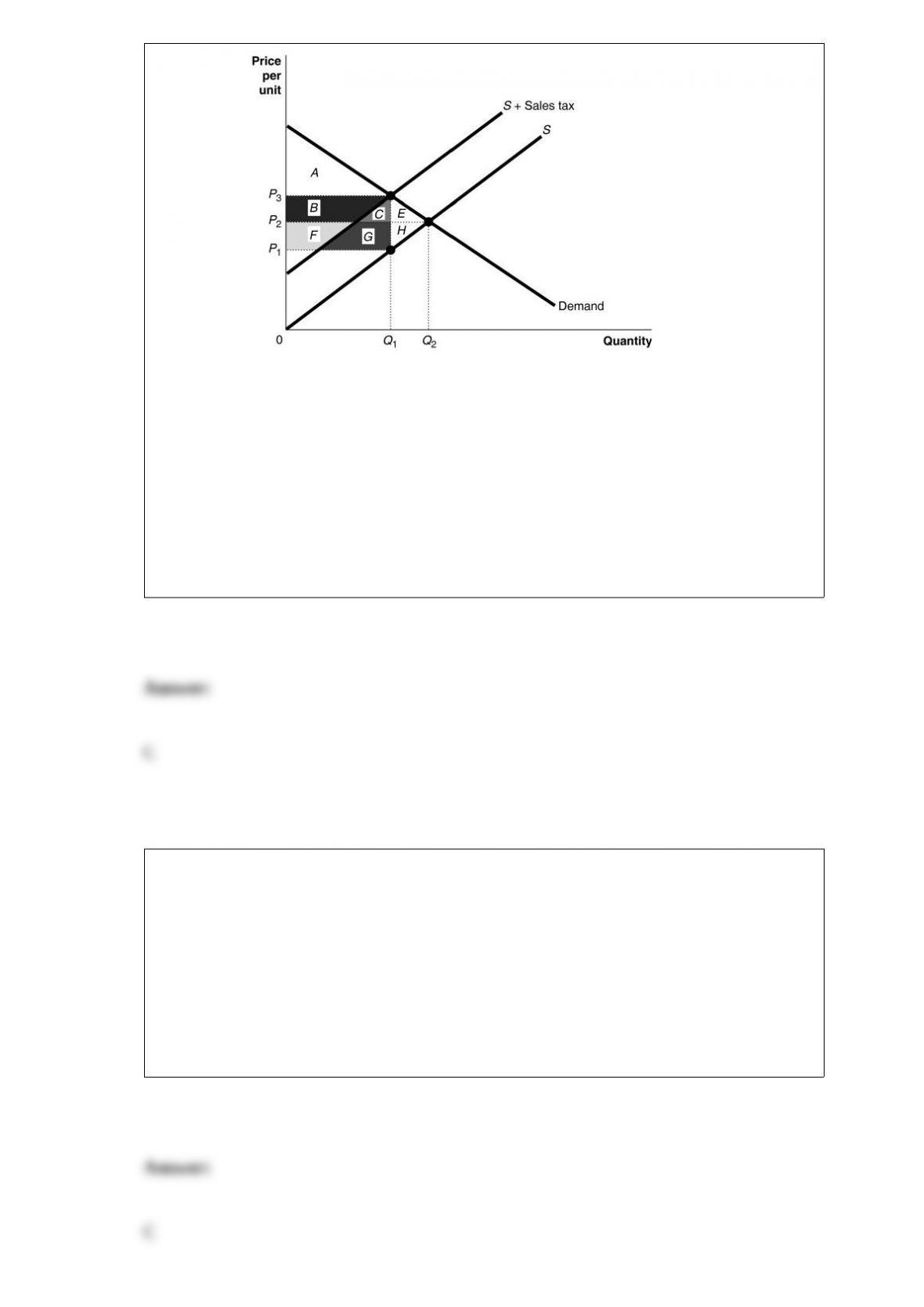
Figure 18-1
The excess burden of the tax is represented by the area
A) B + C.
B) F + G.
C) E + H.
D) B + C + F + G.
If a demand curve shifts to the left, then
A) demand has increased.
B) quantity demanded has increased.
C) demand has decreased.
D) quantity demanded has decreased.

The demand curve for each seller’s product in perfect competition is horizontal at the
market price because
A) each seller is too small to affect market price.
B) the price is set by the government.
C) all the sellers get together and set the price.
D) all the demanders get together and set the price.
The Bretton Woods exchange rate system was a
A) floating exchange rate system.
B) managed float exchange rate system.
C) fixed exchange rate system.
D) flexible exchange rate system.
The economic growth model predicts that
A) the level of real GDP per capita in poor countries will grow faster than in rich
countries.
B) the per-worker production function of poor countries will be flatter than the

per-worker production function of rich countries.
C) lower-income industrial countries will forever be unable to catch up to
higher-income industrial countries.
D) economic growth in rich countries can only be accomplished at the expense of slow
or even negative growth in poor countries.
All but one of the following economists were awarded a Nobel prize for their
contributions to experimental economics and their explorations of the influence fairness
has on consumer decision-making. Which economist did not receive a Nobel Prize for
this work?
A) Vernon Smith
B) Alan Krueger
C) Daniel Kahneman
D) Maurice Allais
A demand curve shows the relationship between
A) the price of a product and the quantity of the product demanded.
B) the amount of a product sellers are willing to sell at a particular price and the amount
consumers are willing to buy at that price.
C) the quantity that consumers are willing and able to buy and the quantity that sellers
are willing and able to offer.
D) the price of a produce and the demand for the product.
One result of the financial meltdown of the late 2000s was that mortgage institutions
________ and ________ were brought under direct control of the government.
A) Fannie Mae; Freddie Mac
B) Glass Steagall; Sarbanes Oxley
C) Goldman Sachs; Morgan Stanley
D) Lehman Brothers; FDIC
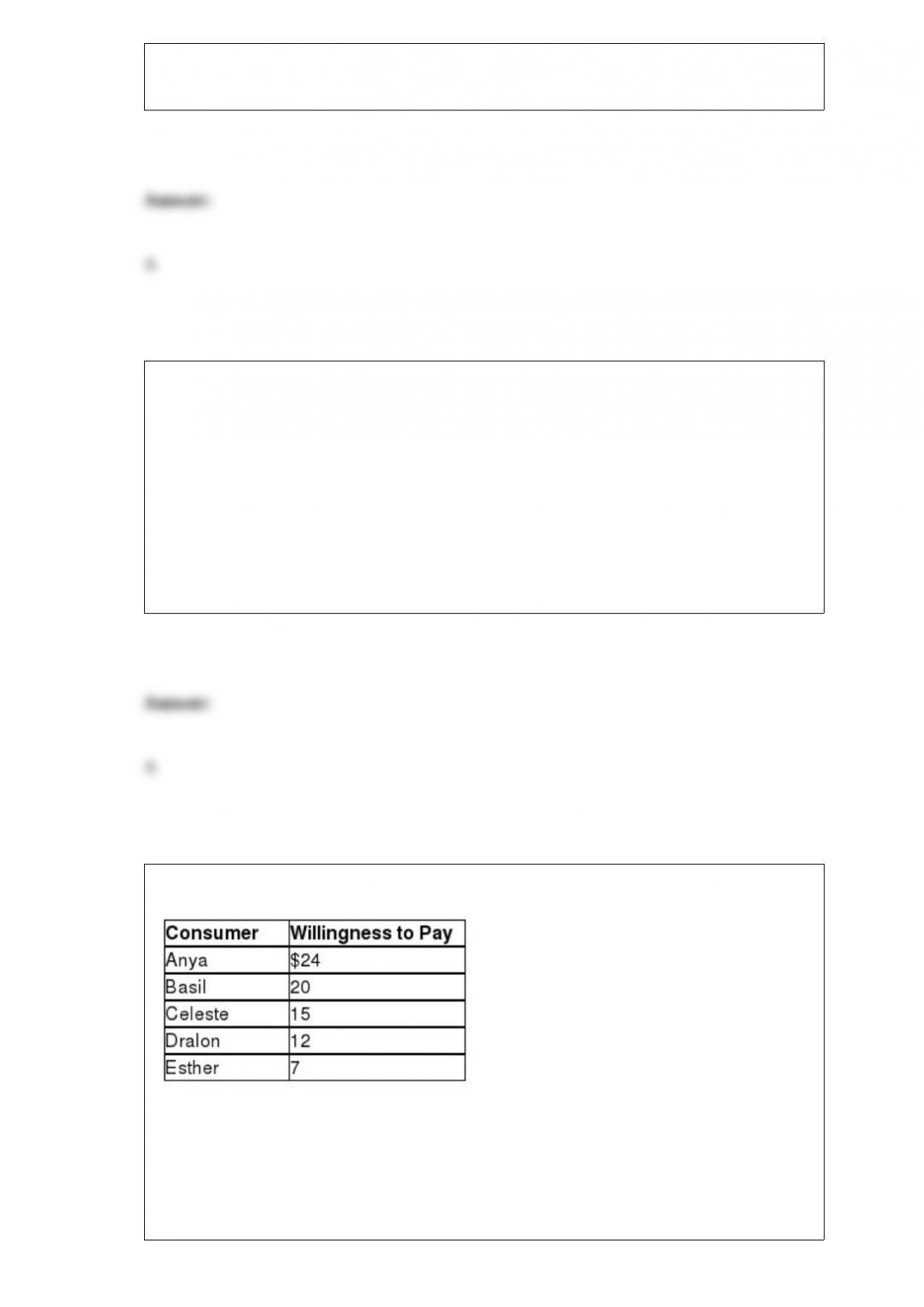
Table 4-2
The table above lists the highest prices five consumers are willing to pay for a theater
ticket. If the price of one ticket falls from $25 to $10
A) only three tickets will be sold.
B) consumer surplus decreases from $24 to $12.
C) consumer surplus increases from $0 to $31.
D) everyone will buy a ticket.
________ is/are the payment for the factor of production ________.
A) Wages; capital
B) Interest; labor
C) Profit; entrepreneurship
D) Rent; capital
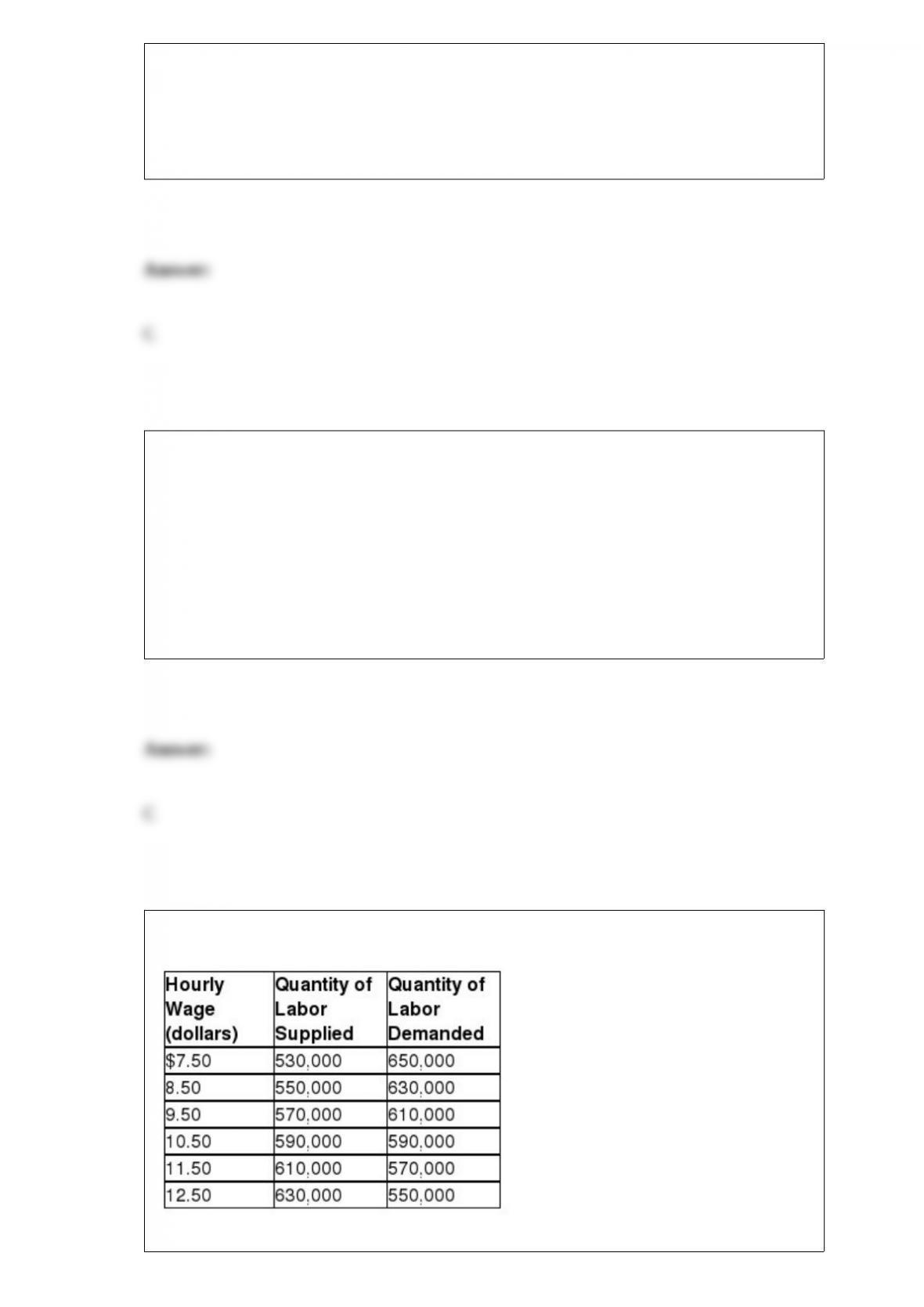
Table 4-7
Table 4-7 shows the demand and supply schedules for labor market in the city of Pixley.

Suppose that the quantity of labor supplied decreases by 80,000 at each wage level.
What are the new free market equilibrium hourly wage and the new equilibrium
quantity of labor?
A) W = $8.50; Q = 550,000
B) W = $12.50; Q = 550,000
C) W = $8.50; Q = 630,000
D) W = $11.50; Q = 610,000
Marginal revenue product for a perfectly competitive seller is equal to
A) the output price multiplied by the total product of labor.
B) the output price multiplied by the number workers hired.
C) the change in total revenue that results from hiring another worker.
D) the marginal cost of production.
In conducting monetary policy, how has the Federal Reserve enhanced its credibility?
A) by not following through with changes it has announced
B) by revealing the Fed’s target for the federal funds rate
C) by keeping the minutes of the open market committee meetings confidential

D) by marketing and increased expenditure on advertising