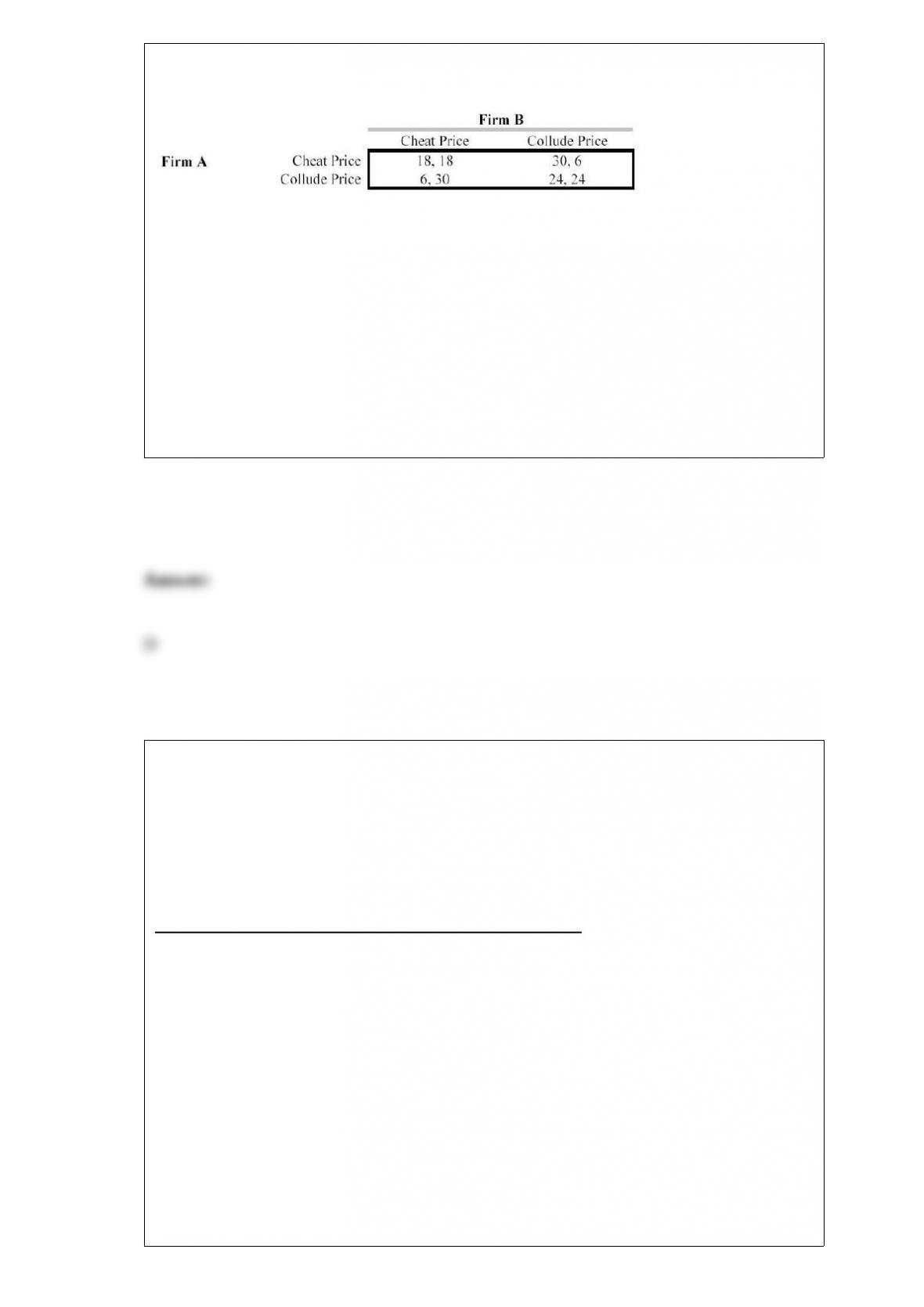
Two firms operating in the same market must choose between a collude price and a
cheat price. Firm A’s profit is listed before the comma, B’s outcome after the comma.
If each firm tries to choose a price that is best for it, regardless of the other firm’s price,
which of these statements is correct?
A) Firm A should charge the collude price, Firm B should charge a cheat price.
B) Firm A should charge a cheat price, Firm B should charge a collude price.
C) Both firms should charge a collude price.
D) Both firms should charge a cheat price.
In this problem, a labor market exists where employers hire and pay workers according
to how much formal education workers possess. Education is a proxy for the level of
productivity that employers can expect from workers. Therefore, employers follow a
strategy in which they hire workers and pay salaries according to the following
conditions:
Degrees Above the Values of Post High School
High School Level Education During Working Life, B(y)
None 0
(y = 0 years)
Associate’s Degree $30,000
(y = 2 years)
Bachelor’s Degree $51,000
(y = 4 years)
Master’s Degree $58,000
(y = 6 years)
Assume that there are only two types of worker abilities, those who are less productive
(type L) and those who are highly productive (type H). The less productive workers
have to study harder than highly productive workers in order to earn any degree.
Consequently, the costs (including the psychic costs of study effort) of attaining various
levels of education for these two types of employees are different.
For less productive workers: CL(y) = $13,000y
For highly productive workers: CH(y) = $10,000y
a. Draw a diagram with years of education on the horizontal axis. Graph the benefits to
education B(y) and the costs of education for each of the two types of workers. Discuss
what level of education each type of worker should obtain.
b. Now use the equations above to verify your answer from part (a) mathematically.
c. Explain the value of formal education above the high school level in the market place
to employers.
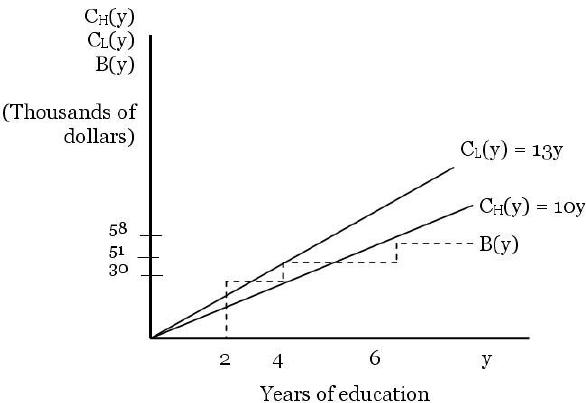
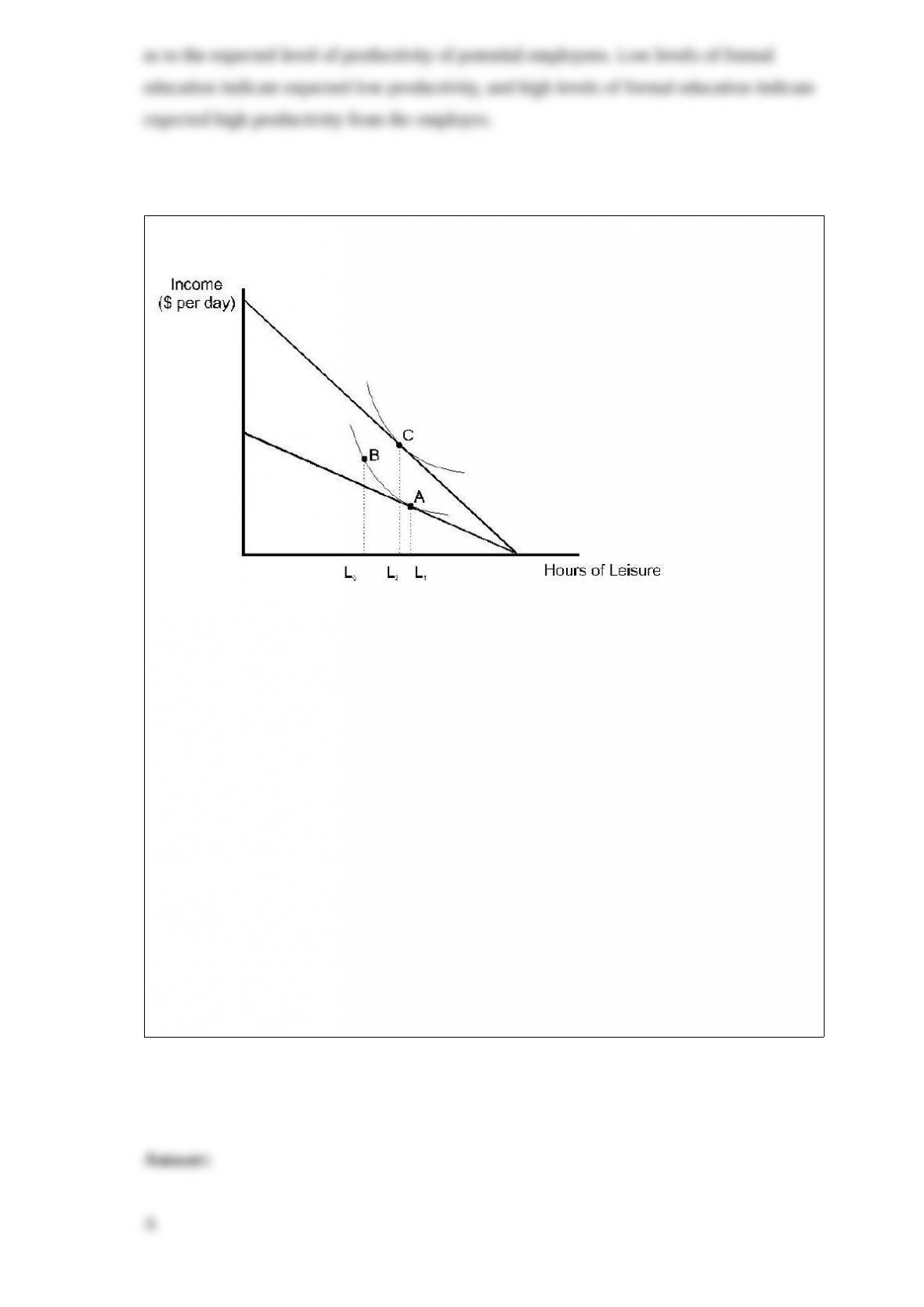
Figure 14.1
A consumer’s original utility maximizing combination of income and leisure is shown
in the diagram above as point A. After a wage increase, the consumer’s utility
maximizing combination changes to point C.
Refer to Figure 14.1. The income effect of the wage increase on the amount of hours of
leisure is:
A) L0 to L2.
B) L0 to L1.
C) L1 to L2.
D) L2 to L1.
E) none of the above
In the short run, a perfectly competitive firm earning positive economic profit is
A) on the downward-sloping portion of its ATC.
B) at the minimum of its ATC.
C) on the upward-sloping portion of its ATC.
D) above its ATC.
E) below its ATC.
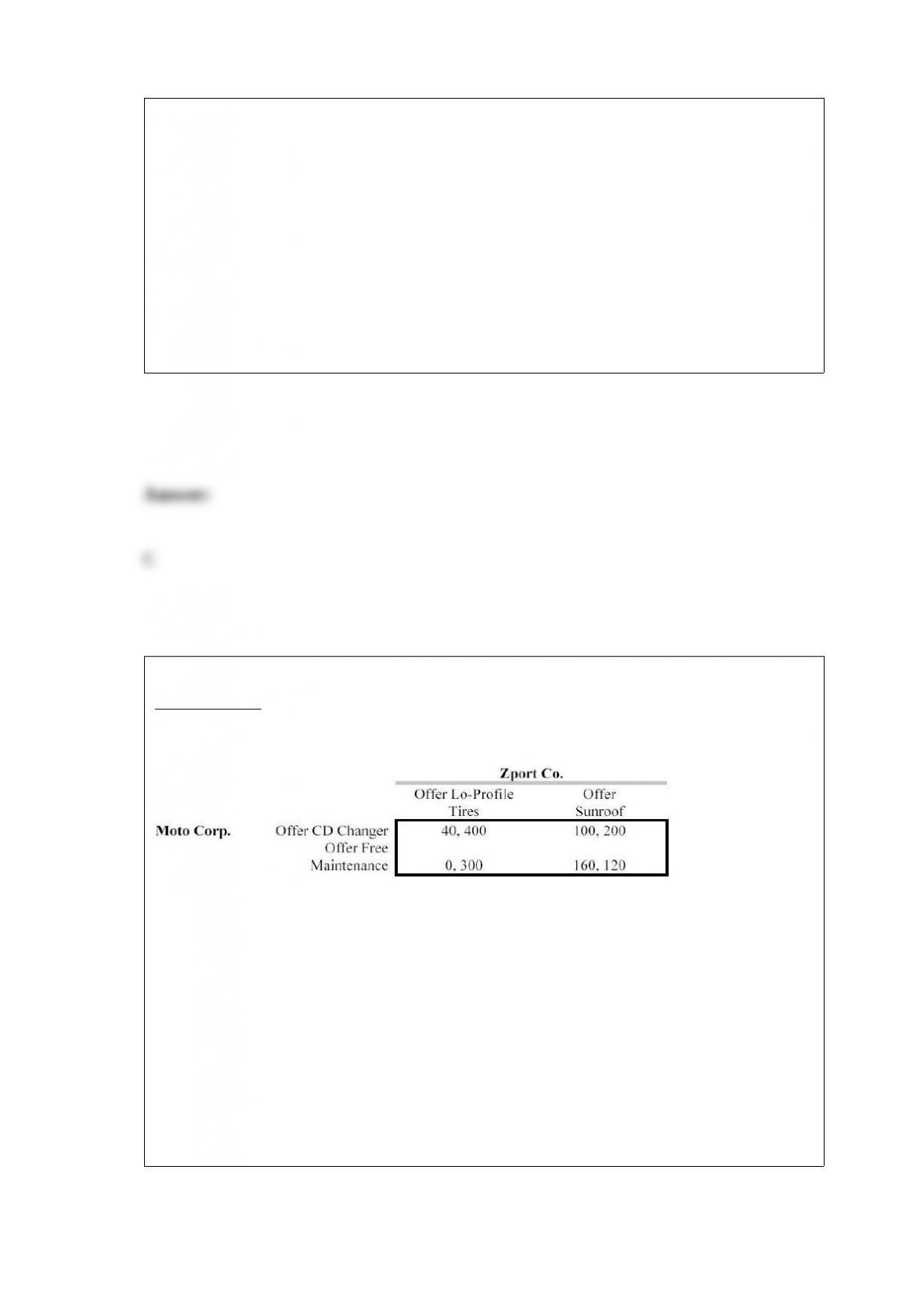
Scenario 13.3
Consider the following game:
Which of the following is true for the game in Scenario 13.3?
A) Moto’s dominant strategy is the CD changer.
B) Moto’s dominant strategy is the free maintenance.
C) Zport’s dominant strategy is the low-profile tires.
D) Zport’s dominant strategy is the sun roof.
E) Neither company has a dominant strategy.

Scenario 5.10:
Hillary can invest her family savings in two assets: riskless Treasury bills or a risky
vacation home real estate project on an Arkansas river. The expected return on Treasury
bills is 4 percent with a standard deviation of zero. The expected return on the real
estate project is 30 percent with a standard deviation of 40 percent.
Refer to Scenario 5.10. If Hillary invests 30 percent of her savings in the real estate
project and the remainder in Treasury bills, the expected return on her portfolio is:
A) 4 percent.
B) 8 percent.
C) 17 percent.
D) 2 percent.
E) 30 percent.
Scenario 10.1:
Barbara is a producer in a monopoly industry. Her demand curve, total revenue curve,
marginal revenue curve and total cost curve are given as follows:
Q = 160 – 4P TR = 40Q – 0.25Q2MR = 40 – 0.5Q TC = 4Q MC = 4
Refer to Scenario 10.1. How much profit will she make?

A) -996
B) 0
C) 1,296
D) 1,568
E) none of the above
Last year, on advice from your sister, you bought stock in Burpsy Soda at $100/share.
During the year, you collected a $2 dividend and then sold the stock for $120/share.
You experienced a
A) dividend yield of 9%.
B) dividend yield of 20%.
C) dividend yield of 11%.
D) total return of 20%.
E) total return of 22%.
An industry analyst observes that in response to a small increase in price, a competitive
firm’s output sometimes rises a little and sometimes a lot. The best explanation for this
finding is that
A) the firm’s marginal cost curve is random.
B) the firm’s marginal cost curve has a very small positive slope.
C) the firm’s marginal cost has a very large positive slope.
D) the firm’s marginal cost curve is horizontal for some ranges of output and rises in
steps.
E) the firm’s marginal cost curve is downward sloping.
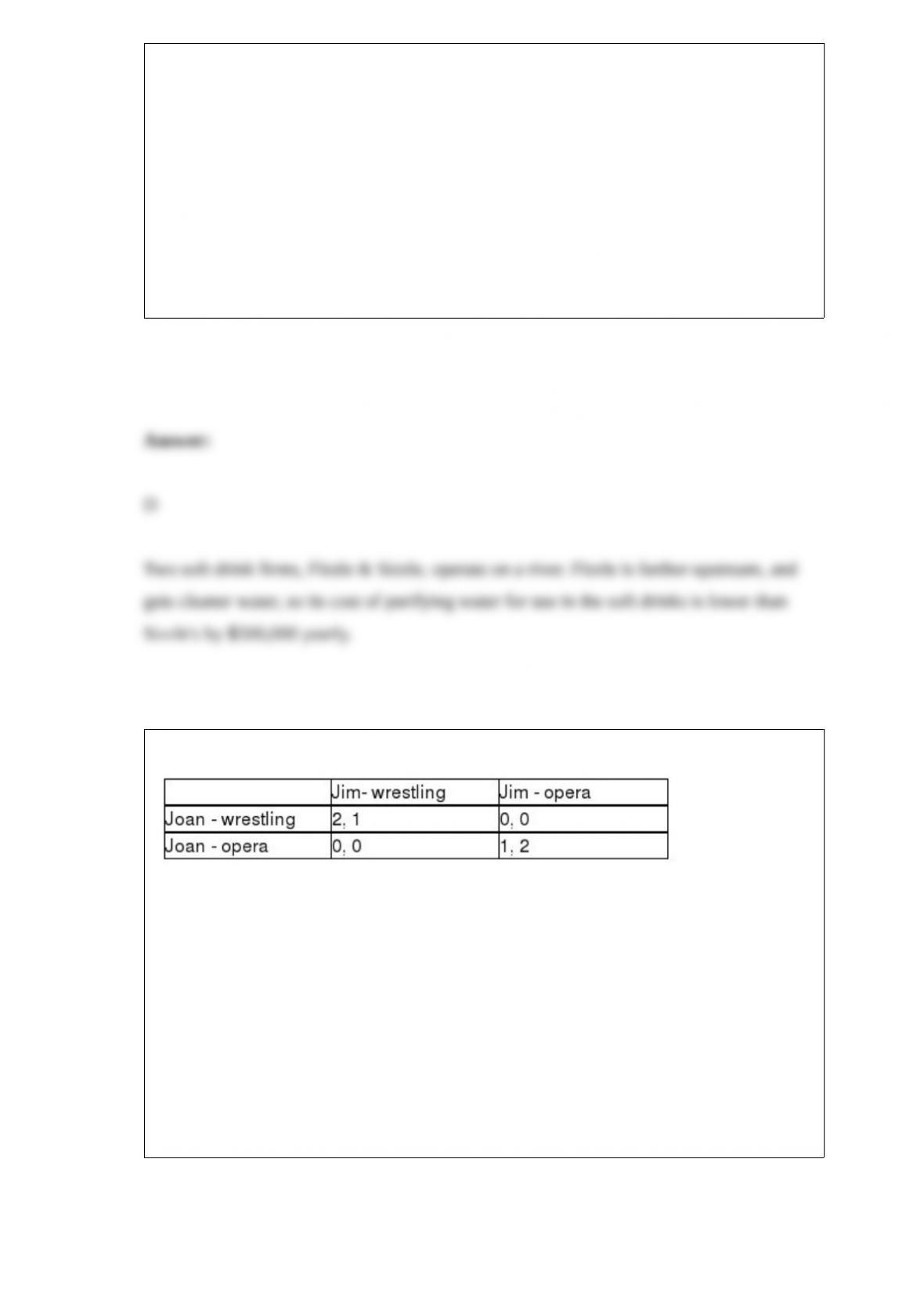
Consider the Battle of the Sexes game:
Suppose both players use mixed strategies for this game. Jim chooses wrestling with
probability 0.9, and Joan chooses wrestling with probability 0.5. What are the expected
payoffs for the players?
A) The expected payoffs are 0.95 for Joan and 0.55 for Jim
B) The expected payoffs are 0.55 for Joan and 0.95 for Jim
C) The expected payoffs are 0.95 for both players
D) The expected payoffs are 0.55 for both players
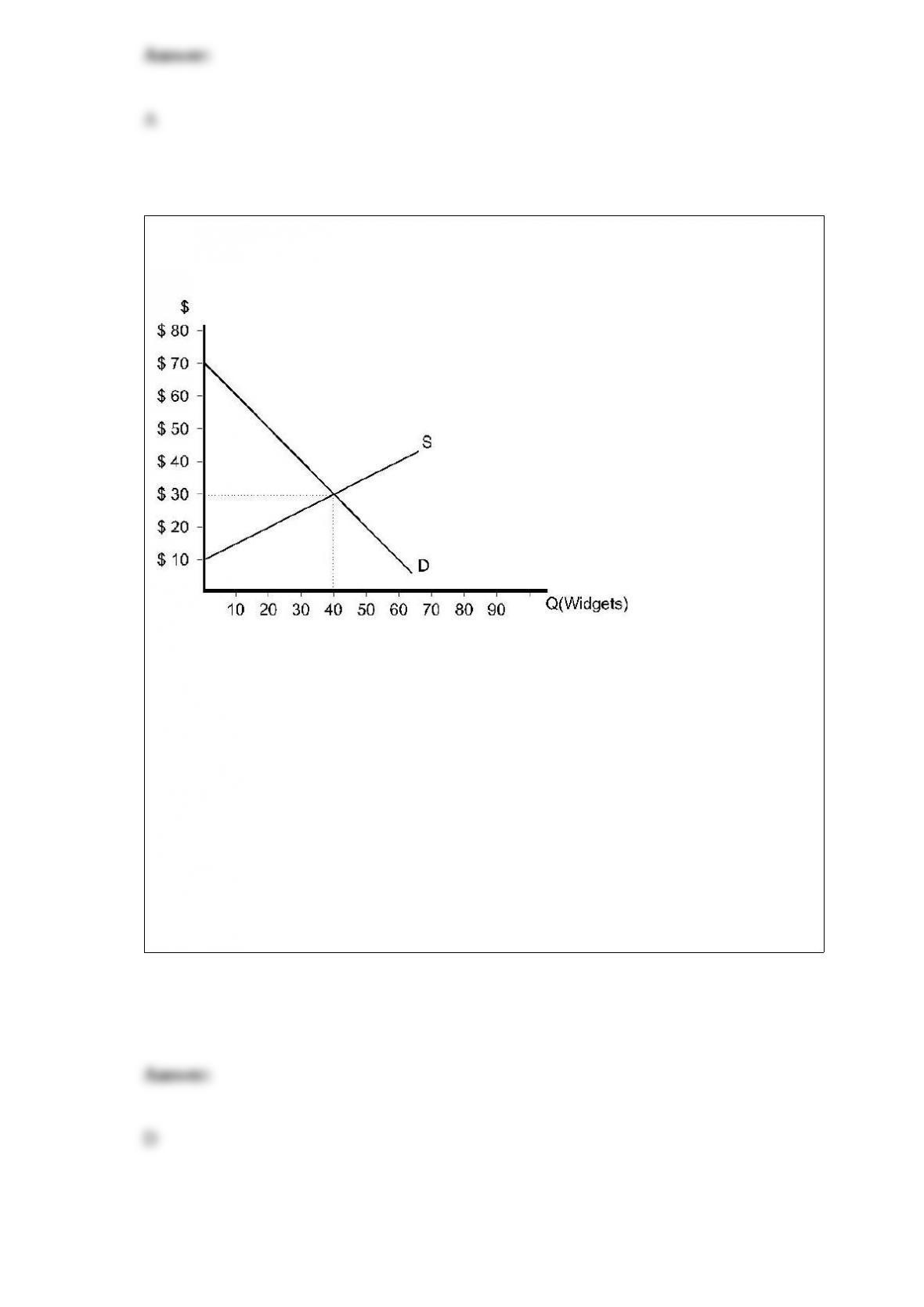
Figure 9.1
Refer to Figure 9.1. If the market is in equilibrium, total consumer and producer surplus
is
A) $0.
B) $100.
C) $800.
D) $1200.
E) $2000.
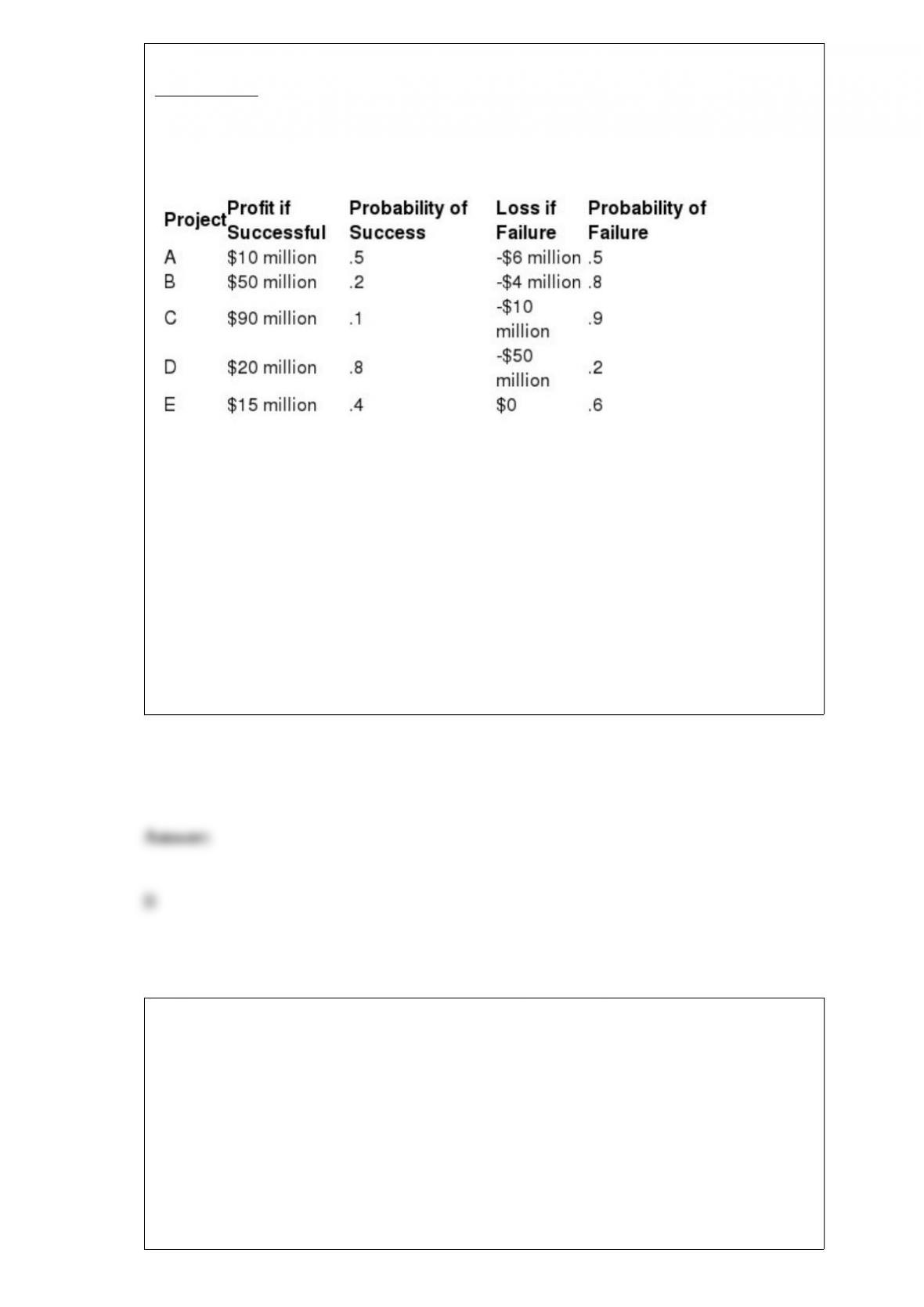
Scenario 5.7:
As president and CEO of MegaWorld industries, Natasha must decide on some very
risky alternative investments. Consider the following:
Refer to Scenario 5.7. Since Natasha is a risk-neutral executive, she would choose
A) A.
B) B.
C) C.
D) D.
E) E.
The price elasticity of gasoline supply in the U.S. is 0.4. If the price of gasoline rises by
8%, what is the expected change in the quantity of gasoline supplied in the U.S.?
A) +3.2%
B) -3.2%
C) +32.0%
D) +0.32%

Which of the following would cause a rightward shift in the demand curve for gasoline?
I. A large increase in the price of public transportation.
II. A large decrease in the price of automobiles.
III. A large reduction in the costs of producing gasoline.
A) I only
B) II only
C) I and II only
D) II and III only
E) I, II, and III
For which of the following market structures is it assumed that there are barriers to
entry?
A) Perfect competition
B) Monopolistic competition
C) Monopoly
D) all of the above

E) B and C only
The marginal revenue product of capital inputs does not provide complete information
about optimal use because capital is:
A) money.
B) not an input.
C) an output as well as an input.
D) durable.
E) all of the above
Scenario 4.2:
Suppose that the demand for artichokes (Qa) is given as:
Qa = 200 – 4PUse the information in Scenario 4.2. Suppose that the price of artichokes
is increased slightly from $10. The total expenditure by consumers on artichokes will
________ and the number of artichokes sold will ________.
A) rise, rise

B) rise, fall
C) fall, rise
D) fall, fall
Scenario 4.4:
The demand curve for the new computer game, Rock and Roll Trivia, is given as
follows:
Q = 200 – 5P – .1Pc – .5Pd + .2A – I
where P is the price of the game
Pc is the price of a computer
Pd is the price of a diskette
A is the level of advertising
Q is the level of incomeSee the information in Scenario 4.4. Suppose P = 10, Pc = 100,
Pd = 2, A = 5, and I = 50. What is the price elasticity of demand?
A) 0
B) -5/9
C) -1
D) -9/5
E) none of the above

Suppose you invest $100,000 in a new machine today, and you earn a $150,000 return
in one year. What is the internal rate of return on this investment?
A) 10 percent
B) 25 percent
C) 50 percent
D) 100 percent
In Eugene, Oregon, next year there is a 2% chance of an earthquake severe enough to
destroy all buildings and personal property. Quincy, who has $3,000,000 in buildings
and personal property, has the opportunity to purchase complete earthquake insurance.
Which is true?
A) Quincy should not purchase earthquake insurance unless he can get it for less than
$60,000, because that’s all he could possibly lose in an earthquake.
B) Quincy should not purchase earthquake insurance unless he can get it for less than
$60,000, because that’s his expected loss in an earthquake.
C) If Quincy buys earthquake insurance, and an earthquake does not occur, he will have
received no utility from the transaction.
D) What Quincy is willing to pay for the earthquake insurance depends upon his degree
of risk aversion.
E) Quincy should be willing and able to pay up to $3,000,000 for earthquake insurance.
In a competitive labor market, the supply of labor curve is expressed as:
AE = $5 + 0.0025L,
where AE represents the average expenditure ($/unit) and L represents units of labor
hired per unit of time. The demand for labor is based on the following expression:
MP = 5 – 0.001L,
where MP represents marginal product of labor. Revenue from the final good is $5 per
unit sold in a competitive market.
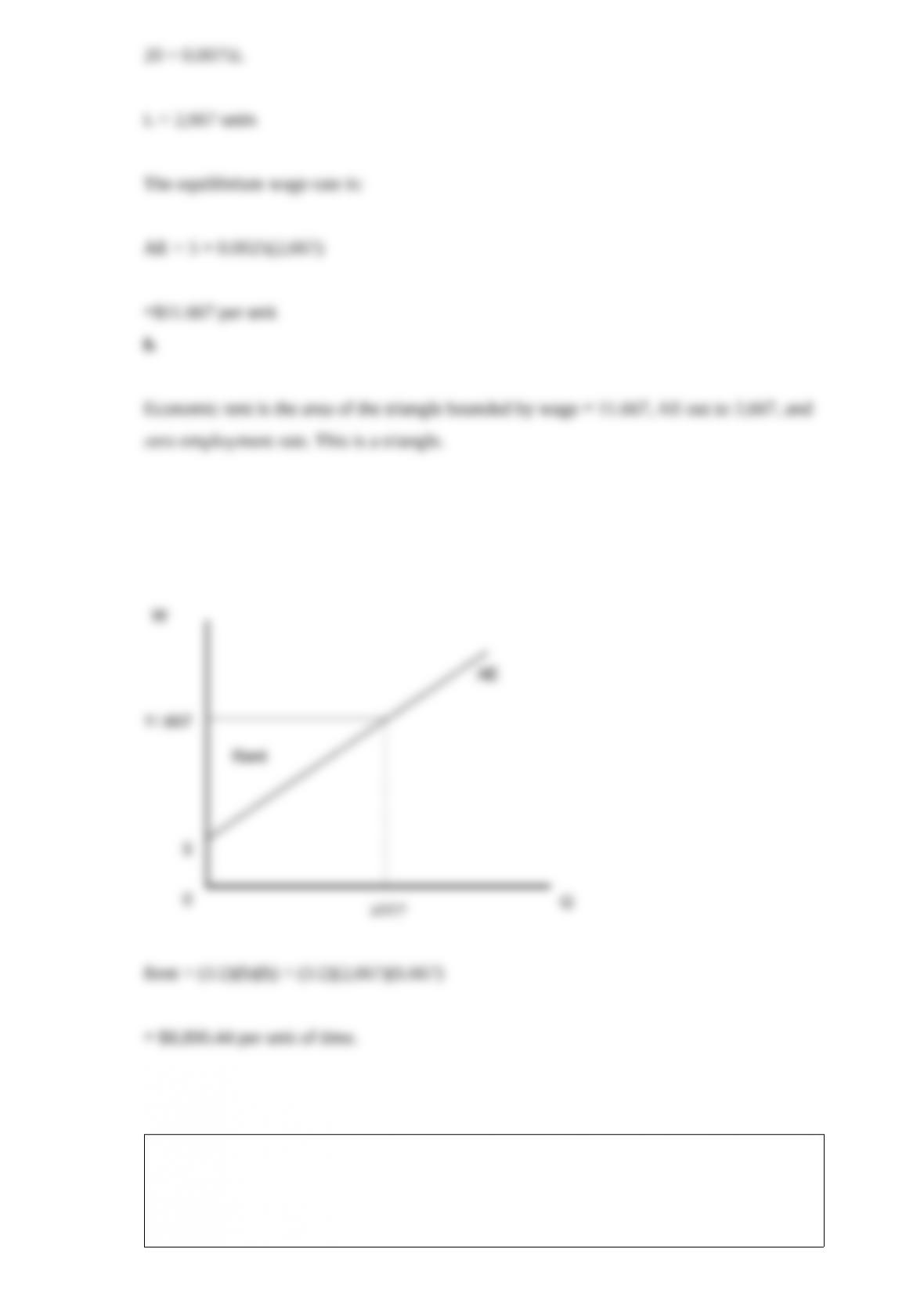
a. Determine the equilibrium wage rate and labor employment rate.
b. Compute the economic rent earned by labor.
What is the problem with paying plant managers in multi-plant firms according to the
level of output they produce?
A) Managers in low-cost or high-capacity plants could be penalized, in percentage

terms, for their overproduction.
B) The production problem in multi-plant firms is usually how to lower production to
increase market power, not how to increase production.
C) Managers in high-cost or low-capacity plants could be penalized for production
constraints over which they have no control.
D) Managers would have an incentive to understate the productive capacity of their
plants.
E) Managers would have an incentive to overstate the productive capacity of their
plants.
Imposition of an output tax on all firms in a competitive industry will result in
A) a downward shift in each firm’s marginal cost curve.
B) a downward shift in each firm’s average cost curve.
C) a leftward shift in the market supply curve.
D) the entry of new firms into the industry.
E) higher profits for the industry as price rises.
Consider the following game in which two firms decide how much of a homogeneous
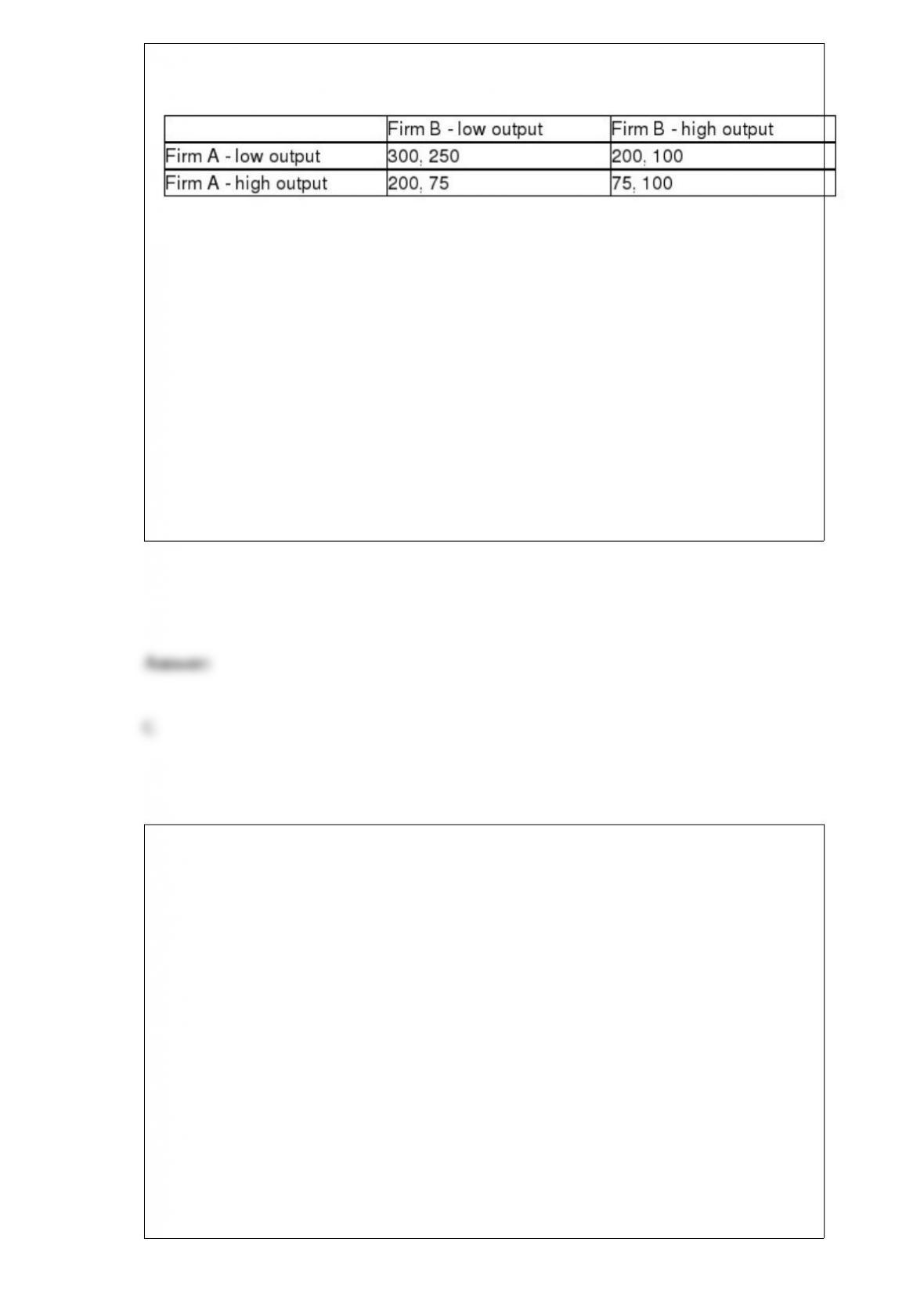
good to produce. The annual profit payoffs for each firm are stated in the cell of the
game matrix, and Firm A’s payoffs appear first in the payoff pairs:
What are the dominant strategies in this game?
A) Both firms produce low levels of output
B) Both firms produce high levels of output
C) Firm A’s dominant strategy is to produce low levels of output, but Firm B does not
have a dominant strategy.
D) Firm B’s dominant strategy is to produce low levels of output, but Firm A does not
have a dominant strategy.
E) Neither firm has a dominant strategy
Use the following statements to answer this question.
I. The bubble concept allows an emitter to sum emission limits for all sources of
pollutants within a particular firm, and to set emissions reductions from each source as
it pleases as long as the total pollutant limit at the plant is not exceeded.
II. Under an emissions offsets program, a new source of emissions can locate in a
region only if their new emissions are accompanied by reduced emissions from existing
sources by at least as much.
A) Both I and II are true.
B) I is true, and II is false.
C) I is false, and II is true.
D) Both I and II are false.
Marginal profit is negative when:
A) marginal revenue is negative.
B) total cost exceeds total revenue.
C) output exceeds the profit-maximizing level.
D) profit is negative.
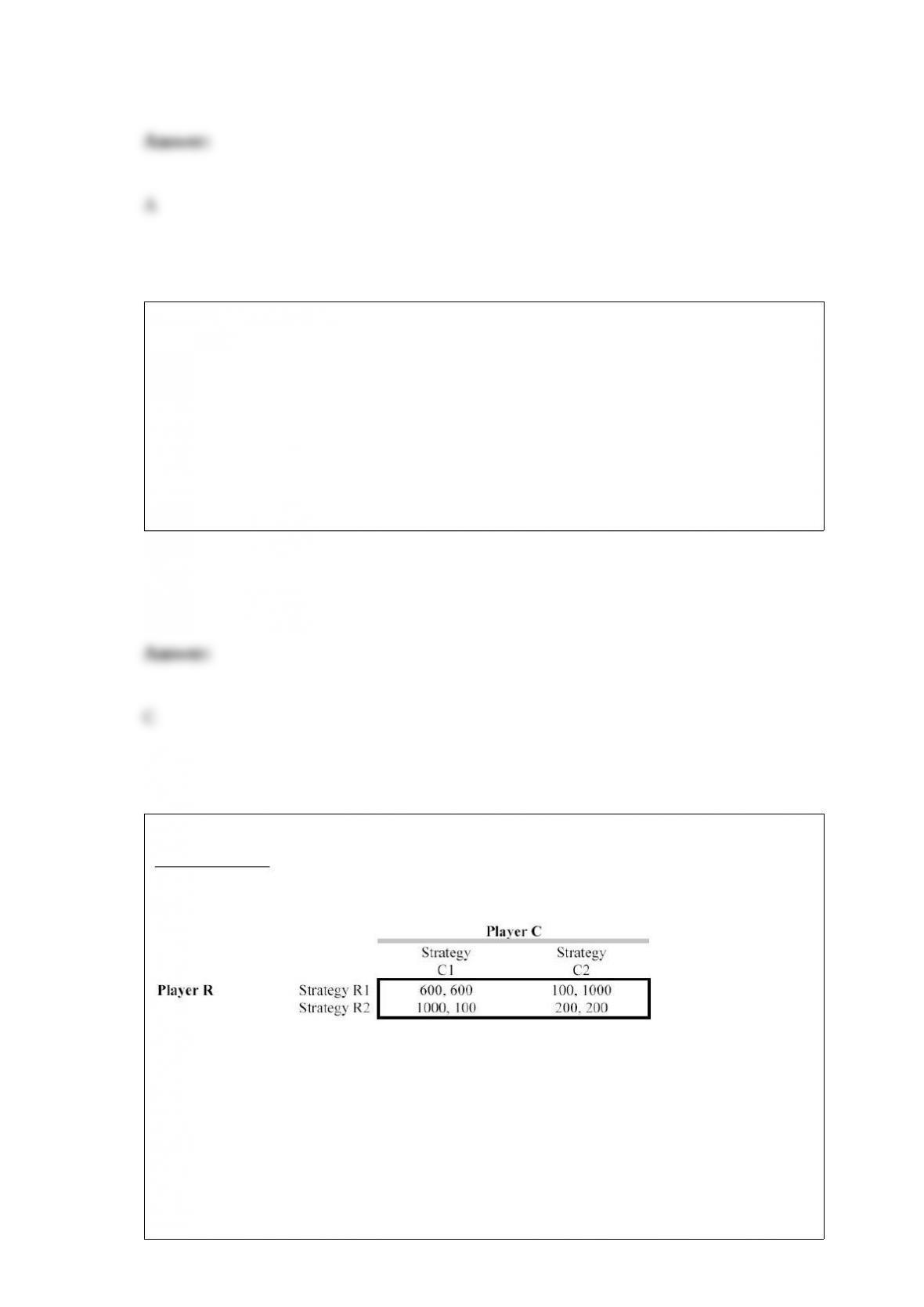
Scenario 13.11
Consider the game below:
What is true about dominant strategies in the game in Scenario 13.11?
A) R1 and C1 are dominant strategies.
B) R1 and C2 are dominant strategies.
C) R2 and C1 are dominant strategies.

D) R2 and C2 are dominant strategies.
E) There are no dominant strategies.
Conigan Box Company produces cardboard boxes that are sold in bundles of 1000
boxes. The market is highly competitive, with boxes currently selling for $100 per
thousand. Conigan’s total and marginal cost curves are:
TC = 3,000,000 + 0.001Q2
MC = 0.002Q
where Q is measured in thousand box bundles per year.
a. Calculate Conigan’s profit maximizing quantity. Is the firm earning a profit?
b. Analyze Conigan’s position in terms of the shutdown condition. Should Conigan
operate or shut down in the shortrun?
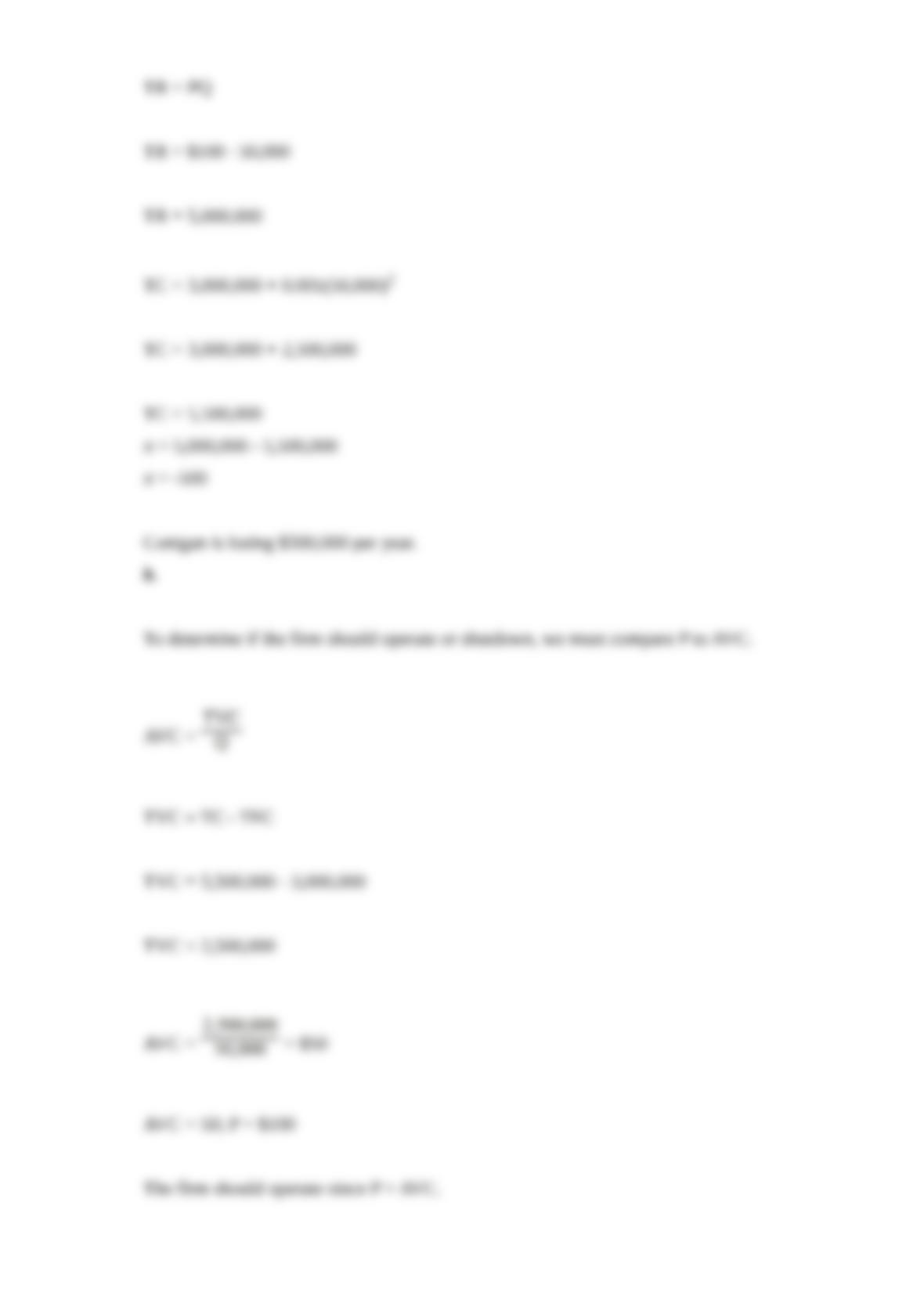

Price ceilings can result in a net loss in consumer surplus when the ________ curve is
________.
A) demand; very elastic
B) demand; very inelastic
C) supply; very inelastic
D) none of the above; price ceilings always increase consumer surplus
In an unregulated, competitive market consumer surplus exists because some
A) sellers are willing to take a lower price than the equilibrium price.
B) consumers are willing to pay more than the equilibrium price.
C) sellers will only sell at prices above equilibrium price (or actual price).
D) consumers are willing to make purchases only if the price is below the actual price.
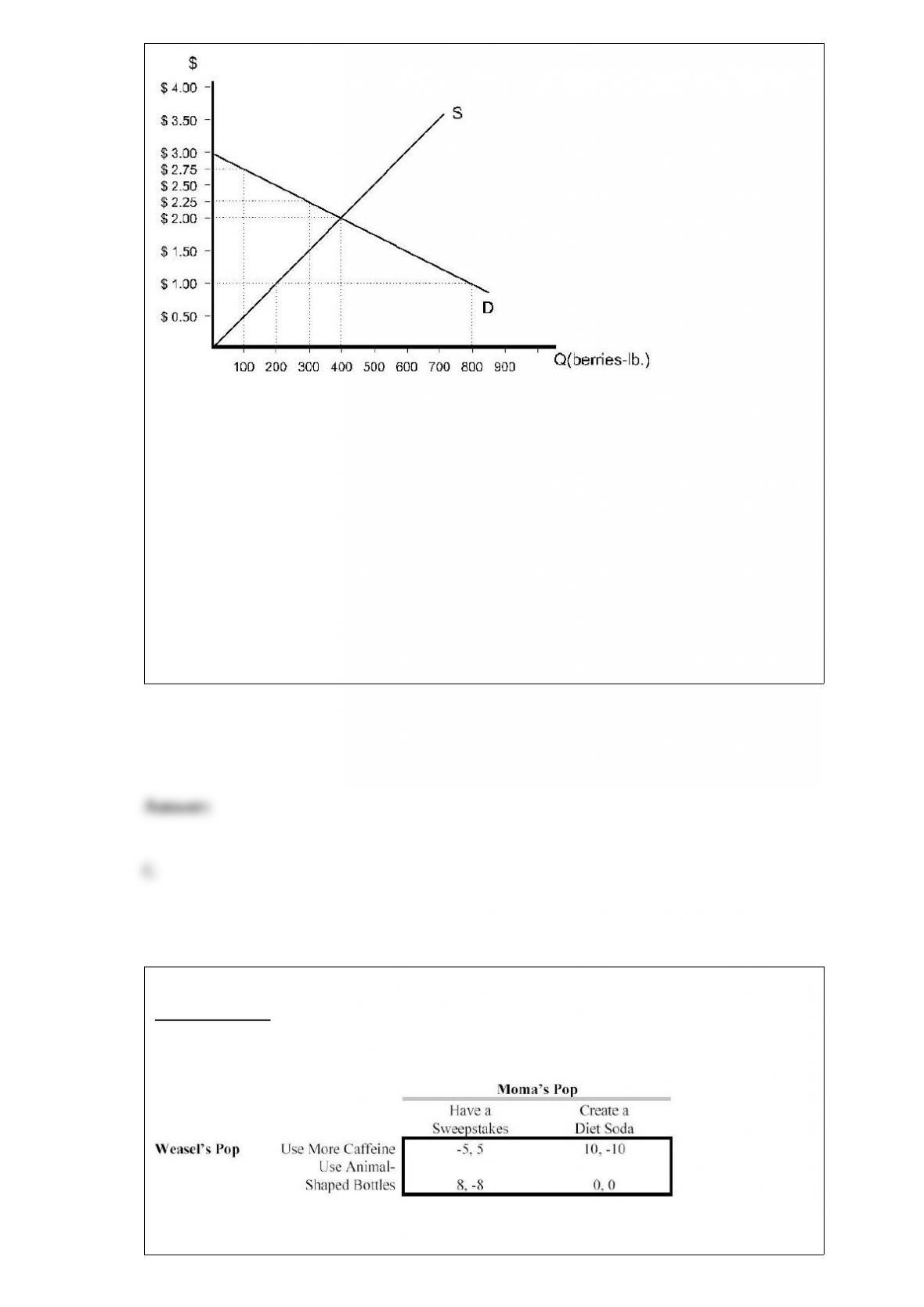
Figure 9.3
Refer to Figure 9.3. If the market is in equilibrium, total consumer surplus is
A) $1.
B) $3.
C) $200.
D) $400.
E) $600.
Scenario 13.10
Consider the game below:
The game in Scenario 13.10 is

A) variable-sum.
B) constant-sum.
C) cooperative.
D) a Prisoners’ Dilemma.
E) a Cournot Production Cross.