1) Horizontal mergers may be anticompetitive because nonmerged firms are foreclosed
from selling their products to the buying firm.
2) The basic function of profits and losses is to allocate society’s scarce resources to
their highest valued uses.
3) An improvement in the technology of pollution control is likely to increase society’s
optimal amount of pollution abatement.
4) Approximately $450 billion of U.S. currency is circulating in foreign countries.
5)
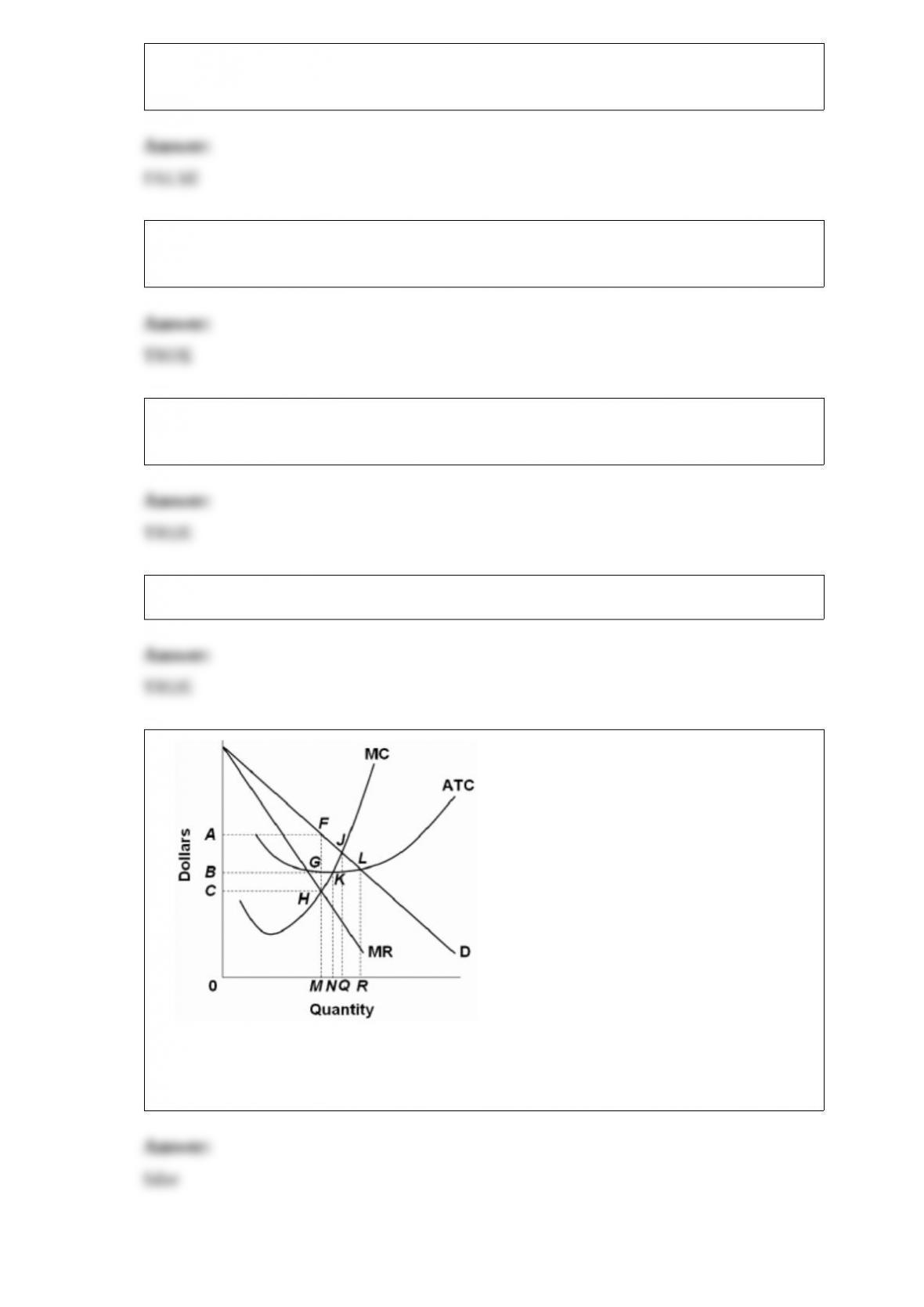
refer to the above diagram for a nondiscriminating monopolist. if the government
regulates the monopolist so that it charges the “fair return” price, the monopolist will
produce output n

6) consumers buy more of normal goods as their incomes rise.
7) A manufacturer using both capital and labor decides to use more labor and less
capital because of an increase in the price of capital. This is likely the result of:
A.capital and labor being complementary inputs.
B.capital and labor being substitute inputs.
C.the output effect being greater than the substitution effect.
D.diminishing returns being applicable to capital but not to labor.
8) Which of the following is a true statement?
A.There is a long-run tradeoff between inflation and unemployment.
B.There is no tradeoff between inflation and unemployment in the long run.
C.The short-run Phillips Curve is horizontal.
D.The long-run Phillips Curve is horizontal.
9) The Bretton Woods system of exchange rates relied on:
A.freely floating exchange rates.
B.fixed exchange rates with no mechanism for changing them.
C.fixed or pegged exchange rates, with occasional orderly adjustments to the rates.
D.the United States to set and periodically review worldwide exchange rates.
10) An economy’s aggregate demand curve shifts leftward or rightward by more than
changes in initial spending because of the:
A.net export effect.
B.wealth effect.
C.real-balances effect.
D.multiplier effect.
11) Increases in the Federal minimum wage during the 1990s:
A.reduced the demand for workers who were earning more than the minimum wage.
B.demonstrated that the demand for teenage labor is highly elastic.
C.produced smaller decreases in teenage employment than did previous minimum wage
hikes.
D.helped reduce poverty substantially in the United States.
12) Which of the following is considered a legitimate concern of a large public debt?
A.Bankruptcy of the Federal government
B.Crowding-out of private investment
C.Burdening future generations
D.Collapse of the financial system
13) (Consider This) Credits cards are:
A.the fastest growing component of the M1 money supply.
B.near-monies that are part of the M2 money supply but not the M1 money supply.
C.not money, officially defined.
D. also known as time deposits.
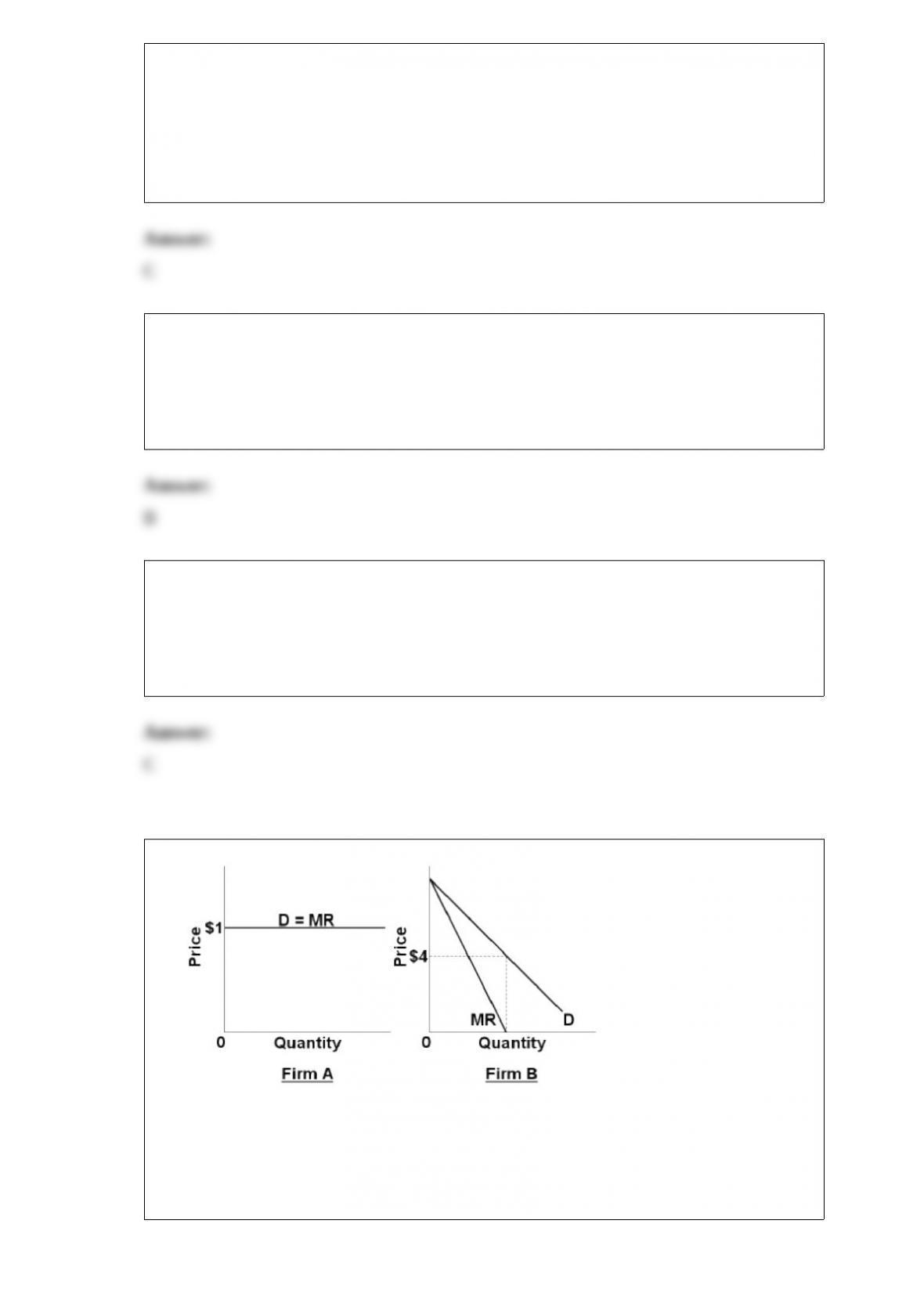
14)
refer to the above diagrams. the demand for firm a’s product is:
a.perfectly elastic over all ranges of output.
b.perfectly inelastic over all ranges of output.
c.elastic for prices above $1 and inelastic for prices below $1.
d.inelastic for prices above $1 and inelastic for prices below $1.
15) If the price level increases in the United States relative to foreign countries, then
American consumers will purchase more foreign goods and fewer U.S. goods. This
statement describes:
A.the output effect.
B.the foreign purchases effect.
C.the real-balances effect.
D.the shift-of-spending effect.
16) If the Fed wants to lower the Federal funds rate, it should:
A.increase the discount rate.
B.increase the reserve ratio.
C.buy government securities in the open market.
D.sell government securities in the open market.
17) Differentiate between expansionary and restrictive monetary policies.
18) What are three policy options for dealing with pure monopolies that are entrenched
and inefficient?
19) A firms labor input, total output of labor, and product price schedules are given
below. If labor is the only variable input, how much labor should the firm employ if the
wage rate is $8 per day?
20) Explain the problems giving rise to this statement: You would think the government
would want to do something to improve economic conditions when the economy is in
trouble, but the government is slow to act.
21) What happens to the money supply when a bank accepts deposits of currency from
the public and places it in checkable deposits (or checking accounts)?
22) When economists refer to labor, what type of workers are they referring to?
23) How does an economy adjust to demand shocks when prices are inflexible?
24) How are countries classified based on income?
25) What are two key facts that serve as the rationale for the multiplier effect?