
1) the main determinant of elasticity of supply is the:
a.number of close substitutes for the product available to consumers.
b.amount of time the producer has to adjust inputs in response to a price change.
c.urgency of consumer wants for the product.
d.number of uses for the product.
2) (last word) growth of real per capita income and china has largely resulted from:
a.increased use of technology and improved technology.
b.population decline.
c.reduced unemployment rates.
d.its trade deficit with the united states.
3) If a firm is hiring a certain type of labor under purely competitive conditions:
A.its labor demand curve will be perfectly elastic at the market-determined wage rate.
B.the labor supply curve will lie above the marginal labor cost curve.
C.the labor supply and marginal labor (resource) cost curves will coincide and be
upsloping.
D.the labor supply and marginal labor (resource) cost curves will coincide and be
perfectly elastic.
4) Which of the following statements is true regarding why the balance on the current
account and the balance on the capital and financial account must always sum to zero?
A.Any deficit or surplus in the current account automatically creates an offsetting entry
in the capital and financial account.
B.People can only trade one of two things with each other; currently produced goods
and services or preexisting assets.
C.If trading partners have an imbalance in their trade of currently produced goods and
services, the only way to correct that imbalance is with a net transfer of assets from one
party to the other.
D.All of these are true statements.
5) if actual gdp is $500 billion and there is a negative gdp gap of $10 billion, potential
gdp is:
a.$510 billion.
b.$490 billion.
c.$10 billion.
d.$990 billion.
6) assume a purely competitive, increasing-cost industry is in long-run equilibrium. if a
decline in demand occurs, firms will:
a.leave the industry, price will decrease, and quantity produced will increase.
b.enter the industry and price and quantity will both increase.
c.leave the industry and price and output will both increase.
d.leave the industry and price and output will both decline.
7) Assume the economy is operating at less than full employment. An expansionary
monetary policy will cause interest rates to ________, which will ___________
investment spending.
A.decrease; decrease
B.decrease; increase
C.increase; increase
D.increase; decrease
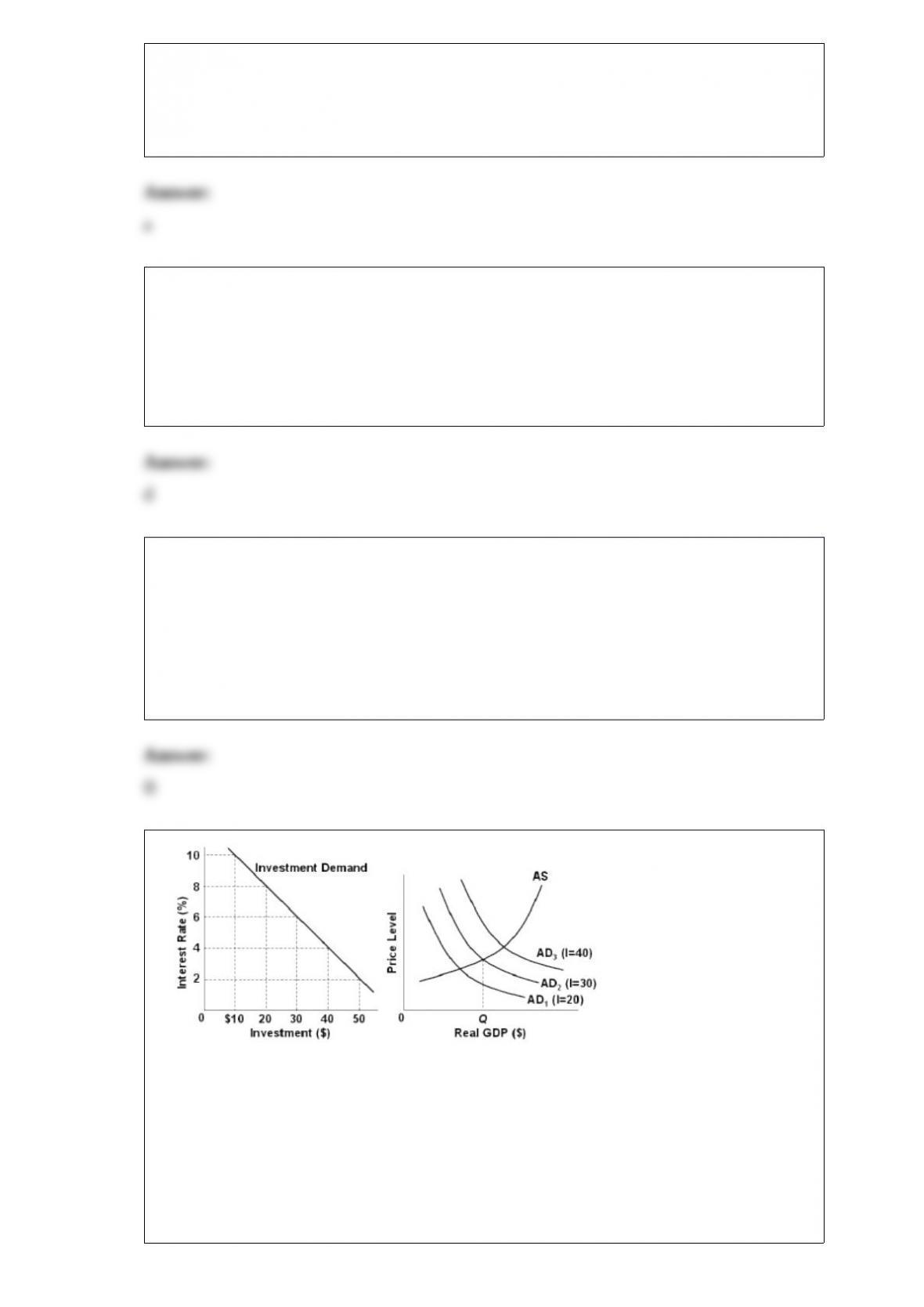
8)
Refer to the above diagrams. The numbers in parentheses after the AD1, AD2, and AD3
labels indicate the levels of investment spending associated with each curve,
respectively. All numbers are in billions of dollars. If the interest rate is 4 percent and
the Fed desires to reduce or eliminate demand-pull inflation, it should:
A.increase the interest rate from 4 percent to 6 percent.
B.decrease the interest rate from 4 to 2 percent.
C.increase investment spending by $20 billion.
D.maintain the interest rate at 4 percent.
9) an external cost or external benefit is also known as a(n):
a.marginal benefit.
b.principal-agent problem.
c.transfer payment.
d.spillover.
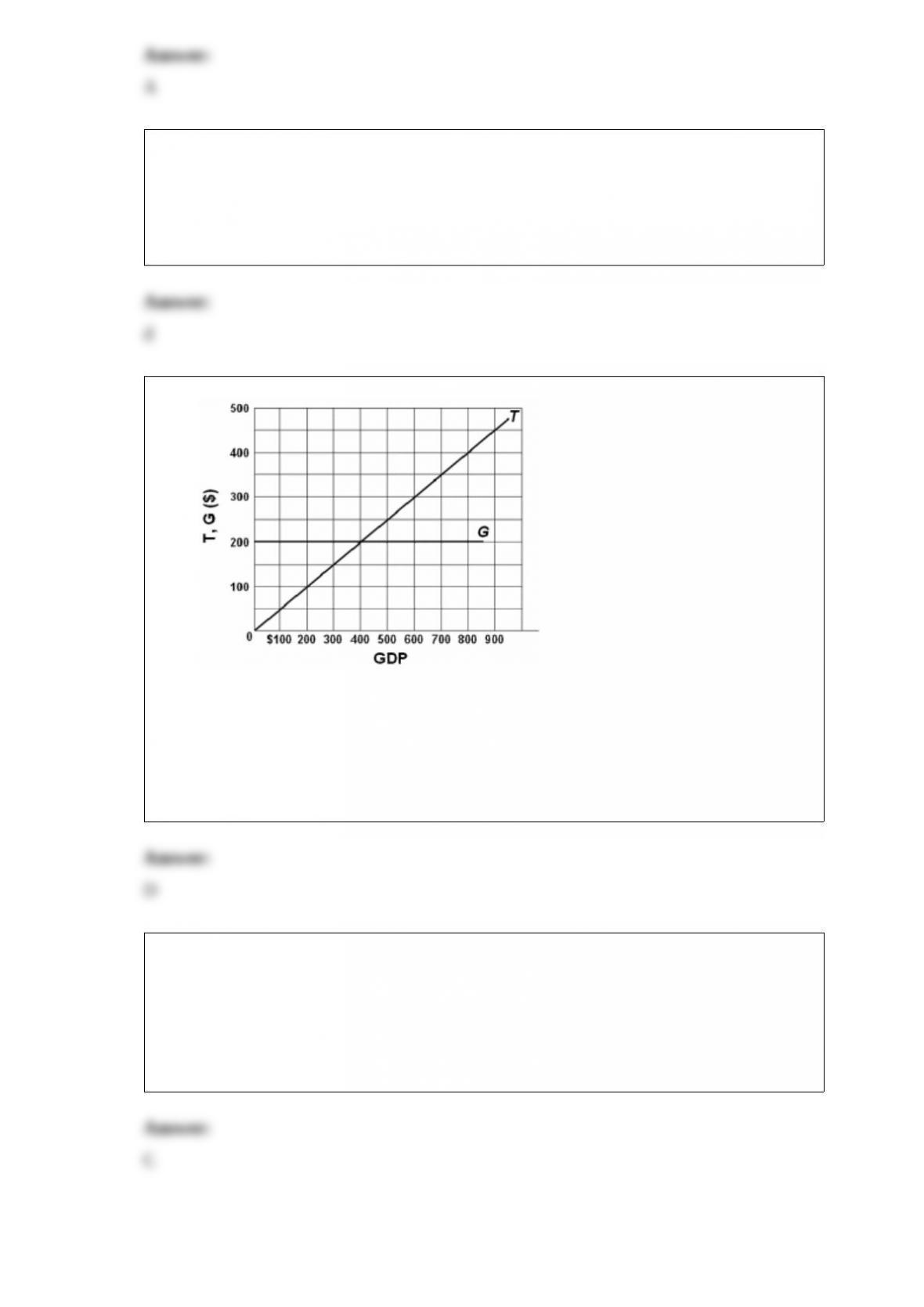
10)
Refer to the above diagram in which T is tax revenues and G is government
expenditures. All figures are in billions. The equilibrium level of GDP in this economy:
A.is $400.
B.is greater than $400.
C.is less than $400.
D.cannot be determined from the information given.
11) The view that the antitrust laws should be enforced relatively leniently because of
the tendency for monopoly power to erode over time is known as the:
A.structuralist view of antitrust.
B.behavioralist view of antitrust.
C.laissez-faire perspective on antitrust.
D.active antitrust perspective.
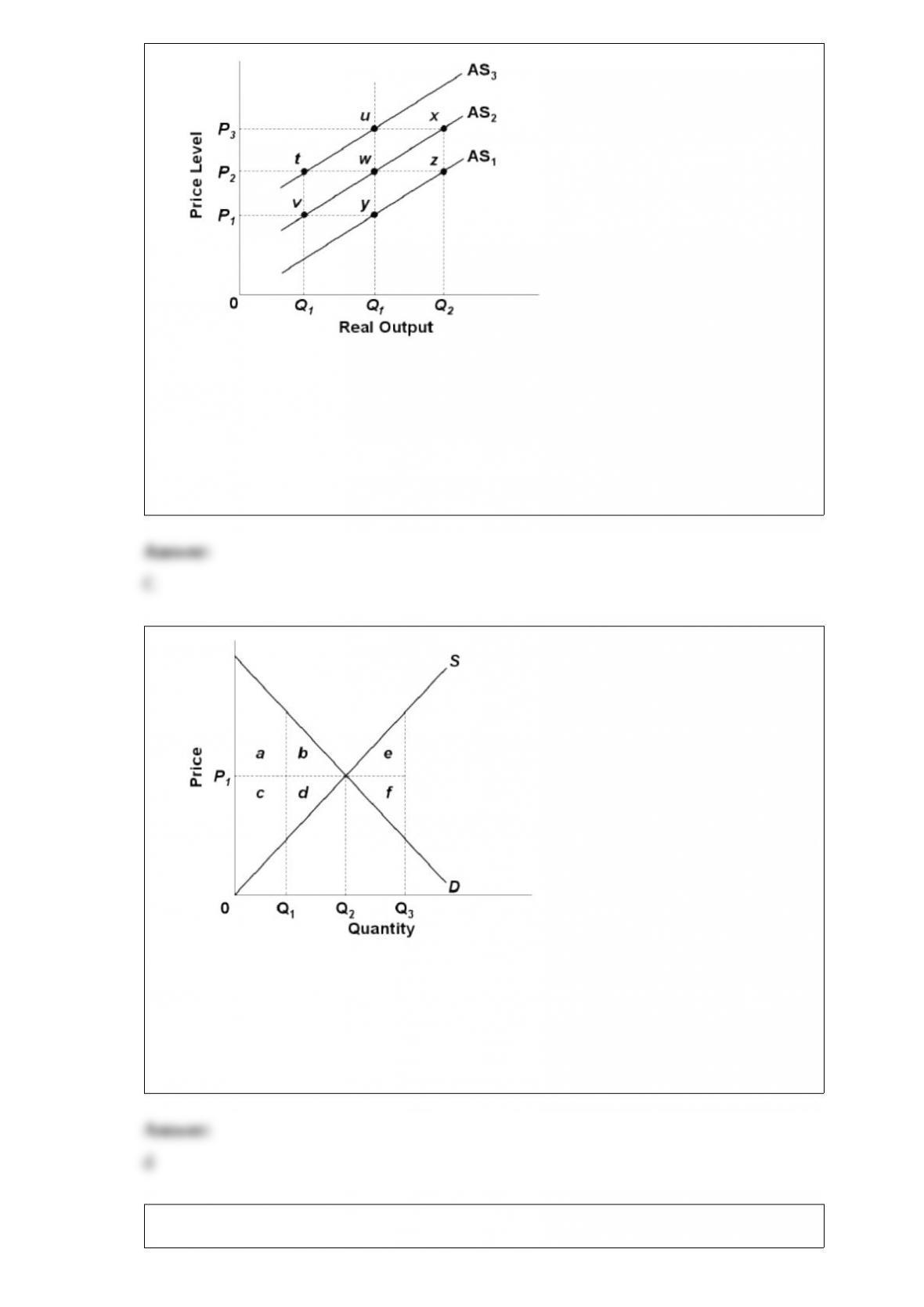
12)
Refer to the above diagram and assume the economy is operating at equilibrium point
w. In the long run, an increase in the price level from P2 to P3 would move the
economy from point w to point:
A.v
B.x
C.u
D.y
13)
refer to the above diagram. the area that identifies the maximum sum of consumer
surplus and producer surplus is:
a.a + b + c + d + e + f.
b.c + d + f.
c.a + b + e.
d.a + b + c + d.
14) The following table shows marginal costs and benefits of the optimal quantity of
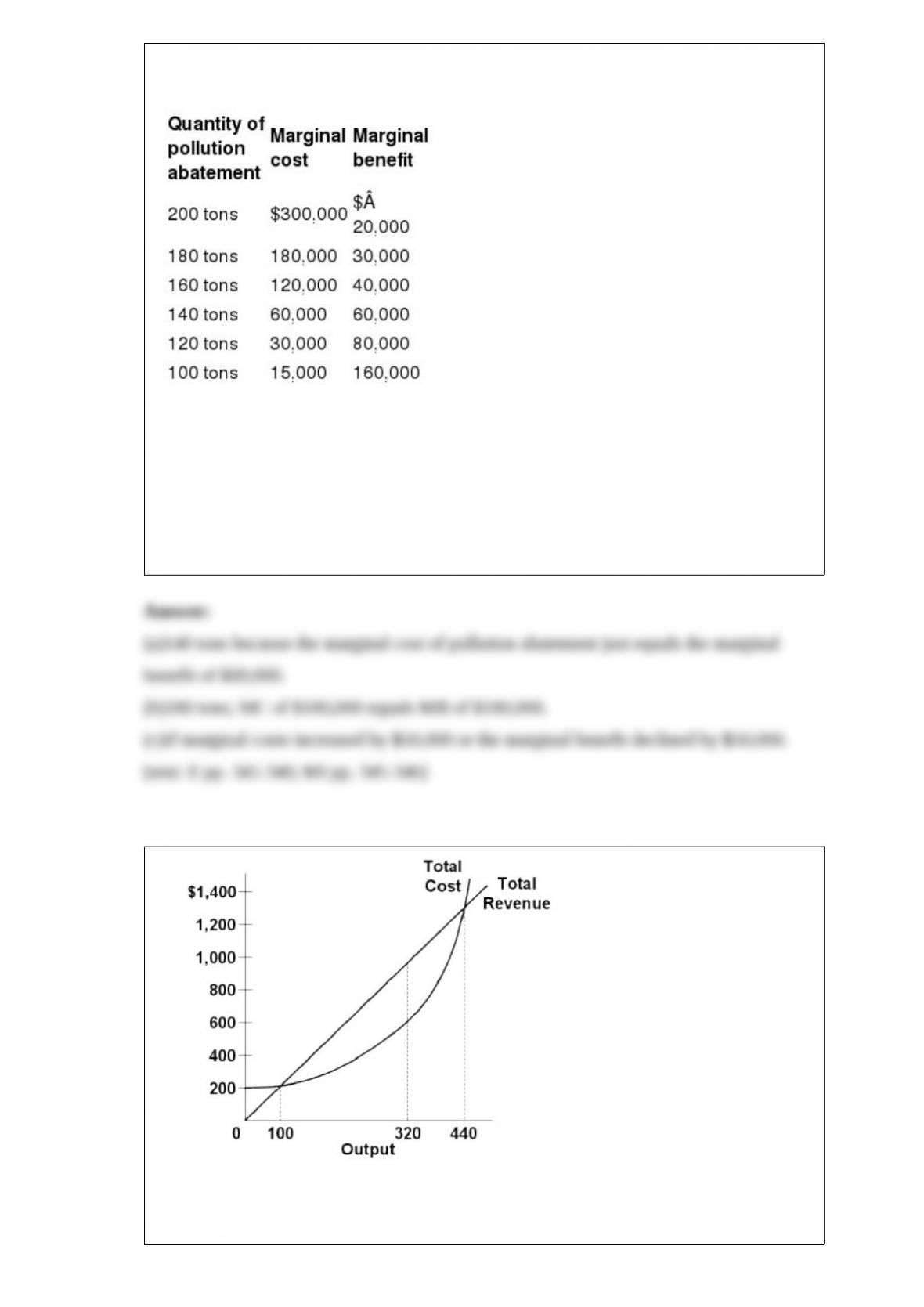
pollution abatement that will occur at a local factory.
(a) What is the optimal level of pollution abatement? Why?
(b)If the marginal benefit of pollution abatement were to increase by $150,000 at each
level because of the factorys desire to improve its image and environment, what would
the optimal level be? Why?(a)What is the optimal level of pollution abatement? Why?
(c)What might cause the optimal level of pollution abatement to be 120 tons?
15)
refer to the above short-run data. the profit-maximizing output for this firm is:
a.above 440 units.
b.440 units.

c.320 units.
d.100 units.
16) Wealth in the United States is:
A.distributed in a way that reduces the degree of income inequality.
B.more unequally distributed than is income.
C.less unequally distributed than is income.
D.distributed in a way that has no effect on income inequality.
17) If the demand for a product is perfectly inelastic and the supply curve is upsloping,
a $1 excise tax per unit of output will:
A.raise price by less than $1.
B.raise price by more than $1.
C.raise price by $1.
D.lower price by $1.
18) the phase of the business cycle in which real gdp declines is called:
a.the peak.
b.an expansion.
c.a recession.
d.the trough.
19) If government increases the size of its standardized surplus, we can:
A.assume that government is causing interest rates to rise.
B.not determine government’s impact on the economy without also knowing the status
of the actual budget.
C.assume that government is having a contractionary effect on the economy.
D.assume that government is having an expansionary effect on the economy.

20) a rightward shift in the demand curve for product c might be caused by:
a.an increase in income if c is an inferior good.
b.a decrease in income if c is a normal good.
c.a decrease in the price of a product that is a close substitute for c.
d.a decrease in the price of a product that is complementary to c.