The marginal product of labor is defined by the:
a. change in output divided by the change in labor input usage.
b. change in labor input usage divided by the change in output.
c. output divided by the labor input usage.
d. labor input usage divided by the output level.
e. output divided by the marginal product of labor.
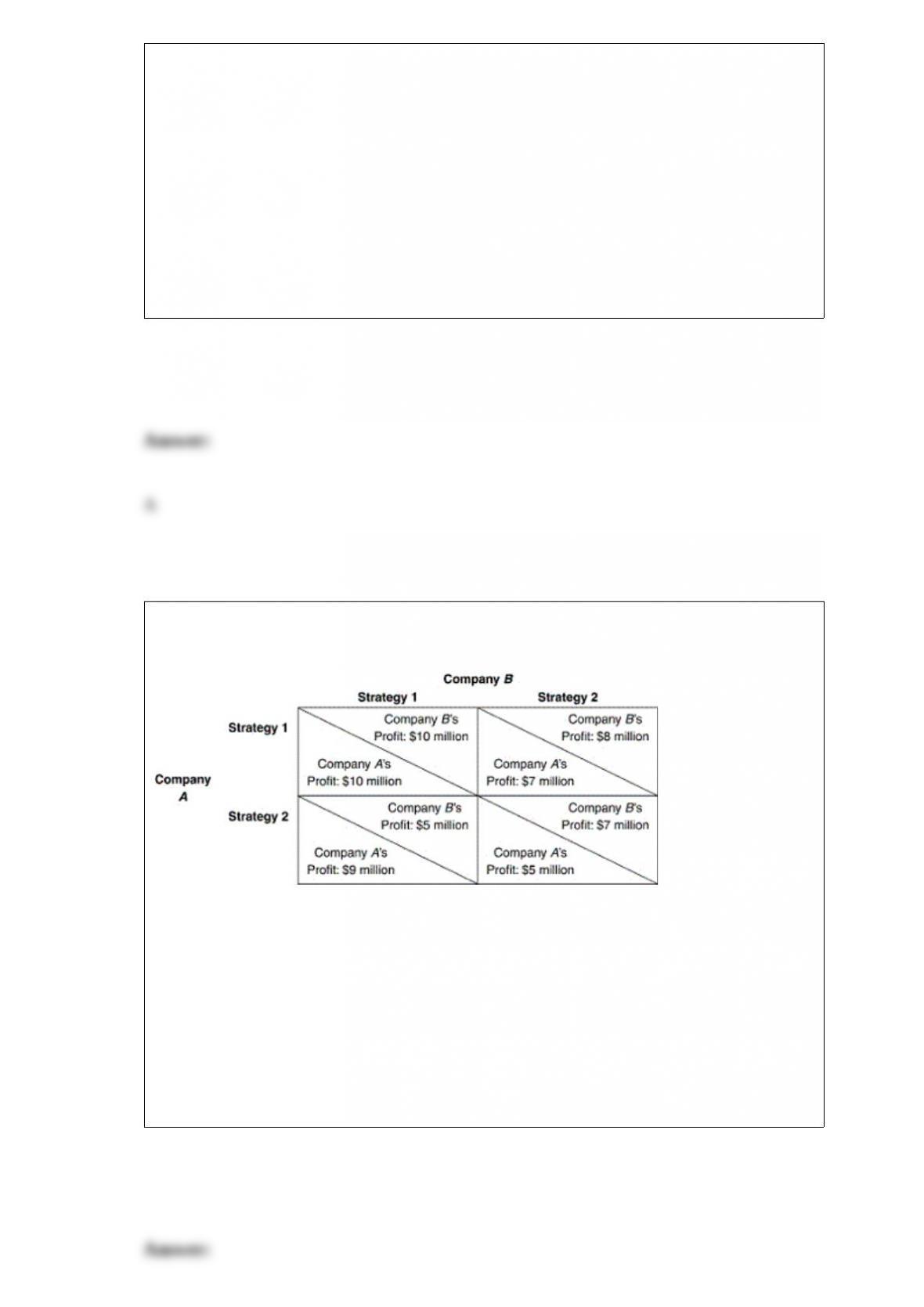
Refer to the accompanying payoff matrix. Which of the following is a Nash
equilibrium?
a. Company A chooses Strategy 1 and Company B chooses Strategy 1.
b. Company A chooses Strategy 1 and Company B chooses Strategy 2.
c. Company A chooses Strategy 2 and Company B chooses Strategy 2.
d. Company A chooses Strategy 2 and Company B chooses Strategy 1.
e. None of the above.

In the article “Colombia, Brazil Advance Proposal to Withhold 10 Percent of Export
Output” (The Wall Street Journal, September 23, 1991, p. B6), a Colombian delegate to
the International Coffee Organization said that if all its members withheld 10% of
export output, the international price would rise 20%. This statement implies that the
price elasticity of demand for coffee is approximately:
a. “0.00.
b. “5.00.
c. “2.00.
d. “0.20.
e. “0.50.
If rice can be produced using water and seed according to Q = WS, where water, W,
costs $3 and seed, S, costs $3, what is the cost-minimizing combination of water and
seed capable of producing 144 units of rice?
a. W = 64, S = 0.
b. W = 0, S = 64.
c. W = 1, S = 64.
d. W = 8, S = 8.
e. W = 12, S = 12.

If the perfectly competitive market demand for tanning beds shifts from QD,91 = 1,230 “
5P to QD,92 = 740 ” 5P and the market supply is given by QS = “100 + 2P, then the
change in equilibrium quantity will be:
a. 140 units.
b. 280 units.
c. “98 units.
d. “140 units.
e. “150 units.
Duopolists who compete on the basis of price will:
a. end up with price equal to marginal cost.
b. charge a price greater than marginal cost.
c. charge a price less than marginal cost.
d. price discriminate.
e. charge a price equal to marginal revenue.

Economic profits may result from:
a. innovation.
b. risk taking.
c. exploiting market inefficiencies.
d. all of the above.
e. a and b
In the model of oligopoly, there:
a. are many firms producing differentiated products.
b. is one firm producing undifferentiated products.
c. are a few firms producing differentiated or undifferentiated products.
d. are many firms producing undifferentiated products.
e. is one firm producing a highly differentiated product.

The constant rule of differentiation is:
a. Y = a + bX dY/dX = a + b.
b. Y = a + bX dY/dX = a.
c. Y = a + bX dY/dX = b.
d. Y = a + bX dY/dX = ab.
e. Y = a + bX dY/dX = ab.
The per-week demand for use of the Golden Gate Bridge in San Francisco is P = 12 ”
0.15Q during peak traffic periods and P = 9 ” 0.1Q during off-peak hours, where Q is
the number of cars crossing the bridge in thousands and P is the toll in dollars. If the
marginal congestion cost of using the bridge is MC = 5 + 0.2Q, what is the optimal peak
load toll for crossing the bridge?
a. 6.5.
b. 8.0.
c. 8.7.
d. 9.9.
e. 10.6.

What is the relationship between economic and accounting profit?
a. Economic profit is equal to accounting profit.
b. Economic profit is greater than accounting profit.
c. Economic profit is less than accounting profit.
d. Economic profit may be equal to or less than accounting profit.
e. Economic profit may be equal to or greater than accounting profit.
If the elasticity of per capita demand with respect to population is zero, then a 10%
increase in the population will cause the quantity demanded to:
a. increase by 25%.
b. decrease by 10%.
c. remain constant.
d. increase by 10%.
e. decrease by 25%.
The marginal rate of technical substitution is defined by:
a. MRTS1,2 = MP1 /MP2.
b. MRTS1,2 = MP1MP2.
c. MRTS1,2 = MP1/P1.
d. MRTS1,2 = P1/P2.
e. MRTS1,2 = MP2/P2.
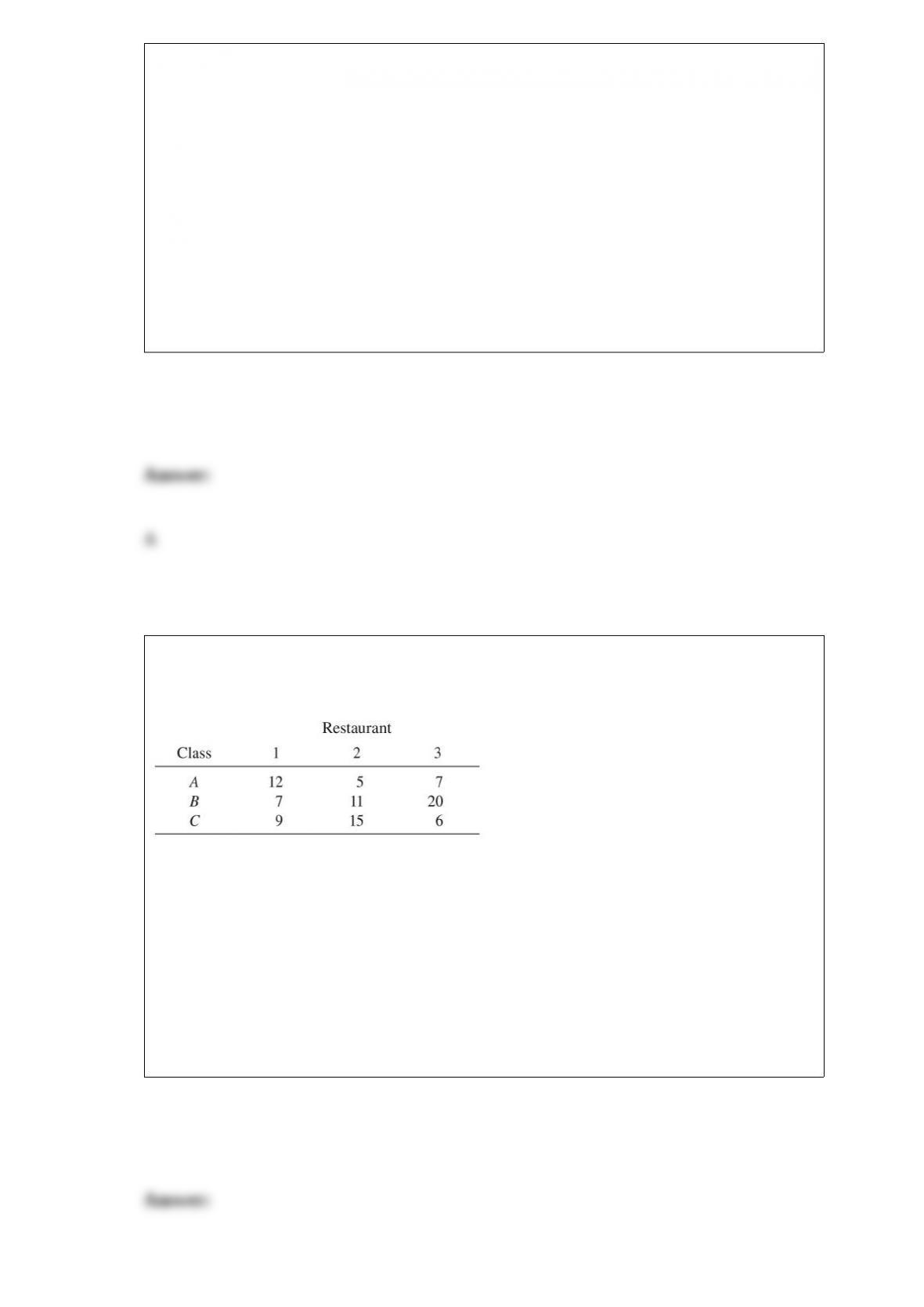
The reservation prices, in dollars, for three classes of demanders (A, B, and C) for three
restaurants (1, 2, and 3) are given in the following table. What is the maximum revenue
that can be generated by setting a separate price for each of the three restaurants?
a. $46.
b. $52.
c. $63.
d. $72.
e. $84.

An increase in a consumer’s income:
a. shifts the consumer’s indifference curves out.
b. causes the consumer to buy more of every good.
c. shifts the consumer’s budget constraint out.
d. causes the consumer to increase purchases of inferior goods.
e. causes the consumer to buy more inferior goods.
Brandy’s Restaurant estimates that its total cost of providing Q meals per month is
given by TC = 6,000 + 2Q. If Brandy charges $4 per meal, what is its break-even level
of output?
a. 1,000 meals.
b. 1,500 meals.
c. 2,000 meals.
d. 2,500 meals.
e. 3,000 meals.

The first federal antitrust law was the:
a. Sherman Act.
b. Clayton Act.
c. Federal Trade Commission Act.
d. Robinson-Patman Act.
e. Celler-Kefauver Act.
ConAgra has introduced a lean mixture of cereal and ground beef that is
indistinguishable from ground beef but has about the same amount of fat as chicken. As
a result, the:
a. demand for chicken increases.
b. demand for ground beef decreases.
c. demand for chicken decreases.
d. demand for cereal decreases.
e. supply of chicken increases.

The range of values the standard deviation(s) can take is:
a. ” ¥ < s < ¥ .
b. 0 < s < ¥ .
c. 0 < s < 1.
d. 0 < s < 100.
e. 0 < s < 1,000.
When using the Lagrangian technique for solving a constrained cost-minimization
problem, the Lagrangian multiplier l is:
a. the optimal level of cost.
b. the minimized marginal cost.
c. the minimized total cost.
d. the maximized profit.
e. equal to zero.
Glyde Air Fresheners is the dominant firm in the solid room aromatizer industry, which
has a total market demand given by Q = 80 ” 2P. Glyde has competition from a fringe

of four small firms that produce where their individual marginal costs equal the market
price. The fringe firms each have total costs given by TCi = 10Qi + 2Q2
i. If Glyde’s total
costs are given by TCG = 100 + 6QG, what are the total profits of the fringe firms?
a. $32.
b. $64.
c. $96.
d. $128.
e. $160.
Along a linear demand curve, total revenue is maximized:
a. where the slope of a line from the origin to the demand curve is equal to the elasticity.
b. where the elasticity is “1.
c. near the quantity axis intercept.
d. near the price axis intercept.
e. where the elasticity is 0.
The consumer’s optimal consumption of X and Y occurs where the consumer:
a. reaches the highest indifference curve that intersects the budget constraint.
b. reaches the highest budget constraint that is tangent to the indifference curve.
c. reaches the lowest indifference curve that intersects the budget constraint at any
point.
d. reaches the highest indifference curve that is just tangent to the budget constraint.
e. is satiated with X and Y.
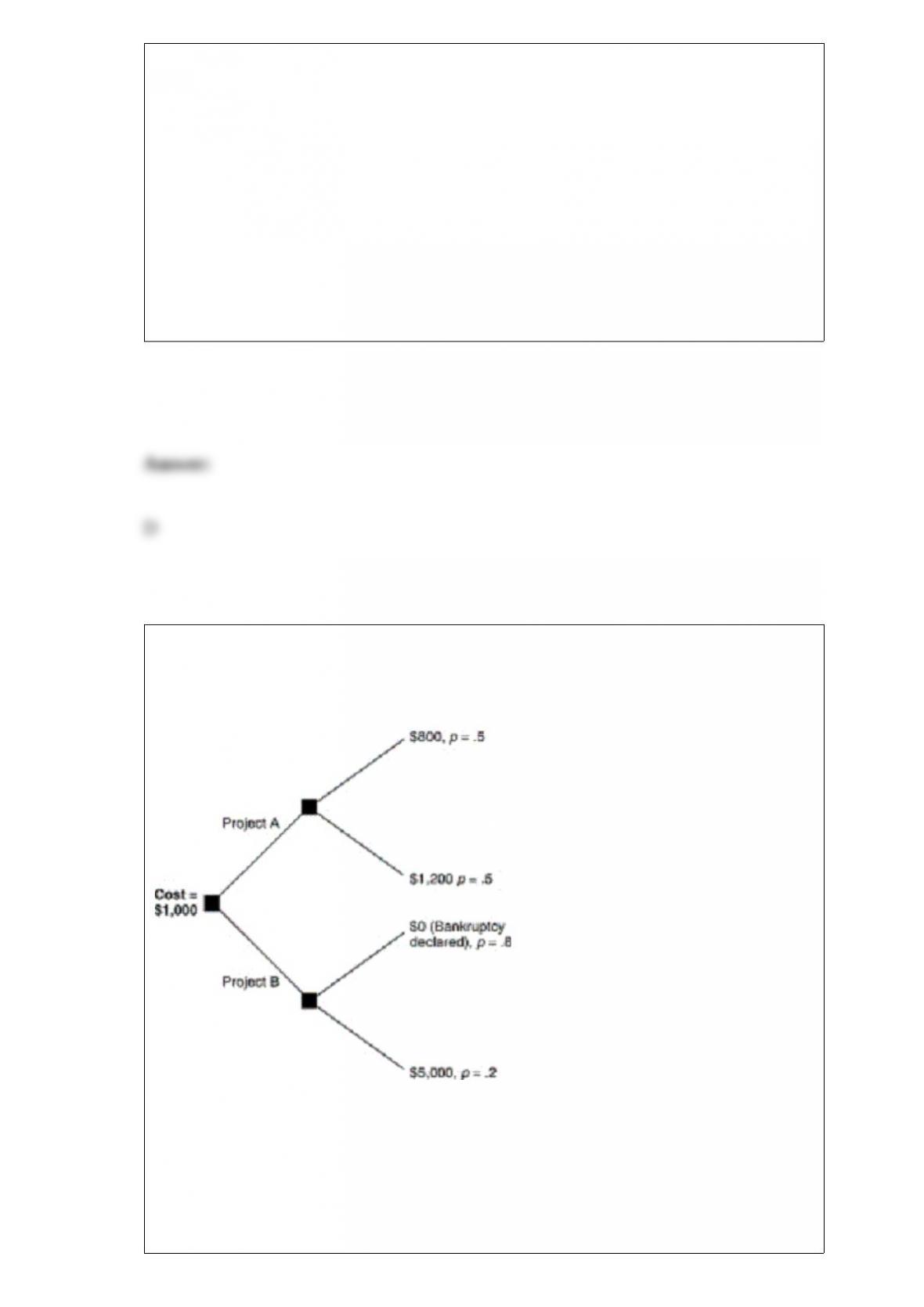
Consider this decision tree, which represents the outcomes of two alternative projects
that Ink Inc., a producer of printers, might pursue. Ink Inc., needs to borrow $1,000 to
pursue either project and is going to sell bonds to finance the venture.
Ink, Inc., is carrying a large amount of debt because of overexpansion during the
dot-com explosion. Under these circumstances, the shareholders would tend to choose:
a. project A, because it has the highest expected value.
b. project B, because it has the greatest degree of risk.

c. project A, because it has the lowest degree of risk.
d. neither project A nor B, because both are risky.
e. either project A or B; both have the same degree of risk.
If xi is defined as xi = pi ” E(pi), and pi is the probability of occurrence of any xi, the
formula for the square of the standard deviation can be written as:
a. S xipi.
b. S xip2
i.
c. S x2
ip2
i.
d. S x2
ipi.
e. S (xipi)2.
Good drivers have a 20% chance, and bad drivers have a 50% chance, of getting into an
accident. A car is worth $900, and an accident would reduce its value to $400. Both
types of drivers have utility U = (car value)0.5. What is a good driver’s expected utility
without insurance?

a. 20
b. 25
c. 28
d. 30
e. None of the above.
A risk-loving person has a utility function that, with income on the horizontal axis and
utility on the vertical axis, as income increases:
a. is horizontal.
b. is vertical.
c. has constant, positive slope.
d. is curved down.
e. is curved up.
A chance fork with payoffs given for each branch is assigned a value based on:
a. the highest-payoff branch.

b. the lowest-payoff branch.
c. an average of the highest- and lowest-payoff branches.
d. an evenly weighted average of all payoff branches.
e. a probability weighted average of all payoff branches.
If Gulfstream and Bombardier, both producers of upscale jet airplanes, were to collude
rather than compete, consumers could expect:
a. higher prices and lower quantities offered for sale.
b. lower prices and lower quantities offered for sale.
c. higher prices and higher quantities offered for sale.
d. each firm to cheat on the cartel agreement.
e. one firm to emerge as the price leader in the oligopoly.
Nature gives company A one of three endowments; then company A picks one of two
options. Depending on A‘s choice, company B picks one of three options with each one
having two possible payoffs, decided by nature. How many chance forks does the
decision tree depicting this have?

a. 4
b. 9
c. 1
d. 28
e. 36
The market demand schedule shows the quantities that would be purchased, holding all
other factors constant, from a group of firms during a given time period:
a. at varying prices.
b. at varying advertising levels.
c. at varying competitors’ prices and advertising levels.
d. at varying prices and advertising levels.
e. over different time intervals.