
1) In deciding whether a good is a public good, one must determine the
a.incomes of those who benefit from the good.
b.value of the external benefits that accrue to resource owners.
c.excludability of the good.
d.All of the above are correct.
2) When a country allows trade and becomes an importer of a good,
a.consumer surplus and producer surplus both increase.
b.consumer surplus and producer surplus both decrease.
c.consumer surplus increases and producer surplus decreases.
d.consumer surplus decreases and producer surplus increases.
3) Scenario 8-1
Erin would be willing to pay as much as $100 per week to have her house cleaned.
Ernesto’s opportunity cost of cleaning Erin’s house is $70 per week.
If Ernesto cleans Erin’s house for $90, Ernesto’s producer surplus is
a.$80.
b.$30.
c.$20.
d.$10.
4) If income were equally distributed among households,
a.each household’s relative share of income would increase.
b.each household’s relative share of income would decrease.
c.the top fifth of households would have 50 percent of the income.
d.50 percent of the households would receive exactly 50 percent of the income.
5) Canada and the U.S. both produce wheat and computer software. Canada is said to
have the comparative advantage in producing wheat if
a.Canada requires fewer resources than the U.S. to produce a bushel of wheat.

b.the opportunity cost of producing a bushel of wheat is lower for Canada than it is for
the U.S.
c.the opportunity cost of producing a bushel of wheat is lower for the U.S. than it is for
Canada.
d.the U.S. has an absolute advantage over Canada in producing computer software.
6) In competitive markets, which of the following is not correct?
a.Firms produce identical products.
b.No individual buyer can influence the market price.
c.Some sellers can set prices.
d.Buyers are price takers.
7) Economists speaking like scientists make
a.positive statements.
b.prescriptive statements.
c.claims about how the world should be.
d.More than one of the above is correct.
8) Flu shots provide a positive externality. Suppose that the market for vaccinations is
perfectly competitive. Without government intervention in the vaccination market,
which of the following statements is correct?
a.At the current output level, the marginal social benefit exceeds the marginal private
benefit.
b.The current output level is inefficiently low.
c.A per-shot subsidy could turn an inefficient situation into an efficient one.
d.All of the above are correct.
9) Necessities tend to have inelastic demands, whereas luxuries tend to have elastic
demands.
a.True
b.False
10) Cole is refinishing an antique china cabinet and has already spent $180 on the
restoration. He expects to be able to sell the cabinet for $360. Cole discovers that he
needs to do an additional $200 worth of work to make the cabinet worth $360 to
potential buyers. He could also sell the cabinet now, without completing the additional
work, for $100. What should Cole do?
a.He should sell the cabinet now for $100.
b.He should keep the cabinet since it wouldn’t be rational to spend $380 restoring a
cabinet and then sell it for only $360.
c.He should complete the additional work and sell the cabinet for $360.
d.It does not matter which action he takes since the outcome will be the same either
way.
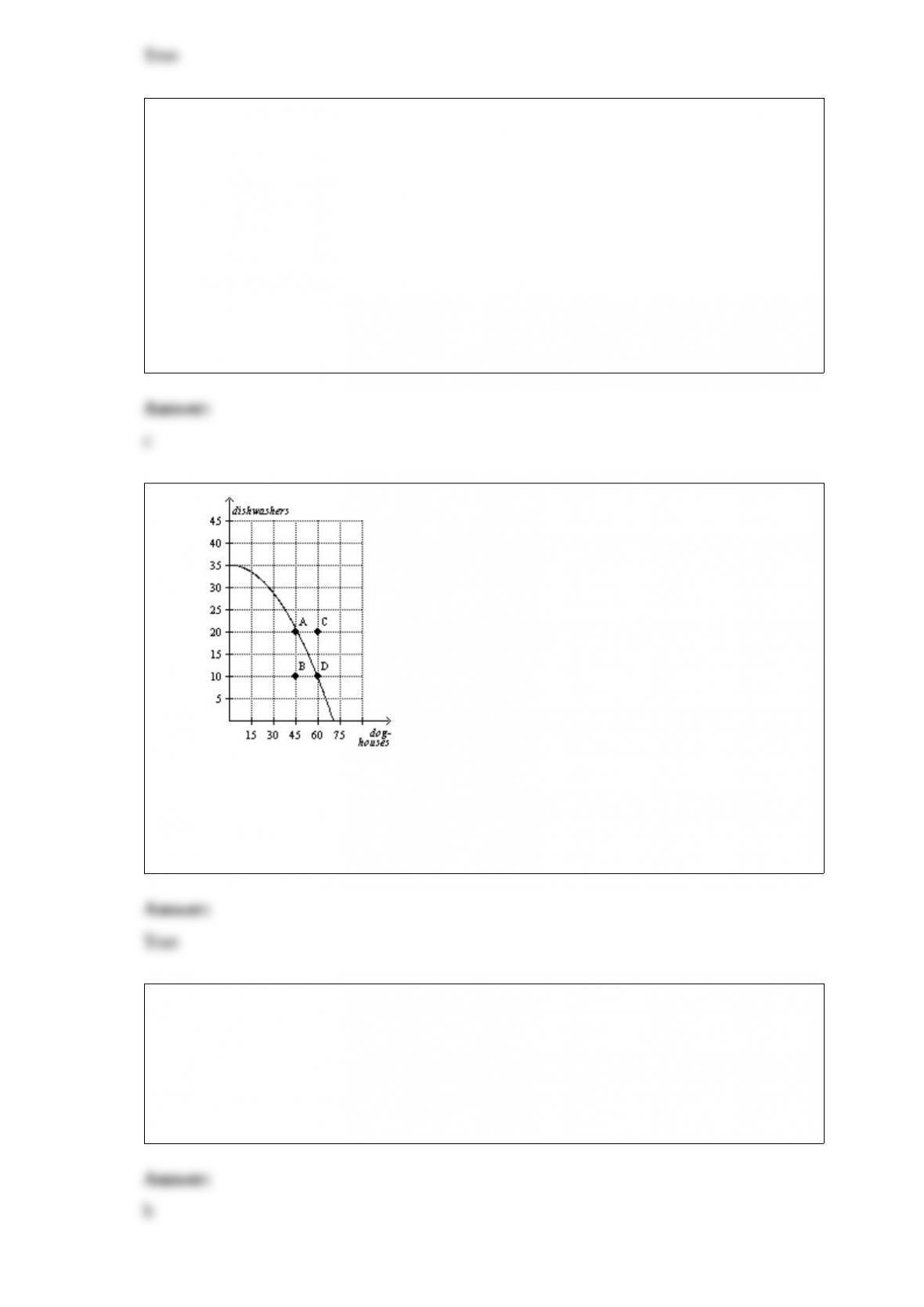
11) Given the technology available for manufacturing
doghouses and dishwashers, this economy does not have enough of the factors of
production to support the level of output represented by point C.
a.True
b.False
12) If the world price of apples is higher than Argentina’s domestic price of apples
without trade, then Argentina
a.should import apples.
b.has a comparative advantage in apples.
c.should produce just enough apples to meet its domestic demand.
d.should refrain altogether from producing apples.
13) Leonard, Sheldon, Raj, and Penny each like science fiction moves. The price of a
special boxed set of Star Trek DVDs is $50. Leonard values the set of movies at $70,
Sheldon at $65, Raj at $60, and Penny at $55. Suppose that if the government taxes
DVDs at $10 each, the price rises to $60. A consequence of the tax is that consumer
surplus shrinks by
a.$50 and tax revenues increase by $30, so there is a deadweight loss of $20.
b.$35 and tax revenues increase by $30, so there is a deadweight loss of $5.
c.$20 and tax revenues increase by $20, so there is no deadweight loss.
d.$15 and tax revenues increase by $20, so there is no deadweight loss.
14) In the long run, a profit-maximizing firm will choose to exit a market when
a.average fixed cost is falling.
b.variable costs exceed sunk costs.
c.marginal cost exceeds marginal revenue at the current level of production.
d.total revenue is less than total cost.
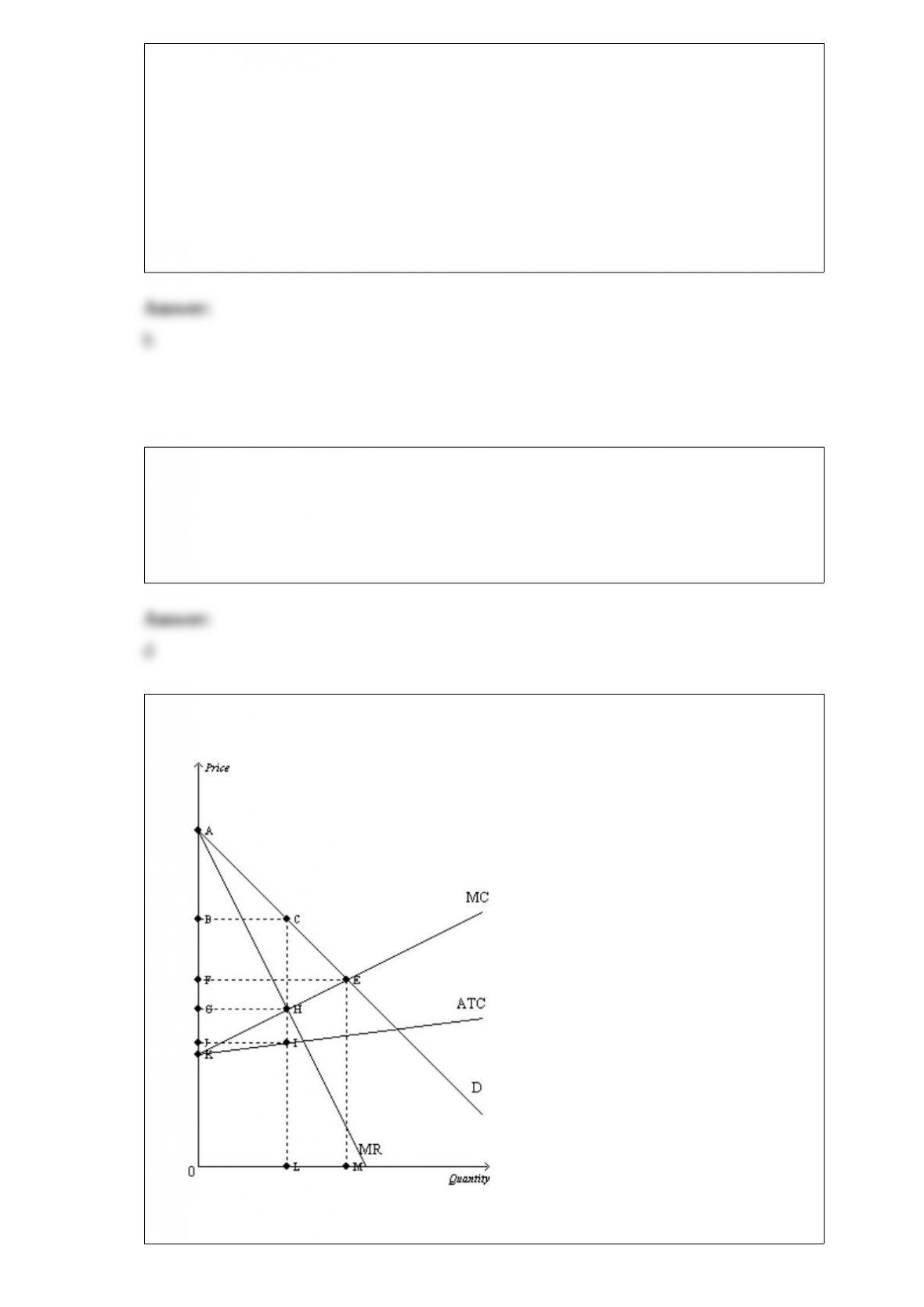
15) Figure 16-13
Use the letters to identify the deadweight loss associated with this firm’s profit-
maximizing production.
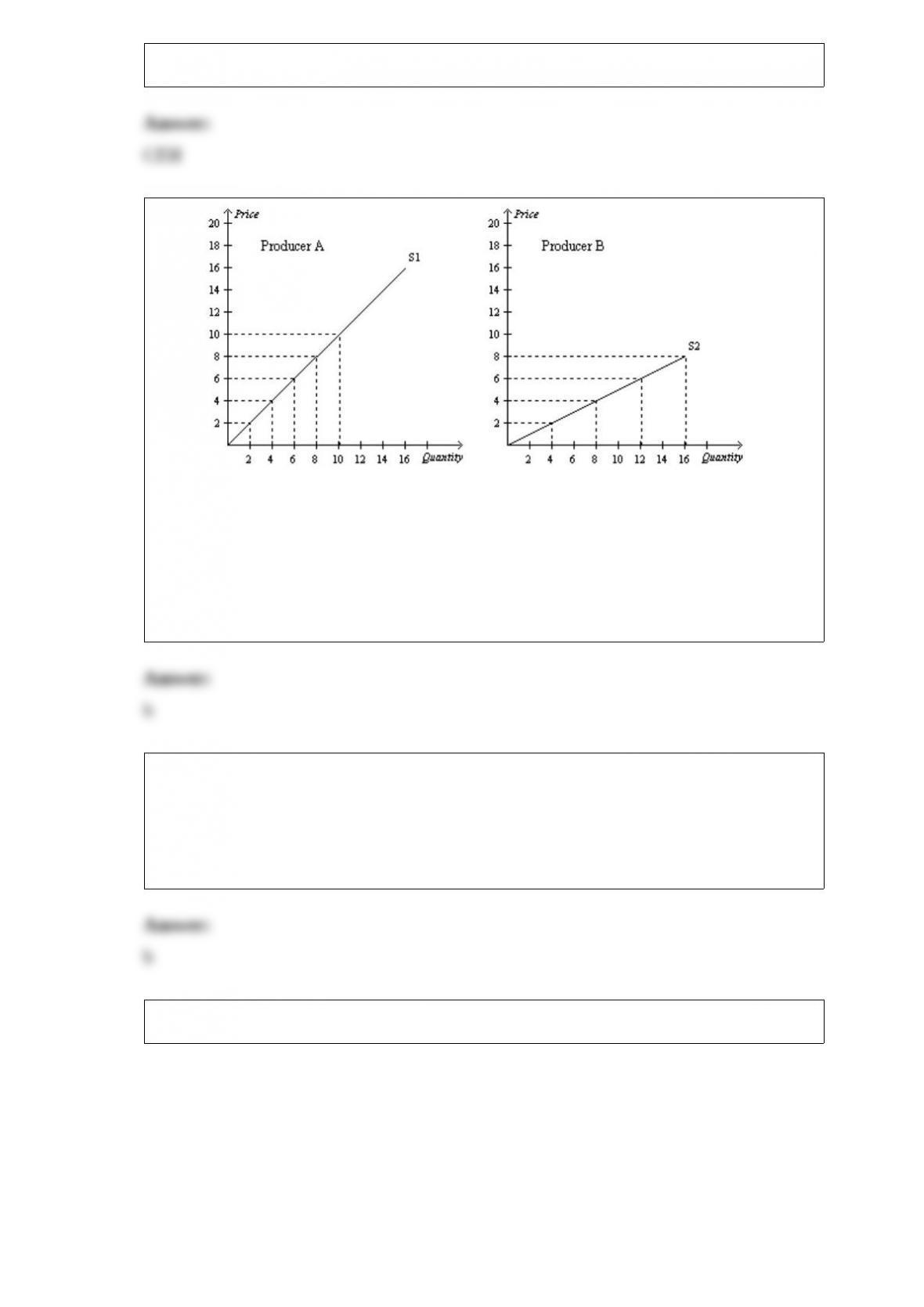
16)
If Producer A and Producer B are the only producers in the market, then the market
quantity supplied when the price is $2 is
a.4 units.
b.6 units.
c.8 units.
d.10 units.
17) What is the shape of the monopolist’s marginal revenue curve?
a.a downward-sloping line that is identical to the demand curve
b.a downward-sloping line that lies below the demand curve
c.a horizontal line that is identical to the demand curve
d.a horizontal line that lies below the demand curve
18) Figure 7-14
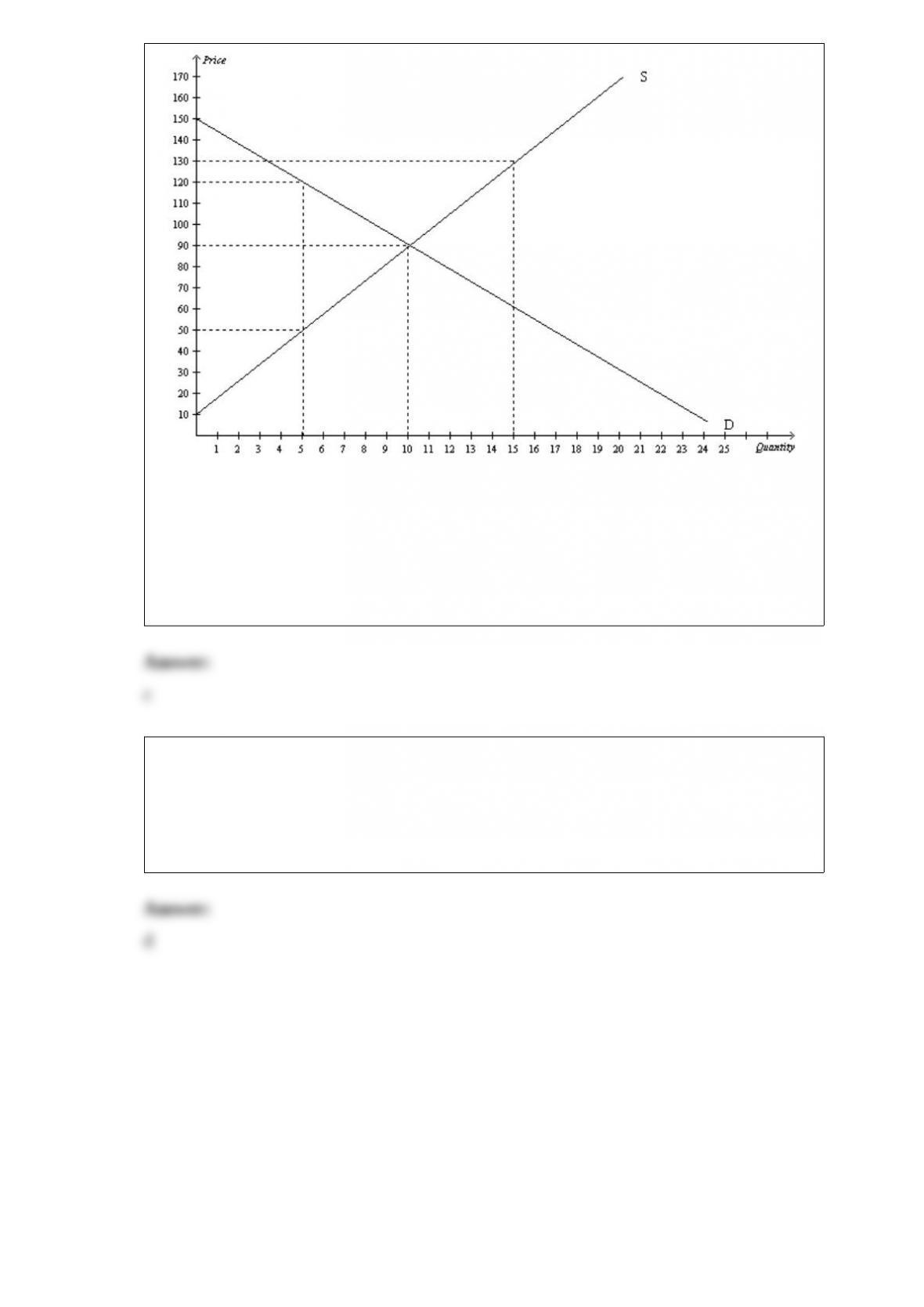
If the government imposes a price ceiling of $50 in this market, then producer surplus
will
a. $325.
b. $100.
c. $300.
d. $200.
19) In competitive markets,
a.firms produce identical products.
b.no individual buyer can influence the market price.
c.no individual seller can influence the market price.
d.All of the above are correct.