1) In saying that the present system of floating exchange rates is managed we mean
that:
A.countries that allow their exchange rate to move freely will lose their borrowing
privileges with the IMF.
B.the value of any IMF member’s currency can only vary 2 percent from its par value.
C.IMF officials determine exchange rates on a day-to-day basis.
D.the central banks of various countries sometimes buy and sell foreign exchange to
alter undesirable trends in exchange rates.
2) A tax reduction of a specific amount will be more expansionary, the:
A.smaller is the economy’s MPC.
B.larger is the economy’s MPC.
C.smaller is the economy’s multiplier.
D.less the economy’s built-in stability.
3) a pure monopolist is:
a.any firm realizing all existing economies of scale.
b.any firm whose demand curve is downsloping.
c.any firm which can engage in price discrimination.
d.a one-firm industry.
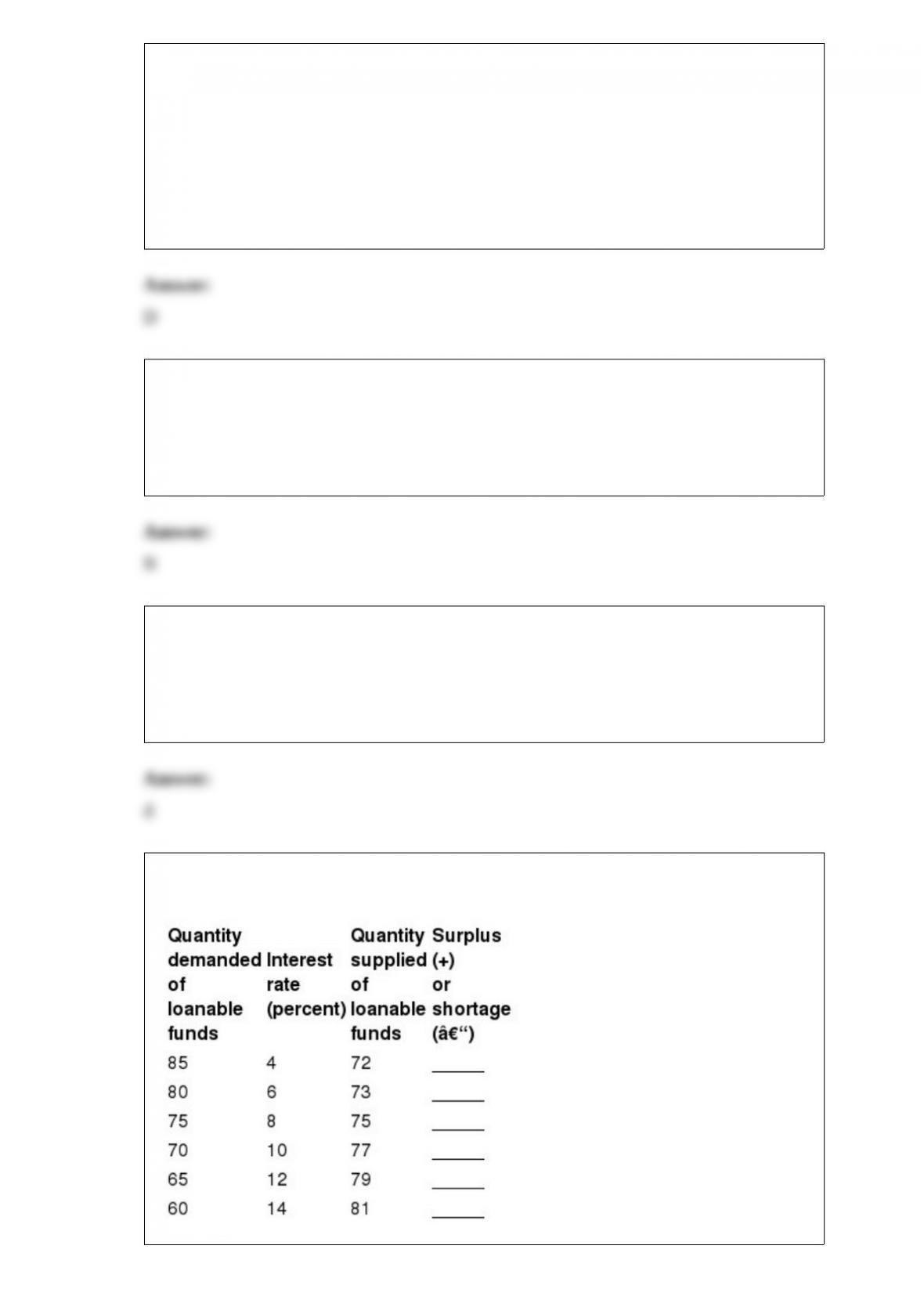
4) Suppose the total demand and supply of loanable funds (in billions) are as follows:

(a)What will be the market or equilibrium interest rate? What is the equilibrium
quantity of loanable funds? Complete the surplus-shortage column.
(b)Why will 4% not be the equilibrium interest rate in this market? Why not 14%?
(c)Now suppose that the government establishes a usury loan that sets the interest rate
at 6%. Explain the economic effects of this usury law.
5) the primary benefits of international trade include:
a.the more efficient use of world resources and higher living standards.
b.greater stability of domestic output, employment, and the price level.
c.diminished dependence on foreign supplies of goods and materials.
d.greater economic security for our domestic producers.
6) answer the next question(s) on the basis of the following data. all figures are in
billions of dollars.
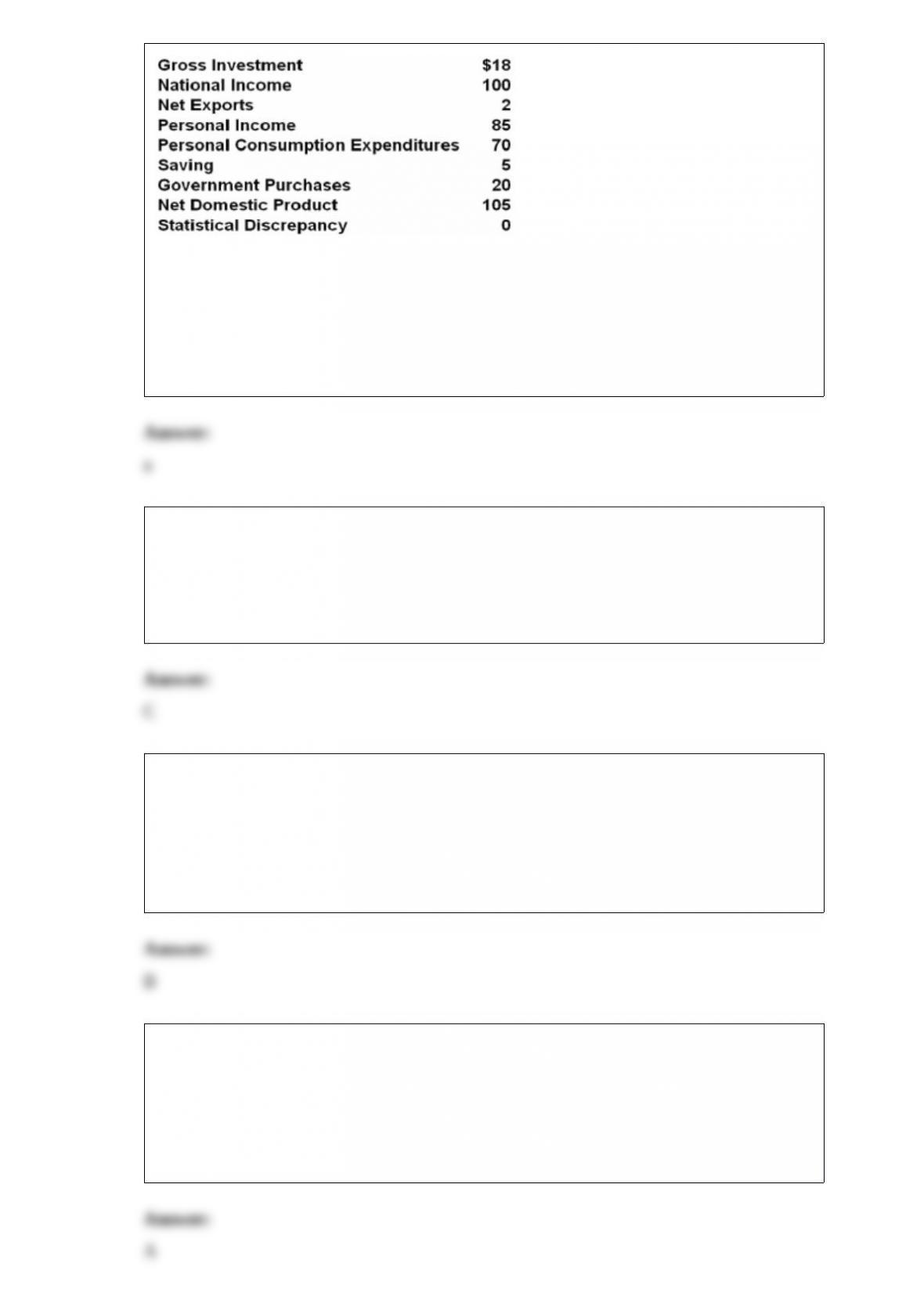
refer to the above data. from this information we can conclude that the net foreign
factor income is:
a.negative $5 billion.
b.zero.
c.positive $5 billion.
d.positive $15 billion.
7) If the demand for an agricultural product is inelastic, a bumper crop will:
A.raise price and decrease total revenues.
B.raise price and increase total revenues.
C.lower price and decrease total revenues.
D.lower price and increase total revenues.
8) If the nominal wages of carpenters rose by 5 percent in 2008 and the price level
increased by 3 percent, then the real wages of carpenters:
A.decreased by 2 percent.
B.increased by 2 percent.
C.increased by 3 percent.
D.increased by 8 percent.
9) In the balance of payments of the United States, inflows of foreign currencies to the
United States are recorded as:
A.a positive entry.
B.a current account entry.
C.a negative entry.
D.net investment income.
10) According to the Taylor rule:
A.for every 1 percentage point that unemployment exceeds the natural rate of
unemployment, there is a 2 percentage point gap between potential and actual GDP.
B.growth in the money supply should be limited to the long-run average growth rate of
real GDP.
C.if inflation rises by 1 percentage point above its target of 2 percent, then the Fed
should raise the real Federal funds rate by one-half a percentage point.
D.the rate of money growth should be set at 4 percent per year.
11)
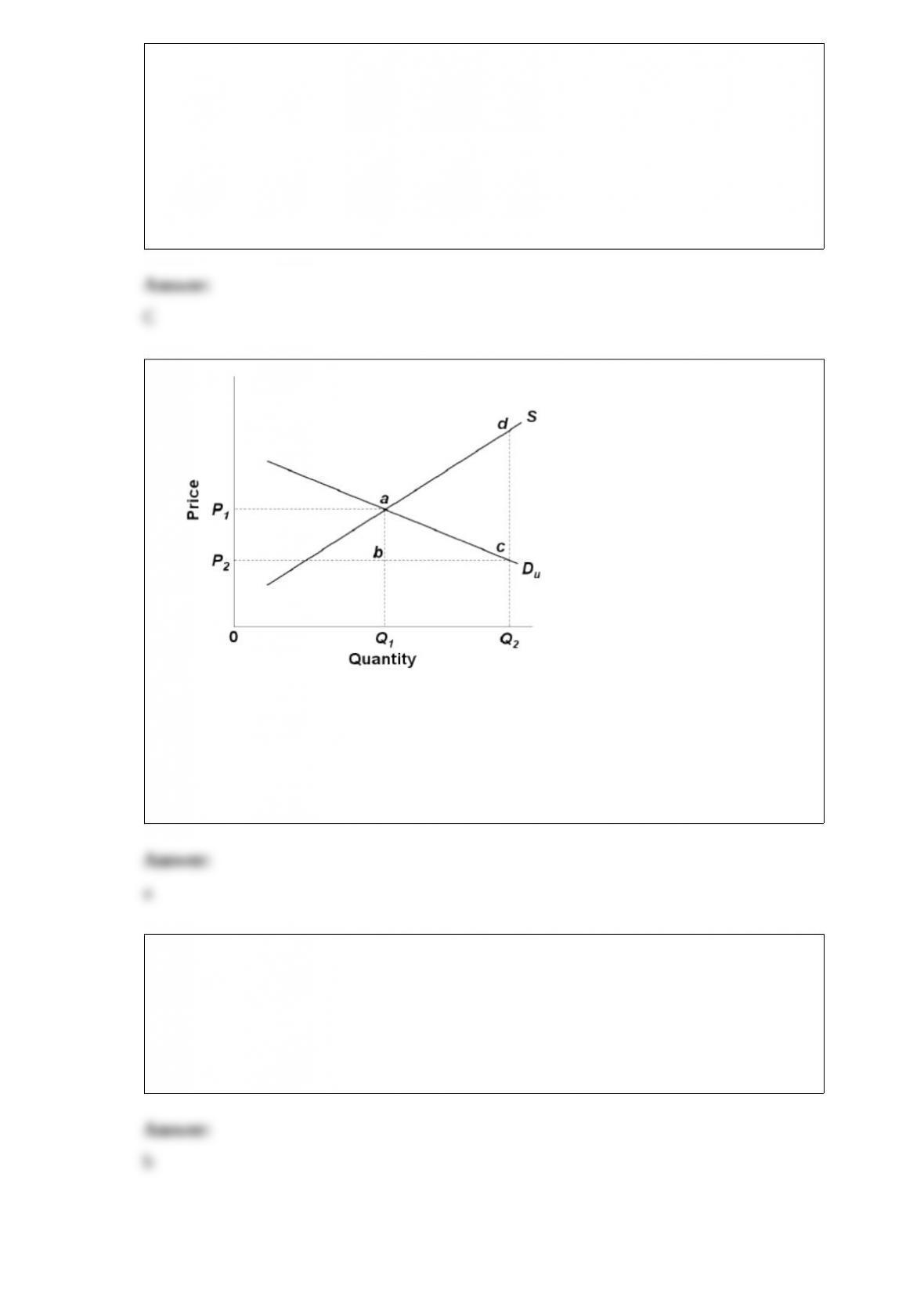
refer to the above demand and supply diagram that relates to the health care market.
without health insurance the equilibrium price and quantity of health care would be:
a.p1 and q1.
b.p1 and q2.
c.p2 and q2.
d.p2 and q1.
12) if we are considering the relationship between two variables and release one of the
other-things-equal assumptions, we would expect:
a.the relationship to change from direct to inverse.
b.the line representing that relationship on a graph to shift.
c.the data points to have a tighter fit to the line representing the relationship.
d.the relationship to change from inverse to direct.

13)
Suppose that a city’s energy demand is 30 megawatts during off-peak times, and 40
megawatts at its peak. The city has been purchasing electricity from an outside
company but has decided to build its own power plants to satisfy all of its energy
demand. The city can choose to build one or more plants to generate the needed
electricity. There are three types of plant: coal, natural gas, and hydroelectric. The three
types of plants face the costs appearing in the table above. Assuming the city’s power
needs will not change in the foreseeable future, to achieve the lowest cost of power
generation the city should build:
A.two coal-fired plants.
B.two natural gas plants.
C.one coal-fired and one hydroelectric plant.
D.four hydroelectric plants.
14) Which of the following nations has a total fertility rate that would suggest that its
next generation will only be half the size of the current generation?
A.Hong Kong.
B.Australia.
C.Sweden.
D.All of these nations.