
Firms that participate in regular open market transactions with the Federal Reserve are
called
A) secondary market banks.
B) Treasury banks.
C) primary dealers.
D) Federal Reserve partners.
If the required reserve ratio is 5 percent, then the simple deposit multiplier is
A) 2.
B) 5.
C) 10.
D) 20.
Which of the following is one reason for the decline in aggregate demand that led to the
recession of 2007-2009?
A) falling oil prices
B) increases in housing prices
C) the financial crisis
D) a decline in government spending
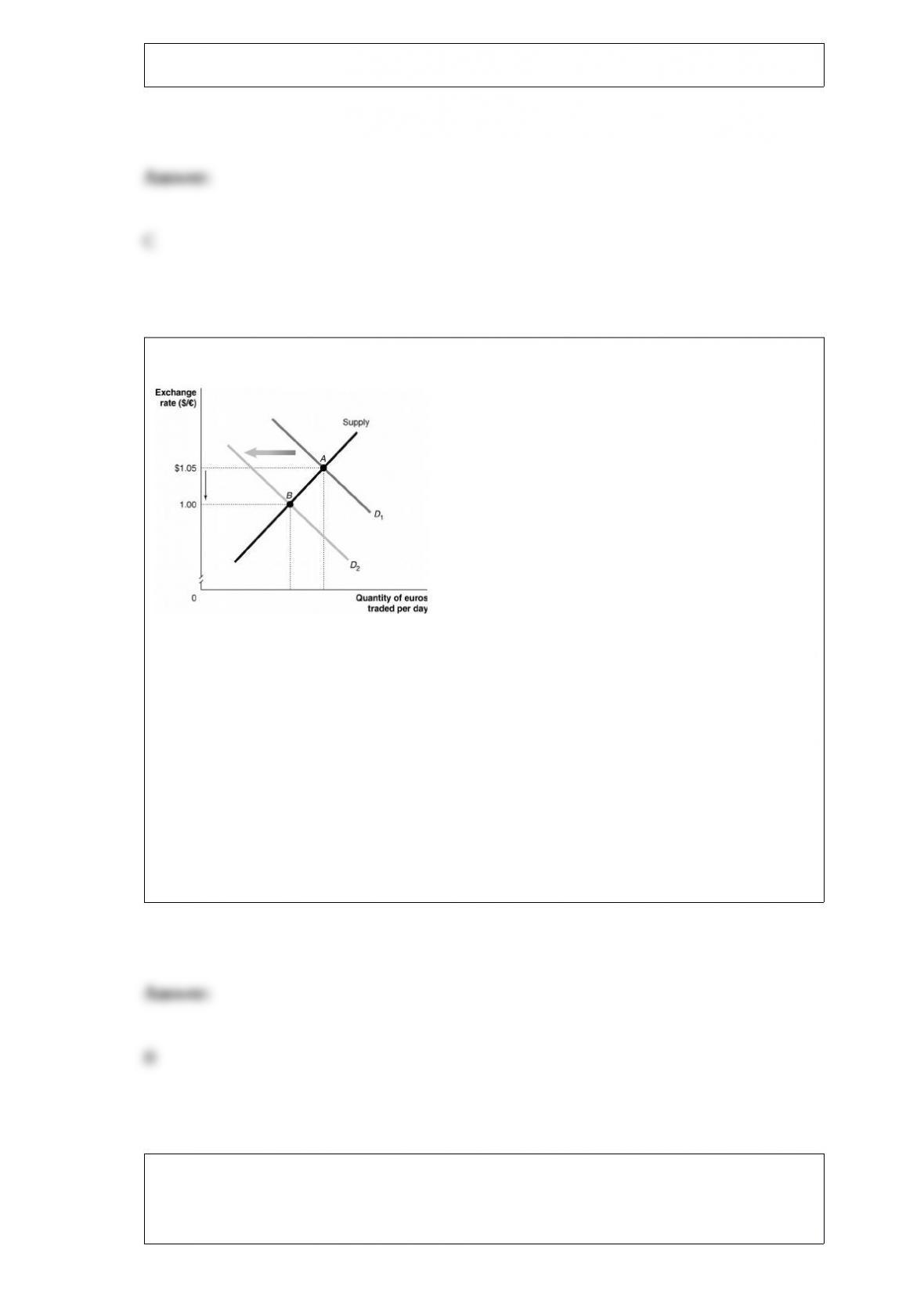
Figure 19-1
Refer to Figure 19-1. Which of the following would cause the change depicted in the
figure above?
A) U.S. productivity falls relative to European productivity.
B) Americans increase their preferences for goods produced in the EU relative to
American goods.
C) The European Union increases its quotas on Italian wine.
D) The price level of goods produced in the EU decreases relative to the price level of
goods produced in the United States.
Fiscal policy is determined by
A) the Federal Reserve.
B) the president and the Federal Reserve.
C) Congress and the Federal Reserve.
D) Congress and the president.
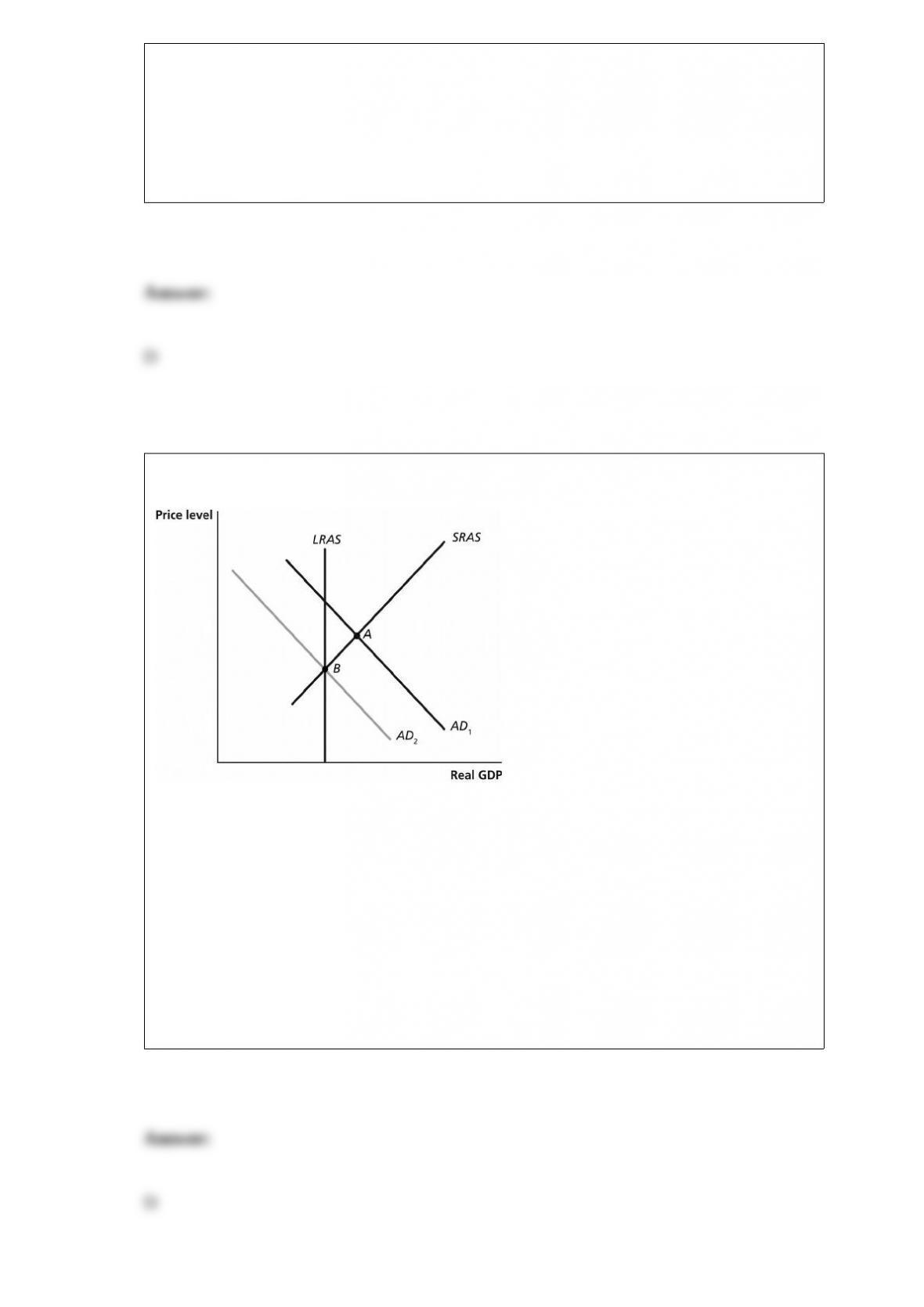
Figure 15-10
Refer to Figure 15-10. In the figure above, suppose the economy is initially at point A.
The movement of the economy to point B as shown in the graph illustrates the effect of
which of the following policy actions by the Federal Reserve?
A) an increase in income taxes
B) a decrease in the required reserve ratio
C) an open market purchase of Treasury bills
D) an open market sale of Treasury bills

Which of the following financial securities is most liquid?
A) a savings account
B) a share of stock
C) a cashier’s check
D) a $20 bill
Which of the following transactions would be included in Japan’s current account?
A) A Japanese citizen purchases 50 shares of Google stock.
B) An American citizen purchases 50 shares of Toshiba stock.
C) A Japanese citizen purchases a new Toyota made in Japan.
D) An American citizen purchases a new Toyota made in Japan.
A decrease in the discount rate ________ bank reserves and ________ the money
supply if banks respond appropriately to the change in the rate.
A) increases; increases
B) increases; decreases

C) decreases; increases
D) decreases; decreases
The demand for soft drinks in the United States has been ________ while the global
demand has been ________.
A) increasing; increasing
B) increasing; decreasing
C) decreasing; increasing
D) decreasing; decreasing
Changes in the price level
A) increase the level of aggregate supply in the long run.
B) decrease the level of aggregate supply in the long run.
C) do not affect the level of aggregate supply in the long run.
D) increase the level of aggregate supply in the long run only at very high levels of
output.

Article Summary
According to the Office for National Statistics in the United Kingdom, productivity in
the UK in 2012 was well below the average of the G7 countries, only faring better than
Japan. The G7 is a group of the seven most industrialized countries, and includes
Canada, France, Germany, Italy, Japan, the United Kingdom, and the United States.
Compared to the G7 average, the UK was 16% less productive per hour worked, and
output was 19% worse when measured on a per worker basis. The productivity gap was
the largest for the UK since 1994. Worker productivity has increased in all of the G7
nations except for the UK since 2007, where it has fallen by two percentage points. The
most productive workers were in the United States, where workers were 29 percentage
points more productive per hour worked than in the UK.
Source: “UK workers much less productive than others in the G7,” Guardian,
September 18, 2013.
Refer to the Article Summary. ________ depend on increases in labor productivity.
A) Advances in technology
B) Decreases in the inflation rate
C) Decreases in the unemployment rate
D) Increases in real GDP per capita
Most economists believe that biases cause changes in the CPI to overstate the inflation
rate by ________ percentage points.
A) 0.1 to 0.2
B) 0.2 to 2.0
C) 0.4
D) 0.5 to 1.0
E) 1.0 to 3.0
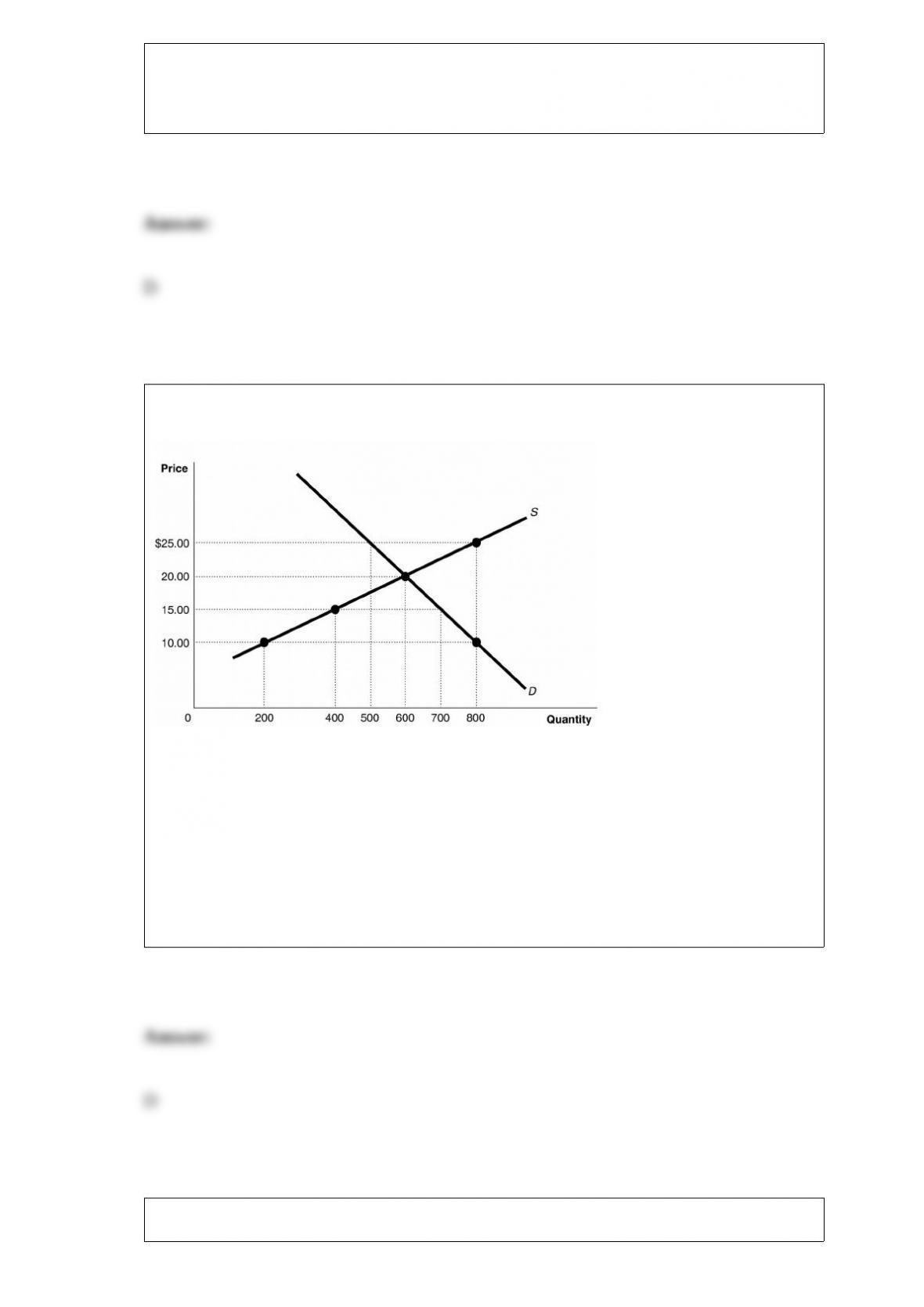
Figure 3-4
Refer to Figure 3-4. At a price of $25, how many units will be supplied?
A) 400
B) 500
C) 600
D) 800
The three categories of federal government expenditures, in addition to government
purchases, are
A) interest on the national debt, grants to state and local governments, and transfer
payments.
B) interest on the national debt, defense spending, and transfer payments.
C) defense spending, budgets of federal agencies, and transfer payments.
D) defense spending, Social Security, and Medicare.
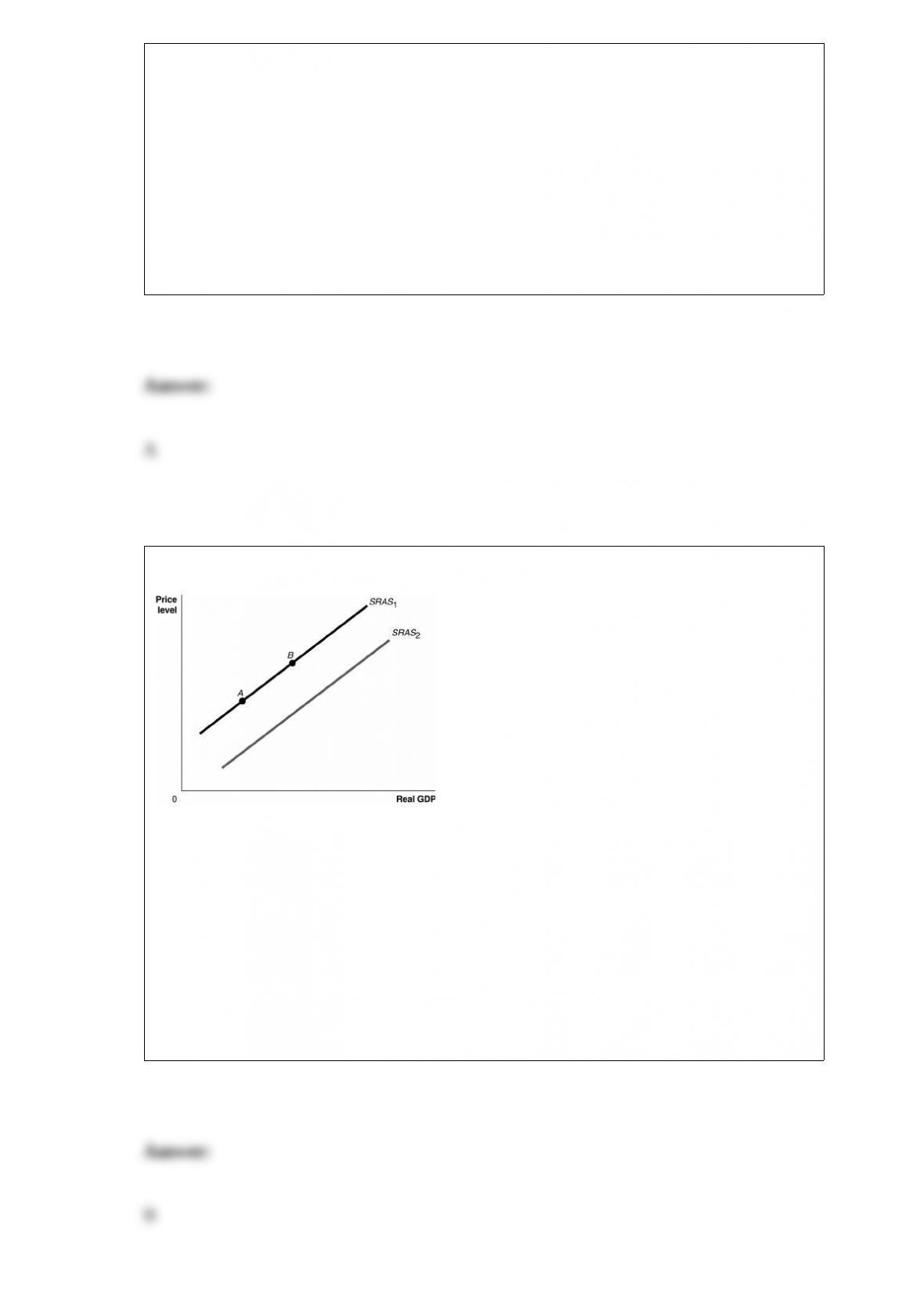
Figure 13-2
Refer to Figure 13-2. Ceteris paribus, an increase in the expected future price level
would be represented by a movement from
A) SRAS1 to SRAS2.
B) SRAS2 to SRAS1.
C) point A to point B.
D) point B to point A.

Explain how each of the following events would affect the long-run aggregate supply
curve.
a. A lower price level
b. A decrease in the labor force
c. A decrease in the quantity of capital goods
d. Technological change
Accumulating debt poses a problem for the U.S. federal government because
A) it is currently in danger of defaulting on the debt.
B) a large debt-to-GDP ratio causes crowding out.
C) building roads and bridges do not yield enough benefits to justify their cost.
D) the debt has to ultimately be paid off.

What is meant by crowding out? Explain the difference between crowding out in the
short run and in the long run.
Your friend does not understand the benefits of globalization. Outline for your friend
the positive economic aspects of globalization.
How would the unemployment rate and the labor force participation rate change if
discouraged workers were counted as unemployed rather than counted as out of the
labor force? Show using the formula for both measurements.
Article Summary
According to the Bureau of Labor Statistics, the unemployment rate fell from 7.4
percent in July 2013 to 7.3 percent in August, and at the same time the labor force
participation rate fell to its lowest level in 35 years, from 63.4 percent to 63.2 percent.
The decrease in the labor force participation rate was due to a decline in the size of the
workforce of about 300,000 people. A large portion of the job growth in August was in
the food service and retail sectors, areas which typically account for part-time and

lower-paying jobs. On a brighter note, the average number of hours worked per week
rose slightly, as did average hourly earnings and temporary employment.
Source: Peter Coy, “Not Looking for Work: Labor-Force Participation Hits 35-Year
Low,” BloombergBusinessweek, September 6, 2013.
Refer to the Article Summary. Explain how the labor force declining by 300,000 people
could have led to the decrease in the unemployment rate.
What is an economic market?