Which of the following is not an example of inflation causing a redistribution of income
because the inflation was unanticipated?
A) A firm signs a 3-year contract with a union based on a 2 percent anticipated rate of
inflation per year, and the actual rate of inflation ends up being 7 percent per year.
B) A worker receives a raise in salary that is less than the rate of inflation, because
management under-predicted inflation.
C) Firms have to hire an extra worker to change prices in its store because of inflation.
D) A bank collects a lower amount of interest from a loan because inflation was
under-predicted.
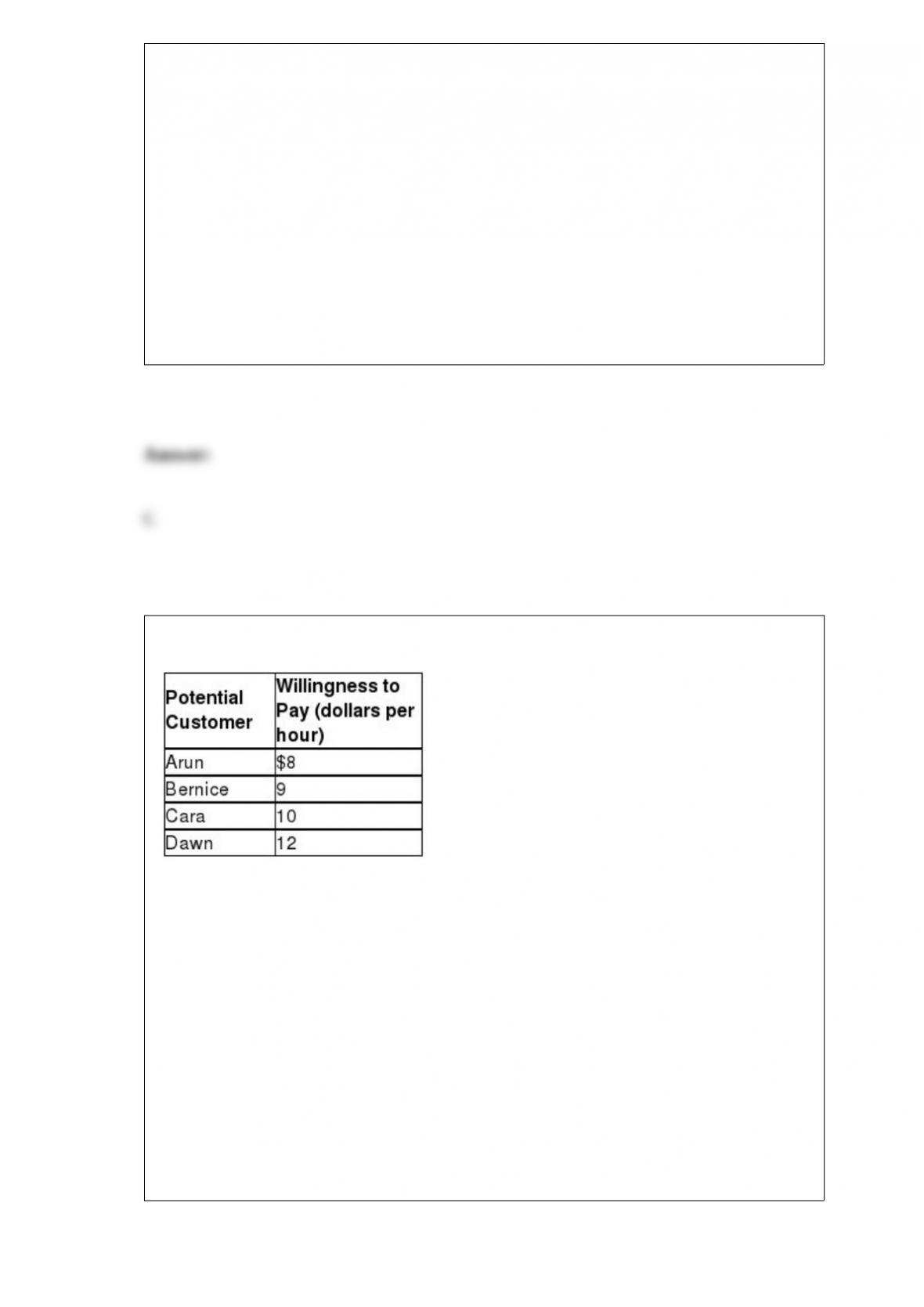
Table 16-3
Julie plans to start a pet-sitting service. She surveyed her neighborhood to determine the
demand for this service. Assume that each person surveyed demands only one hour of
pet sitting services per period. Table 16-3 above shows a portion of her survey results.
Suppose Julie’s marginal cost of providing this service is constant at $7 and she charges
$7 per hour. What is her marginal revenue?
A) It is $7 for the first hour and starts declining thereafter.
B) It is $7 for the first hour and starts increasing thereafter.
C) It is constant at $7.
D) It coincides with the figures in the table; $12 for the first hour, $10 for the second,
$9 for the third and $8 for the fourth.

Izzy Amador is a highly talented tattoo artist. She has chosen to specialize in tattoo art
because of all of the followingexcept
A) her tattoos are highly esteemed by tattoo lovers who are willing to pay very high
prices.
B) for her, this is the most lucrative way to purchase the products that she wants to
consume.
C) her opportunity cost of pursuing another career is very low.
D) she obviously has a comparative advantage in tattoo art.
Which of the following is a result of government price controls?
A) Some people win and some people lose.
B) Price controls benefit poor consumers but harm producers and wealthy consumers.
C) Price controls increase economic efficiency.
D) The deadweight loss from price ceilings is greater than the deadweight loss from
price floors.
Suppose that domestic investment in Canada is 10.7% of GDP, and Canadian national
savings is 13% of GDP. What is Canada’s foreign investment as a percentage of GDP?
A) 1.15%
B) 2.3%
C) 15.3%
D) 23.7%
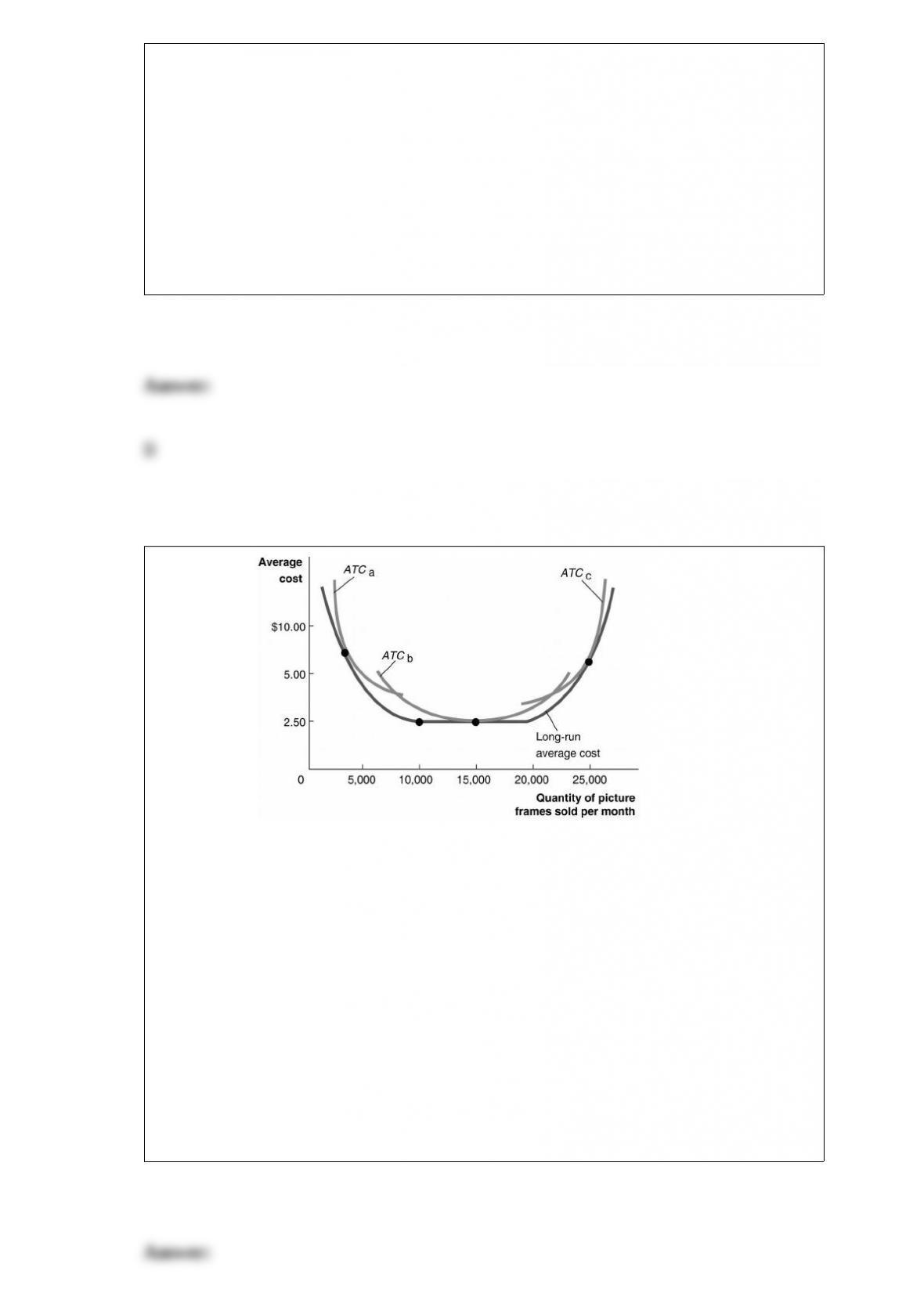
Figure 11-11 Figure 11-11
illustrates the long-run average cost curve for a firm that produces picture frames. The
graph also includes short-run average cost curves for three firm sizes: ATCa, ATC and
ATCc.
In the short run, if the firm sells fewer than 5,000 picture frames per month,
A) it should produce with the scale of operation associated with ATCa.
B) it should produce with the scale of operation associated with ATC.
C) it should produce with the scale of operation associated with ATCc.
D) it will experience constant returns to scale.

If, at the current exchange rate between the dollar and the Norwegian kroner of 5.78
kroner per dollar, the dollar is “overvalued,” how do you expect demand and supply in
the foreign exchange markets to respond?
A) The demand for the dollar will rise, while the supply of the kroner will fall.
B) The demand for the dollar will fall, while the supply of the kroner will rise.
C) The supply of the dollar will rise, while the demand for the kroner will fall.
D) The supply of the dollar will rise, while the demand for the kroner will rise.
Suppose that nominal GDP in 2013 was less than real GDP in 2013. Given this
information, we know for certain that
A) the price level in 2013 was greater than the price level in the base year.
B) the price level in 2013 was less than the price level in the base year.
C) real GDP in 2013 was less than real GDP in the base year.
D) real GDP in 2013 was greater than real GDP in the base year.
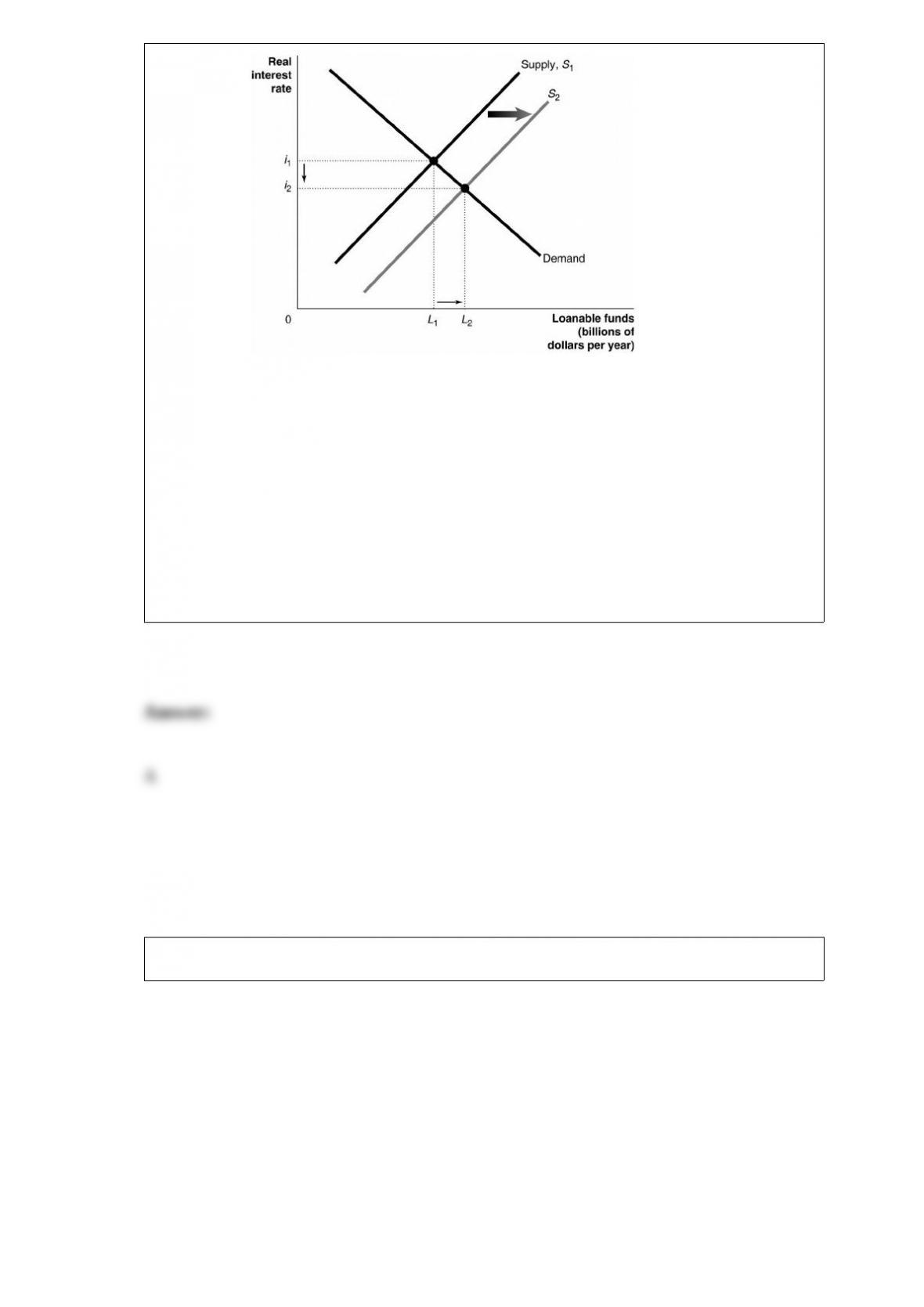
Figure 21-3
Which of the following is consistent with the graph depicted above?
A) Taxes are changed so that real interest income is taxed rather than nominal interest
income.
B) An expected recession decreases the profitability of new investment.
C) The government runs a budget deficit.
D) Technological change increases the profitability of new investment.
Table 17-2
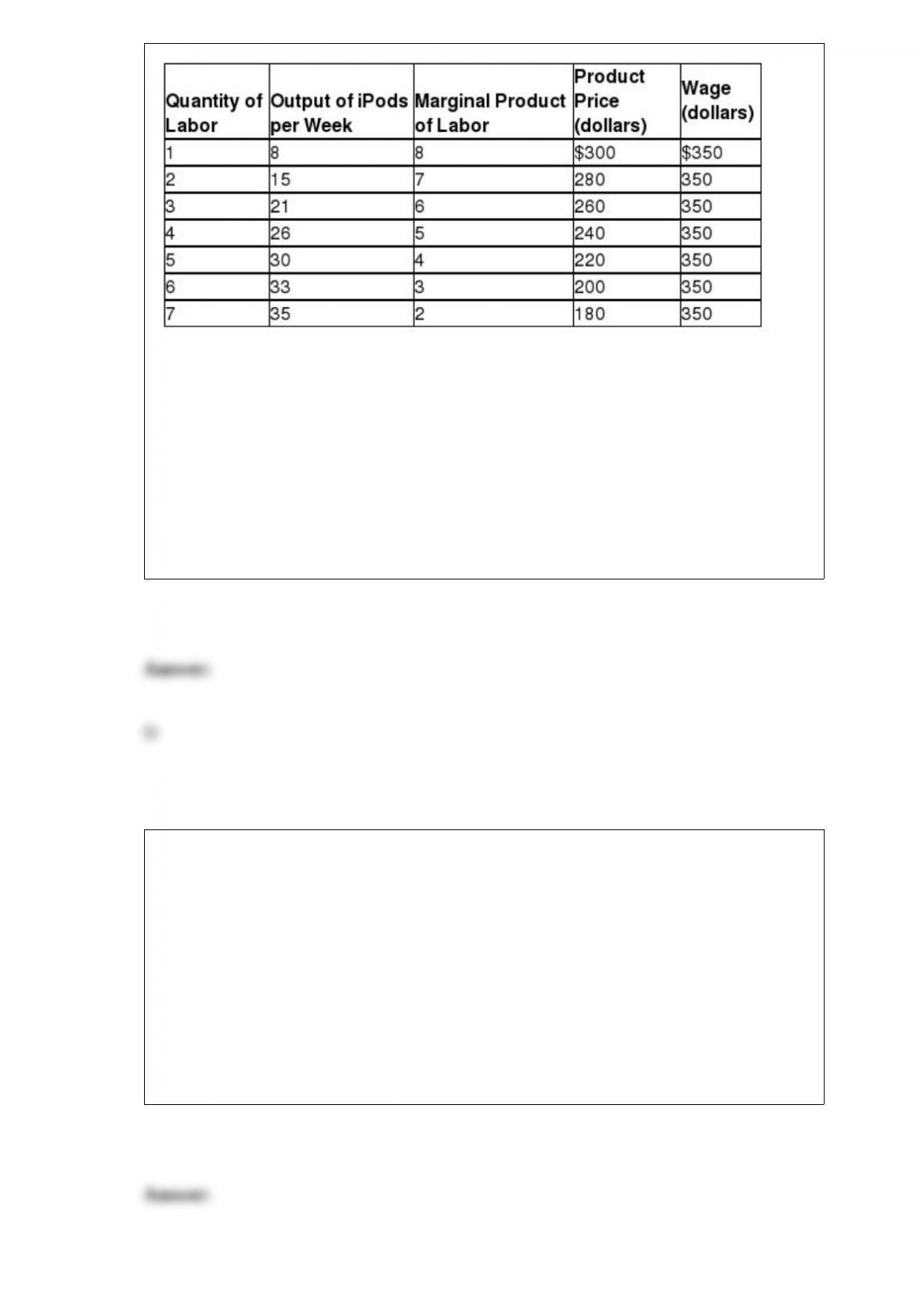
The marginal profit from hiring the second unit of labor is
A) $4,200.
B) $1,960.
C) $1,800.
D) $1,450.
Employees at the hospital have negotiated a 3 percent increase in wages for the next
year, based on their inflation expectations. If inflation is actually 5 percent over the next
year, which of the following will occur?
A) Unemployment of hospital employees will rise.
B) Real wages for hospital employees will fall.
C) Inflation will be 3 percent the following year.
D) The increase in inflation is expected.

________ have a horizontal and a vertical axis and are used in economics to illustrate
relationships between two economic variables.
A) Two-dimensional graphs
B) One-dimensional graphs
C) Pie Charts
D) Bar graphs
The market demand curve for labor
A) is determined by adding up the quantity of labor demanded by each firm at each
wage, holding constant the other variables that affect the willingness of firms to hire
workers.
B) is the same as the market demand curve for the product labor produces because it is
a derived demand.
C) is determined by adding up the demand for labor by each firm at each wage, holding
constant the other variables that affect the willingness of firms to hire workers.
D) is perfectly inelastic because there is a finite number of workers in the market for
labor.

The period of time from 1,000,000 B.C. to 1300 A.D. was a period of
A) no sustained economic growth.
B) slow and steady economic growth.
C) moderate economic growth.
D) rapid and sustained economic growth.
In discussions of barriers to entry, what is meant by the term “virtuous cycle”?
A) A virtuous cycle refers to successful research and development that leads to
information that is used to develop other new products.
B) A virtuous cycle refers to a firm using the profits from a monopoly in one market to
establish a monopoly in another market.
C) A virtuous cycle refers to the situation where the pursuit of self-interest in
establishing an entry barrier leads to an increase in social welfare (the “invisible hand”).
D) A virtuous cycle refers to a situation where if a firm can attract enough customers
initially, it can attract additional customers because its product’s value has been
increased by other customers using it, which attracts even more customers.