
In collective bargaining,
a. union members act together as a single unit.
b. each union member represents herself in labor-management negotiations.
c. the objective of the union is to increase its bargaining power with management.
d. a and c
e. b and c
A market is said to be in disequilibrium if
a. it exhibits either a surplus or a shortage.
b. the number of units that individuals are willing to buy exceeds the number of units
they can afford.
c. it is a market for an inferior good.
d. none of the above
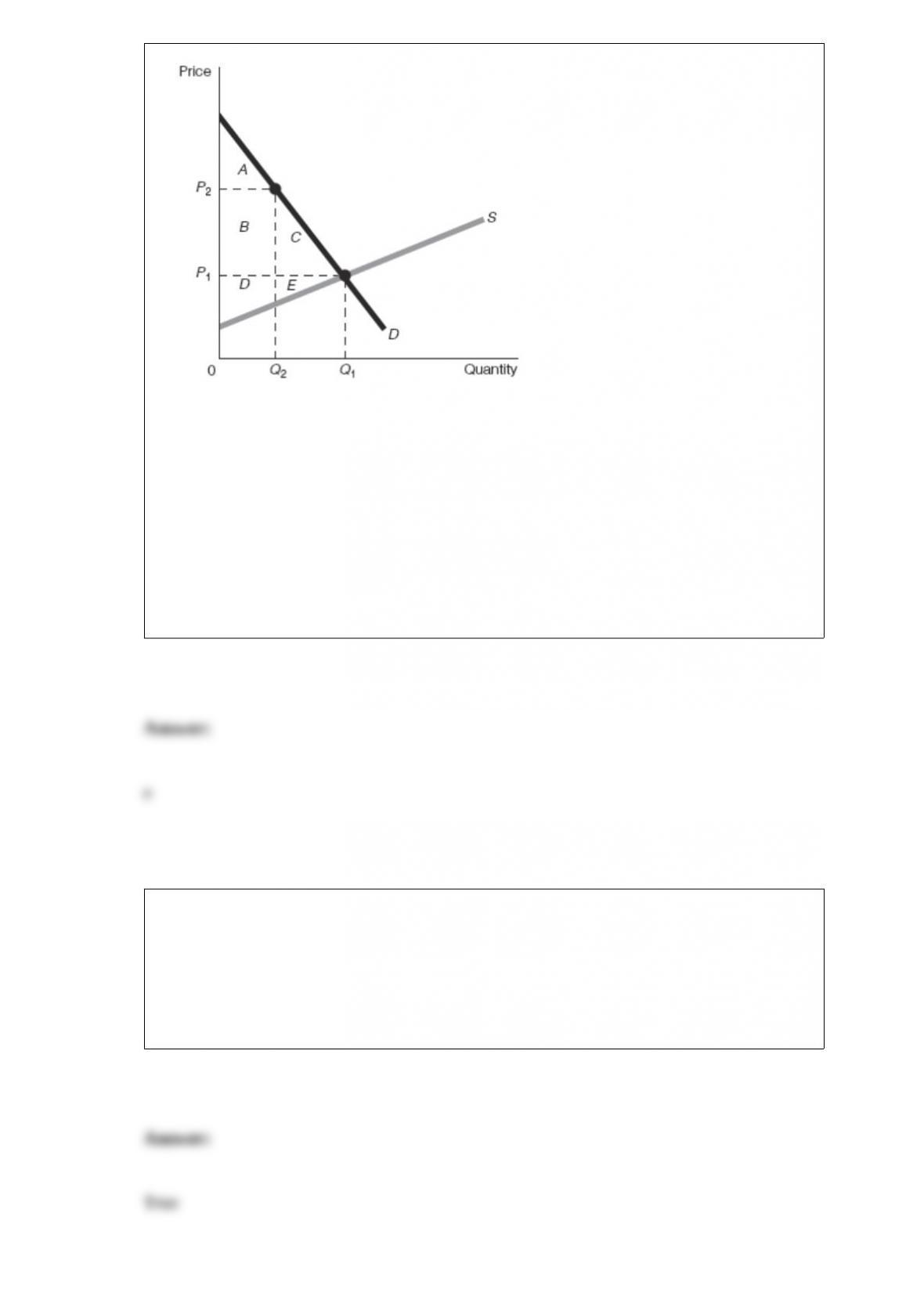
Refer to Exhibit 32-4.If producers of this good engage in rent seeking which results in
the government imposing a price floor of P2, then consumers’ surplus ends up being
area
Exhibit 32-4
a. D + E
b. A + B + C + D + E
c. A + B + C
d. C + E
e. A
In the foreign exchange market between dollars and pesos, the demand for dollars by
Mexicans creates the supply of pesos.
a. True
b. False

A decrease in the quantity of resources available causes a movement down along a
given PPF.
a. True
b. False
Suppose Johnny, seven years old, is selling lemonade to his neighbors and he sells each
of his buyers the refreshment for the maximum price that each buyer is willing to pay.
Johnny is practicing
a. perfect competition.
b. perfect price discrimination.
c. second-degree price discrimination.
d. third-degree price discrimination.
Suppose a consumer is purchasing Coke and pretzels in quantities such that she is
achieving consumer equilibrium. Then the price of Coke decreases. The consumer will
likely __________ her consumption of Coke and the marginal utility of Coke will
__________ while the total utility from Coke will __________.
a. increase; increase; increase
b. increase; decrease; decrease
c. increase; decrease; increase
d. decrease; increase; increase
e. decrease; decrease; decrease
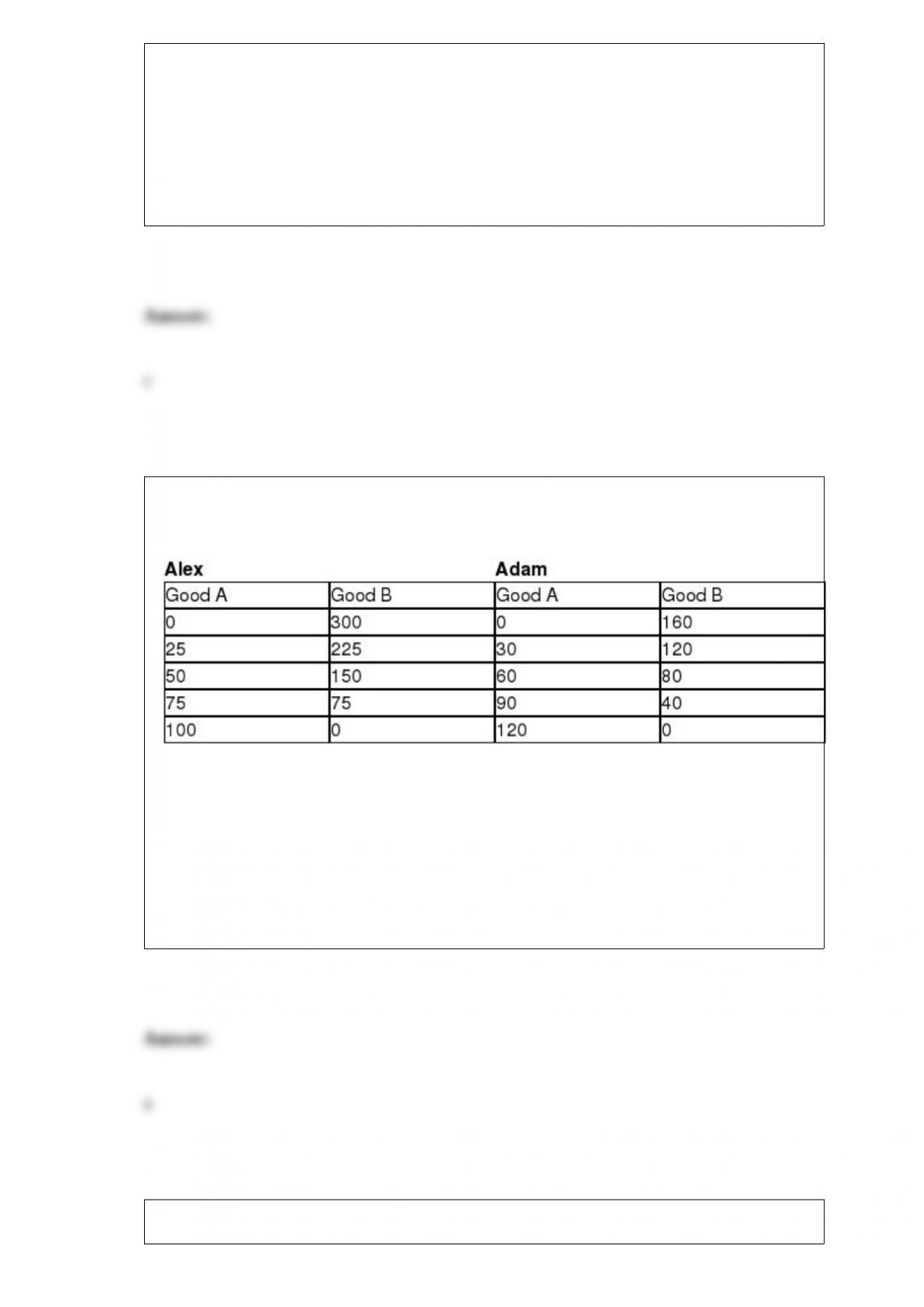
Refer to Exhibit 2-9. Who has the comparative advantage in the production of good B?
Exhibit 2-9
a. Alex
b. Adam
c. Both Alex and Adam
d. Neither Alex nor Adam
The federal government began issuing inflation-indexed Treasury bonds in
a. 1913.
b. 1989.
c. 1997.
d. 2001.
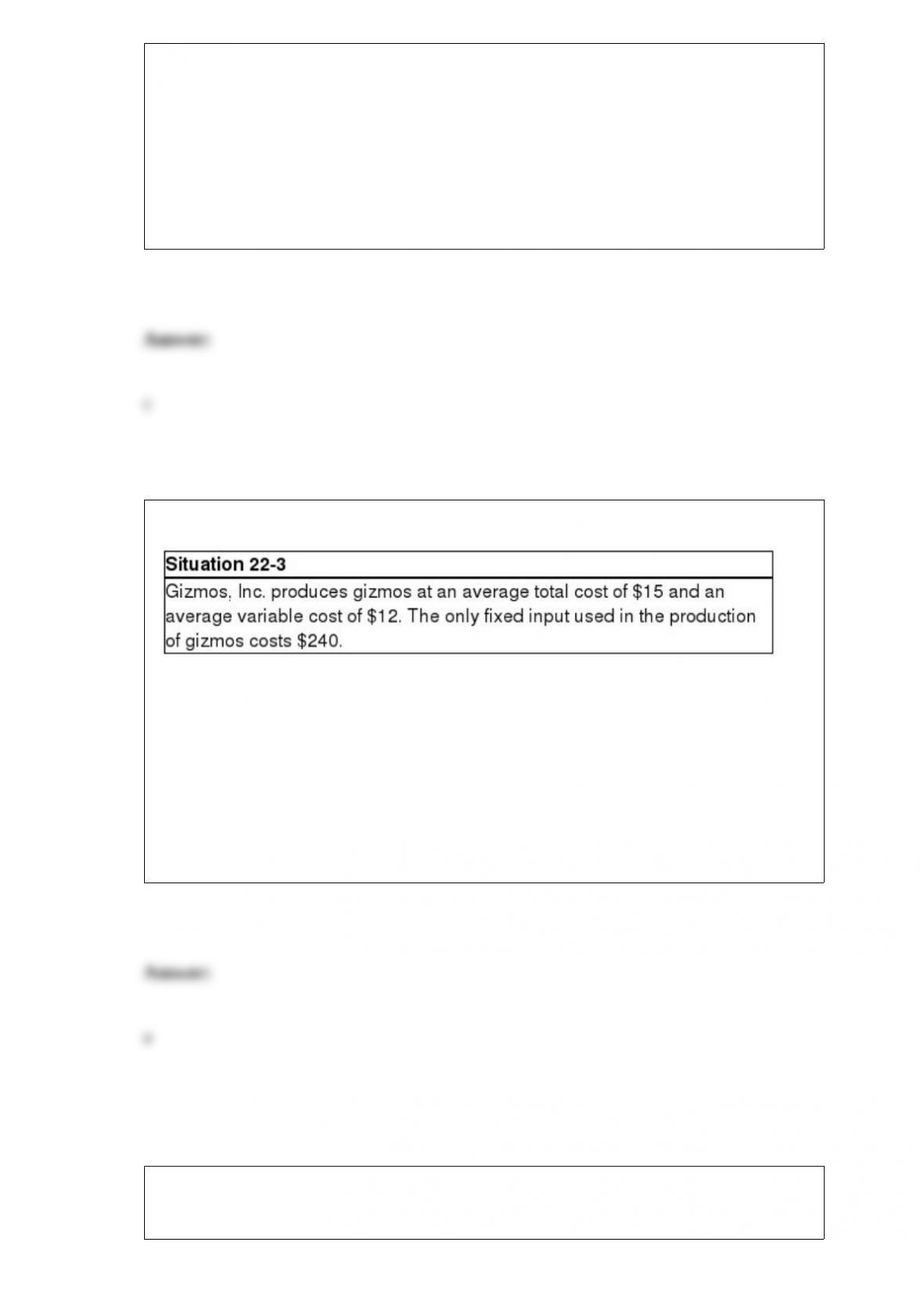
Refer to Situation 22-3. What are the total costs?
a. $1,200
b. $2,400
c. $850
d. $960
e. There is not enough information to answer the question.
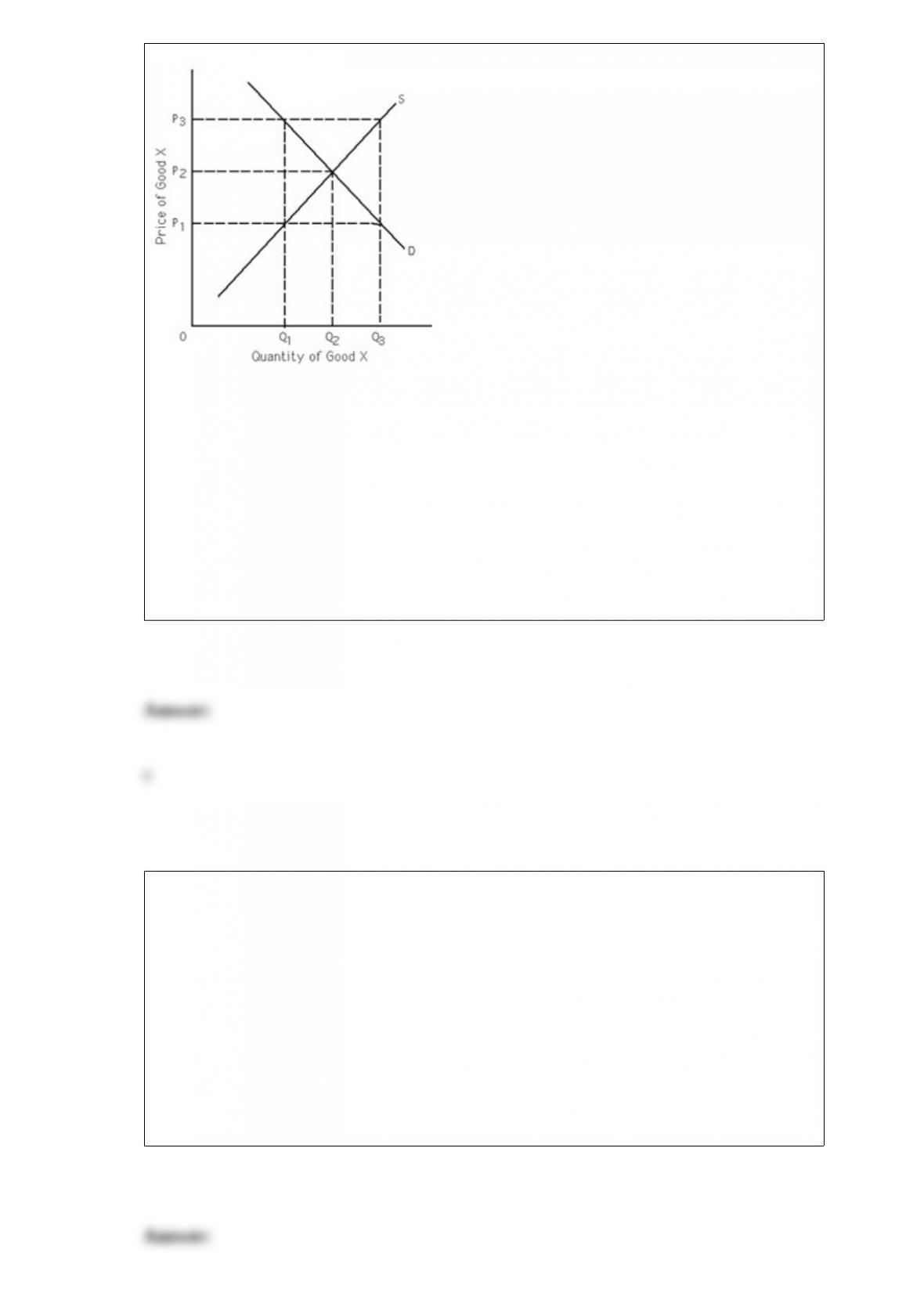
Refer to Exhibit 4-3. If price P2 is a price ceiling, then
Exhibit 4-3
a. there is a shortage in the market for good X.
b. the highest price that can legally be charged in this market is P3.
c. the price at which exchange legally takes place in the market for good X is P2.
d. the quantity exchanged is less than the quantity demanded.
e. all of the above
When marginal private cost is equal to marginal social cost,
a. the activity in question generates no positive externality.
b. the activity in question generates no negative externality.
c. all positive externalities have been internalized.
d. all negative externalities have been internalized.
e. b or d

A farmer has 1,000 acres on which he has previously grown corn. His yield per acre is
100 bushels of corn. If the corn payment rate is $0.43 a bushel, his production
flexibility contract payment equals
a. $39,600.
b. $43,000.
c. $36,550.
d. $12,345.
e. none of the above
Economies of scale are exclusively a long-run phenomenon, while the law of
diminishing marginal returns applies to both the short-run and to the long-run.
a. True
b. False
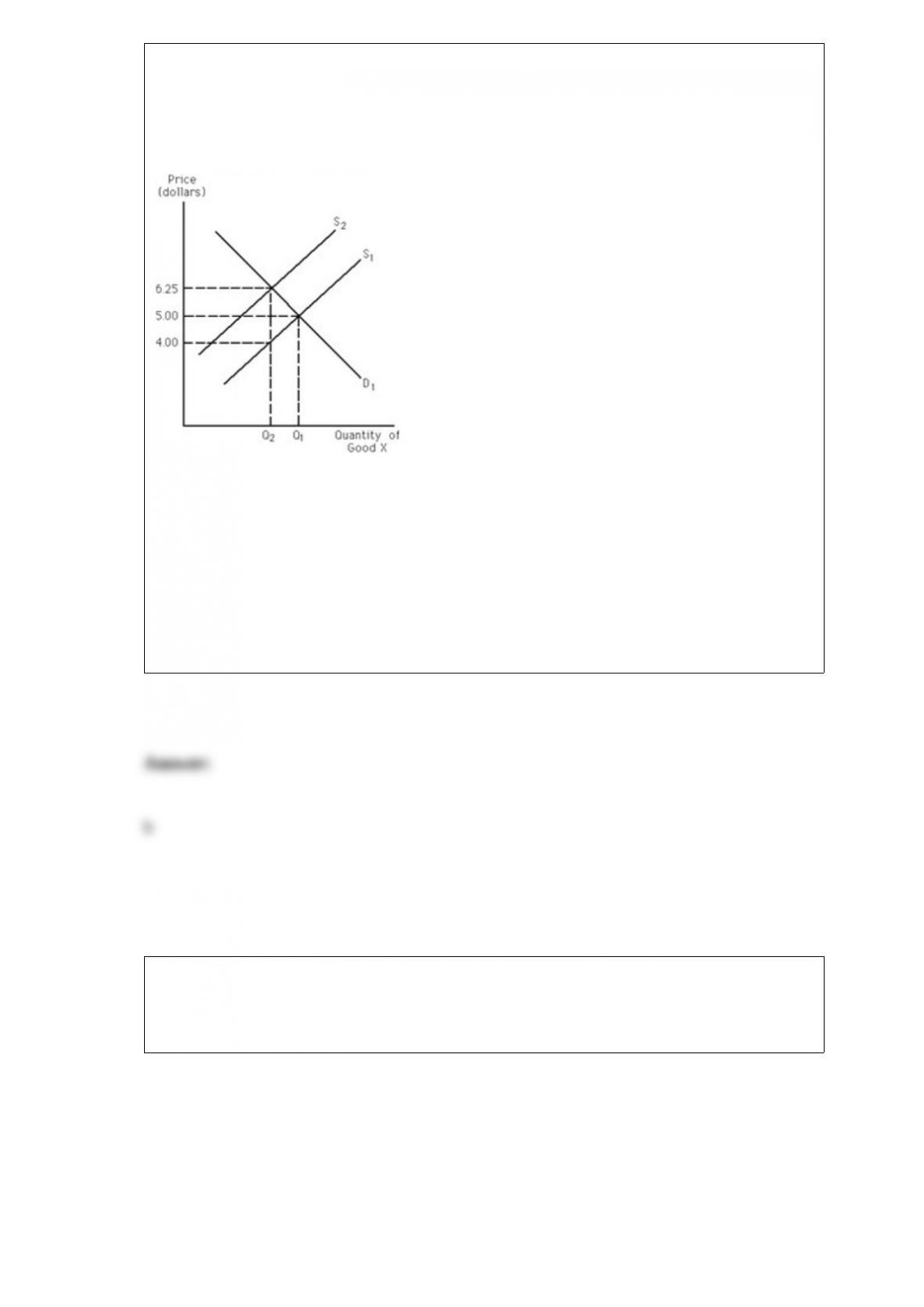
Refer to Exhibit 20-2. The market for good X is initially in equilibrium at $5. The
government then places a per-unit tax on good X, as shown by the shift of S1 to S2.
Approximately what percentage of the tax do producers end up paying?
Exhibit 20-2
a. 55 percent
b. 45 percent
c. 70 percent
d. 63 percent
e. 25 percent
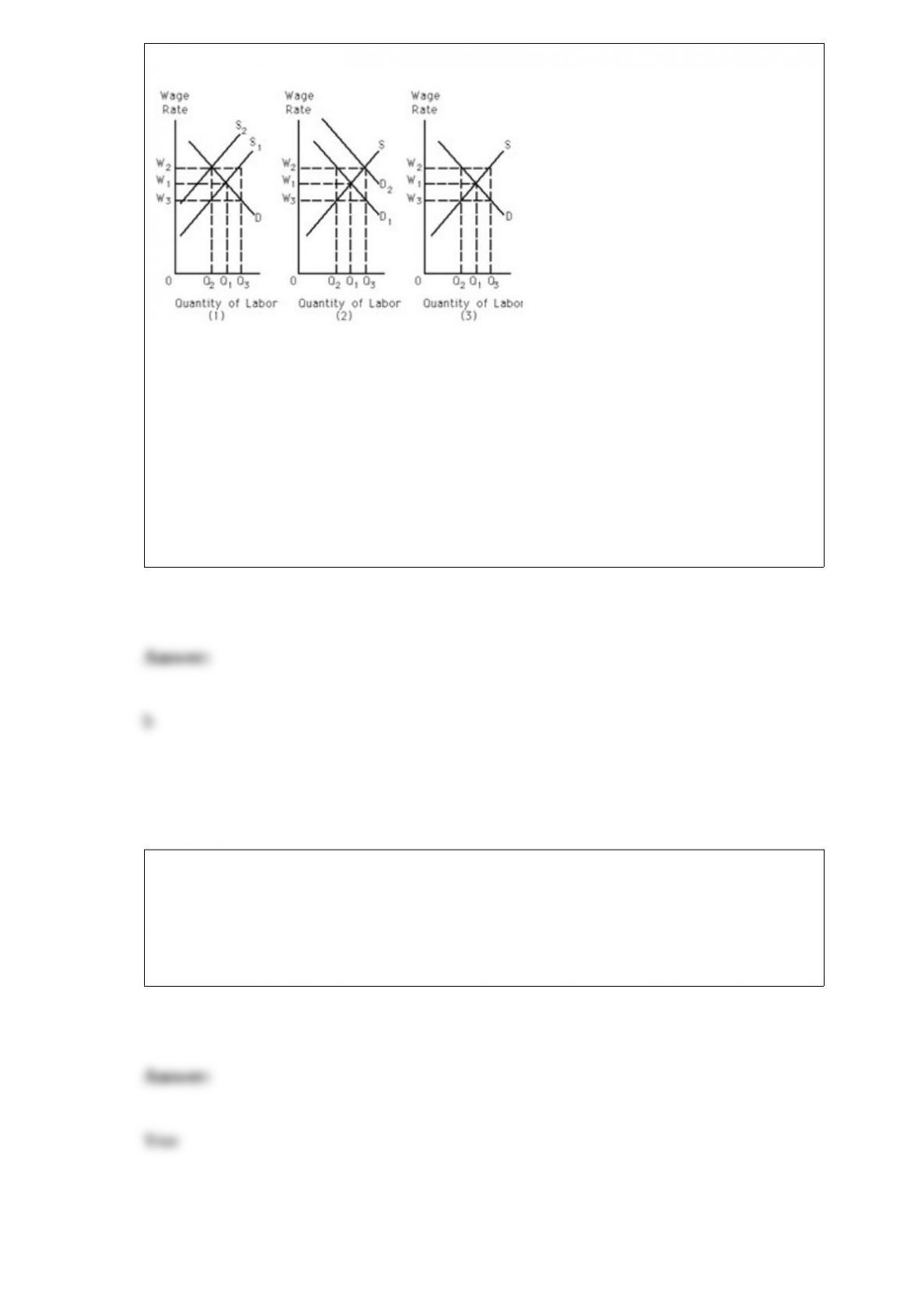
Refer to Exhibit 28-5. In which case or cases does the increase in the wage rate from
W1 to W2 definitely cause the total wage bill to rise?
Exhibit 28-5
a. (1)
b. (2)
c. (3)
d. (1) and (2)
e. (1) and (3)
Logrolling is the exchange of votes to gain support for legislation.
a. True
b. False

Refer to Exhibit 34-9. In the no specialization-no trade case, suppose country X
produces and consumes 100 units of good A and 20 units of good B. Country Y
produces and consumes 20 units of good A and 60 units of good B. If the two countries
specialize and trade, and the actual amounts traded are 125 units of good A for 25 units
of good B, how many more units of good A will country X consume by specializing and
trading?
Exhibit 34-9
a. 75
b. 25
c. 15
d. 105
e. 50
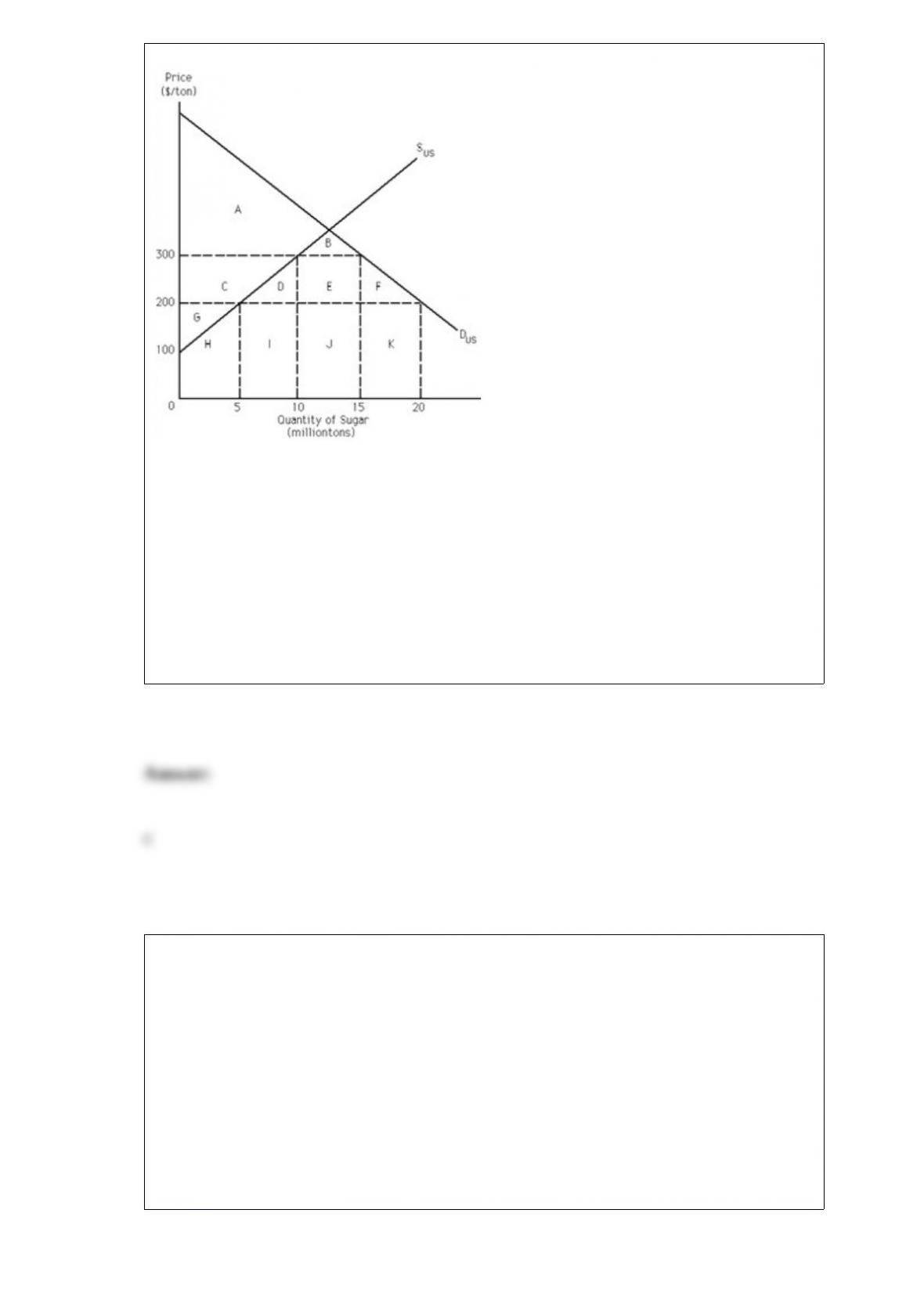
Refer to Exhibit 34-8. Assume that the current price of sugar in the United States is
$300 per ton (which includes a $100 per ton tariff on sugar imports). Consumers’
surplus is equal to the area __________ while producers’ surplus is equal to the area
__________.
Exhibit 34-8
a. A + B + C + D + E + F;G + H + I + J + K
b. A + C + G;B + D + E + F
c. A + B;C + G
d. A + C;G
e. A + C;B + D + E + F
Which of the following is not a condition of long-run competitive equilibrium?
a. There is no incentive for firms to enter the industry.
b. There is no incentive for firms to exit the industry.
c. There is no incentive for firms to produce more or less output.
d. There is no incentive for firms to change plant size.
e. None of the above; that is, all are conditions of long-run competitive equilibrium.

If all the individuals had the same innate and learned skills and abilities, applied the
same degree of effort on the job, and worked with the same amount and quality of other
factors of production,
a. all labor supply curves would be horizontal.
b. all labor demand curves would be horizontal.
c. wages in different markets would differ less than they currently do.
d. the quantity of labor supplied would decrease in all markets.
e. the demand curve for capital would be upward sloping.
Does a real-world market have to meet all the assumptions of the theory of perfect
competition before it is considered a perfectly competitive market?
a. No, probably no real-world market meets all the assumptions of the theory of perfect
competition. All that is necessary is that a real-world market behave as if it satisfies all
the assumptions.
b. Yes, if a real-world market does not meet the assumptions, then it cannot be
considered a perfectly competitive market.
c. Yes, unless it is a new market such as the computer market. New markets are not held
to the same assumptions as old, more established markets.
d. No, but it does have to meet the assumption of producing and selling a homogeneous
product. It does not have to fully meet the other assumptions.

Which of the following is a positive macroeconomics statement?
a. The central bank should increase the nation’s money supply.
b. The increase in the nation’s money supply helped push the nation’s unemployment
rate down in the short run.
c. Ford Motor Company’s new advertising campaign ended up hurting General Motors’
sales.
d. The local government ought to spend more on recreational facilities.
Which of the following statements is false?
a. People who live in cities with good weather receive that benefit for free.
b. People who own property in cities with good weather receive higher rents, ceteris
paribus.
c. Housing prices are higher in cities with better weather, ceteris paribus.
d. The demand for housing is higher in cities with good weather, ceteris paribus.