
1) to protect domestic producers from foreign competition, the u.s. government levies
both import tariffs and export tariffs.
a.true
b.false
2) according to the fast-track provision of u.s. trade law, once the president has
completed trade negotiations, their outcome is subject to a vote (without amendment) in
congress within 90 legislative days of submission.
a.true
b.false
3) according to the factor-endowment theory, a nation will export that good for which a
large amount of the relatively scarce resource is used.
a.true
b.false
4) current-account transactions include direct foreign investment, purchases of foreign
government securities, and commercial bank loans made abroad.
a.true
b.false
5) given a two-country world, assume canada and sweden devalue their currencies by
20 percent. this would result in:
a.an appreciation in the canadian currency
b.an appreciation in the swedish currency
c.an appreciation in both currencies

d.an appreciation in neither currency
6) the movement to free international trade is most likely to generate short-term
unemployment in which industries?
a.industries in which there are neither imports nor exports
b.import-competing industries
c.industries that sell to domestic and foreign buyers
d.industries that sell to only foreign buyers
7) that u.s. charities donate funds to combat starvation in africa constitutes a debit
transaction on the u.s. balance of payments.
a.true
b.false
8) joint ventures lead to losses in national welfare when the newly established business
adds to pre-existing production capacity and fosters additional competition.
a.true
b.false
9) under the price-adjustment mechanism, a government’s efforts to maintain a
current-account surplus is self defeating over the long run because a nation’s current
account automatically moves toward equilibrium.
a.true
b.false
10) the united states was less open to international trade between:
a.1890 and 1910

b.1930 and 1950
c.1890 and 1950
d.1950 and 2013
11) according to the j-curve effect, currency depreciation:
a.decreases a trade deficit
b.increases a trade deficit
c.decreases a trade deficit before increasing a trade deficit
d.increases a trade deficit before decreasing a trade deficit
12) linder’s theory of overlapping demand provides an explanation of:
a.product life cycle theory
b.factor endowment model
c.economies of large-scale production
d.intra-industry trade
13) ricardo’s theory of comparative advantage is a static theory that does not consider
changes in international competitiveness over the long run.
a.true
b.false
14) trade theory suggests that the united states would gain from a subsidy provided by
japan to its calculator producers if the gains to american consumers of calculators more
than offset the losses to american calculator producers. this occurs as long as the united
states:
a.is a net importer of calculators
b.is a net exporter of calculators
c.has an absolute advantage in calculator production
d.has a comparative advantage in calculator production
15) if a currency’s exchange rate is overvalued, a government would likely initiate
actions to revalue the currency.
a.true
b.false
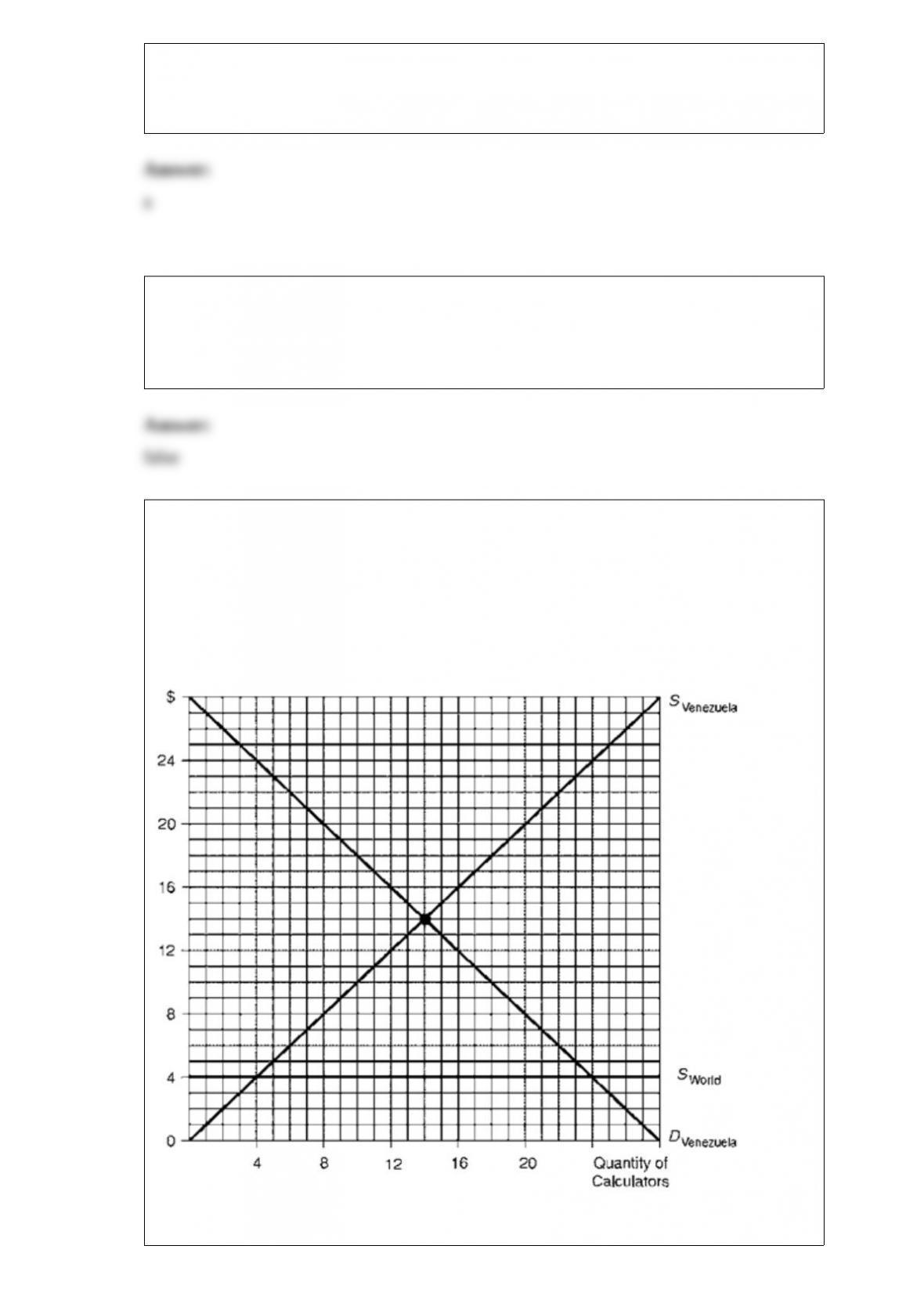
16) figure 5.4 illustrates the calculator market for venezuela, assumed to be a ‘small”
country that is unable to affect the world price. svenezuela is the domestic supply
schedule and dvenezuela is the domestic demand schedule.
figure 5.4. venezuelan calculator market
consider figure 5.4. the cost of the production subsidy to the venezuelan government
totals:

a.$32
b.$40
c.$48
d.$54
17) the leontief paradox suggested that, in contrast to the predictions of the
factor-endowment theory, u.s. exports were less capital-intensive than u.s.
import-competing goods.
a.true
b.false