
In the Keynesian causal chain, changes in GDP cause changes in the level of interest
rates.
a. True
b. False
Which of the following is concerned with the distribution part of resource allocation?
a. An economy decides to produce equal quantities wheat, rice, and clothes.
b. An economy decides to use 25% of the available capital for producing clothes.
c. An economy decides to ration 40% of its output to low income groups.
d. An economy decides to use more labor for producing wheat and rice.
The contestable market theory best applies to
a. pure monopoly.
b. oligopoly.
c. monopolistic competition.
d. perfect competition.

According to supply siders, tax cuts should increase aggregate supply.
a. True
b. False
Price discrimination
a. may lead to greater output.
b. always leads to a reduction of output.
c. leads to lower profits for the firm.
d. causes firms to operate at a higher cost.

Which of the following best describes a situation of moral hazard?
a. Sicker people are more likely to buy health insurance.
b. Prospective used-car buyers have less information about a particular car than its
seller does.
c. Drivers with collision insurance drive more recklessly.
d. Drivers with collision insurance wear seatbelts less often.
It pays the firm to produce only if total variable costs exceed total revenue.
a. True
b. False
The demand for education is determined by the
a. demand for human capital.
b. demand for nonhuman capital.
c. supply of human capital.
d. supply of nonhuman capital.

The ability-to-pay principle is most closely tied to the concept of
a. horizontal equity in taxation.
b. fiscal federalism.
c. vertical equity in taxation.
d. the benefits principle of tax equity.
In 2001, the first year of the Bush administration, Americans learned that recessions
were a thing of the past.
a. True
b. False

On a steeply sloped aggregate supply curve, monetary policy will affect primarily
output.
a. True
b. False
The currency value of Agraria is set by government decree. Which of the following
happens when the government alters the exchange rate so that its currency can buy
more units of foreign currency?
a. Reflation
b. Devaluation
c. Appreciation
d. Revaluation
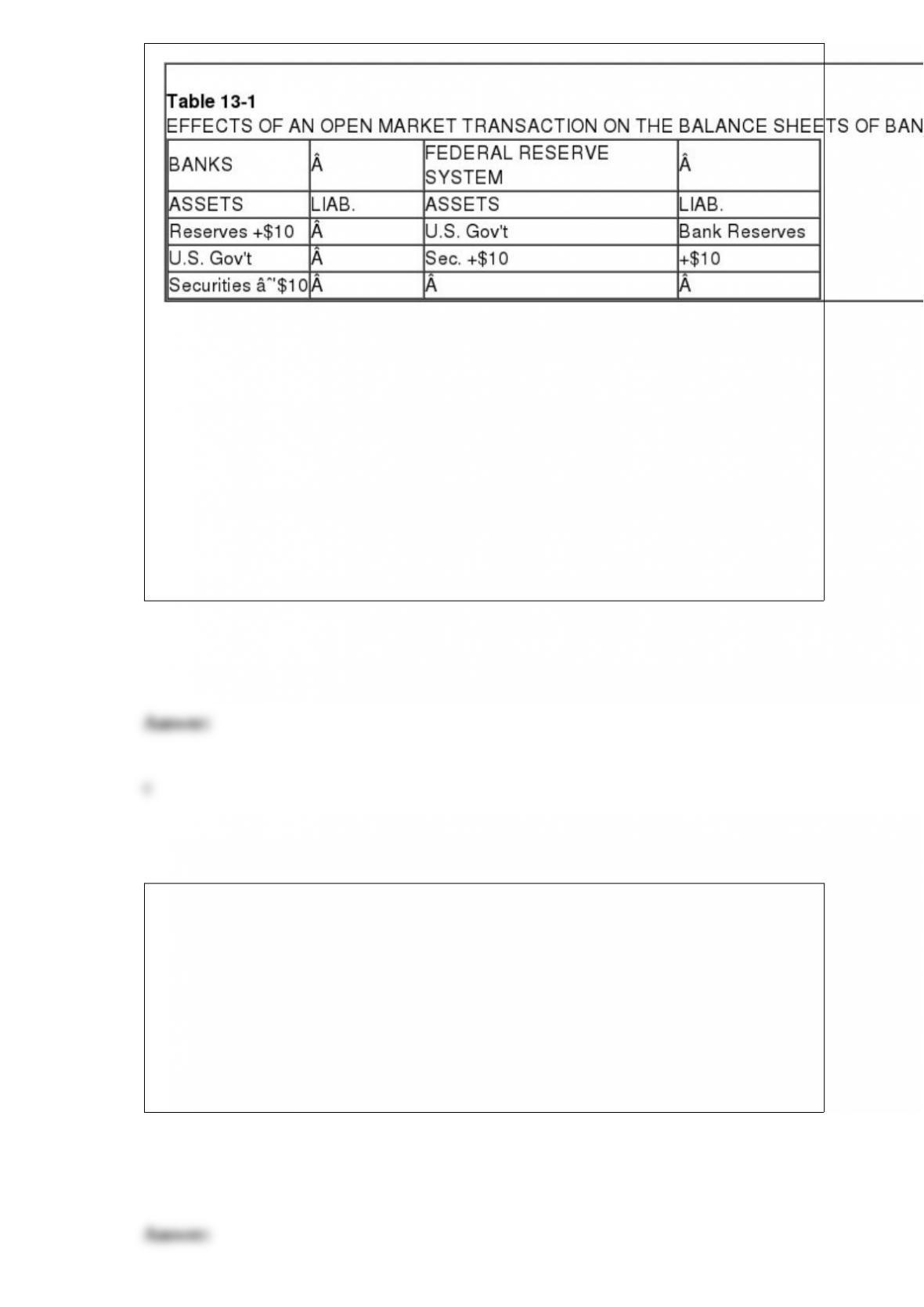
In Table 13-1, the Federal Reserve System has
a. sold $10 million in government securities to banks, taking payment in cash.
b. sold $10 million in government securities to banks, taking payment from the bank’s
reserves.
c. purchased $10 million in government securities from banks, paying for them with
increases in banks’ reserves.
d. purchased $10 million in government securities from banks, paying for them with
new Federal Reserve notes.
Identify the main reason to expect convergence in the long run.
a. Low-productivity countries learning from high-productivity countries
b. Rapid growth in the supply of capital in low-productivity countries
c. Educational attainment rising quickly in low-productivity countries
d. Economic complacency and mismanagement in high-productivity countries

Economies of scale
a. require inputs’ MPP to fall as output increases (everything else equal).
b. pertain to the long run only.
c. refer to increased output generalized by an increase in the quantity of a single input.
d. imply that the AC curve will fall continuously as output increases in the short run.
At least two demand curves are present in an international equilibrium model.
a. True
b. False
Suppose the federal government wants to encourage businesses to increase investment
spending. Which policy may be the most effective?
a. an increase in corporate income taxes

b. an increase in real interest rates
c. an increase in warnings of a coming recession
d. an increase in tax deductions for investment spending
At a given output level, a monopolist earns a profit only if the
a. slope of its TR curve exceeds the slope of his TC curve.
b. height of its MR curve exceeds the height of his MC curve.
c. height of its demand curve exceeds the height of his MR curve.
d. height of its demand curve exceeds the height of his ATC curve.
Total utility will be at its maximum when
a. marginal utility is negative.
b. marginal utility is positive.
c. marginal utility is maximized.
d. marginal utility is zero.

In the late 1990s, the more than expected increases in tax revenues were the result of
a. rapid economic growth.
b. rapid increases in the national debt.
c. rising rates of inflation, and therefore, nominal incomes.
d. rising balance of trade surpluses and the import duties they generated.
Firms with monopoly power tend to be more efficient than competitive firms.
a. True
b. False
A decrease in the price of a good will cause a movement along the demand schedule to
a higher quantity demanded.

a. True
b. False
In William Safire’s 1983 essay, “Smoot-Hawley Lives,” he argues that the United States
should
a. threaten retaliation if trading partners practice protectionism.
b. pursue a unilateral free trade policy regardless of what others do.
c. limit government’s role in the economy.
The technique that addresses the problem of assigning inputs to specific industries is
a. known as laissez faire.
b. input-output analysis.
c. cost-benefit analysis.
d. a production possibilities frontier.

Velocity is commonly calculated by which of the following formulas?
a. (Value of money stock)/(Value of nominal GDP)
b. (Value of transactions)/(money stock)
c. (Value of financial transactions)/(GDP)
d. (Value of output)/(Value of input)
A perfectly competitive firm is a “price maker.”
a. True
b. False
The Federal Reserve System functions as America’s
a. tax collector.

b. stock and bond market.
c. savings bank.
d. central bank.
The economic rent analysis does not apply to any factor
a. except land.
b. whose supply curve is vertical.
c. whose supply curve is horizontal.
d. whose quantity supplied is fixed.
According to the convention followed in the text, “money” consists all of the following
except
a. coins.
b. credit cards.
c. checkable deposits.
d. paper money.

The United States is one of the least marketized economies in the world.
a. True
b. False
The MU of computers is initially larger than the MC of producing them in a free
market. We may expect output of computers to
a. fall, MC to rise, and MU to rise.
b. rise, MC to fall, and MU to fall.
c. rise, MC to rise, and MU to fall.
d. fall, MC to fall, and MU to rise.

Ex-London School of Economics student Mick Jagger sang, “You can’t always get what
you want, but if you try sometime, you just might find you can get what you need.”
Another statement of the basic economic principle expressed in this lyric is that
a. rational decisions are not always possible.
b. you can allocate your resources to what gives you the highest value.
c. you can create the supply to meet your own demand.
d. you can maximize social welfare by making optimal decisions.
To protect themselves from the effects of inflation, lenders try to estimate the expected
rate of inflation.
a. True
b. False
In contrast to the need for legal enforcement under a system of direct controls, a taxes
approach
a. is subject to greater uncertainty of payment of fees.
b. makes taxes automatic and certain.
c. speeds the prosecution and conviction process.

d. does not actually reduce pollution, merely the cost of monitoring it.
A model that is an oversimplification for one purpose will likely be an
oversimplification for other purposes as well.
a. True
b. False