
Assume that for good X the supply curve for a good is a typical, upwardsloping straight
line, and the demand curve is a typical downwardsloping straight line. If the good is
taxed, and the tax is doubled, the
a. base of the triangle that represents the deadweight loss quadruples.
b. height of the triangle that represents the deadweight loss doubles.
c. deadweight loss of the tax doubles.
d. All of the above are correct.
The flatter the demand curve through a given point, the
a. greater the price elasticity of demand at that point.
b. smaller the price elasticity of demand at that point.
c. closer the price elasticity of demand will be to the slope of the curve.
d. greater the absolute value of the change in total revenue when there is a movement
from that point upward and to the left along the demand curve.
The overriding reason why households and societies face many decisions is that
a. resources are scarce.
b. goods and services are not scarce.
c. incomes fluctuate with business cycles.
d. people, by nature, tend to disagree.
The price elasticity of demand measures how much
a. quantity demanded responds to a change in price.

b. quantity demanded responds to a change in income.
c. price responds to a change in demand.
d. demand responds to a change in supply.
What would happen to the equilibrium price and quantity of latts if consumers’ incomes
rise and latts are a normal good?
a. Both the equilibrium price and quantity would increase.
b. Both the equilibrium price and quantity would decrease.
c. The equilibrium price would increase, and the equilibrium quantity would decrease.
d. The equilibrium price would decrease, and the equilibrium quantity would increase.
Sellers of a good bear the larger share of the tax burden when a tax is placed on a
product for which the
(i)supply is more elastic than the demand.
(ii)demand in more elastic than the supply.
(iii)tax is placed on the sellers of the product.
(iv)tax is placed on the buyers of the product.
a. (i) only
b. (ii) only
c. (i) and (iv) only
d. (ii) and (iii) only
A shortage exists in a market if
a. there is an excess supply of the good.
b. quantity supplied exceeds quantity demanded.
c. the current price is below its equilibrium price.
d. All of the above are correct.
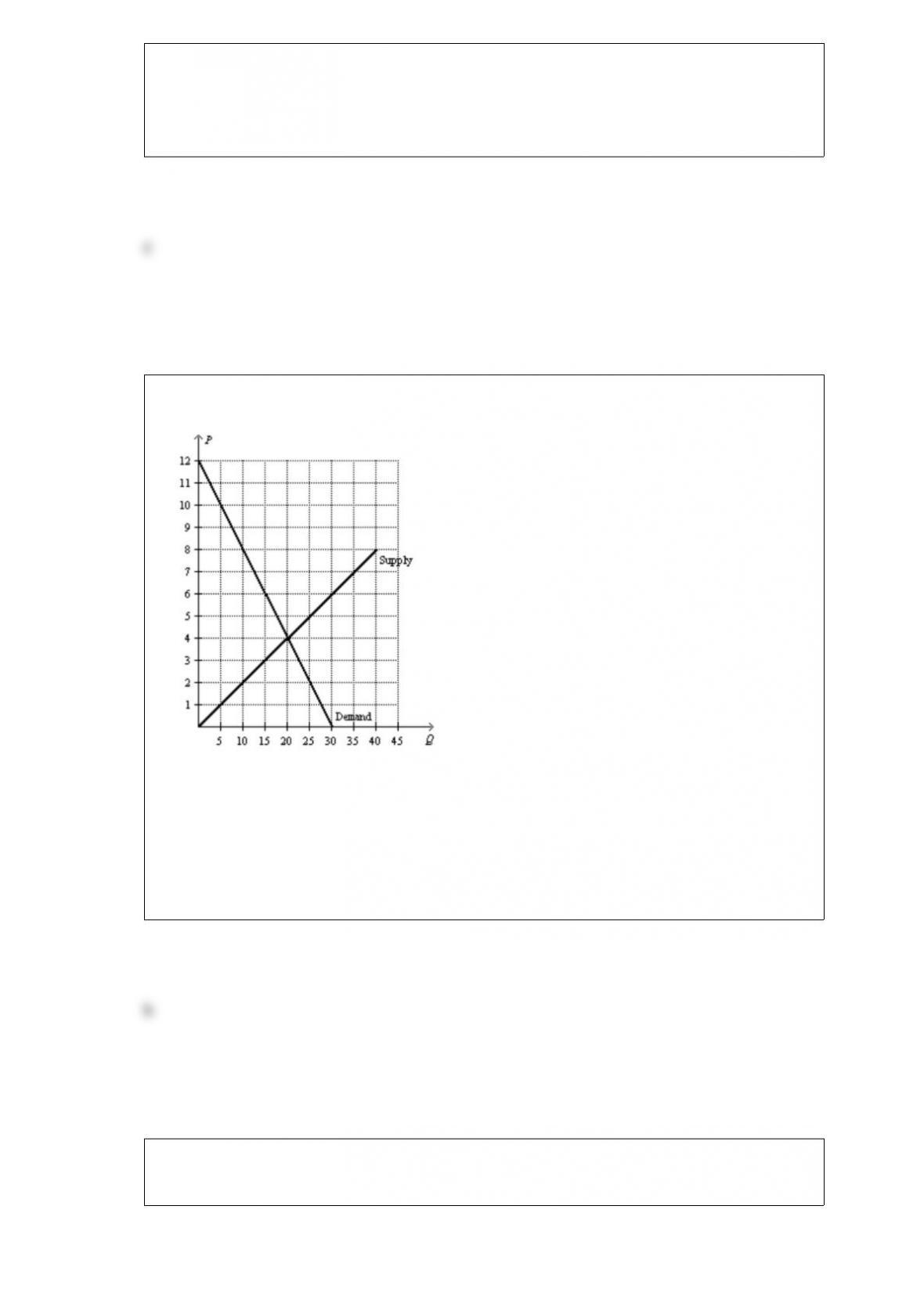
Figure 812
Refer to Figure 812. Suppose a $3 perunit tax is placed on this good. The loss of
producer surplus resulting from this tax is
a. $5.50.
b. $17.50.
c. $22.50.
d. $45.00
Figure 220
Relationship Between Years of Education and Annual Income
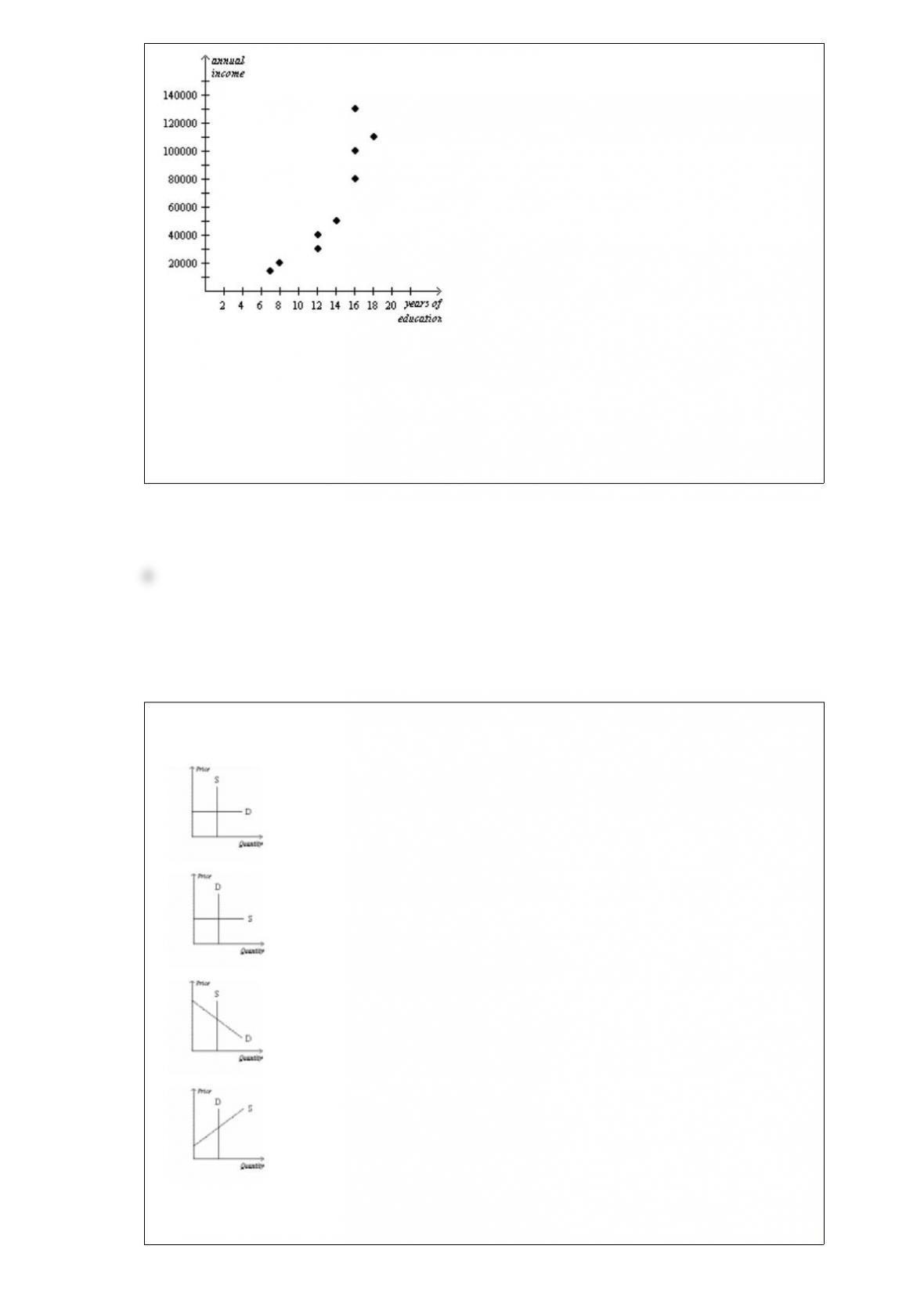
Refer to Figure 220. According to the graph, the correlation between years of
education and annual income is
a. positive
b. negative
c. inverse
d. normative
Which of the following is an illustration of the market for original paintings by
deceased artist Vincent Van Gogh?
a.
b.
c.
d.
a. A
b. B

c. C
d. D
Table 326
Assume that Japan and Korea can switch between producing cars and producing
airplanes at a constant rate.
Hours Needed to Make 1Quantity Produced in 2400 Hours
CarAirplaneCarsAirplanes
Japan301508016
Korea501504816
Refer to Table 326. Korea has an absolute advantage in the production of
a. cars and a comparative advantage in the production of cars.
b. cars and a comparative advantage in the production of airplanes.
c. neither good and a comparative advantage in the production of cars.
d. neither good and a comparative advantage in the production of airplanes.
Table 326
Assume that Japan and Korea can switch between producing cars and producing
airplanes at a constant rate.
Hours Needed to Make 1Quantity Produced in 2400 Hours
CarAirplaneCarsAirplanes
Japan301508016
Korea501504816
Refer to Table 326. Japan has an absolute advantage in the production of
a. cars and a comparative advantage in the production of cars.
b. cars and a comparative advantage in the production of airplanes.
c. neither good and a comparative advantage in the production of cars.
d. neither good and a comparative advantage in the production of airplanes.

Refer to Figure 27. If this economy devotes all of its resources to the production of
engines, then it will produce
a. 0 engines and 40 tvs.
b. 10 engines and 35 tvs.
c. 40 engines and 0 tvs.
d. 40 engines and 40 tvs.
Which of the following events would cause a movement upward and to the right along
the supply curve for mangos?
a. The number of sellers of mangos increases.
b. There is an advance in technology that reduces the cost of producing mangos.
c. The price of fertilizer decreases, and fertilizer is an input in the production of
mangos.
d. The price of mangos rises.
One should be especially wary of the nationalsecurity argument for restricting trade
when that argument is made by
a. representatives of industry.
b. representatives of the defense establishment.
c. members of households.
d. foreign government officials.

It costs a company $35,000 to produce 500 graphing calculators. The company’s cost
will be $35,080 if it produces an additional graphing calculator. If the company
produces 501 graphing calculators then
a. its average cost is greater than its marginal cost.
b. its average cost and its marginal cost are equal.
c. its average cost is less than its marginal cost.
d. This cannot be determined from the information given.
When quantity supplied increases at every possible price, we know that the supply
curve has
a. shifted to the left.
b. shifted to the right.
c. not shifted; rather, we have moved along the supply curve to a new point on the same
curve.
d. not shifted; rather, the supply curve has become flatter.
Figure 620
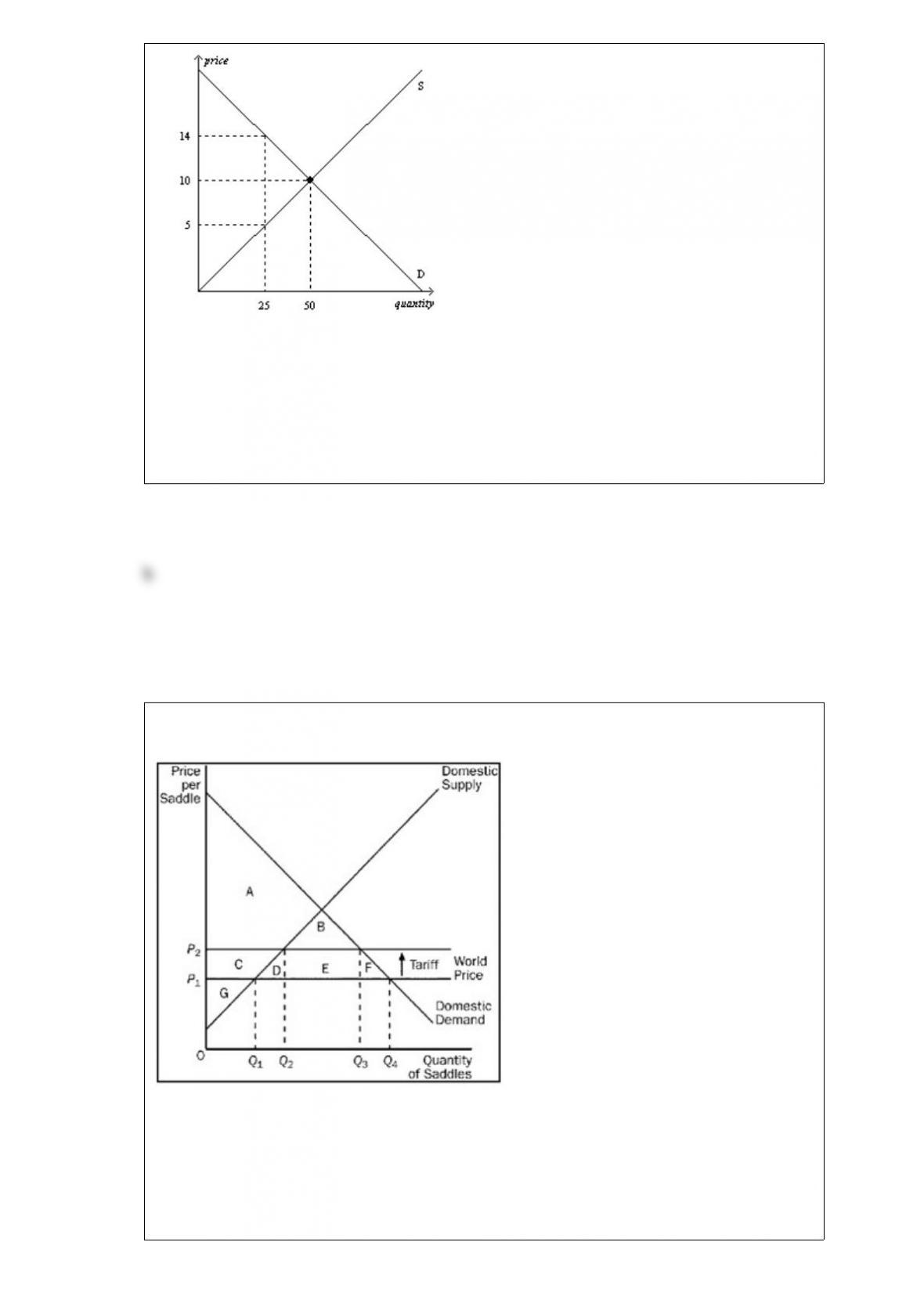
Refer to Figure 620. Suppose a tax of $5 per unit is imposed on this market. How
much will sellers receive per unit after the tax is imposed?
a. $5
b. between $5 and $10
c. between $10 and $14
d. $14
Figure 915
Refer to Figure 915. With the tariff, the quantity of saddles imported is
a. Q3Q1.
b. Q3Q2.
c. Q4Q1.
d. Q4Q2.

Ronald Reagan believed that reducing income tax rates would
a. do little, if anything, to encourage hard work.
b. result in large increases in deadweight losses.
c. raise economic wellbeing and perhaps even tax revenue.
d. lower economic wellbeing, even though tax revenue could possibly increase.
Economists normally assume people’s preferences should be
a. respected.
b. adjusted.
c. overruled.
d. ignored.
When a tax is placed on the buyers of a product, buyers pay
a. more and sellers receive more than they did before the tax.
b. more and sellers receive less than they did before the tax.
c. less and sellers receive more than they did before the tax.
d. less and sellers receive less than they did before the tax.
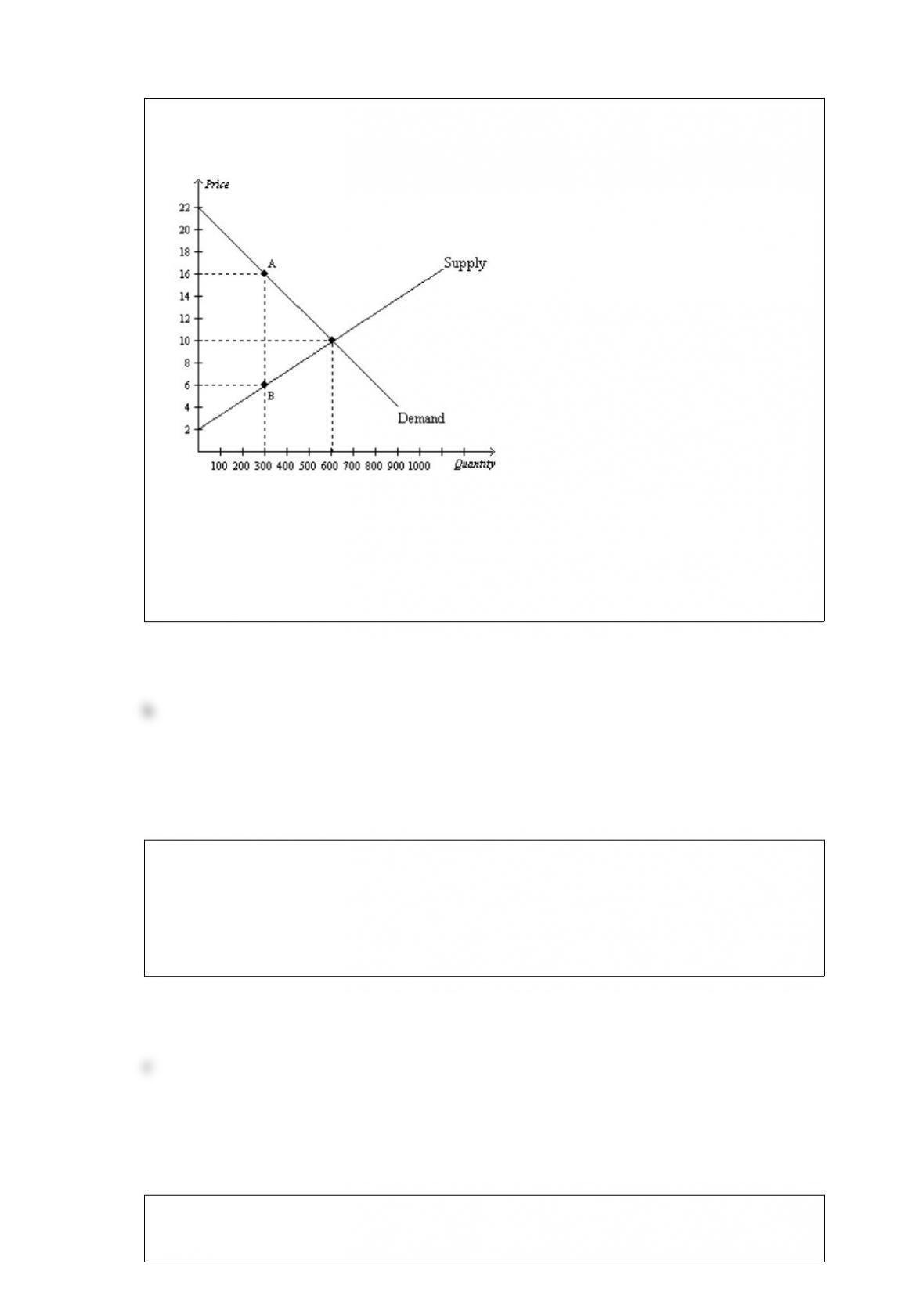
Figure 86
The vertical distance between points A and B represents a tax in the market.
Refer to Figure 86. When the tax is imposed in this market, producer surplus is
a. $450.
b. $600.
c. $900.
d. $1,500.
Economists use some familiar terms in specialized ways
a. to make the subject sound more complex than it is.
b. because every respectable field of study has its own language.
c. to provide a new and useful way of thinking about the world.
d. because it was too difficult to come up with new terms.
A tax on the buyers of personal computer external hard drives encourages
a. sellers to supply a smaller quantity at every price.
b. buyers to demand a smaller quantity at every price.
c. buyers to demand a larger quantity at every price.
d. Both a) and b) are correct.
The principle that trade can make everyone better off applies to
a. individuals.
b. families.
c. countries.
d. All of the above
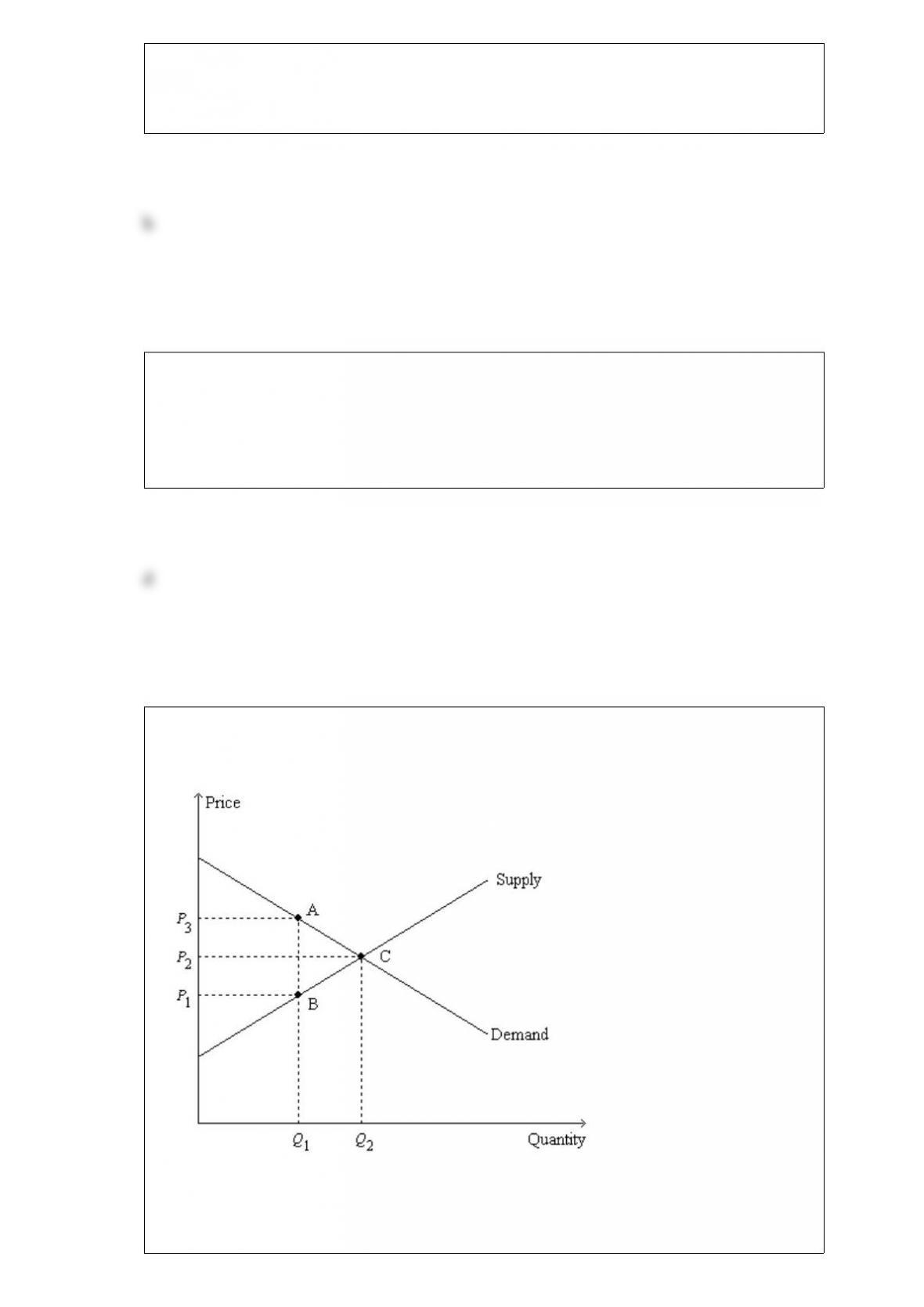
Figure 811
Refer to Figure 811. Suppose Q1 = 4; Q2 = 7; P1 = $6; P2 = $8; and P3 = $10. Then,
when the tax is imposed,
a. the government collects $28 in tax revenue.
b. producer surplus decreases by $13.
c. consumer surplus decreases by $11.
d. the deadweight loss amounts to $9.
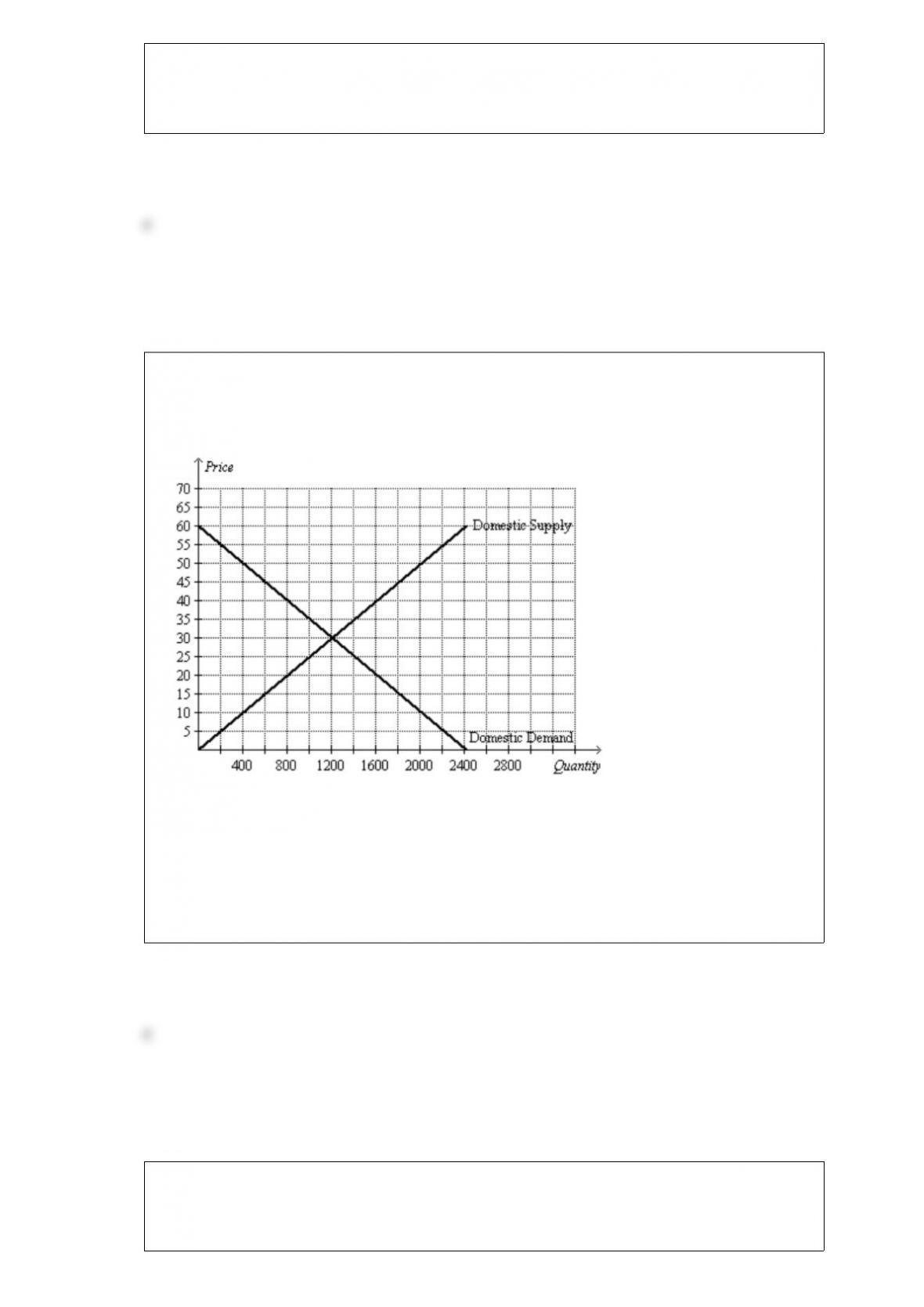
Figure 921
The following diagram shows the domestic demand and domestic supply for a market.
In addition, assume that the world price in this market is $40 per unit.
Refer to Figure 921. With free trade, domestic production and domestic consumption,
respectively, are
a. 1,200 and 800.
b. 1,600 and 1,200.
c. 1,600 and 800.
d. 1,200 and 1,200
When a country that imports a particular good imposes a tariff on that good,
a. producer surplus increases and total surplus increases in the market for that good.
b. producer surplus increases and total surplus decreases in the market for that good.

c. producer surplus decreases and total surplus increases in the market for that good.
d. producer surplus decreases and total surplus decreases in the market for that good.
Table 339
Assume that Japan and Korea can switch between producing cars and producing
airplanes at a constant rate.
Hours Needed to Make 1Quantity Produced in 2400 Hours
CarsAirplanesCarsAirplanes
Japan301508016
Korea501504816
Refer to Table 339. Korea should specialize in the production of
a. cars and import airplanes.
b. airplanes and import cars.
c. both goods and import neither good.
d. neither good and import both goods.