
1) Because the quantity theory of money tells us how much money is held for a given
amount of aggregate income, it is also a theory of
A) interest-rate determination
B) the demand for money
C) exchange-rate determination
D) the demand for assets
2) Currency circulated by banks that could be redeemed for gold was called
A) junk bonds
B) banknotes
C) gold bills
D) state money
3) If the money supply is $20 trillion and velocity is 2, then nominal GDP is
A) $2 trillion
B) $10 trillion
C) $20 trillion
D) $40 trillion
4) In response to banks entering into the insurance business, insurance companies have
started to supply ________ insurance.
A) debt
B) credit
C) equity
D) currency
5) Suppose the economy is producing at the natural rate of output. A decrease in
consumer and business confidence will cause ________ in real GDP in the short run
and ________ in inflation in the short run, everything else held constant.
A) an increase; an increase
B) a decrease; a decrease
C) no change; an increase
D) no change; a decrease
6) Depositors lack of information about the quality of bank assets can lead to
A) bank panics
B) bank booms
C) sequencing
D) asset transformation
7)
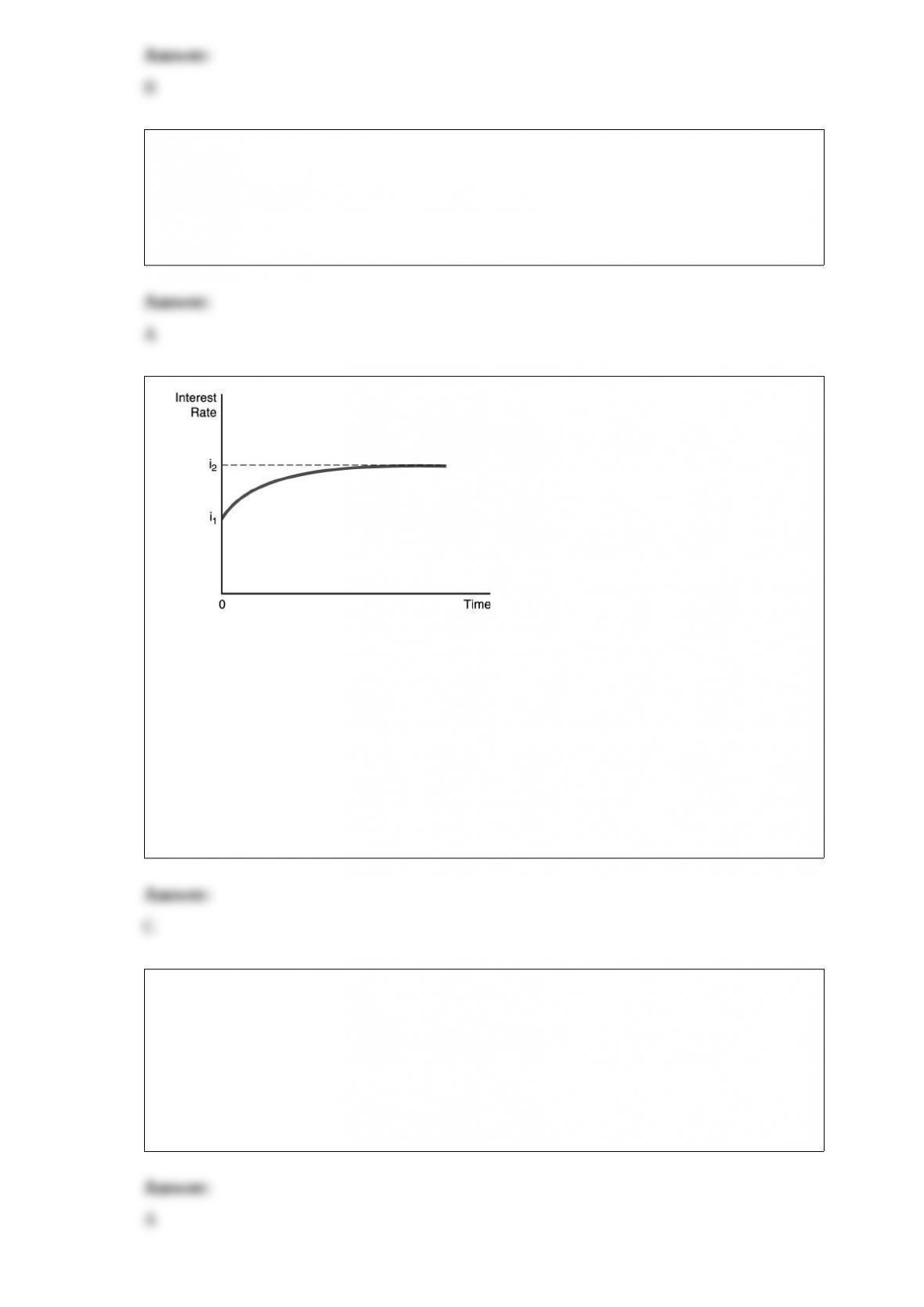
The figure above illustrates the effect of an increased rate of money supply growth at
time period 0 . From the figure, one can conclude that the
A) Fisher effect is dominated by the liquidity effect and interest rates adjust slowly to
changes in expected inflation
B) liquidity effect is dominated by the Fisher effect and interest rates adjust slowly to
changes in expected inflation
C) liquidity effect is dominated by the Fisher effect and interest rates adjust quickly to
changes in expected inflation
D) Fisher effect is smaller than the expected inflation effect and interest rates adjust
quickly to changes in expected inflation
8) An increase in the expected future domestic exchange rate causes the demand for
domestic assets to shift to the ________ and the domestic currency to ________,
everything else held constant.
A) right; appreciate
B) right; depreciate
C) left; appreciate
D) left; depreciate

9) Under a fixed exchange rate regime, a central bank that does not want to acquire
international reserves to keep its currency from ________ will decide to ________ its
currency.
A) depreciating; revalue
B) depreciating; devalue
C) appreciating; revalue
D) appreciating; devalue
10) If uncertainty about banks’ health causes depositors to begin to withdraw their funds
from banks, the country experiences a(n)
A) banking crisis
B) financial recovery
C) reduction of the adverse selection and moral hazard problems
D) increase in information available to investors
11) U.S. dollar deposits in foreign banks outside the U.S. or in foreign branches of U.S.
banks are called
A) Atlantic dollars
B) Eurodollars
C) foreign dollars
D) outside dollars
12) Which of the following is not a contractual savings institution?
A) A life insurance company
B) A pension fund
C) A savings and loan association
D) A fire and casualty insurance company
13) To say that inflation is a monetary phenomenon seems to beg the question:
A) Why does inflationary monetary policy occur?
B) Why do politicians seek reelection?
C) Why is the Fed independent?
D) Why does the U.S. Treasury print so much money?

14) In May 1991, the FDIC announced that it would sell the government’s final 26%
stake in Continental Illinois, ending government ownership of the bank that it had
rescued in 1984. The FDIC took control of the bank, rather than liquidate it, because it
believed that Continental Illinois
A) was a good investment opportunity for the government
B) could be the Chicago branch of a new governmentally-owned interstate banking
system
C) was too big to fail
D) would become the center of the new midwest region central bank system
15) Everything else held constant, a decrease in marginal tax rates would likely have
the effect of ________ the demand for municipal bonds, and ________ the demand for
U.S. government bonds.
A) increasing; increasing
B) increasing; decreasing
C) decreasing; increasing
D) decreasing; decreasing
16) Factors that led to worsening financial market conditions in East Asia in 1997-1998
include
A) weak supervision by bank regulators
B) a rise in interest rates abroad
C) unanticipated increases in the price level
D) increased uncertainty from political shocks
17) Which of the following statements concerning external sources of financing for
nonfinancial businesses in the United States are true?
A) Stocks are a far more important source of finance than are bonds
B) Stocks and bonds, combined, supply less than one-half of the external funds
C) Financial intermediaries are the least important source of external funds for
businesses
D) Since 1970, more than half of the new issues of stock have been sold to American
households

18) A put option gives the seller the
A) right to sell the underlying security
B) obligation to sell the underlying security
C) right to buy the underlying security
D) obligation to buy the underlying security
19) Financial markets improve economic welfare because
A) they channel funds from investors to savers
B) they allow consumers to time their purchase better
C) they weed out inefficient firms
D) eliminate the need for indirect finance
20) The originate-to-distribute business model has a serious ________ problem since
the mortgage broker has little incentive to make sure that the mortgagee is a good credit
risk.
A) principal-agent
B) debt deflation
C) democratization of credit
D) collateralized debt
21) Which of the following statements uses the economists’ definition of money?
A) I plan to earn a lot of money over the summer
B) Betsy is richshe has a lot of money
C) I hope that I have enough money to buy my lunch today
D) The job with New Company gave me the opportunity to earn more money
22) Which of the following insurance practices attempts to minimize the adverse
selection problem insurance companies face?
A) Prevention of fraud

B) Risk-based premiums
C) Restrictive provisions
D) Deductibles
23) Suppose the U.S. economy is producing at the natural rate of output. A depreciation
of the U.S. dollar will cause ________ in real GDP in the short run and ________ in
inflation in the long run, everything else held constant. (Assume the depreciation causes
no effects in the supply side of the economy.)
A) an increase; an increase
B) a decrease; a decrease
C) no change; an increase
D) no change; a decrease
24) If an economy has aggregate output of $20 trillion, then aggregate income is
A) $10 trillion
B) $20 trillion
C) $30 trillion
D) $40 trillion
25) Deposits in European banks denominated in dollars for the purpose of international
transactions are known as
A) Eurodollars
B) European Currency Units
C) European Monetary Units
D) International Monetary Units
26) When Americans or foreigners expect the return on dollar assets to be high relative
to the return on foreign assets, there is a ________ demand for dollar assets and a
correspondingly ________ demand for foreign assets.
A) higher; higher
B) higher; lower
C) lower; higher
D) lower; lower

27) Suppose that the European Central Bank enacts expansionary policy. Everything
else held constant, this will cause the demand for U.S. assets to ________ and the U.S.
dollar to ________.
A) increase; appreciate
B) decrease; appreciate
C) increase; depreciate
D) decrease; depreciate
28) Mortgage brokers often did not make a strong effort to evaluate whether the
borrower could pay off the loan. This created a
A) severe adverse selection problem
B) decline in mortgage applications
C) call to deregulate the industry
D) decrease in the demand for houses
29) There is a ________ association between inflation and the growth rate of money
________.
A) positive; demand
B) positive; supply
C) negative; demand
D) negative; supply
30) When good weather speeds the check-clearing process, float tends to ________
causing the Fed to initiate ________ open market ________.
A) decrease; defensive; sales
B) decrease; dynamic; sales
C) decrease; defensive; purchases
D) increase; dynamic; purchases

31) If firms have an incentive to hide information from mandatory disclosure because
the information is proprietary, then which of the following remedies is the least
intrusive way to overcome this incentive?
A) Leave it to the market
B) Separation of functions
C) Supervisory oversight
D) Socialization of information production
32) Assuming the economy is starting at the natural rate of output and everything else
held constant, the effect of ________ in aggregate ________ is a rise in both inflation
and output in the short-run, but in the long-run the only effect is a rise in inflation.
A) a decrease; supply
B) a decrease; demand
C) an increase; supply
D) an increase; demand
33) A higher ________ means that an asset’s return is more sensitive to changes in the
value of the market portfolio.
A) alpha
B) beta
C) CAPM
D) APT
34) The discount rate refers to the interest rate on
A) primary credit
B) secondary credit
C) seasonal credit
D) federal funds
35) All of the following are operating expenses for a bank except
A) service charges on deposit accounts
B) salaries and employee benefits
C) rent on buildings

D) servicing costs of equipment such as computers