
1) Suppose planting flowering shrubs creates a positive externality equal to $7 per
shrub. Further suppose that the local government offers a $7 per-shrub subsidy to
planters. The number of shrubs that are planted is then
a.less than the socially optimal quantity.
b.greater than the socially optimal quantity.
c.equal to the socially optimal quantity.
d.There is not enough information to answer the question.
2) Suppose that elementary education creates a positive externality. If the government
does not subsidize education, then
a.the equilibrium quantity of education will be equal to the socially optimal quantity of
education.
b.the equilibrium quantity of education will be greater than the socially optimal quantity
of education.
c.the equilibrium quantity of education will be less than the socially optimal quantity of
education.
d.There is not enough information to answer the question.
3) A street vendor sells a replica of a pair of designer shoes to a young woman who
believes the shoes are authentic. The street vendor is engaging in
a.both moral hazard and adverse selection.
b.neither moral hazard nor adverse selection.
c.moral hazard, but not adverse selection.
d.adverse selection, but not moral hazard.
4) The two “goods” used when economists analyze labor supply are
a.work and leisure.
b.work and consumption.
c.saving and consumption.
d.leisure and consumption.
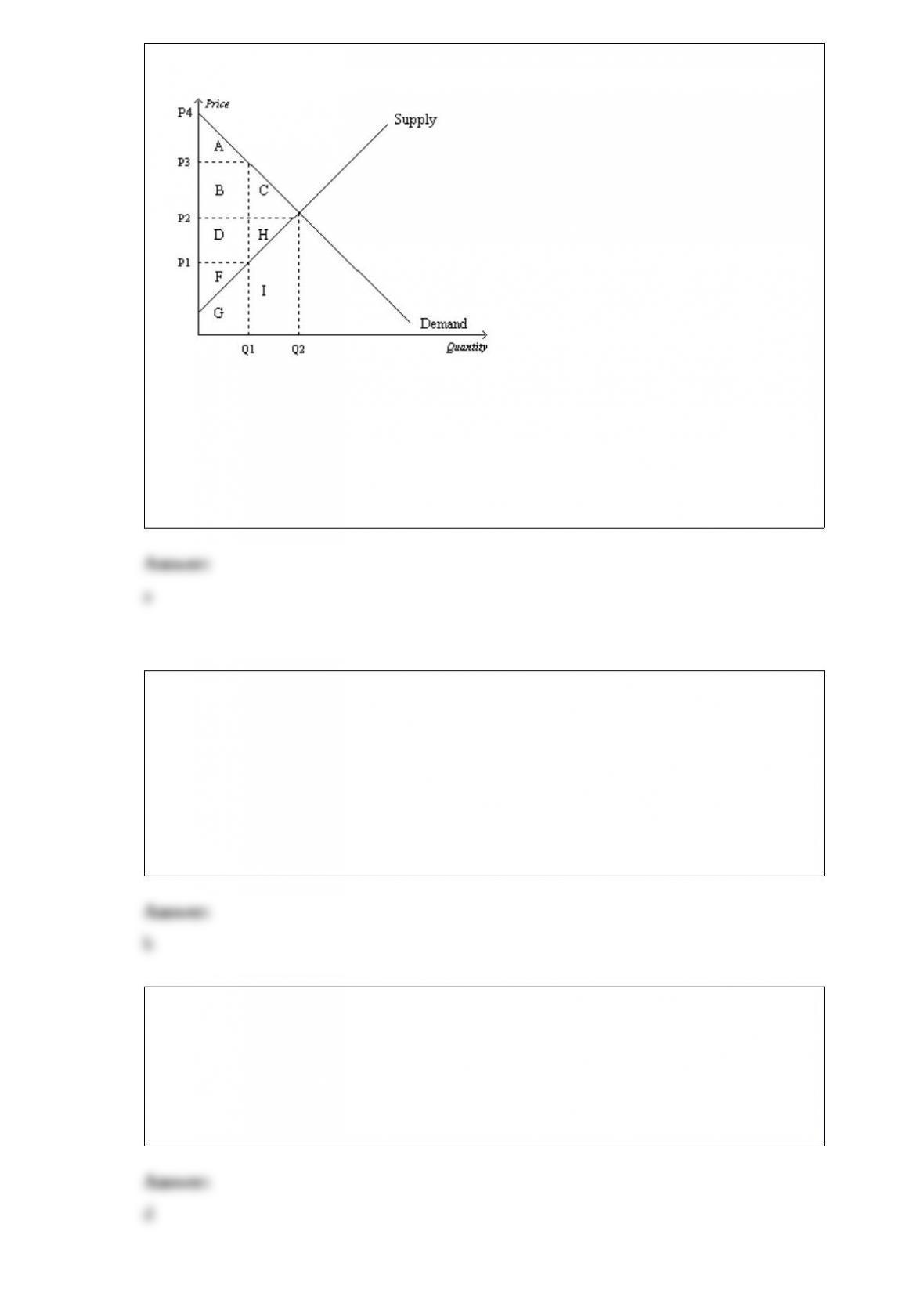
5) Figure 7-23
Refer to Figure 7-23. If the price were P3, consumer surplus would be represented by
the area
a.A.
b.A+B+C.
c.D+H+F.
d.A+B+C+D+H+F.
6) Suppose that a competitive firm hires labor up to the point at which the value of the
marginal product equals the wage and that labor is the only input that varies for the
firm. If the firm pays a wage of $700 per week and the marginal product of labor equals
10 units per week, then the marginal cost of producing an additional unit of output is
a.$7.
b.$70.
c.$700.
d.We do not have enough information to answer this question.
7) Comparing the United States household income distribution to other countries is
a.easy, because data is available for all countries in the world.
b.easy, because some countries collect data on expenditures instead of incomes.
c.problematic, because international agreements require countries to standardize their
income accounting procedures.
d.problematic, because countries collect data in different ways.

8) The relationship between the marginal utility that Casey gets from eating ice cream
sundaes and the number of ice cream cones he eats per week is as follows:
Casey receives 3 units of utility from the last dollar spent on each of the other goods he
consumes. If ice cream sundaes cost $4 each, how many ice cream sundaes will he
consume per month if he maximizes utility?
a.2
b.3
c.4
d.5
9) Which of the following moves the wage above its equilibrium value?
a.both compensating differentials and efficiency wages
b.compensating differentials but not efficiency wages
c.efficiency wages but not compensating differentials
d.neither compensating differentials nor efficiency wages
10) On a certain supply curve, one point is (quantity supplied = 200, price = $2.00) and
another point is (quantity supplied= 250, price = $2.50). Using the midpoint method,
the price elasticity of supply is about
a. 0.2
b.0.5
c.1.0
d.2.5
11) Which of the following statements is not correct?
a.An advantage of an in-kind transfer is that it prevents an alcoholic from spending a
cash benefit on alcohol.
b.An advantage of the Supplemental Security Income (SSI) program is that it benefits
the sick and disabled.
c.An advantage of a negative income tax program is that the poor must work to be
eligible.
d.Minimum wage laws result in higher unemployment among those groups of workers
affected by the minimum wage.
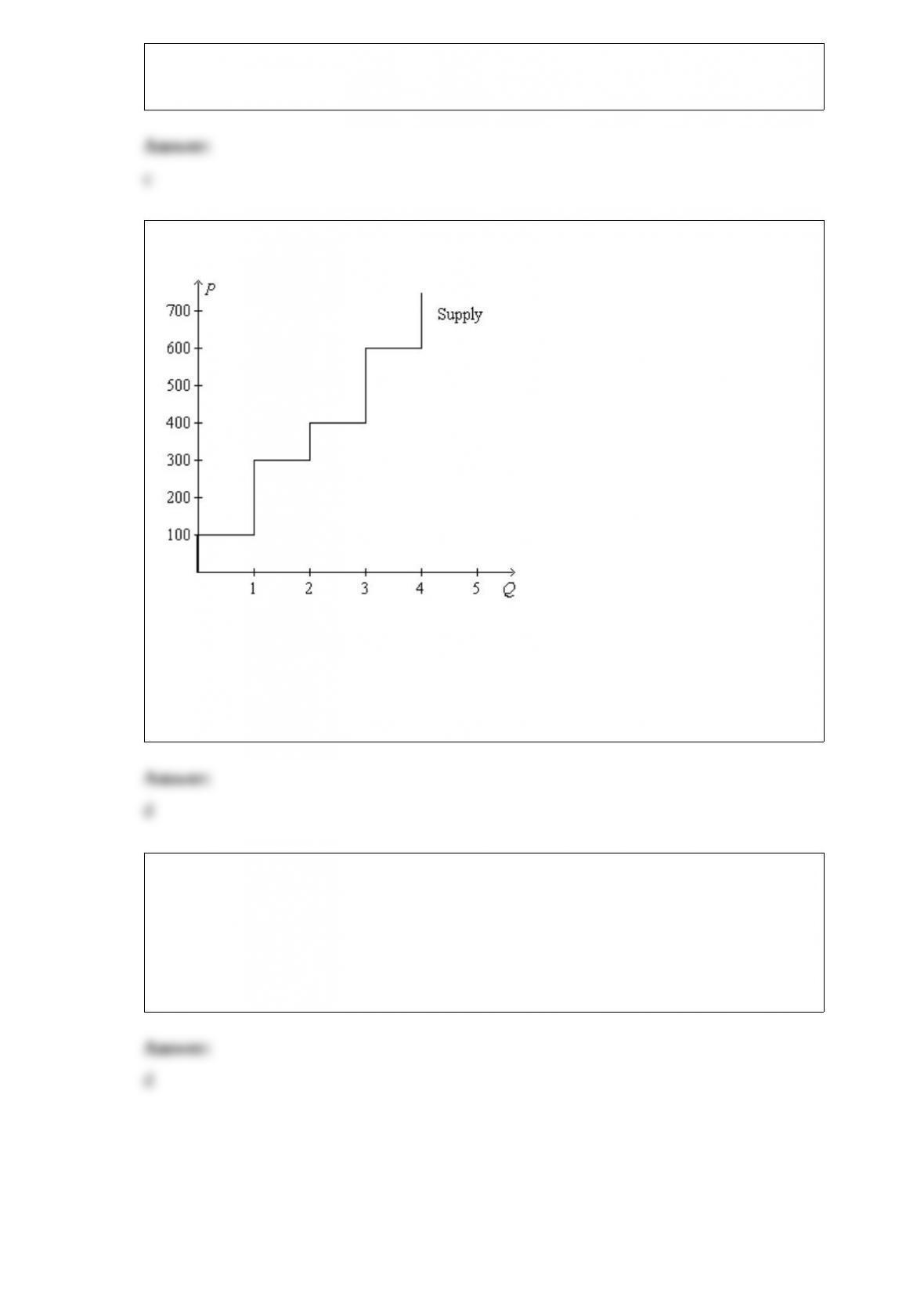
12) Figure 7-16
If the price of the good is $600, then
a.consumer surplus is $800.
b.consumer surplus is $900.
c.producer surplus is $900.
d.producer surplus is $1,000.
13) Which of the following is not an assumption of the productions possibilities
frontier?
a.A country produces only two goods or types of goods.
b.Technology does not change.
c.The amount of available resources does not change.
d.There is a fixed quantity of money.