
1) Fish in the open ocean are protected by strong property rights.
2) the economy of 1995-2007 was characterized by greater productivity growth and
greater economic growth than in the immediately preceding two decades.
3) The Consumer Product Safety Commission engages in social regulation, rather than
industrial regulation.
4) marginal utility theory and indifference curve analysis are both consistent with the
law of demand.
5) An employer (biased against African-Americans) whose discrimination coefficient is
$5 will hire only whites if the actual African-American-white wage gap is $7.
6) the long-run supply curve for a decreasing-cost industry is downsloping.
7) The World Trade Organization is comprised of 25 European nations and dedicated to
abolishing trade barriers and integrating their economies.
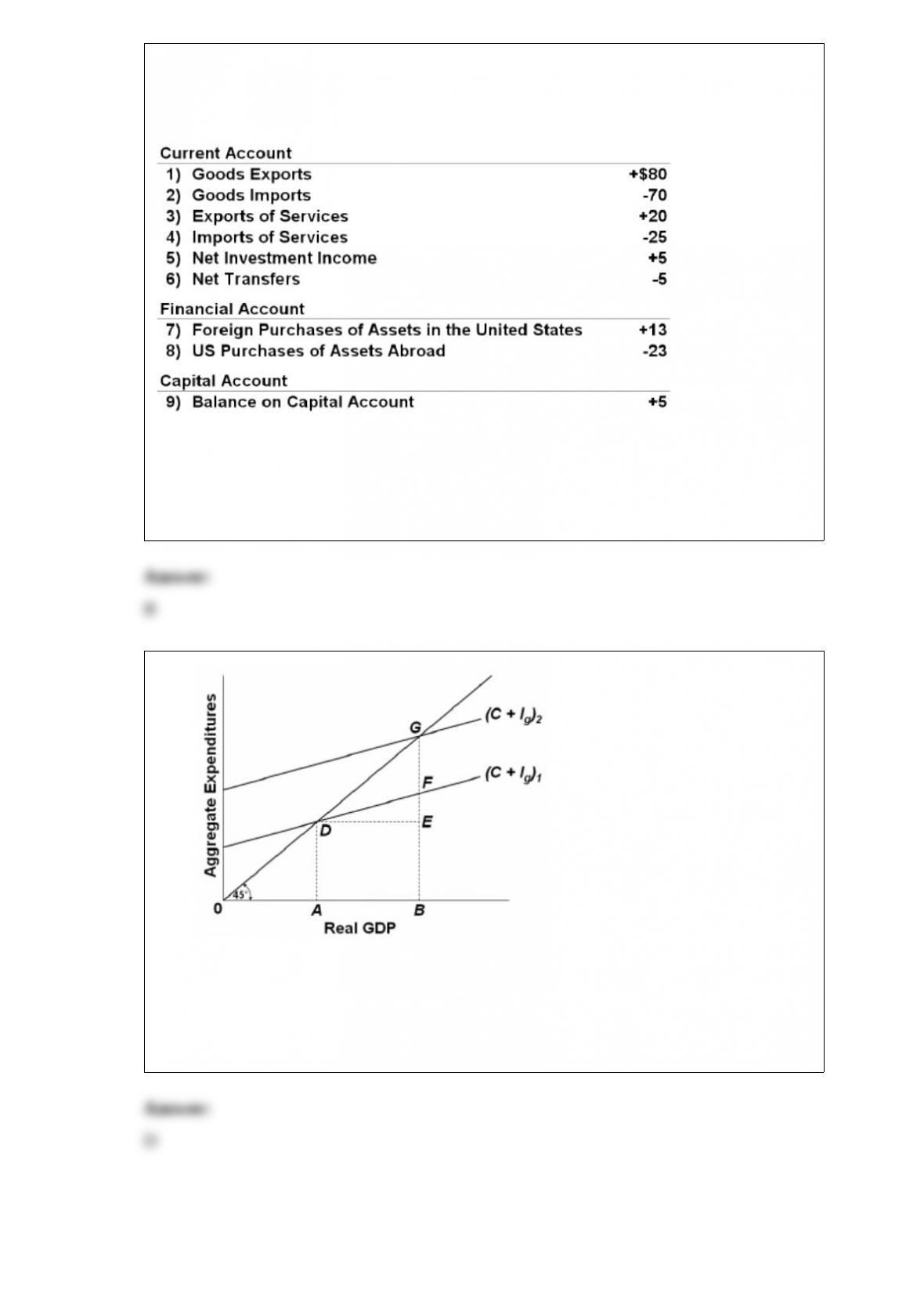
8) The following 2006 balance of payments data (+ and -) for the hypothetical nation of
Zabella. All figures are in billions of dollars.
Refer to the above data. Zabella’s balance on goods and services shows a:
A.$5 billion deficit.
B.$5 billion surplus.
C.$10 billion surplus.
D.$15 billion deficit.
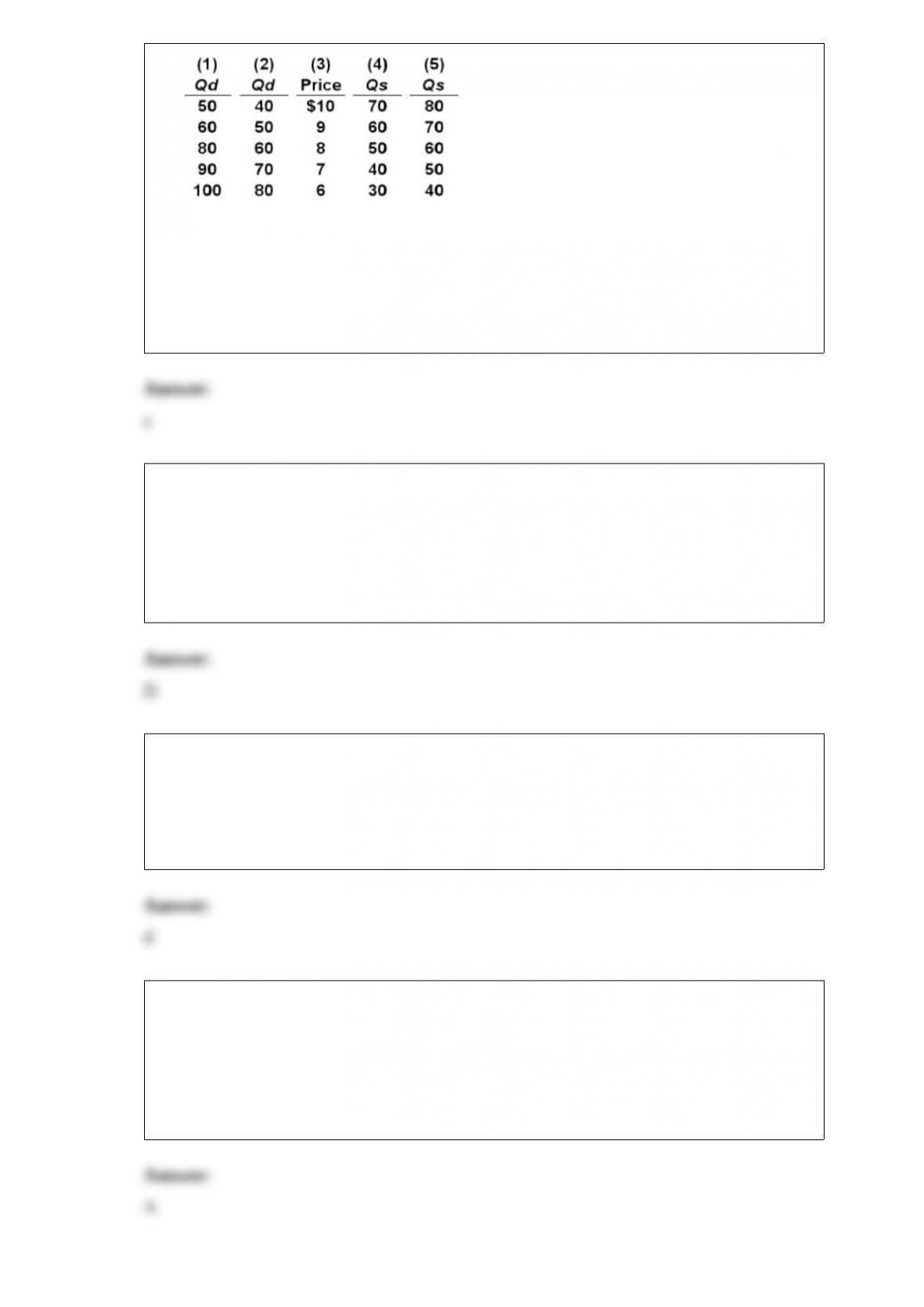
9)
Refer to the above diagram for a private closed economy. The multiplier is:
A.GF/DE.
B.GF/GB.
C.FE/GF.
D.AB/GF.
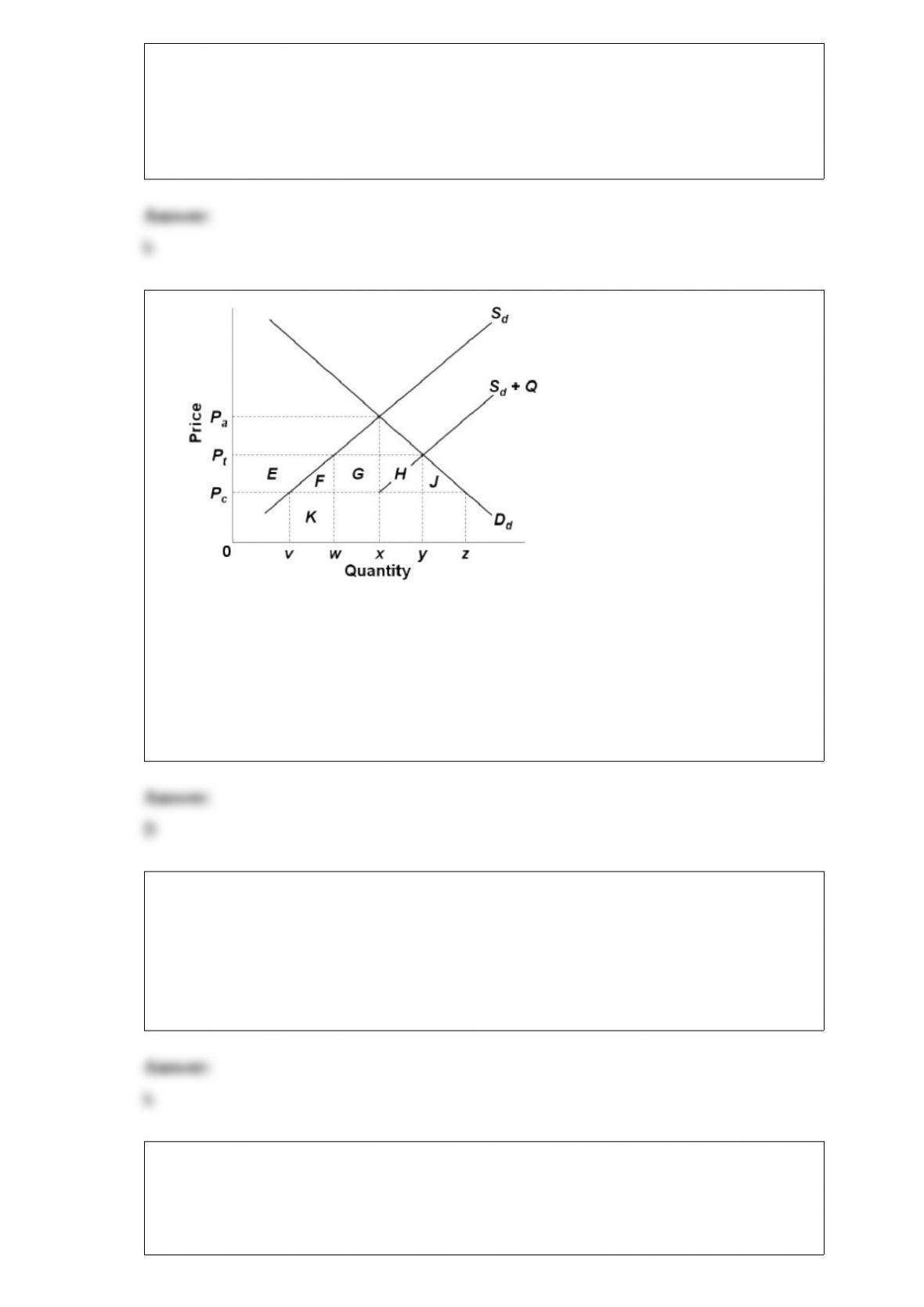
10)
refer to the above table. suppose that demand is represented by columns (3) and (2) and
supply is represented by columns (3) and (5). if the price were artificially set at $6, a:
a.the market would clear.
b.a surplus of 40 units would occur.
c.a shortage of 40 units would occur.
d.demand would change from columns (3) and (2) to columns (3) and (1).
11) Critics of the regulation of natural monopolies contend that:
A.regulation increases the incentive of firms to lower costs.
B.regulated firms may use creative accounting to reduce costs, prices, and profits.
C.when rates of return are based on the value of real capital, an uneconomic
substitution of labor for capital may occur.
D.the industry may “capture” or control the regulatory commission.
12) the quantity demanded of a product increases as its price declines because the:
a.lower price shifts the demand curve rightward.
b.lower price shifts the demand curve leftward.
c.lower price results in an increase in supply.
d.demand curve is downsloping.
13) Defined narrowly as wages and salaries, labor’s share of the national income is
about:
A.70 percent.
B.53 percent.
C.42 percent.
D.89 percent.
14) on a per unit basis economic profit can be determined as the difference between:
a.marginal revenue and product price.
b.product price and average total cost.
c.marginal revenue and marginal cost.
d.average fixed cost and product price.
15)
Refer to the above diagram, where Sd and Dd are the domestic supply and demand for a
product and Pc is the world price of that product. Sd + Q is the product supply curve
after an import quota is imposed. A tariff of Pc Pt will:
A.lower domestic price and increase domestic consumption.
B.increase the revenues of domestic producers by areas E + F + K
C.increase the revenues of domestic producers by areas G + H
D.increase the revenues of domestic producers by areas E + F + G + H + J
16) which of the following is not an example of pricing based on group differences in
elasticity of demand?
a.senior-citizen discounts at restaurants and motels.
b.cash rebates for purchases of automobiles.
c.child discounts for admission to theme parks.
d.discounted student prices for visits to museums.
17) Suppose lawyers seek legislation to limit the use of computer software that enables
people to use their personal computers to self-prepare their own wills, trusts, and other
legal documents. This is an example of:
A.logrolling.
B.the principal-agent problem.
C.rent-seeking behavior.
D.limited and bundled choices.
18) When the required reserve ratio is increased, the excess reserves of member banks
are:
A.reduced, but the multiple by which the commercial banking system can lend is
unaffected.
B.reduced and the multiple by which the commercial banking system can lend is
increased.
C.increased and the multiple by which the commercial banking system can lend is
increased.
D. reduced and the multiple by which the commercial banking system can lend is
reduced.
19) The crowding-out effect suggests that:
A.tax increases are paid primarily out of saving and therefore are not an effective fiscal
device.
B.government borrowing to finance the public debt increases the real interest rate and
reduces private investment.
C.it is very difficult to have excessive aggregate spending in a capitalist economy.
D.consumer and investment spending always vary inversely.
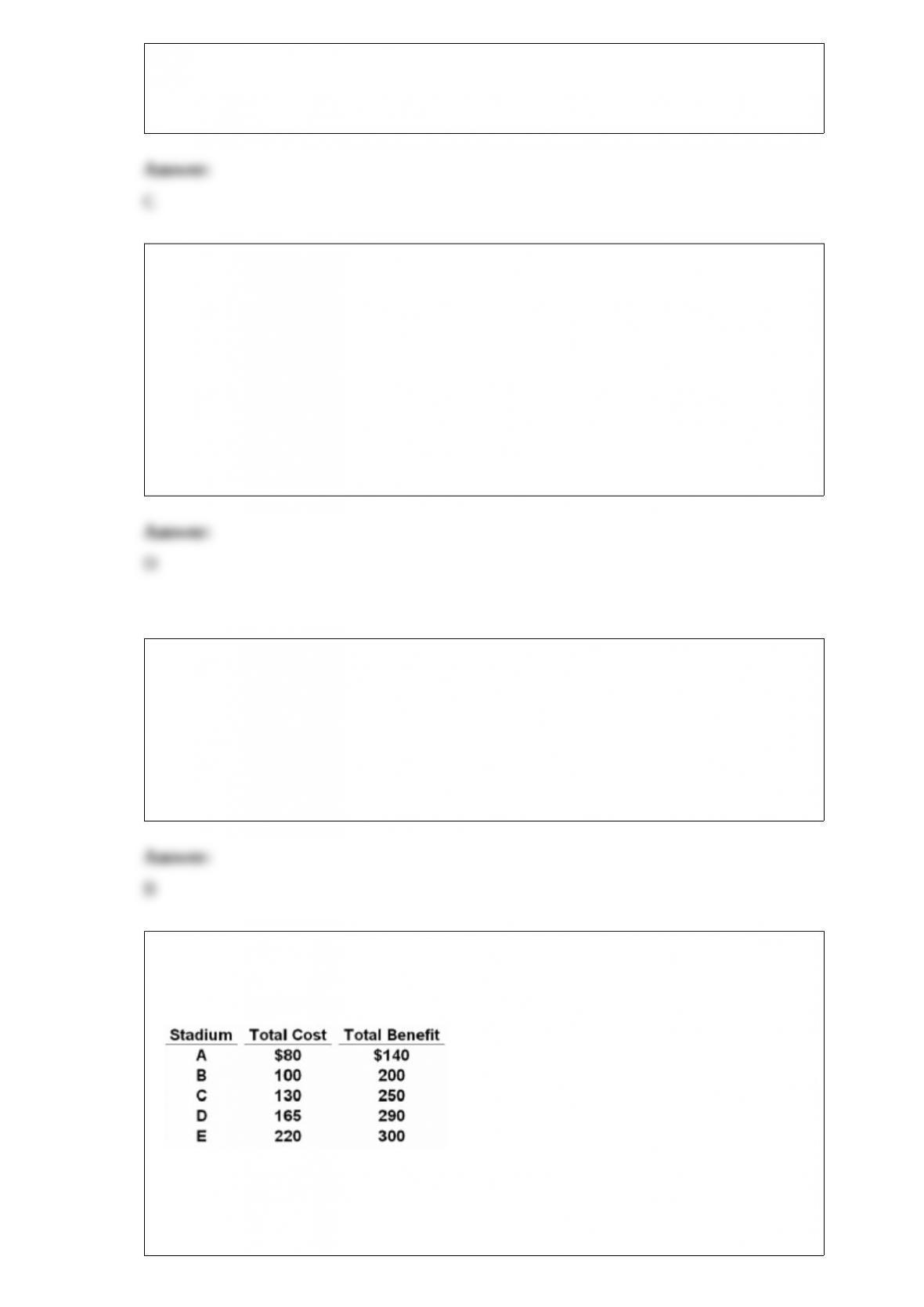
20) The following table shows the total costs and total benefits facing a city of five
different potential baseball stadiums of increasing size. All figures are in millions of
dollars.
Refer to the above table. Suppose a five-person city council must decide via majority
voting which of these stadiums to build. Also suppose that each of the stadium sizes has
the support of one council member. According to the median voter model, the council
will ultimately vote in favor of stadium:
A.A
B.B
C.C
D.D
21)
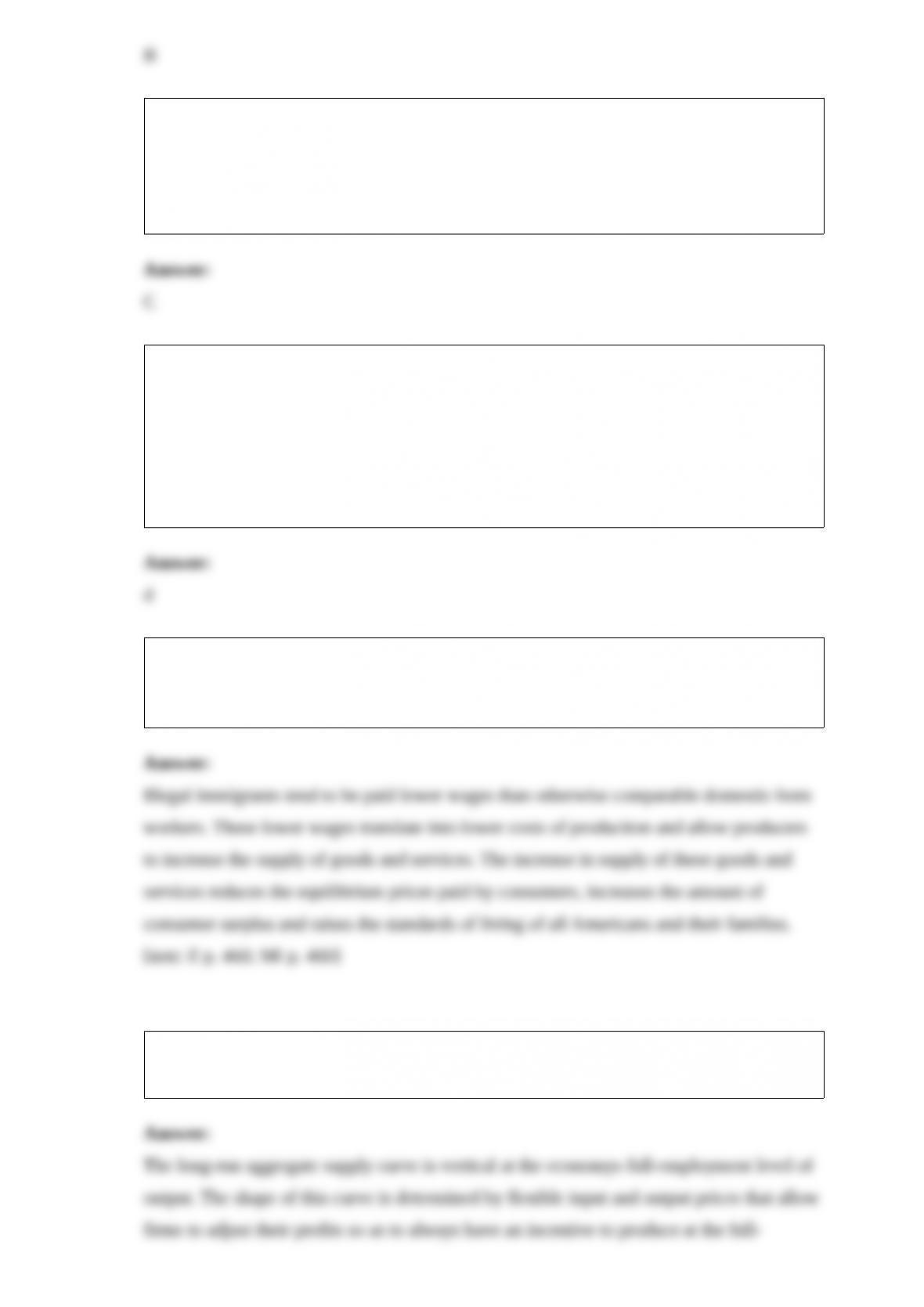
in the above diagrams for a hypothetical economy, figure 2 shows the:
a.personal distribution of income.
b.functional distribution of income.
c.microeconomic distribution of income.
d.rates of poverty in the united states.
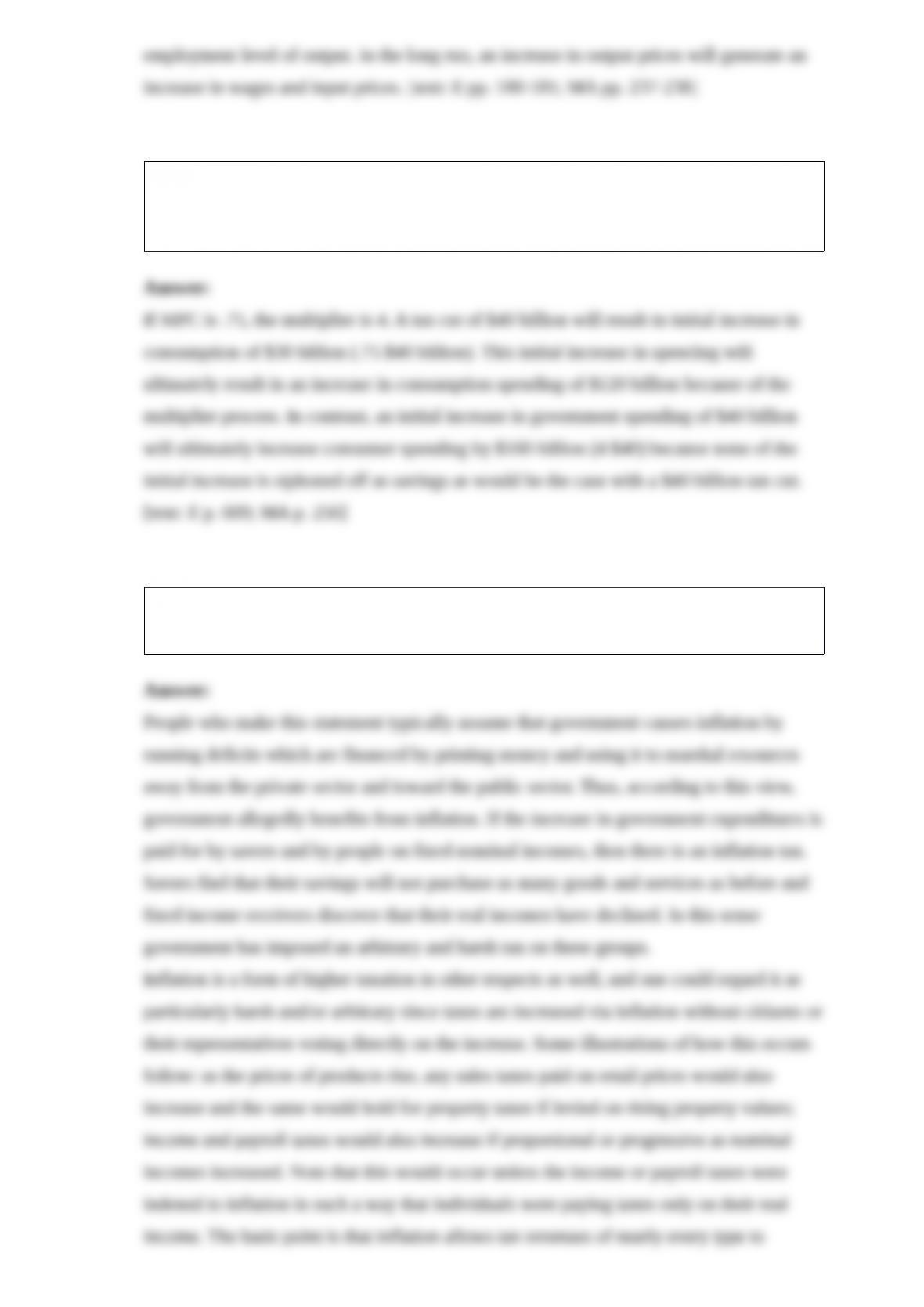
22)
The demand for Federal funds is
A.horizontal.
B.downward sloping.
C.upward sloping.
D.vertical.
23) A profit-maximizing firm employs resources to the point where:
A.MRC = MP.
B.Resource price equals product price.
C.MRP = MRC.
D.MP = product price.
24) okun’s law:
a.measures the tradeoff between the rate of inflation and the rate of unemployment.
b.indicates the number of years it will take for a constant rate of inflation to double the
price level.
c.quantifies the relationship between nominal and real incomes.
d.shows the relationship between the unemployment rate and the size of the negative
gdp gap.
25) Why would illegal immigration have an effect on the prices of goods and services
produced by illegal workers? Who benefits from these lower product and service
prices?
26) What factors determine the vertical shape of the aggregate supply curve in the
long-run? Explain.
27) Explain the effect of a discretionary cut in taxes of $40 billion on the economy
when the economys marginal propensity to consume is .75. How does this discretionary
fiscal policy differ from a discretionary increase in government spending of $40 billion?
28) Inflation is a harsh and arbitrary form of taxation. Do you agree? If so, who pays
this tax?
29) It is stated that the avenues of economic growth are essentially the same for both
industrially advanced and developing nations. What are the two basic avenues?
30) What is the relationship between marginal cost and the supply curve for the purely
competitive firm?
31) Can the large public debt cause the nation to go bankrupt? Explain.
32) How do the consumer and producer surpluses in the monopolistic case differ from
those in the competitive case?