Most employees ________ pay taxes on the value of health insurance provided by
employers, and most people ________ get a tax break when buying individual health
insurance policies.
A) do; do
B) do; do not
C) do not; do
D) do not; do not
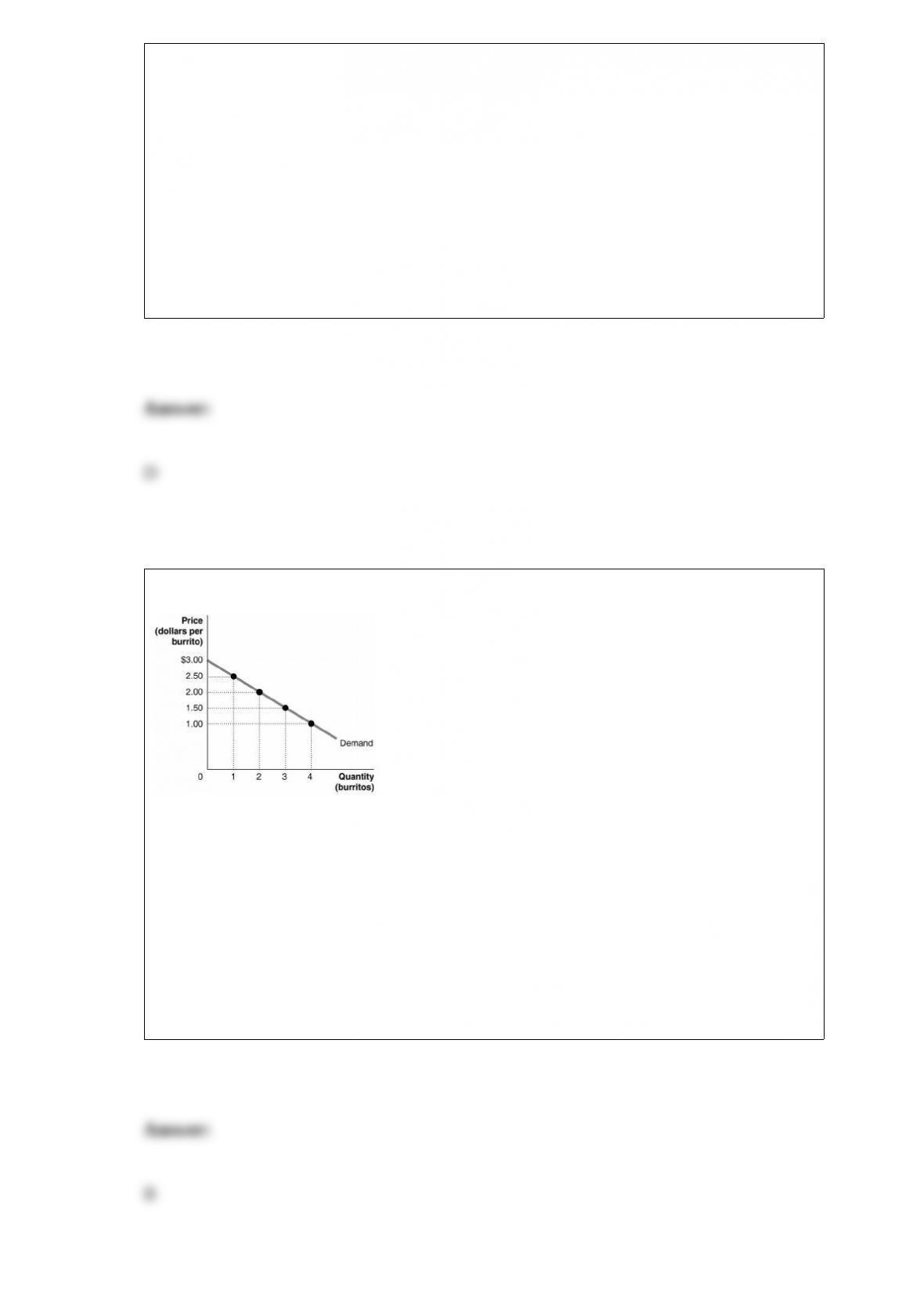
Figure 4-1
Figure 4-1 shows Arnold’s demand curve for burritos.
If the market price is $1.50, what is the consumer surplus on the first burrito?
A) $0.50
B) $1.00
C) $1.50
D) $7.50
In a closed economy, private saving is equal to which of the following? (Y = GDP, C =
Consumption, G = Government purchases, T = Taxes, and TR = Transfers)
A) Y – C – T
B) Y – G – T
C) Y – G – T + TR
D) Y + TR – C – T
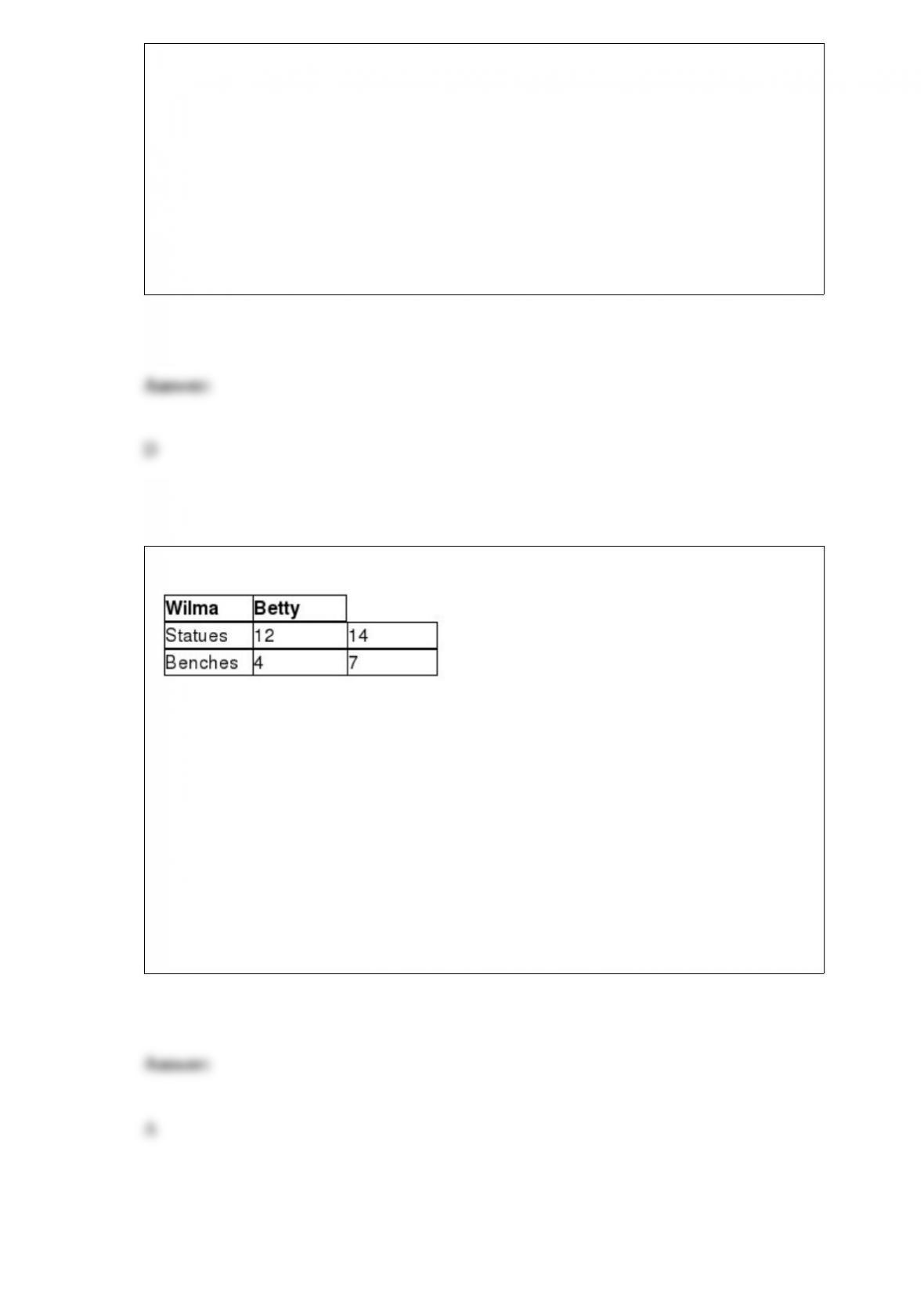
Table 2-8
Table 2-8 shows the output per month of two people, Wilma and Betty. They can either
devote their time to making marble statues or making marble benches.
What is Wilma’s opportunity cost of making a statue stick?
A) 1/3 bench
B) 3 benches
C) 6/7 statue
D) 1/2 bench

Which of the following is not a determinant of a good’s price elasticity of demand?
A) the slope of the demand curve
B) the share of the good in the consumer’s total budget
C) whether the good is a luxury or a necessity
D) the passage of time
To be a natural monopoly a firm must
A) control a key resource input.
B) have economies of scale that are so large that it can supply the entire market at a
lower cost than two or more firms.
C) have significant network externalities.
D) be very large relative to the total market.
If, at the current exchange rate between the dollar and the South African rand of 6.92
rand per dollar, the rand is “undervalued,” how do you expect demand and supply in the
foreign exchange markets to respond?
A) The demand for the dollar will fall, while the supply of the rand will rise.
B) The demand for the dollar will rise, while the supply of the rand will fall.
C) The supply of the dollar will rise, while the demand for the rand will rise.

D) The supply of the dollar will rise, while the demand for the rand will fall.
Which of the following would cause a decrease in the equilibrium price and an increase
in the equilibrium quantity of salmon?
A) a decrease in demand and an increase in supply
B) an increase in supply
C) an increase in supply and an increase in demand greater than the increase in supply
D) a decrease in demand and a decrease in supply
A Big Mac costs $4.00 in the United States and 9.00 reals in Brazil. If the exchange rate
is 2 reals per dollar, purchasing power parity predicts that
A) the dollar will appreciate as the demand for dollars falls in the long run.
B) the dollar will appreciate as the supply of dollars falls in the long run.
C) the dollar will depreciate as the demand for dollars falls in the long run.
D) the dollar will depreciate as the supply of dollars rises in the long run.

What is the marginal rate of substitution?
A) the price ratio
B) the rate at which the consumer must give up one good to purchase an additional unit
of the other goods in the market
C) the rate at which the consumer is willing to trade one good for another so that she
increases her utility
D) the rate at which the consumer is willing to trade one good for another without any
loss in utility
If a buyer in an economic transaction has more information than the seller, the buyer
benefits at the expense of the seller. This phenomenon is due to
A) moral hazard.
B) adverse selection.
C) economically irrational behavior.
D) gains from trade.
In the United States in 2012, the percentage of people with private health insurance was

about
A) 17%.
B) 29%.
C) 74%.
D) 83%.
In 1931, the first major country to abandon the gold standard – in order to increase its
policy options in face of the Great Depression – was
A) Great Britain.
B) the United States.
C) Germany.
D) France.