The law of demand says that
In the classical model, when an open economy has balanced trade, Say’s law holds.
Suppose that when the price of aspirin rises from $2 to $3 per bottle, the quantity
demanded falls from 800 bottles per day to 700 bottles per day. Over this range, the
demand for aspirin is
If the labor supply and demand curves cross at a wage of $20,
a. a wage rate of $10 per hour would lead to an excess demand for labor
b. a wage rate of $10 per hour would lead to an excess supply of labor
c. that wage causes a high rate of cyclical unemployment
d. employees are overpaid
e. a wage rate of $10 per hour would mean there is a significant amount of structural
unemployment
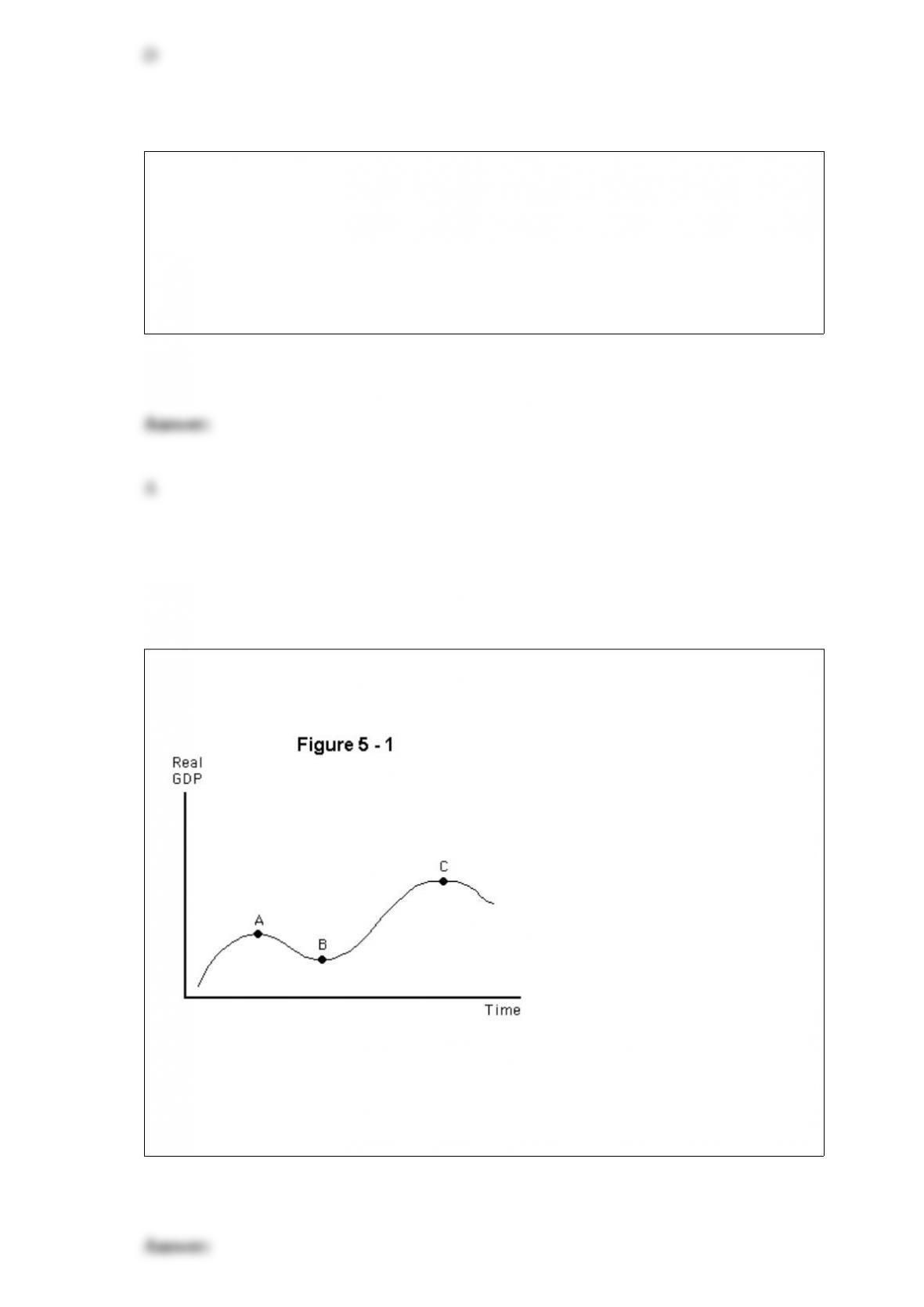
Refer to Figure 5-1 above. If the economy moves from point A to B on the graph, it is
going through a(n)
a. peak
b. trough
c. expansion
d. boom
e. recession
Which of the following is the most liquid category of assets?
a. Large time deposits
b. Money market mutual fund balances
c. Small time deposits
d. Saving-type accounts
e. Demand deposits
Accounting profit is defined as
U.S. residents bear the burden of unemployment equally.
The federal government
a. runs a deficit when tax revenues are greater than government purchases.
b. runs a surplus when tax revenues are smaller than government purchases.
c. runs a deficit when tax revenues are greater than government outlays.
d. runs a surplus when tax revenues are greater than government outlays.
e. runs a surplus when tax revenues are smaller than transfer payments..
When there is a change in demand,
Using the table below, calculate GDP for a particular year.
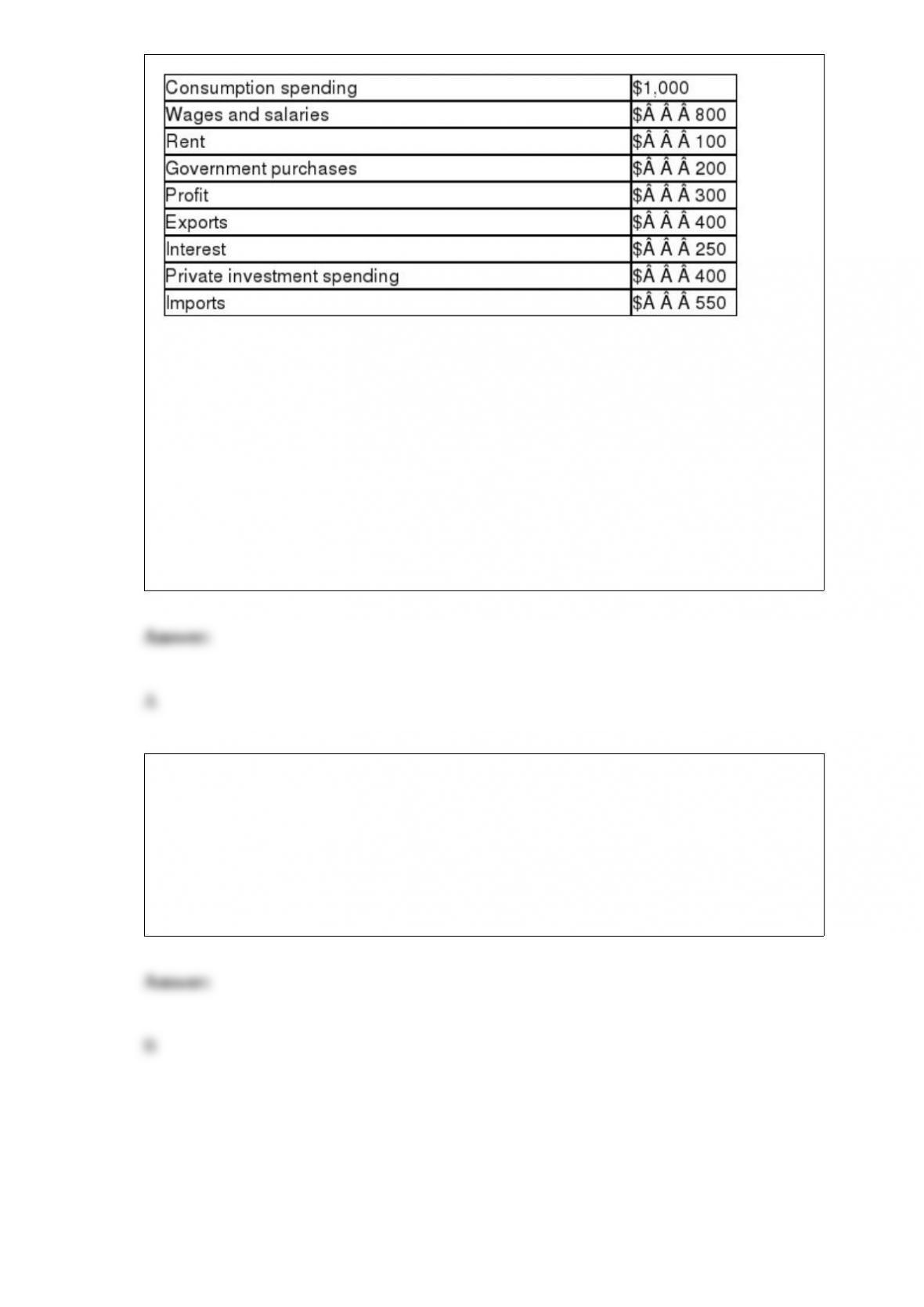
Based on the above information, GDP in this year was
a. $1,450
b. $2,000
c. $2,550
d. $2,900
e. $4,000
Which of the following statements best describes the U.S. labor force since World War
II?
a. Total employment grew, but the labor force participation rate fell.
b. Total employment grew, and so did the labor force participation rate.
c. Total employment grew, but the labor force participation rate remained unchanged.
d. Total employment remained constant, but the labor force participation rate fell.
e. Total employment remained constant, but the labor force participation rate rose.