In explaining consumer behavior economists explain how consumer tastes and
preferences are formed.
The Federal Reserve’s performance in the mid-to-late 1980s, 1990s, and early 2000s has
received high marks from economists, even without inflation targeting.
Even if expectations of inflation are rational, sluggish adjustment of wages and prices
will still create a short-run trade-off between inflation and unemployment.
The market demand curve facing a monopolist is more elastic than the market demand
curve facing a monopolistic competitor.
In the circular flow diagram, the value of all the income in the economy is greater than
the value of goods and services produced in the economy.
A decrease in the labor force shifts the production possibility frontier inwards over
time.
In the long-run equilibrium, a monopolistically competitive firm earning normal profit
produces the allocatively efficient output level.
In an economy with money, as opposed to barter, people are more likely to specialize in
the production of goods and services.
The cyclically adjusted budget is calculated at potential GDP.
Economic efficiency requires that a natural monopoly’s price be set corresponding to
the quantity where marginal revenue equals marginal cost.
An increase in the price level in the United States will shift the aggregate expenditure
line upward.
To maximize utility consumers should buy goods and services to the point where the
marginal utility of each item consumed is equal.
If, in a perfectly competitive industry, the market price facing a firm is above its
average total cost at the output where marginal revenue equals marginal cost, then
A) firms are breaking even.
B) new firms are attracted to the industry.
C) existing firms will exit the industry.
D) market supply will remain constant.
Health insurance typically pays for most preventive care procedures in all of the
following countries except
A) Canada.
B) Japan.
C) the United Kingdom.
D) the United States.
Figure 5-9
Companies producing toilet paper bleach the paper to make it white. The bleach is
discharged into rivers and lakes and causes substantial environmental damage. Figure
5-9 illustrates the situation in the toilet paper market.
The private profit-maximizing output level is
A) Q1.
B) Q2.
C) Q3.
D) Q4.
If a firm shuts down in the short run
A) its loss equals zero.
B) its loss equals its fixed cost.
C) is makes zero economic profit.
D) its total revenue is not large enough to cover its fixed cost.
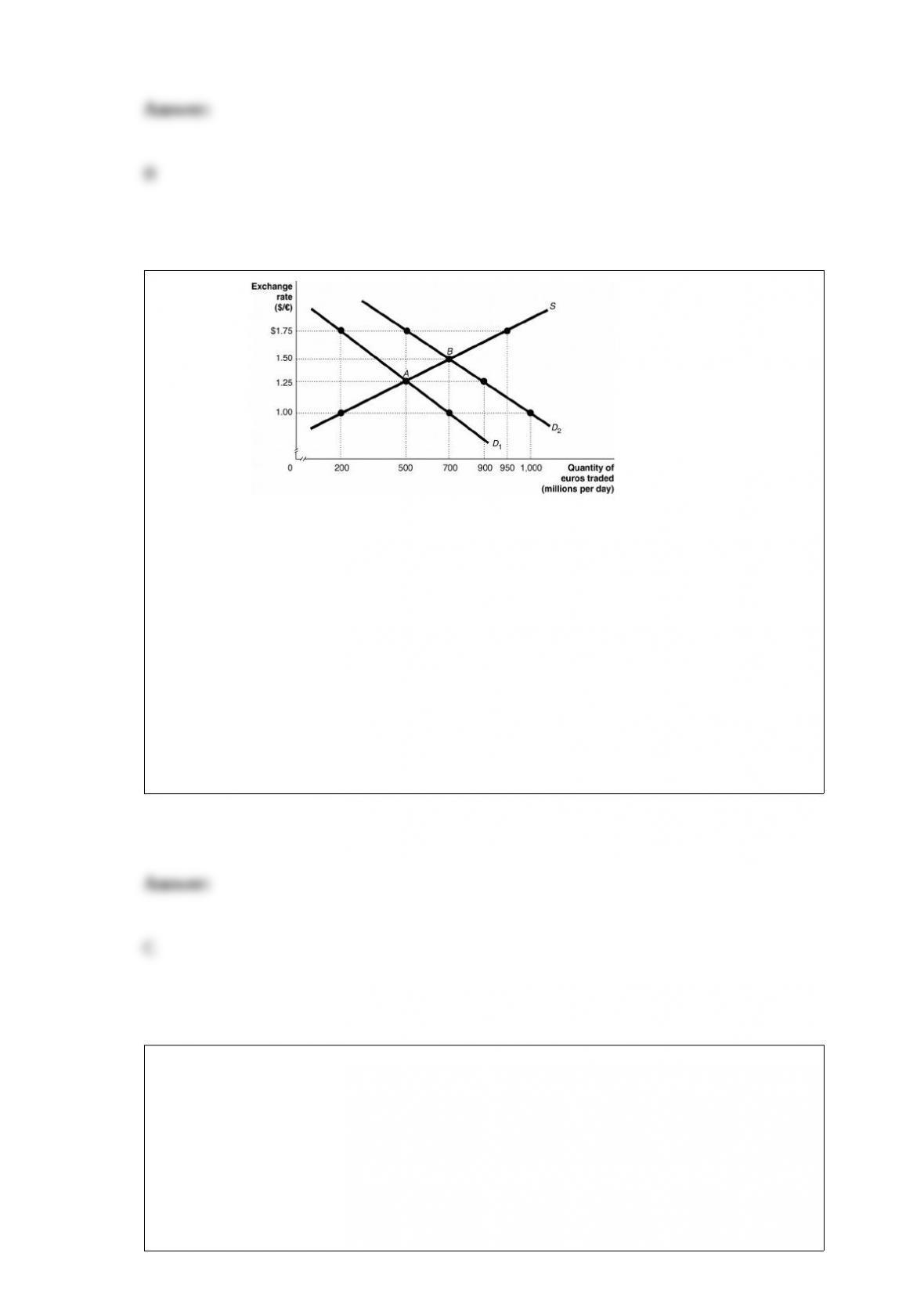
Figure 30-8
The equilibrium exchange rate is at A, $1.25/euro. Suppose the European Central Bank
pegs its currency at $1.00/euro. Speculators expect that the value of the euro will rise
and this shifts the demand curve for euro to D2. After the shift,
A) there is a shortage of euro equal to 1,000 million.
B) there is a surplus of euro equal to 400 million.
C) there is a shortage of euro equal to 800 million.
D) there is a surplus of euro equal to 500 million.
Suppose a restaurant is trying to determine how much to charge for a bowl of chili, and
decides to run an experiment to see how much its customers are willing to pay by
allowing them to set their own price for this menu item.
a. Is charging a customer the price he or she is willing to pay for the bowl of chili an
example of price discrimination? Briefly explain.
b. What is it called when a firm knows every consumer’s willingness to pay, and can
charge every consumer a different price? What happens to consumer surplus in this
situation?
In cities with rent controls, the actual rents paid can be ________ than the legal
maximum. One explanation for this is because there is a ________ of apartments,
tenants are ________.
A) higher; shortage; often willing to pay rents higher than the law allows
B) higher; surplus; often forced to pay rents higher than the law allows
C) lower; surplus; never willing to pay rents below the legal maximum
D) lower; shortage; rarely willing to pay rents lower than the law allows
Stricter laws and regulations to protect intellectual property rights
A) will help to create a more successful market system.
B) will only benefit those companies whose intellectual property rights have in the past
been ignored.
C) will tend to have little impact on an economy since intellectual property is not
tangible.
D) will create a stronger and more successful black market for intellectual property.
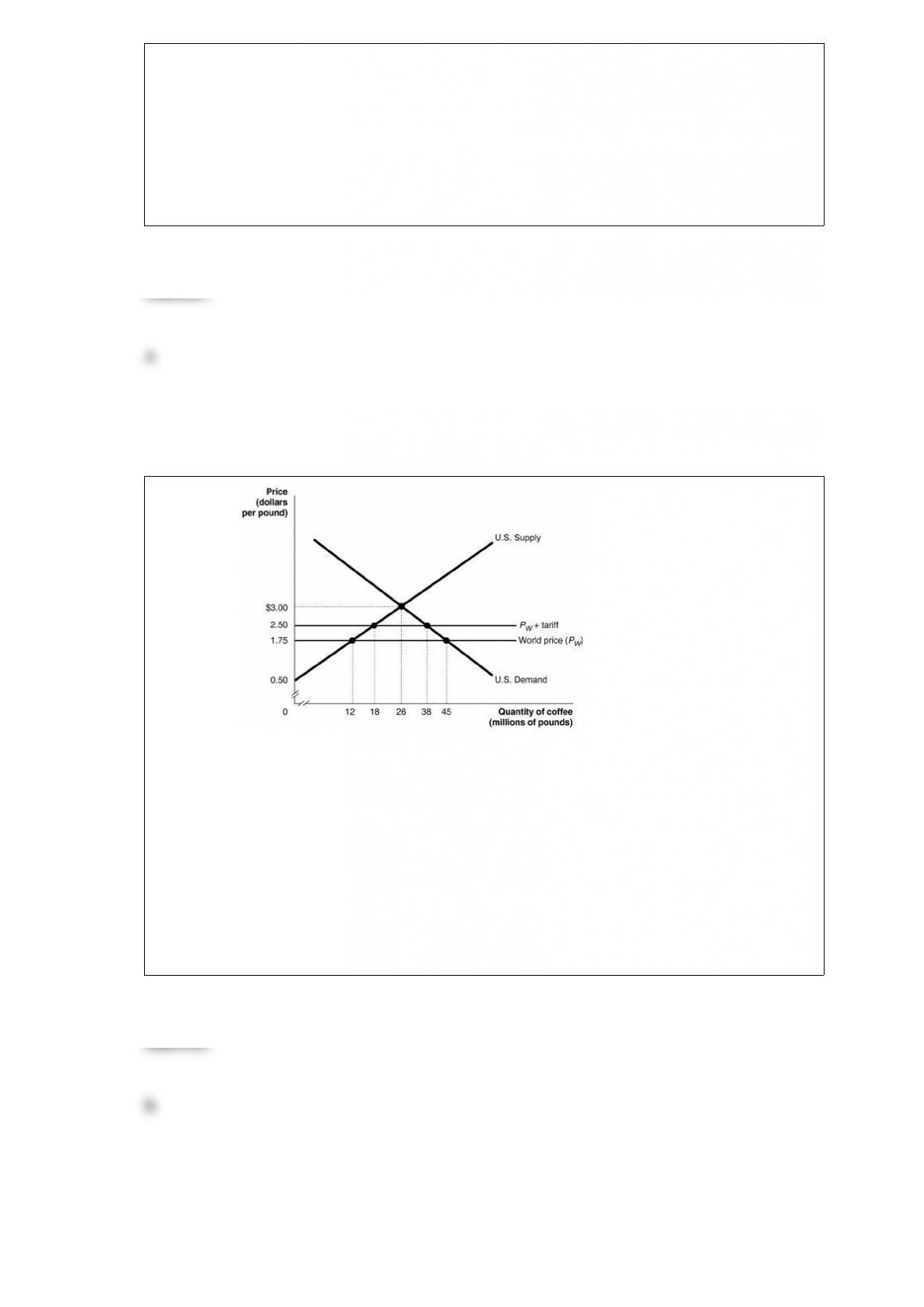
Figure 9-5 Suppose the U.S. government
imposes a $0.75 per pound tariff on coffee imports. Figure 9-5 shows the impact of this
tariff. The tariff revenue collected by the government equals
A) $10 million.
B) $15 million.
C) $19.875 million.
D) $35 million.
Since 1950, recessions in the United States
A) have not occurred.
B) have become more severe than before 1950.
C) have become less severe than before 1950.
D) are about as severe as they were before 1950.
An external cost is created when you
A) graduate from college.
B) buy flowers for your mother on Mother’s Day.
C) litter on the side of the road.
D) buy a sandwich for lunch.
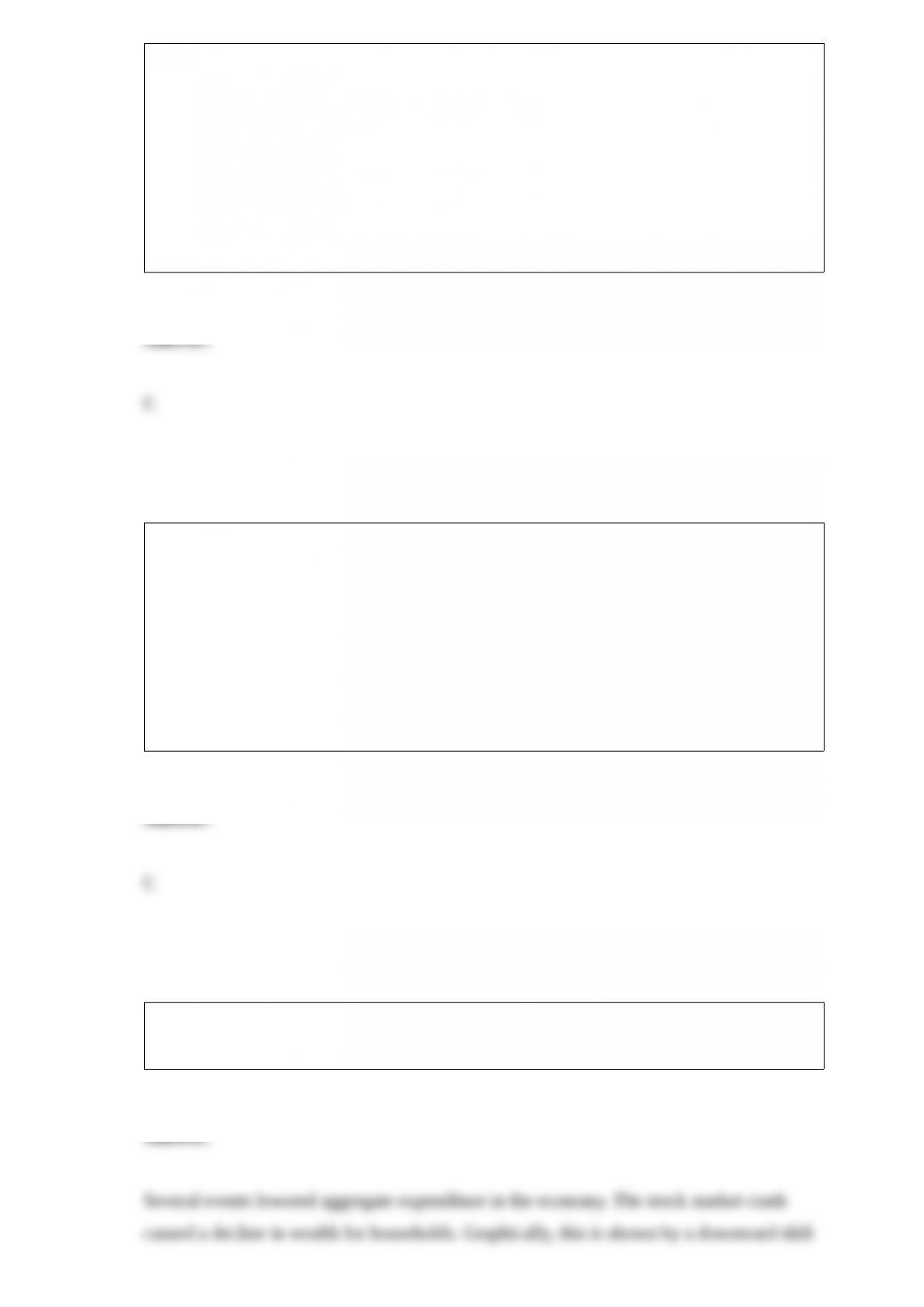
Discuss the leading causes of the Great Depression. Use the 45-degree line diagram to
show how they caused a decline in GDP.
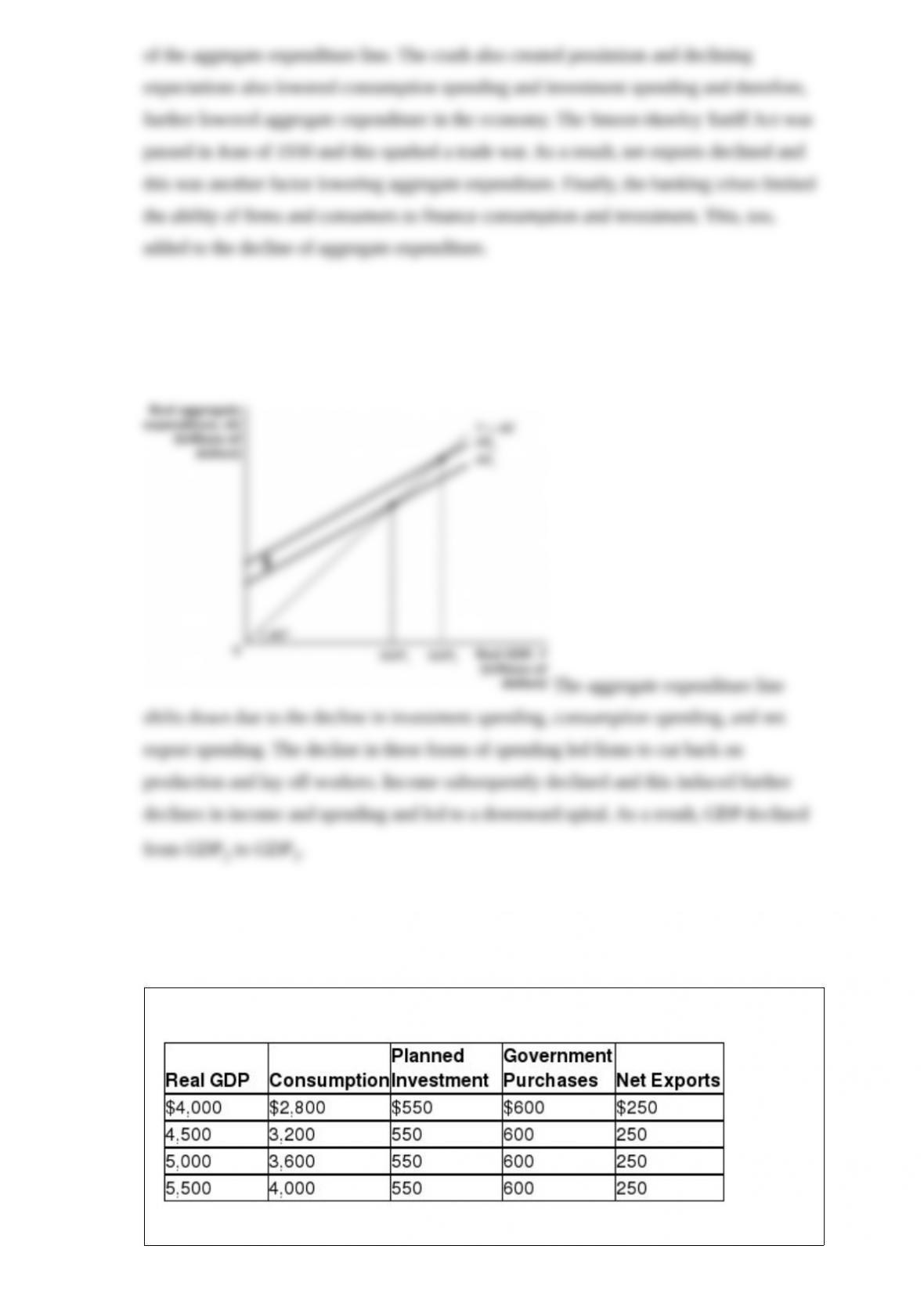
Table 12-1
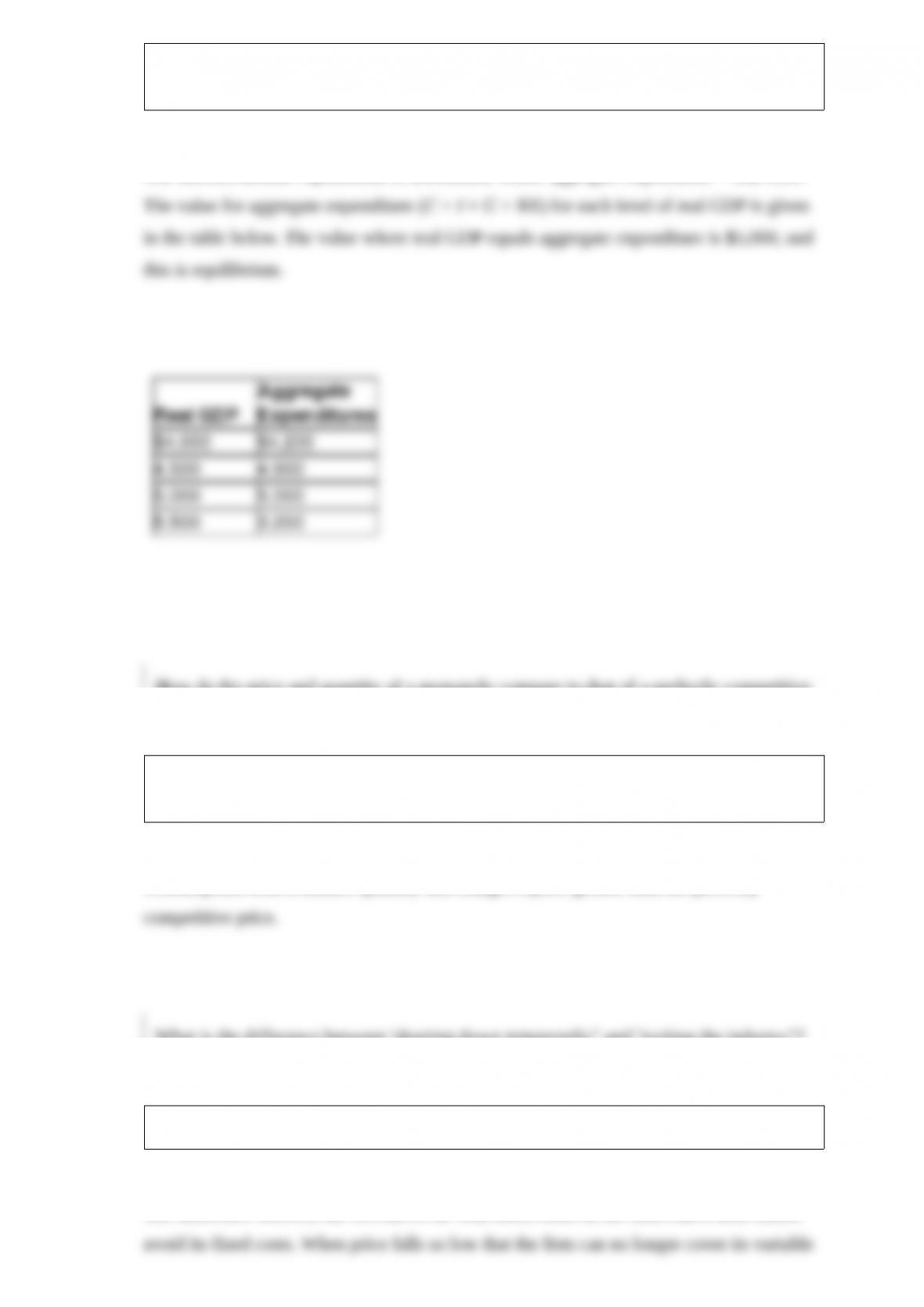
Using the table above, compute aggregate expenditure and identify the macroeconomic
equilibrium.
How do the price and quantity of a monopoly compare to that of a perfectly competitive
industry?
What is the difference between ‘shutting down temporarily” and “exiting the industry”?
Workers at a local construction company are paid $32.50 per hour, and they have
incorporated a 4 percent annual raise in their contracts to account for expected inflation.
Explain how unexpected inflation of 2 percent will affect the real wages earned by these
workers and the unemployment rate of these workers.
Does the fact that monopolistically competitive firms do not achieve productive
efficiency or allocative efficiency mean that there is a significant loss in consumer
welfare?
What is opportunity cost?
What is destabilizing speculation? What role did it play in the collapse of the Bretton
Woods system?