Which of the following explains why two firms, Apex and Bongo, would engage in
implicit collusion, rather than explicit collusion?
A) Implicit collusion allows Apex to increase its profits at the expense of Bongo
without Bongo knowing that collusion has occurred; if Apex engages in explicit
collusion, Bongo will realize collusion has taken place and retaliate against Apex.
B) Implicit collusion is less costly to both firms than explicit collusion; therefore,
profits will be greater for both firms if they engage in implicit collusion.
C) Explicit collusion is illegal; if the managers of Apex and Bongo engage in implicit
collusion they may be within the law.
D) Implicit collusion always has an enforcement mechanism that forces both firms to
collude; explicit collusion does not have an enforcement mechanism.
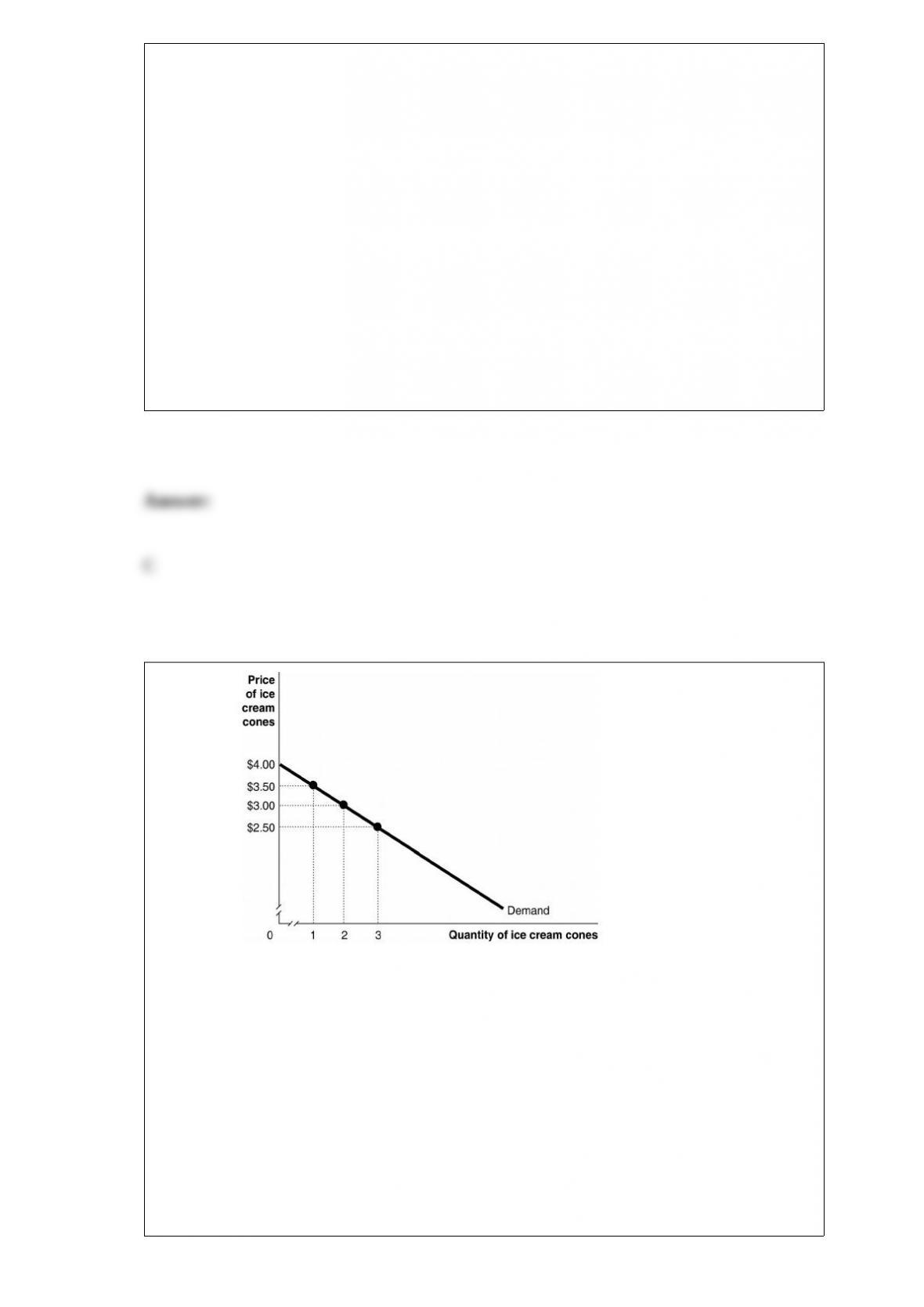
Figure 4-3 Figure 4-3 shows Kendra’s
demand curve for ice-cream cones.
If the market price is $2.50, what is the consumer surplus on the second ice cream
cone?
A) $0.50
B) $1.50
C) $3.00
D) $10.50

The Walt Disney Company is in a position to use a two-part tariff policy in setting
prices for admission and rides at Disney World. If this strategy resulted in maximum
profit, Disney would convert all consumer surplus into profit. Which of the following
explains why Disney does not maximize its profits from admission and rides?
A) To maximize its profits, Disney would have to know the demand curves of each of
its customers. Since this is not possible, Disney is not able to convert all consumer
surplus into profit.
B) Disney purposely charges less than the profit-maximizing price for admission to
Disney World because it does not want to risk alienating its customers.
C) Disney purposely charges less than the profit-maximizing price for admission to
Disney World in order to earn more profit from sales of food, lodging and other related
services.
D) Disney does not charge the profit-maximizing price for admission because it wants
to keep admission affordable for children who will be more likely to visit Disney World
when they become parents.
Table 2-14
Table 2-14 shows the number of labor hours required to produce a motorcycle and a
guitar in Ireland and Scotland.
Ireland has a comparative advantage in the production of

A) both products.
B) guitars.
C) motorcycles.
D) neither product.
When groups of mortgages are bundled together by financial institutions and sold to
investors, these institutions are said to be ________ mortgage loans.
A) securitizing
B) underwriting
C) liquidating
D) harvesting
Relative to productivity growth in the United States, which of the following countries
experienced the largest decline in productivity growth from 1990 to 2012?
A) Canada
B) Japan
C) Germany
D) the United Kingdom

Disposable income is defined as
A) national income – transfers + taxes.
B) national income + transfers + taxes.
C) national income – transfers – taxes.
D) national income + transfers – taxes.
Which of the following statements is true about the price elasticity of demand along a
downward-sloping linear demand curve?
A) It is inelastic at high prices and elastic at low prices.
B) It is unit-elastic throughout the demand curve.
C) It is elastic at high prices and inelastic at low prices.
D) It is perfectly elastic at very high prices and perfectly inelastic at very low prices.

At a product’s equilibrium price,
A) the product’s demand curve is the same as the product’s supply curve.
B) the quantity of the product demanded is greater than the quantity of the product
supplied.
C) the quantity of the product demanded is less than the quantity of the product
supplied.
D) the product’s demand curve crosses the product’s supply curve.
Parents who do not have their children immunized and attempt to benefit from other
parents who did have their own children immunized are exhibiting an economic
behavior known as
A) excludability.
B) public rivalry.
C) free riding.
D) internalizing an external cost.
An economic ________ is a simplified version of some aspect of economic life used to
analyze an economic issue.

A) market
B) trade-off
C) variable
D) model
Donnie’s Donuts incurs $450,000 per year in explicit costs and $200,000 in implicit
costs. The bakery earns $800,000 in revenues and has $2 million in net worth. Based on
this information, what is the economic profit for Donnie’s Donuts?
A) $150,000
B) $350,000
C) $600,000
D) $1.2 million
A tariff is
A) a limit placed on the quantity of goods that can be imported into a country.
B) a tax imposed by a government on goods imported into a country.
C) a subsidy granted to importers of a vital input.
D) a health and safety restriction imposed on an imported product.

The M1 measure of the money supply equals
A) paper money plus coins in circulation.
B) currency plus checking account balances.
C) currency plus checking account balances plus traveler’s checks.
D) currency plus checking account balances plus traveler’s checks plus savings account
balances.
If, at a firm’s projected sales level, the marginal cost is $125, the average cost is $150
and the markup is 20 percent, then its selling price is
A) $125.
B) $150.
C) $165.
D) $180.

________ is the ability to produce more of a good or service than competitors when
using the same amount of resources.
A) Absolute advantage
B) Comparative advantage
C) Trade superiority
D) Trade autarky