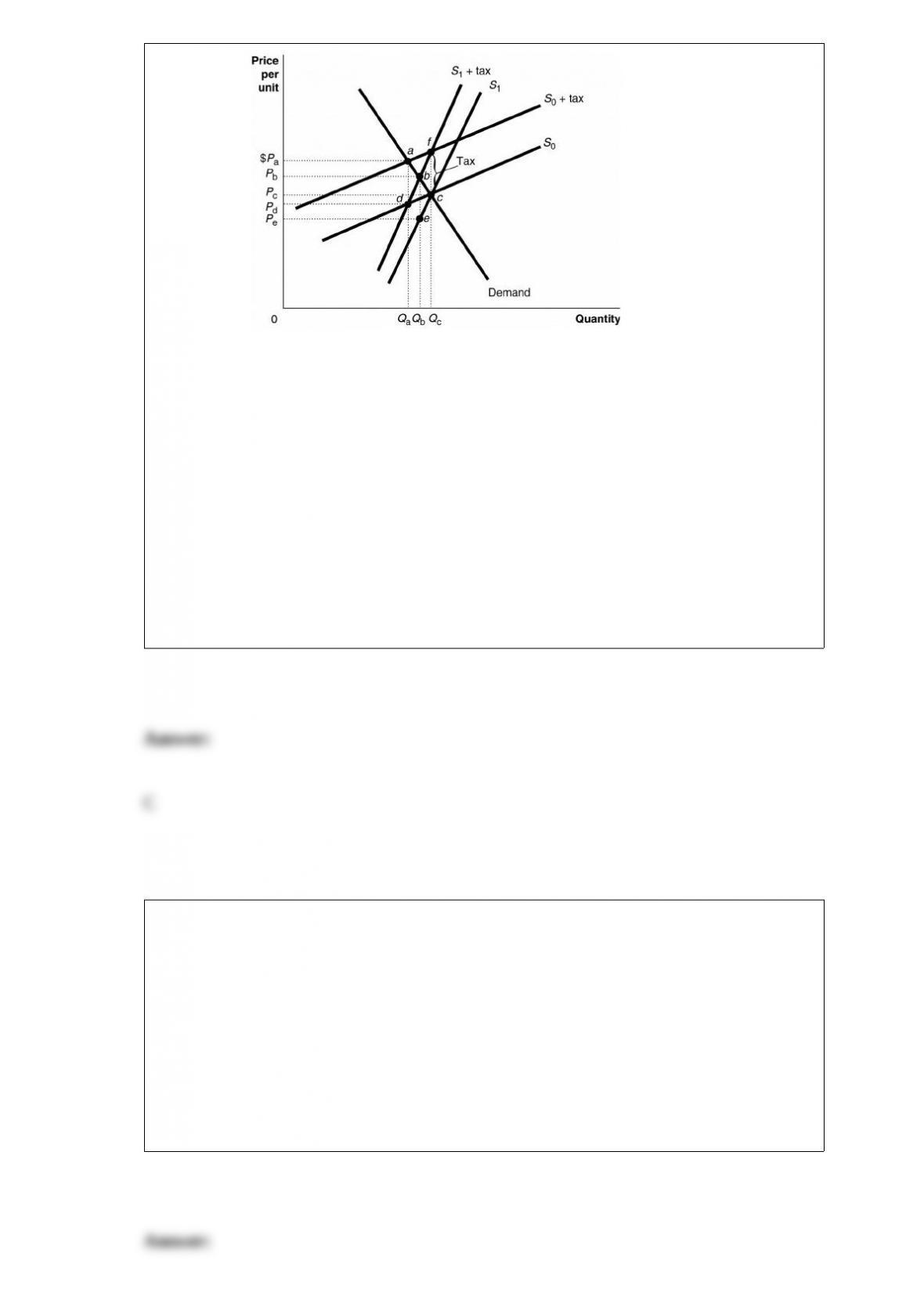
Figure 18-2 Figure 18-2 shows a
demand curve and two sets of supply curves, one set more elastic than the other.
If the government imposes an excise tax of $1.00 on every unit sold, the consumer’s
burden of the tax
A) is Pa– Pcunder either supply curve.
B) is P- Pcunder either supply curve.
C) is Pa– Pcif the supply curve is S0 and P- Pcif the supply curve is S1.
D) is Pa– Pdif the supply curve is S0 and P- Peif the supply curve is S1.
In which of the following countries are substantial co-payments typically required as a
part of the health care system?
A) Canada and the United States
B) Japan and Canada.
C) the United States and Japan
D) the United States and the United Kingdom
Knowledge capital is ________ in production and ________. As a result, firms
________ free ride.
A) nonrival; nonexcludable; can
B) nonrival; excludable; can
C) rival; nonexcludable; cannot
D) nonrival; nonexcludable; cannot
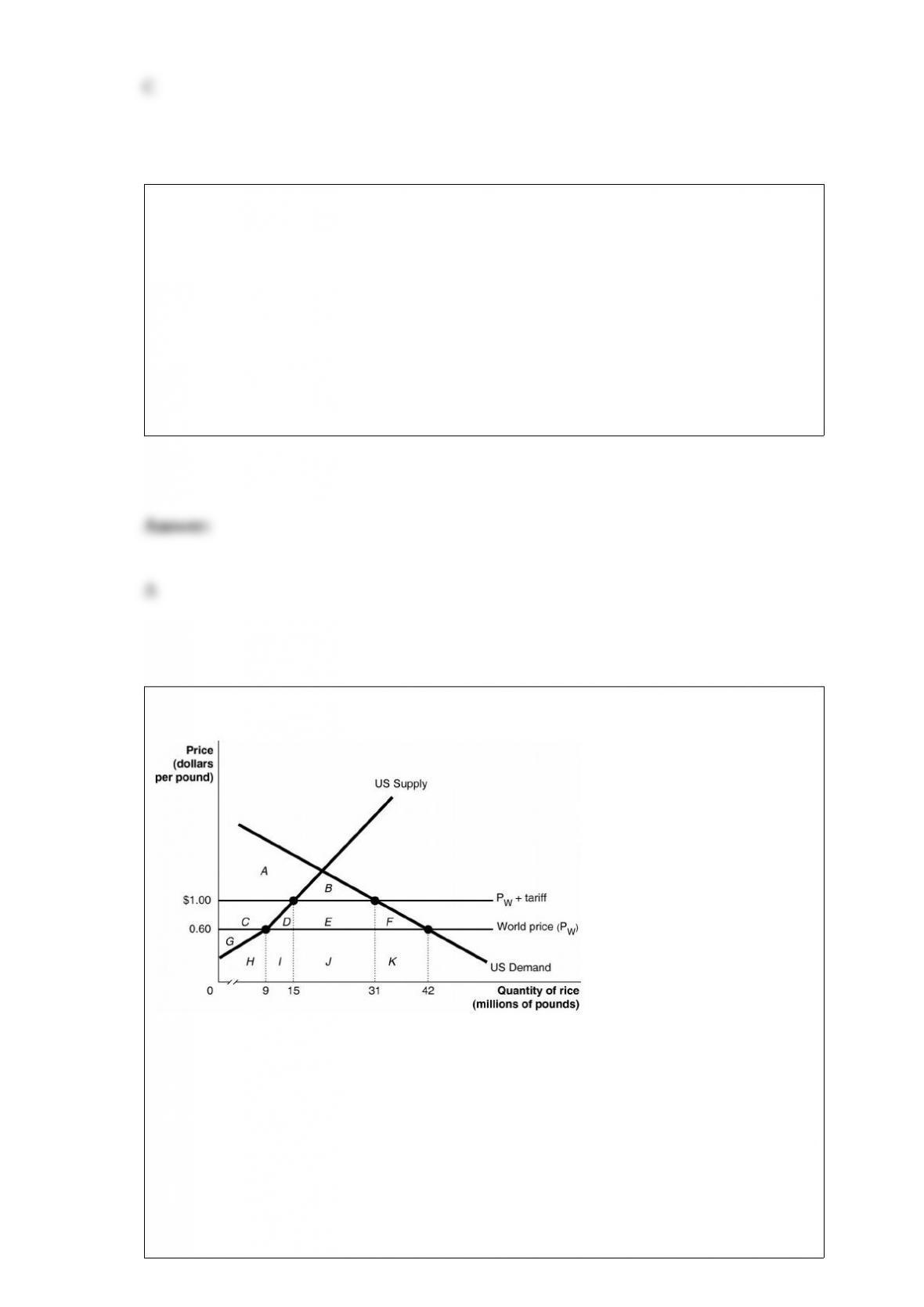
Figure 9-2
Suppose the U.S. government
imposes a $0.40 per pound tariff on rice imports. Figure 9-2 shows the impact of this
tariff. Without the tariff in place, the United States produces
A) 9 million pounds of rice.
B) 15 million pounds of rice.
C) 31 million pounds of rice.
D) 42 million pounds of rice.

The total amount of producer surplus in a market is equal to
A) the Difference between quantity supplied and quantity demanded.
B) the area above the market supply curve and below the market price.
C) the area above the market supply curve.
D) the area between the demand curve and the supply curve below the market price.
A firm that can effectively price discriminate will charge a higher price to
A) customers who have the more elastic demand for the product.
B) customers who have the more inelastic demand for the product.
C) buyers who belong to the largest market segment.
D) buyers who are members of the smallest market segment.

The law of diminishing marginal utility states that
A) eventually total utility falls as more of a good is consumed, other things constant.
B) the extra satisfaction from consuming a good decreases as more of a good is
consumed, other things constant.
C) the extra satisfaction from consuming a good increases slowly as more of a good is
consumed, other things constant.
D) when the extra satisfaction from consuming a good becomes negative, total utility
starts falling, other things constant.
The entry and exit of firms in a monopolistically competitive market guarantee that
A) marginal revenue equals marginal cost and average total cost is minimized.
B) firms can earn economic profits in the long run.
C) price equals average total cost in the long run.
D) firms can earn economic profits in the short run.

Figure 2-4
Figure 2-4 shows various points on three Different production possibilities frontiers for
a nation.
Consider the following events:
a. a decrease in the unemployment rate
b. general technological advancement
c. an increase in consumer wealth Which of the events listed above could cause a
movement from V to X?
A) a only
B) a and b only
C) b and c only
D) a, b, and c
If a corporate bond with face value of $1,000 has an interest rate of eight percent paid
once a year for a term of 30 years, what is the size of the coupon payment?
A) $1,000
B) $300

C) $80
D) $8
Studies have shown that smoking cigarettes can cause heart disease. Assume this is true,
and favorable weather has increased the tobacco harvest in North Carolina. In the
market for cigarettes, these two developments would
A) decrease demand and decrease supply, resulting in an increase in the equilibrium
quantity and a decrease in the equilibrium price of cigarettes.
B) increase demand and increase supply resulting in an increase in the equilibrium
quantity and an uncertain effect on the equilibrium price of cigarettes.
C) decrease demand and increase supply, resulting in a decrease in the equilibrium price
and an uncertain effect on the equilibrium quantity of cigarettes.
D) decrease demand and increase supply, resulting in an increase in both the
equilibrium price and the equilibrium quantity of cigarettes.
By 2012, Iceland’s real GDP ________, and the real GDPs of Italy, Spain, Greece, and
Ireland ________.
A) was still 5 percent lower than its level prior to the financial crisis; were more than 5
percent lower than their precrisis levels
B) had returned to its level prior to the financial crisis; were all higher than their
precrisis levels
C) was still 5 percent lower than its level prior to the financial crisis; had returned to

their precrisis levels
D) had returned to its level prior to the financial crisis; were still 5 percent or more
lower than their precrisis levels
You decide to work in London for the next 5 years, accumulate some savings, then
move back to the United States and convert your savings from British pounds to dollars.
At the time of your move, economists predict that consumers in the United States have
lost their affinity for British products, and expect that this declining preference for
British products will continue for the next decade. How should this influence your
decision to work and save in London?
A) You should be discouraged as the declining U.S. preference for British goods should
increasethe value of the pound to the dollar and decrease the value of your savings
when converted to dollars.
B) You should be discouraged as the declining U.S. preference for British goods should
decrease the value of the pound to the dollar and decrease the value of your savings
when converted to dollars.
C) You should be encouraged as the declining U.S. preference for British goods should
decrease the value of the pound to the dollar and raise the value of your savings when
converted to dollars.
D) You should be encouraged as the declining U.S. preference for British goods should
increase the value of the pound to the dollar and raise the value of your savings when
converted to dollars.

A tariff is the same as a quota.
Consider this quote from an article in the Wall Street Journal: “The stock of educated
workers isn’t increasing fast enough to keep up with rising demand…. Employers are
paying the typical four-year college graduate [without graduate school] 75% more than
they pay high-school grads. Twenty-five years ago, they were paying 40% more.
Employers insist on ever better-educated, skilled workers. “
Source: David Wessel, “Lack of Well-Educated Workers Has Lots of Roots, No
Quick Fix,” Wall Street Journal, April 19, 2007, Page A2. Which of the following
best explains the rapid increase in the wage differential between college graduates and
high school graduates?
A) The demand for college educated workers shifted to the right while the supply of
college educated workers shifted to the left.
B) The supply of high-school educated workers shifted to the right faster than the
demand for college educated workers shifted to the right.
C) The demand for college educated workers shifted to the right faster than the supply
of college educated workers shifted to the right.
D) The demand for high-school educated workers shifted to the left faster than the
supply of college educated workers shifted to the right.
Suppose that some teachers have decided that economic and financial uncertainty have
made the prospect of retiring more risky, and therefore carry a higher cost than not
retiring. By using all available information as they act to achieve their goals, these
teachers are exemplifying the economic idea that
A) people are rational.
B) people respond to economic incentives.
C) optimal decisions are made at the margin.
D) equity is more important than efficiency.
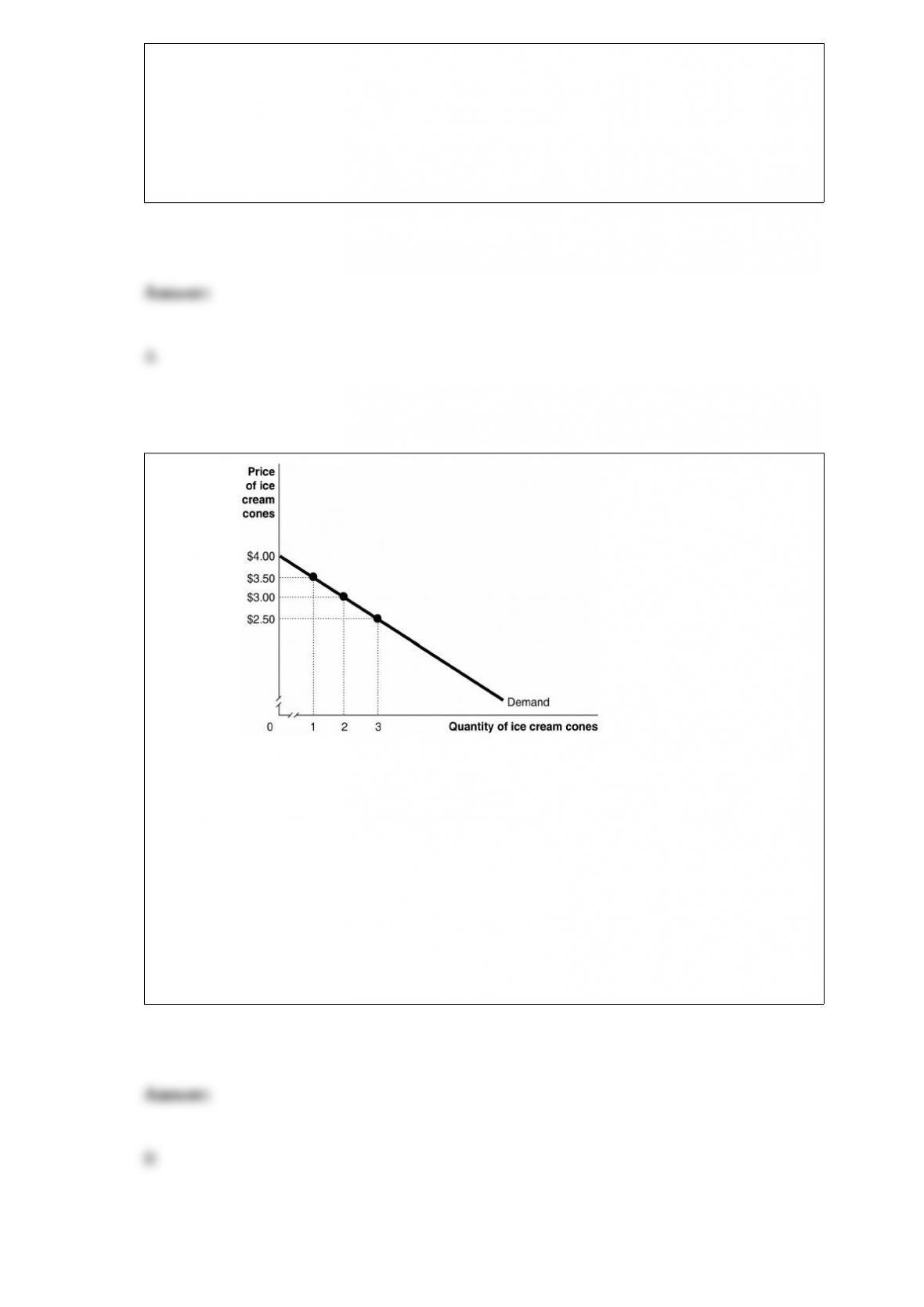
Figure 4-1 Figure 4-1 shows Kendra’s
demand curve for ice-cream cones.
If the market price is $2.50, what is the consumer surplus on the first ice cream cone?
A) $0.50
B) $1.00
C) $3.50
D) $9.00