
Total profit is maximized where
a. MR = MC.
b. marginal profit is zero.
c. the slope of the marginal profit curve is zero.
d. All of the above are correct.
According to Baumol and Blinder, from the demand side a decrease in the price level
causes aggregate expenditures to
a. fall, resulting in a lower level of equilibrium income.
b. fall, resulting in a higher level of equilibrium income.
c. rise, resulting in a higher level of equilibrium income.
d. rise, resulting in a lower level of equilibrium income.
Price ceilings are designed to protect sellers, while price floors are designed to protect
buyers.
a. True
b. False

The public assistance program that economists believe can promote economic equality
at the least cost in economic efficiency is
a. Aid to Families with Dependent Children (AFDC).
b. a negative income tax (NIT).
c. food stamps.
d. Medicaid.
The United States has the largest economy in the world because
a. it has the most land to work with.
b. it has a large population.
c. American workers are very productive.
d. both b and c are correct.
Regarding government intervention in the economy, which of the following statements
is not true?
a. Liberals tend to favor intervention.
b. Conservatives are inclined to adhere to fixed rules.
c. There is no guarantee that government intervention will have the desired effect.
d. The effect of government actions on interest rates and spending is unknown.
e. All of the above are true.
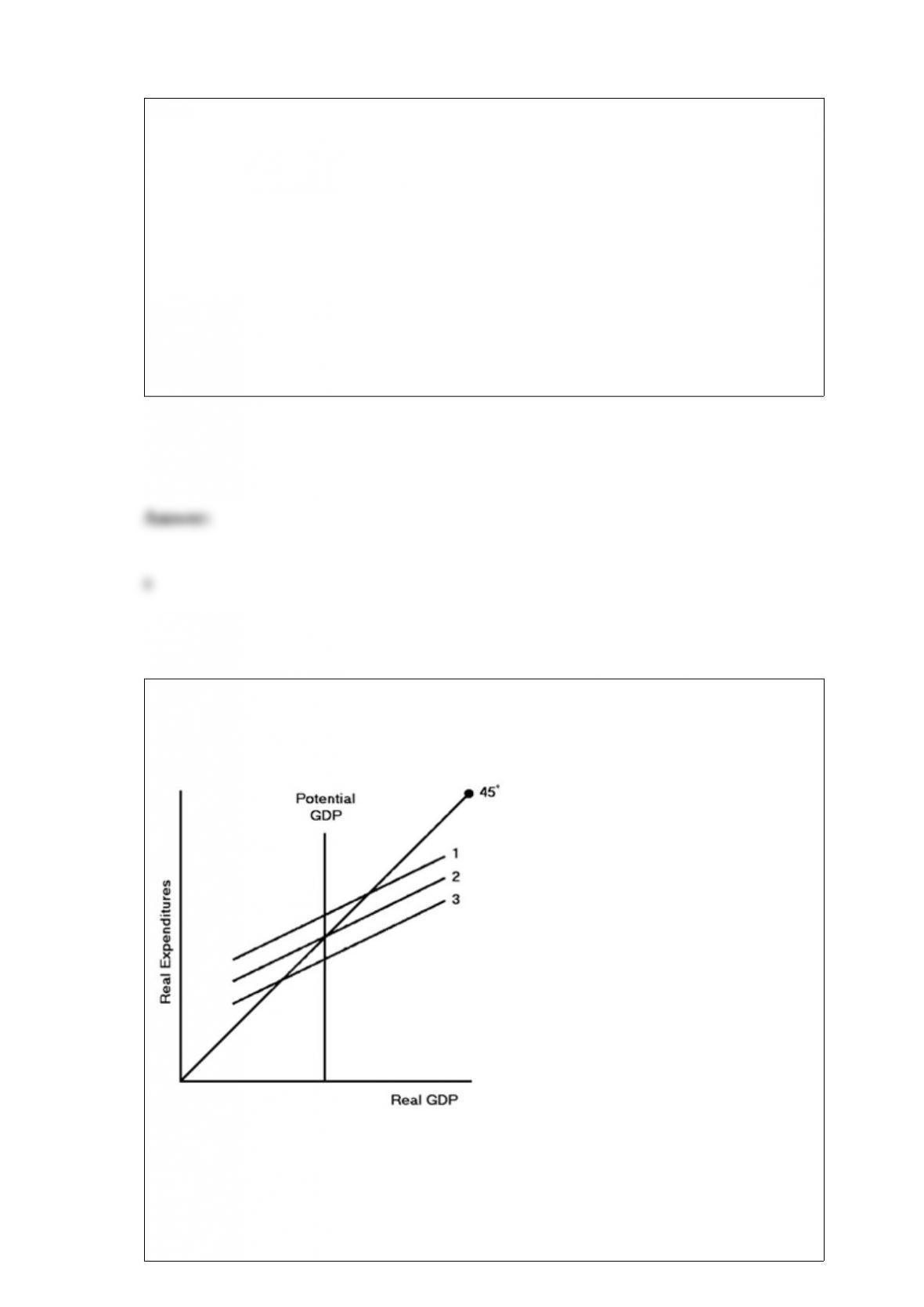
Figure 9-4
In Figure 9-4, if the economy is in a recessionary gap, what must happen to reach
potential GDP?
a. The expenditure level must fall and/or the price level must rise.

b. The expenditure level must rise and/or the price level must fall.
c. The expenditure level must rise and/or the price level must rise.
d. The expenditure level must fall and /or the price level must fall.
To efficiently manage traffic on a system of bridges,
a. the more-crowded bridges should have lower tolls, so that they are affordable.
b. the tolls should be equal for all bridges, so that people can choose the most
convenient routes.
c. tolls should be higher on more-crowded bridges and lower on less-crowded bridges.
d. there should be no tolls on bridges, because people should not have to pay to drive to
their jobs.
Higher energy prices can be used to explain the productivity slowdown in the period
from
a. 1948 to 1973.
b. 1973 to 1995.
c. 1973 to 1980.

d. 1995 to 2000.
A ptomaine poisoning scare causes a decrease in the demand for canned tuna fish.
Everything else equal, the demand curve for aluminum cans will
a. become steeper.
b. become flatter.
c. fall.
d. rise.
More economists adopted monetarism in the early 1990s.
a. True
b. False
Briefly and concisely define the following terms:
a. price discrimination
b. tying contracts
c. concentration ratio
d. market power
Economic discrimination occurs when equivalent factors of production receive different
payments for equal contributions to output.
a. True
b. False
According to the principle of increasing costs, as the production of one good expands,
the opportunity cost of producing another unit of the good tends to increase.
a. True
b. False
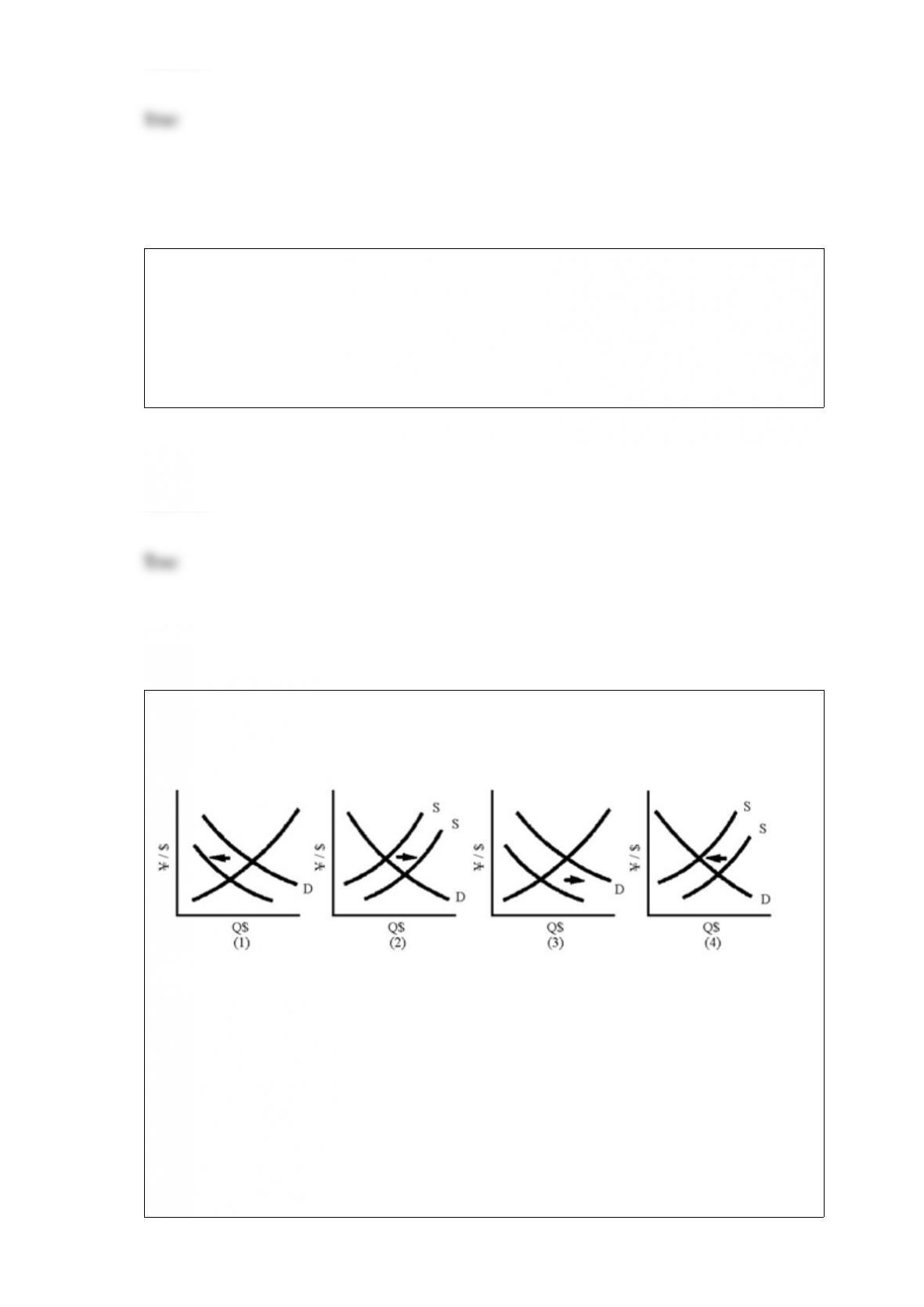
Figure 19-1
Of the graphs in Figure 19-1, which one shows the effects of an increase in interest
rates in Japan and a depreciation of the dollar?
a. 1
b. 2
c. 3
d. 4

In the U.S. the total amount of work time lost to strikes is less than the amount of work
time lost for coffee breaks.
a. True
b. False
The differences between monetarist and Keynesian theories are more apparent than real.
a. True
b. False
As a student, one of the costs of sleeping in rather than going to class is likely to be a
lower grade in the class.

a. True
b. False
Suppose that the economy is currently at full employment. All other things being equal,
if the government implements expansionary fiscal policy, then the appropriate monetary
policy is
a. no change from the current policy.
b. reduce the growth of the money supply.
c. constant growth of the money supply.
d. increase the growth of the money supply.
The money creation process generated by an injection of reserves stops when
a. people deposit their loans into other banks.
b. reserve requirements are raised.
c. the increase in required reserves equals the size of the injection.
d. bankers begin to fear runs and stop making loans.

A real estate salesperson sells a house in 2015 that was built in 2005. How does this
transaction get counted in the GDP statistics?
a. The price of the house and the real estate salesperson’s commission are both included
in 2015’s GDP.
b. Neither the price of the house or the commission is included in 2015’s GDP.
c. The real estate salesperson’s commission but not the price of the house is included in
2015’s GDP.
d. The price of the house would be included in both 2005’s GDP and the GDP for 2015.
A black market develops only when quantity demanded exceeds quantity supplied.
a. True
b. False

To determine whether a market is perfectly competitive, economists examine the
a. number of firms in the market.
b. similarities among the products of the different firms in the market.
c. ease of entry and exit by firms in the market.
d. All of the above are correct.
If a depletable resource is selling in a perfectly competitive market, its price will rise by
greater and greater dollar amounts each year.
a. True
b. False
Price controls usually enhance efficiency in the allocation of resources.
a. True
b. False

The suggestion that the Fed concentrate only on reducing inflation is an attempt to
a. stabilize the level of unemployment and inflation.
b. shift the long-run Phillips curve to the right.
c. improve the efficiency of the self-correcting mechanism.
d. simplify demand management by focusing on only one goal.
A constitutional amendment requiring an annually balanced budget would help stabilize
the economy.
a. True
b. False
If two individuals have identical schooling, their incomes will be equal.
a. True

b. False
The Great Depression ended in the United States when
a. the New Deal reforms were initiated by President Roosevelt.
b. deficit spending ended in 1937.
c. the United States returned to the gold standard in 1940.
d. the United States began to mobilize for war in the early 1940s.
e. the German economy suffered hyperinflation in the 1920s.
If the national debt is owned by domestic citizens:
a. the debt will not have to be repaid.
b. future interest payments transfer funds from one group of Americans to another.
c. the debt will have to be repaid first to domestic creditors, then to foreign creditors.
d. future interest payments will go to pay foreign debt first, then debt owed to American
citizens.

“Fiscal Policy” is the federal government’s plan for
a. international trade, designed to balance exports and imports.
b. spending and taxes, designed to influence the level of aggregate demand.
c. manipulating the money supply and the control of interest rates.
d. All of the above are correct.
Price ceilings lead to market surpluses.
a. True
b. False
Conventional budget accounting practices tend to overstate deficits in inflationary
periods because they

a. ignore the inflation tax.
b. confuse repayment of principal with real interest expenditures.
c. double count some expenditures.
d. understate real interest rates.
The argument that the national debt imposes a burden on future generations becomes
more compelling as
a. the percentage of the national debt held by foreigners rises.
b. tax rates rise.
c. interest rates fall.
d. debt service payments (interest) rise.
What would be the opportunity cost of a child using a coupon for a free ice cream cone?
a. the dollar cost of the cone she selected
b. the other types of ice cream she could have selected
c. zero – because the good was not a durable good

d. zero – because the good was free