
If the quantity of euro demanded were greater than the quantity supplied, then the price
of the
a. euro would rise.
b. euro would fall.
c. dollar would rise.
d. euro would be in equilibrium.
From 2000 to 2001, the U.S. economy’s annual growth rate slowed down abruptly.
a. True
b. False
The main reason that firms adjust their output when the price level changes is that
a. uncertainty causes a drop in output.
b. taxes cause a supply-side reaction.
c. their profit margins change.
d. increased risks lead to a change in output.

e. All of the above are correct.
The structural deficit is extremely sensitive to the performance of the economy.
a. True
b. False
A positive aspect of monopolies is that they may aid innovation in the marketplace.
a. True
b. False
Empirical evidence indicates that imposing taxes on polluting emissions by firms

a. has no effect on the amount of pollution emitted.
b. does not give the government leeway to regulate more dangerous emissions
differently than less dangerous emissions.
c. does reduce the amount of pollution emitted.
d. discourages firms from investing in new methods of pollution abatement.
In 2010, which of the following was true regarding the extremely large deficits that the
U.S. recently encountered?
a. Most politicians and economists argued that the deficit had to be reduced.
b. Most politicians argued that the deficit had to be reduced but economists cautioned
against this course of action.
c. Most economists argued that the deficit had to be reduced but politicians cautioned
against this course of action.
d. Both politicians and economist cautioned against deficit reduction.
Before the breakup of AT&T several years ago, profits on long-distance calls offset
losses on basic residential service. This practice is known as
a. abuse of monopolistic power.

b. cream skimming.
c. cross-subsidization.
d. the Ramsey rule.
Airline deregulation led to the demise of many smaller airlines but large carriers were
not materially affected.
a. True
b. False
If real interest rates decrease, we generally expect
a. saving to increase.
b. saving to decrease.
c. consumption spending to decrease.
d. no significant change in saving.

According to an old saying, when too much money is chasing too few goods, we have
a(n)
a. recessionary gap.
b. inflationary gap.
c. full employment.
d. paradox of thrift.
A reduction in aggregate demand will normally reduce
a. prices.
b. real GDP.
c. employment.
d. All of the above are correct.

If the marginal profit of the next unit is negative, the firm should produce more output
in order to generate greater profit.
a. True
b. False
Recycling rates for aluminum, paper, and glass have been increasing in the United
States.
a. True
b. False
Which of the following is correct?
a. Policy lags are normally much shorter for fiscal policy than for monetary policy.
b. Congress usually makes major fiscal policy changes in a fairly short period of time.
c. Expenditure lags are much longer for investment, the main way in which monetary
policy affects aggregate demand.
d. Monetary policy affects aggregate demand more quickly than fiscal policy, such as
tax or government spending changes.

The oversimplified multiplier formula assumes that the
a. level of consumption spending is fixed.
b. price level is fixed.
c. government spending is fixed.
d. net exports depend on income.
The price for labor is the wage rate. What happens to the supply of labor if wages
increase?
a. It increases.
b. It decreases.
c. It does not change.
d. Uncertain-economic theory has no answer to this question.

Productivity growth tends to affect all industries to the same degree.
a. True
b. False
A tariff on imports affects foreign suppliers ____; a quota affects foreign suppliers
____.
a. effectively, ineffectively
b. haphazardly, carefully
c. equally, capriciously
d. unfairly, fairly
e. unequally, unequally
One possible cure for the trade deficit is protectionism.
a. True
b. False

Consumer spending accounts for what share of GDP?
a. 20%
b. 40%
c. 70%
d. 90%
In the short run, a perfectly competitive firm can make a profit, a loss, or go out of
business.
a. True
b. False
In an attempt to raise sales, Hannah cut prices in her bookstore by 20 percent. If the

dollar value of her sales remained constant, that indicates
a. old customers bought no more books.
b. no new customers bought books.
c. the quantity of books sold increased 20 percent.
d. the demand curve is vertical.
As inflation rates increase, borrowing and lending contracts tend to
a. increase in size.
b. decrease in size.
c. decrease in length of time.
d. increase in length of time.
The growing federal budget deficit in the 1980s was accompanied by a
a. growing trade surplus.
b. growing trade deficit.
c. shrinking trade deficit.

d. shrinking capital account surplus.
The system of measurement for expressing macroeconomic data is called
a. national income accounting.
b. balance of payment accounting.
c. generally accepted accounting principles.
d. double entry bookkeeping.
Economists generally assume that there is a short-run trade-off between
a. output and employment.
b. inflation and employment.
c. deflation and unemployment.
d. inflation and unemployment.
e. output and growth.

Under a proportional tax, the fraction of income paid in taxes
a. rises as income rises.
b. is unchanged as income changes.
c. falls as income rises.
d. is proportional to the change in income.
Decreasing profit margins indicate a need to increase production in an economy.
a. True
b. False
Figure 16-2
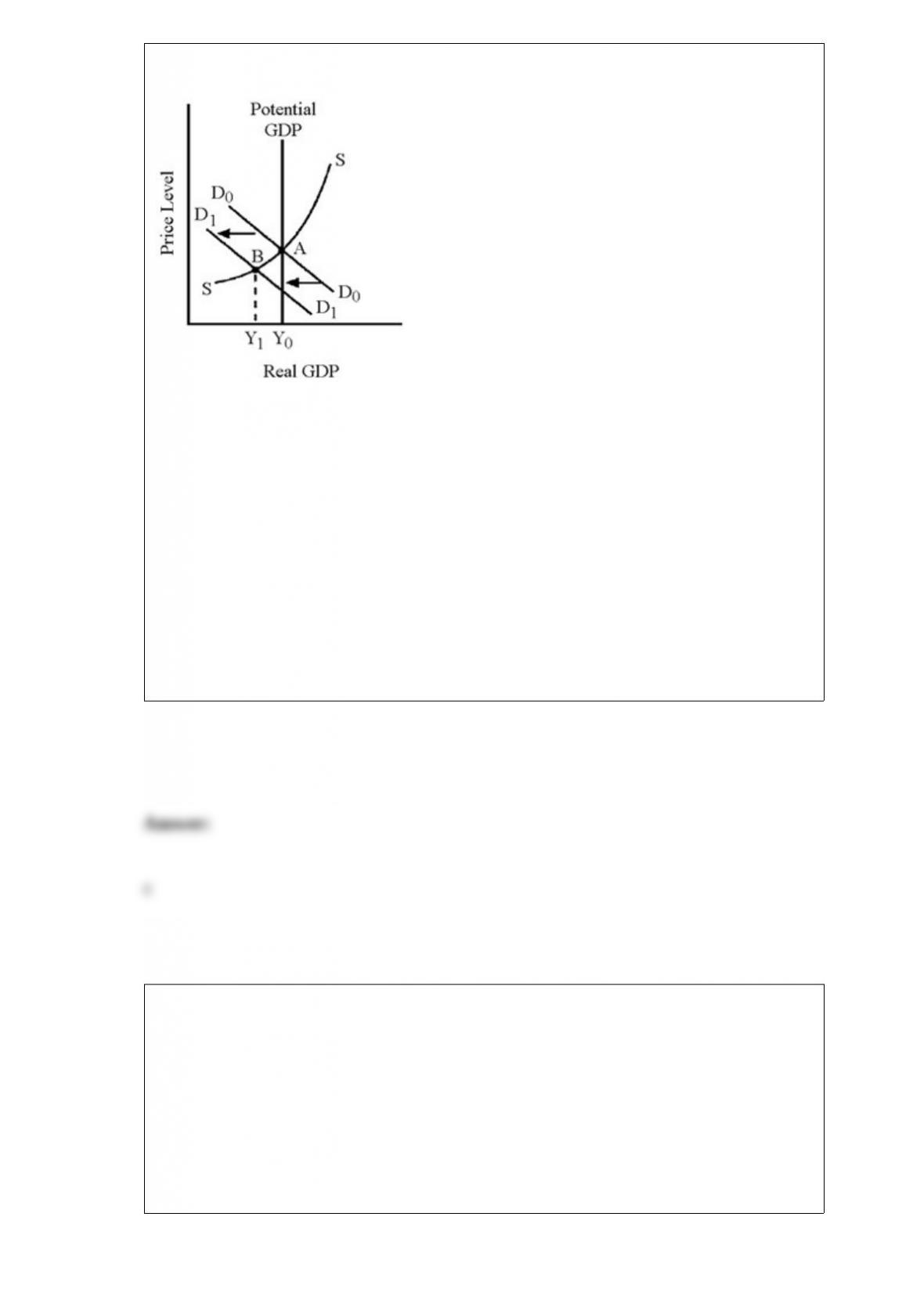
Assume that a contractionary monetary policy has shifted the aggregate demand curve
in Figure 16-2 from D0D0 to D1D1. Fiscal authorities who wish to restore real GDP to
the full-employment level will
a. run a budget surplus by increasing taxes or cutting government spending.
b. run a balanced budget to prevent the interest rate from rising and cutting off
investment.
c. run a budget deficit by cutting taxes or increasing government spending.
d. ignore the change in monetary policy since it has no effect on fiscal policy.
Minimum wage laws usually
a. increase the number of unskilled workers who are employed.
b. benefit all unskilled workers.
c. raise the wages paid to unskilled workers who are employed.
d. All of the above are correct.

The government can fight inflation by manipulating both aggregate demand and
aggregate supply.
a. True
b. False
Economists believe having higher prices for scarcer resources promotes efficiency.
a. True
b. False
Define the following terms and explain their importance to the study of economics.
a. common stock
b. corporation
c. limited liability
d. plowback
When price is below the equilibrium level, there is a shortage of the commodity being
sold.
a. True
b. False