
Which of the following scenarios best illustrates the concept of cyclical unemployment?
a. Grace loses her job because of new automated machinery.
b. Sean quits his job to look for work that is more fun.
c. Ellen quits looking for work because she doesn’t think she can find a suitable job.
d. Marian loses her job because of a recession.
Nothing raises the standard of living more than a greater
a. abundance of goods.
b. effort of production.
c. population.
d. number of import tariffs.
e. All of the above are true.
The capital gains tax cut enacted in 2003 will hinder capital formation.
a. True
b. False

The slope of a downward-sloping straight line can be calculated as the distance from
the
a. horizontal intercept of the line to the origin divided by the distance from the origin to
the vertical intercept of the line.
b. origin to the horizontal intercept of the line minus the distance from the origin to the
vertical intercept of the line.
c. vertical intercept of the line to the origin divided by the distance from the origin to
the horizontal intercept of the line.
d. vertical intercept of the line to the origin minus the distance from the origin to the
horizontal intercept of the line.
Payroll tax is a proportional tax.
a. True
b. False

The supply of workers in an industry is influenced by the available working population
and the nonmonetary attractiveness of the job.
a. True
b. False
When businesses are cutting back production, then it probably true that
a. total spending is greater than total output.
b. total output is greater than total income.
c. total spending is less than total output.
d. inventory levels are decreasing.
The equation representing the final demand approach to calculating GDP is
a. Y = C + I + X + IM.
b. Y = C + I + G.
c. Y = G + I + X − IM.

d. Y = C+ I + G + (X − IM).
Average cost is the cost of producing the next unit.
a. True
b. False
In 1963, government economists assumed that the MPC for the United States was
approximately 0.90. If taxes were cut by $9 billion, then consumer expenditures would
initially be expected to
a. decrease by $9.0 billion.
b. increase by $9.0 billion.
c. decrease by $8.1 billion.
d. increase by $8.1 billion.

Between 2009 and 2013:
a. both the actual and the structural deficit fell substantially.
b. both the actual and the structural deficit rose subtantially.
c. the actual deficit rose, while the structural deficit fell substantially.
d. the structural deficit rose, while the actual deficit fell substantially.
The slope of the consumption function is equal to the marginal propensity to save.
a. True
b. False
Table 20-1
Suppose the economy of Macroland is described by the following:
C = 200 + .8DI (DI = disposable income)
I = 300 + .2Y − 50r (Y = GDP)

(r, the interest rate, is measured in percentage points. For example, a 9 percent interest
rate is r = 9).
For this economy, assume that the Federal Reserve uses its monetary policy to peg the
interest rate at
r = 5
G = 750
T = .25Y
X = 200
M = 150 + .2Y
Hint: DI = Y − T
From Table 20-1, find the trade deficit or surplus.
a. 475 deficit
b. 75 deficit
c. 75 surplus
d. 475 surplus
An important effect of foreign currency speculators is that
a. they have consistently lost money and have left the market.
b. they have pushed exchange rates to wider extremes than most economists predicted.
c. they actually limit the volatility of exchange rate movements.
d. they have had no effect at all on exchange rate volatility.

During the late 1980s and early 1990s, most of the budget deficits were accounted for
by
a. the decline of foreign investment in the United States.
b. the downturn in the economy.
c. deliberate fiscal policy changes.
d. All of the above are correct.
A monopolist’s profit per unit is shown by the difference between price and average cost
per unit.
a. True
b. False
Government can raise GDP by $1,000 billion by:
a. raising government purchases
b. reducing taxes
c. increasing transfer payments
d. All of the above.
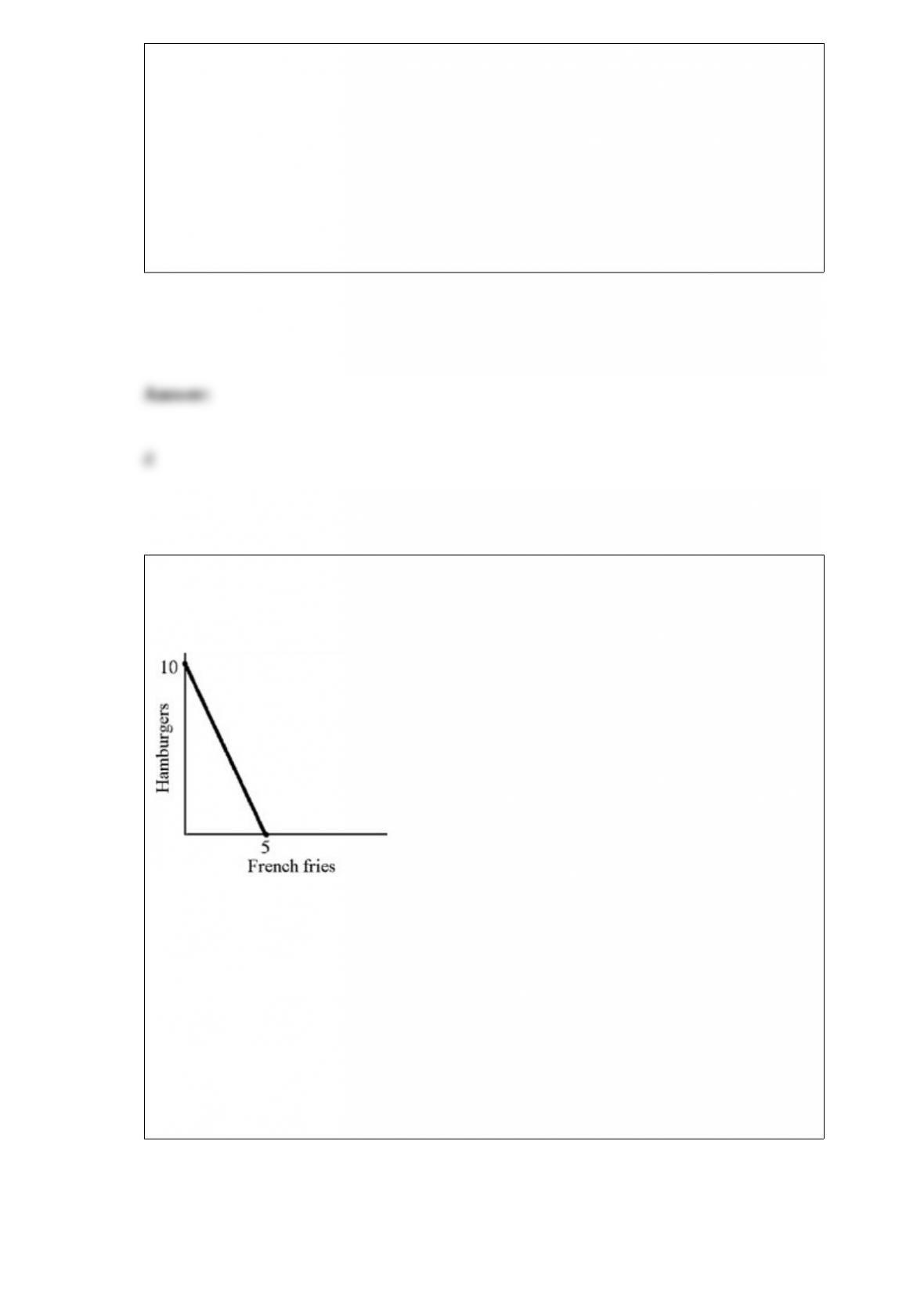
Figure 5-5
Figure 5-5 shows a consumer budget line for french fries and hamburgers. The price of
an order fries is $2. The price of a burger is
a. $1.
b. $2.
c. $4.
d. $8.

A tariff is better than a quota because
a. it does not distort trade as much.
b. quotas are inflexible.
c. tariffs produce tax revenue.
d. quotas hurt domestic producers; tariffs hurt foreign producers.
The economy’s self-correcting mechanism always tends to push the unemployment rate
back toward a specific rate of unemployment called
a. the ideal rate of unemployment.
b. the natural rate of unemployment.
c. the full rate of unemployment.
d. the mature rate of unemployment.

“Near monies” are
a. stocks, bonds, and real estate.
b. U.S. notes and Federal Reserve notes.
c. included in the M1 definition of the money supply.
d. liquid assets that are close substitutes for money.
e. All of the above are correct.
If the exchange rate of the Swiss franc is 1.61 francs per dollar, then the Swiss franc is
worth about
a. 15 cents.
b. 57 cents
c. 62 cents.
d. $15.70.
A market is not a pure monopoly if firms
a. can enter it freely.

b. sell unique products.
c. can exit the market freely.
d. require government permission to sell in the market.
Macroeconomists think that
a. most questions about individual markets are more important than the overall
economy.
b. questions of overall unemployment are less important than the jobs of particular
workers.
c. the details of resource allocation and individual market prices are less important than
the amount of national output.
d. the causes of unemployment usually lie with the personalities of individual workers.
e. the price of particular products is more important than the overall price level.
Workers earn less than half of the income generated by the production process.
a. True
b. False

What was the lowest federal funds rate target the Fed set in response to the financial
crisis?
a. 0%
b. 1.8%
c. 2.0%
d. 2.2%
If the Federal Open Market Committee decides to expand the money supply, then it will
a. raise the discount rate to member banks.
b. issue directions to purchase government securities, thus putting more reserves in
member banks.
c. issue directions to sell government securities, thus taking reserves from member
banks.
d. order new Federal Reserve notes delivered to member banks.

Government in the United States spends more as a percentage of GDP than in most
other industrialized nations.
a. True
b. False
Which of the following acts required that financial derivatives be traded in established,
regulated markets?
a. Glass-Steagall Banking Act
b. Gramm-Leach-Bliley Financial Services Modernization Act
c. Dodd-Frank Wall Street Reform and Consumer Protection Act
d. Celler-Kefauver Financial Reform Act
The Reagan tax cuts of the 1980s
a. had not impact on the budget deficit.

b. decreased the budget deficit.
c. increased the budget deficit.
d. initially decreased the deficit but later increased it.
During economic fluctuations, individual markets usually move in different directions.
a. True
b. False
Regarding structural deficits, which of the following assertions is true?
a. The structural deficit depends on the state of the economy.
b. The structural deficit is basded on actual expenditures and receipts.
c. The structural deficit change only when policy changes.
d. The structural deficit changes when GDP changes.

If average cost is declining,
a. marginal cost must be below average cost.
b. firms would go bankrupt if all prices were set equal to marginal costs.
c. marginal cost may be declining or increasing.
d. All of the above are correct.