
1) The real-balances effect indicates that inflation makes the public feel wealthier and
they therefore spend more out of their current incomes.
2) Marginal revenue product (MRP) is the change in total product (total output)
associated with hiring an additional unit of labor.
3) welfare payments to low-income families are included in national income.
4) the natural rate of unemployment in the united states is about 4 to 5 percent.
5) the wto is comprised of 27 european nations.
6) follower countries achieve high rates of growth by adopting technologies developed
by leader countries.
7) if the xyz company can sell 4 units per week at $10 per unit and 5 units per week at
$9 per unit, the marginal revenue of the fifth unit is $5.
8)
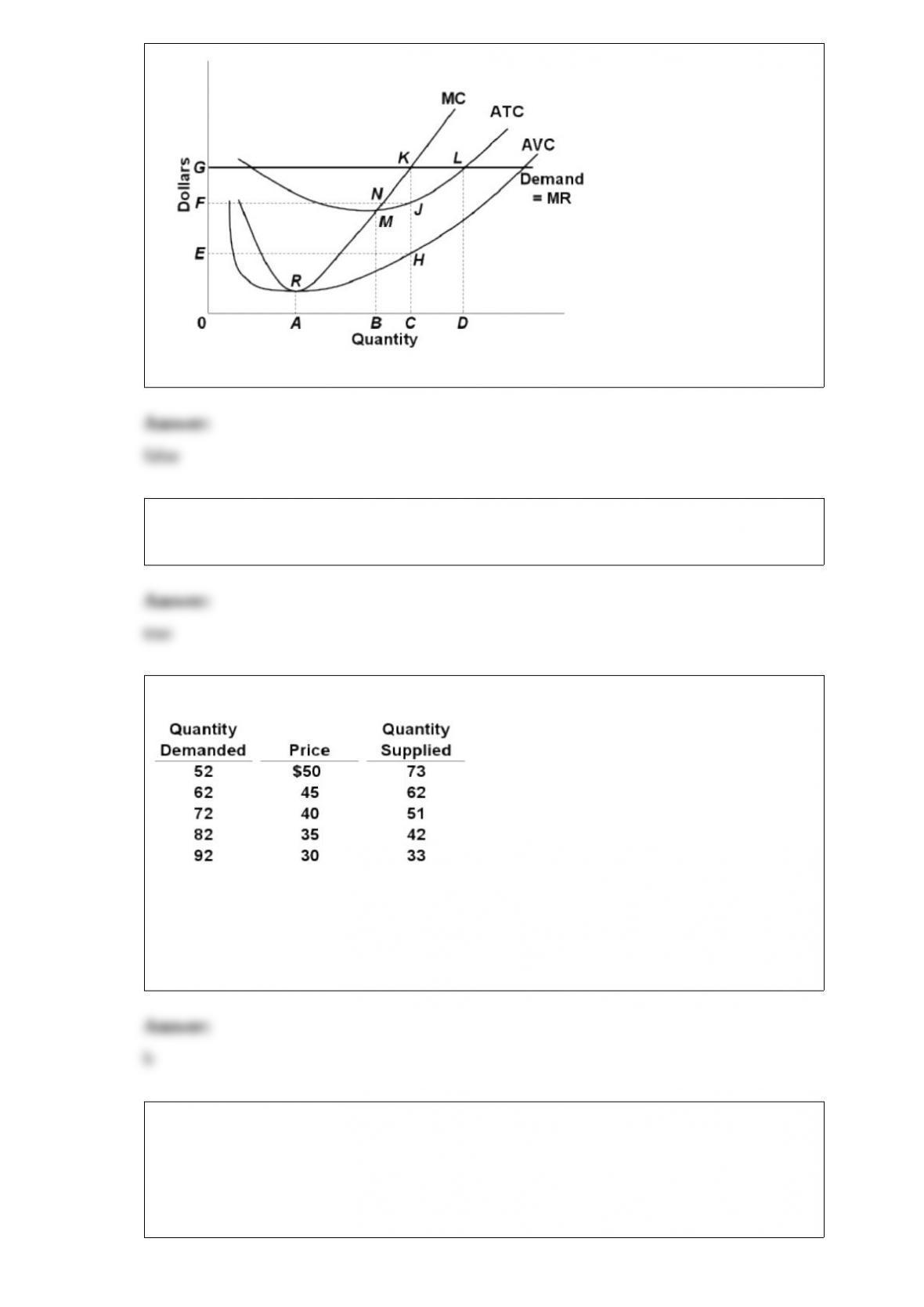
refer to the above diagram. this firm will maximize profits by producing output d.
9) marginal cost is a measure of the alternative goods which society forgoes in using
resources to produce an additional unit of some specific product.
10) government-set prices
in the above market, economists would call a government-set minimum price of $50 a:
a.price ceiling.
b.price floor.
c.equilibrium price.
d.fair price.
11) the problem of asymmetric information is that:
a.neither health care buyers nor providers are well-informed.
b.health care providers are well-informed, but buyers are not.
c.the outcomes of many complex medical procedures cannot be predicted.
d.insurance companies are well-informed but policy purchasers are not.

12) A firm that is hiring labor in a purely competitive labor market and selling its
product in a purely competitive product market will maximize its profit by hiring labor
until:
A.marginal revenue product is zero.
B.marginal revenue product exceeds marginal resource (labor) cost by the greatest
amount.
C.marginal resource cost is zero.
D.marginal revenue product equals marginal resource (labor) cost.
13) The main focus of the vignette “Slicing the Pizza” is the:
A.equality-efficiency tradeoff.
B.principal-agent problem.
C.impact of market power on economic efficiency.
D.the highly unequal distribution of U.S. wealth.
14) proponents of economic growth make all of the following arguments except:
a.growth is the basic means of improving living standards.
b.it is easier to reduce poverty when the economy is growing than when it is not.
c.there is a direct relationship between a growing real gdp and rising pollution.
d.growth provides an economic environment favorable to education and
self-fulfillment.
15) Other things equal, which of the following would increase the Federal funds rate?
A.a decrease in loan demand in the Federal funds market
B.a decrease in the reserve ratio
C.Fed purchases of government securities from banks
D.a decline in excess reserves in the banking system

16) if the law of diminishing returns applies to study time:
a.the 10th hour of study will likely be less productive than the 3rd.
b.this implies that longer lectures are less productive than shorter ones.
c.there is no benefit to studying a subject more than 5 hours in any given day.
d.people with less intelligence necessarily experience diminishing returns sooner than
those with greater intelligence.
17) when entering a building, sam diverts his path to go through an open door rather
than make the physical effort to open the closed door that is directly in his path. this is
an example of:
a.irrational behavior.
b.a lazy person.
c.marginal benefit-marginal cost analysis.
d.programmed learning.
18) Private capital flows to the DVCs:
A.increased substantially in the 1990s.
B.have changed in composition in recent years from direct foreign investment toward
bank loans.
C.now must first be approved by the IMF.
D.have dwindled to near zero in the last few years.
19) the concept of net domestic investment refers to:
a.the amount of machinery and equipment used up in producing the gdp in a specific
year.
b.the difference between the market value and book value of outstanding capital stock.
c.gross domestic investment less net exports.
d.total investment less the amount of investment goods used up in producing the year’s
output.
20) deltonia produces both consumer and capital goods. other things equal, if deltonia
reduces the percentage of its output devoted to capital goods, then:
a.its rate of growth will decline.
b.its production possibilities curve will shift to the left.
c.it must also reduce the percentage of its output devoted to consumer goods.
d.its rate of growth will increase.
21) Government-provided foreign aid to developing countries has:
A.averaged about 1 percent of the IACs GDP each year.
B.increased sharply since 1995.
C.dwarfed the size of foreign direct investment to the DVC in recent years.
D.declined from 1995 to 1999, but has rebounded sharply in recent years.
22) which of the following is not a precondition for price discrimination?
a.the commodity involved must be a durable good.
b.the good or service cannot be resold by original buyers.
c.the seller must be able to segment the market, that is, to distinguish buyers with
different elasticities of demand.
d.the seller must possess some degree of monopoly power.
23)
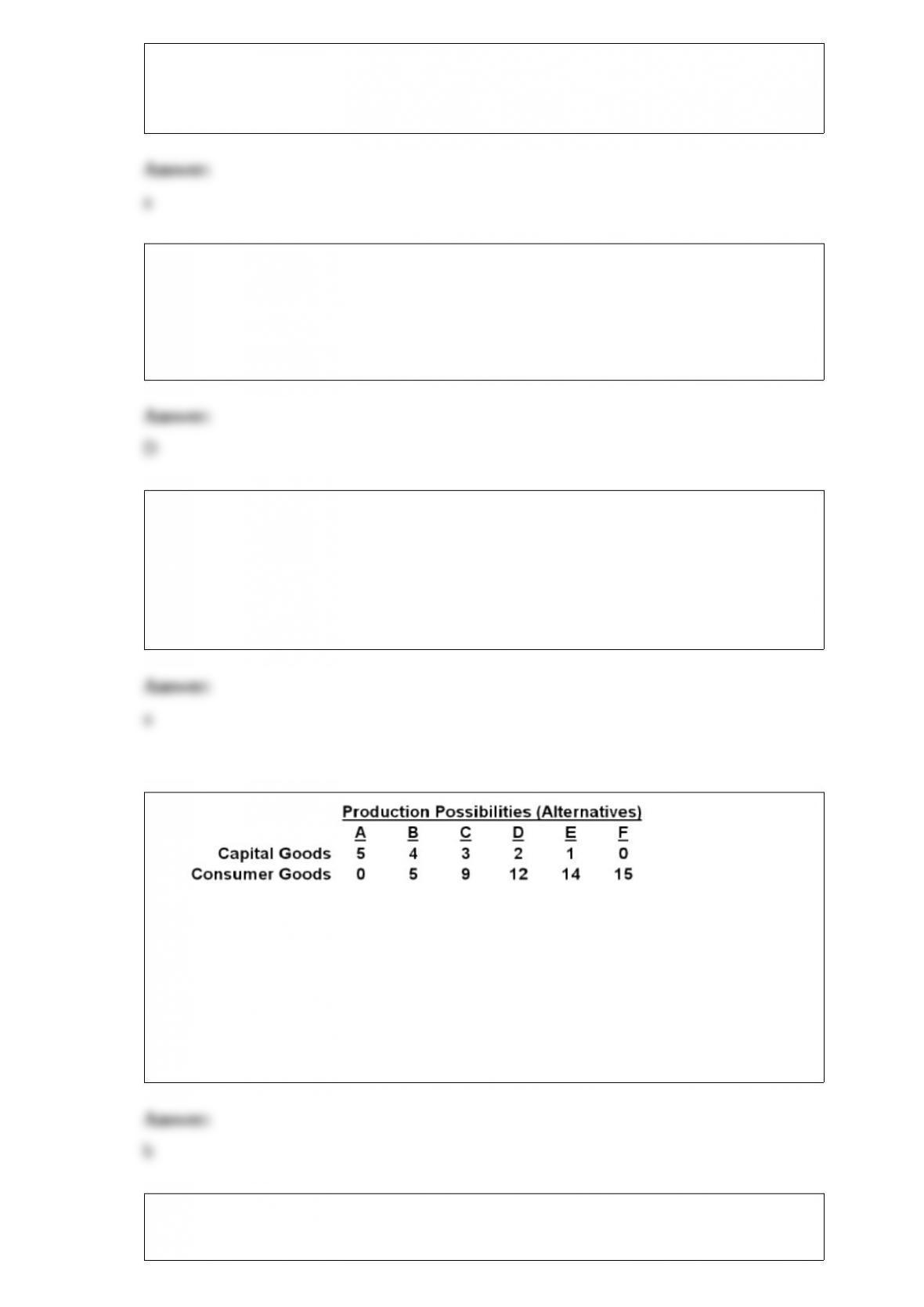
refer to the above table. for these data the law of increasing opportunity costs is
reflected in the fact that:
a.the amount of consumer goods that must be sacrificed to get more capital goods
diminishes beyond a point.
b.larger and larger amounts of capital goods must be sacrificed to get additional units of
consumer goods.
c.the production possibilities data would graph as a straight downsloping line.
d.the economy’s resources are presumed to be scarce.
24)
Suppose that a firm’s legal staff concludes that a new production process which a firm is

developing is patentable. Graphically, this new information would shift the firm’s
expected rate of return curve on R&D to the:
A.right and reduce its optimal amount of R&D.
B.right and increase its optimal amount of R&D.
C.left and increase its optimal amount of R&D.
D.left and reduce its optimal amount of R&D
25) If a nation’s goods exports are $55 billion, while its goods imports are $50 billion,
we can conclude with certainty that this nation has a:
A.balance of trade (goods) surplus.
B.balance of payments surplus.
C.positive balance on current account.
D.positive balance on goods and services.
26) if a nondiscriminating pure monopolist decides to sell one more unit of output, the
marginal revenue associated with that unit will be:
a.equal to its price.
b.the price at which that unit is sold less the price reductions which apply to all other
units of output.
c.the price at which that unit is sold plus the price increases which apply to all other
units of output.
d.indeterminate unless marginal cost data are known.
27) An example of a public good is:
A.broadband Internet access.
B.homeland defense.
C.a baseball.
D.a lawn mower.
28) The:
A.short-run aggregate supply curve is downward sloping.
B.short-run aggregate supply curve is vertical.
C.long-run aggregate supply curve is vertical.
D.long-run aggregate supply curve is upsloping.
29) Explain the long-run relationship between real hourly earning and productivity.
30) Explain why the economic analysis of monopolistic competition is so complex.
31) Who gains and who loses from a protective tariff? Explain.
32) What conditions must exist in order for a pure monopolist to achieve economic
profits? Is the profitability of a firms operation a good index of the degree of monopoly
power it possesses?
33) Describe and give an example of a dominant strategy.
34) Under what circumstances might the Coase theorem not be applicable? Apply these
circumstances to an example to illustrate your point.
35) Why is the difference between the actual and expected rates of inflation important
for explaining inflation?