By looking at the different slices of a pie chart, and comparing one slice to another, it is
possible to quickly estimate
a. relative relationships.
b. absolute relationships.
c. the slope of a line.
d. the slope of a curve.
e. none of the above
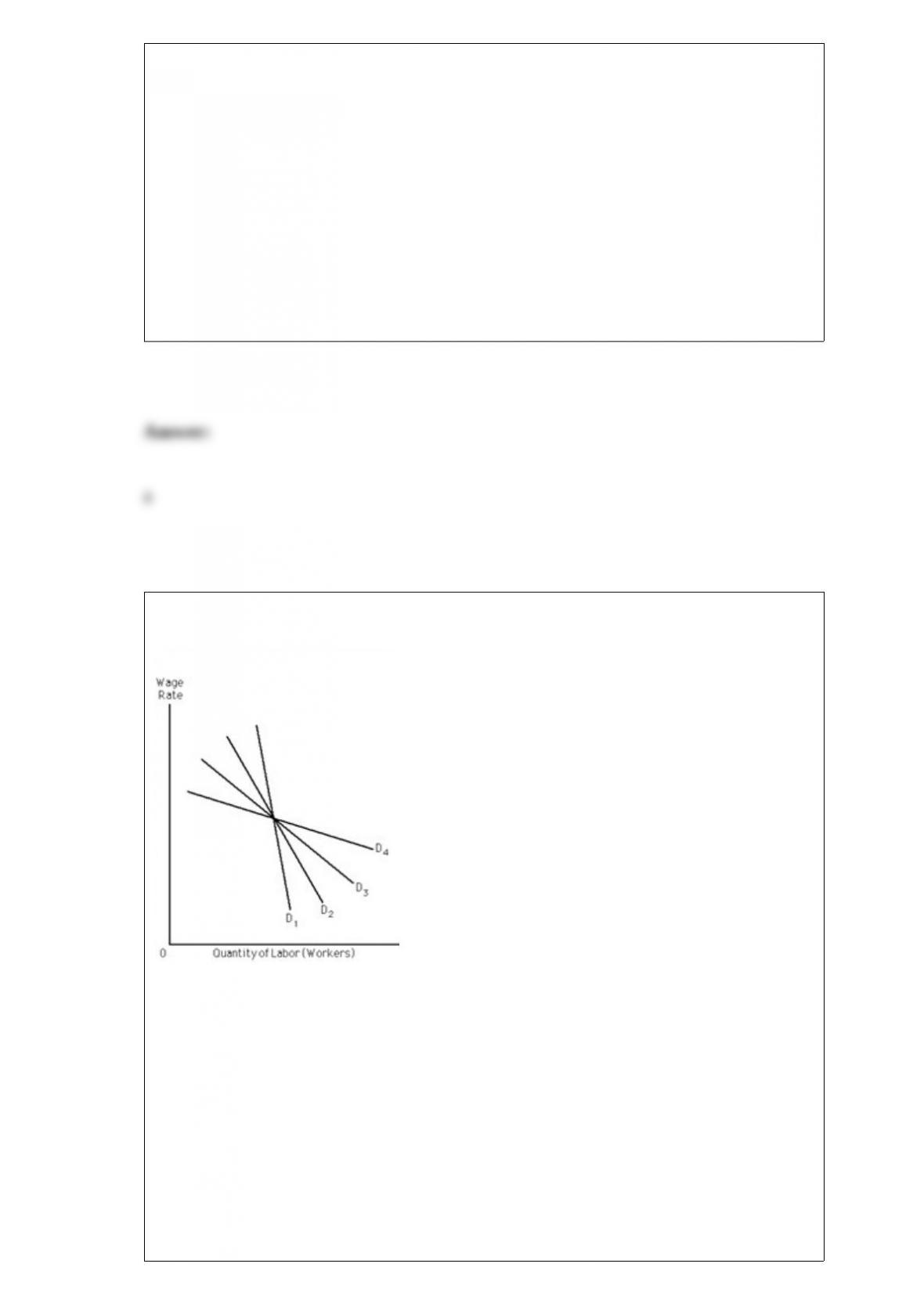
Exhibit 28-1
Four demand curves for labor are displayed: D1, D2, D3, and D4. Which provides the
most pronounced wage-employment tradeoff?
a. D1
b. D2
c. D3
d. D4
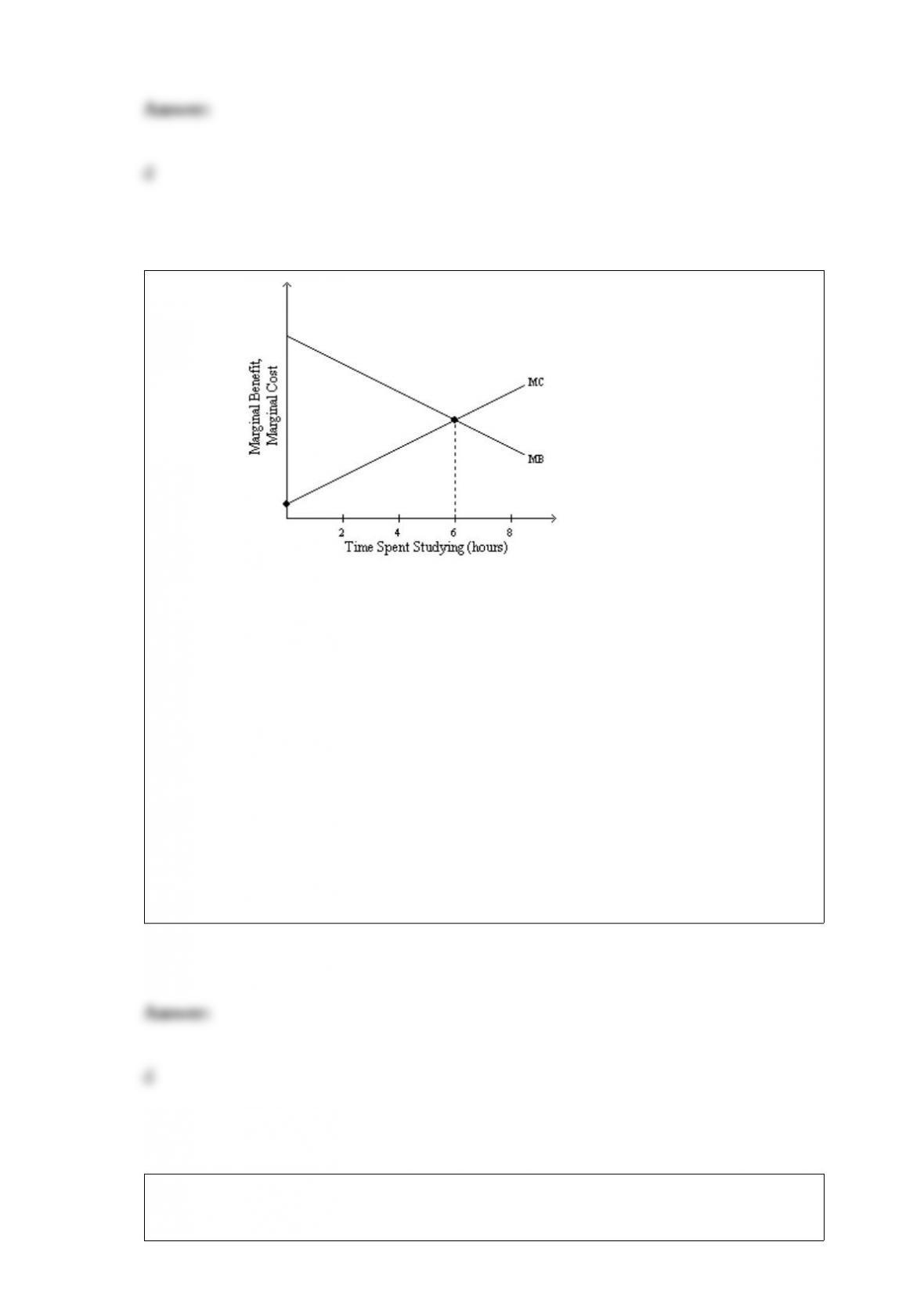
Exhibit 1-1
If the student whose study habits are illustrated here is currently studying for the 2nd
hour she should
a. cut back on the number of hours she is studying because the marginal benefit of
studying for the 2nd hour is less than the marginal cost of doing so.
b. cut back on the number of hours she is studying because the marginal benefit of
studying for the 2nd hour is greater than the marginal cost of doing so.
c. increase the number of hours she is studying because the marginal benefit of studying
for the 2nd hour is less than the marginal cost of doing so.
d. increase the number of hours she is studying because the marginal benefit of studying
for the 2ndhour is greater than the marginal cost of doing so.
Economist B thinks that it is important to identify the condition(s) under which the case
for government is strongest.With respect to the provision of nonexcludable public

goods, she says
a. people must pay taxes to pay for the nonexcludable public good.
b. firms must pay taxes to pay for the nonexcludable public good.
c. people must actually want the nonexcludable public good that the government
provides.
d. people must express their desire for the nonexcludable public good by voting for it.
e. none of the above
Which of the following is a positive economic statement?
a. We should raise the minimum wage in order to provide a decent wage for more
people.
b. Consumers bought fewer cars when the relative price of cars increased.
c. The budget deficit has been rising in recent years.
d. Federal government spending ought to be curtailed.
e. b and c
Consumer equilibrium exists when the
a. slope of the indifference curve is greater than the slope of the budget constraint.

b. consumer is on his highest indifference curve.
c. marginal rate of substitution equals the slope of the budget constraint.
d. slope of the indifference curve equals the slope of the budget constraint.
e. c and d
Which of the following statements is true?
a. Nominal interest rate = real interest rate – expected inflation rate.
b. Nominal interest rate = real interest rate + expected inflation rate.
c. Real interest rate = nominal interest rate + expected inflation rate.
d. Expected inflation rate = nominal interest rate + real interest rate.
If a person gives a gift to another person, an economist would say that it is because
a. the marginal benefit of giving the gift is at least as great as the marginal cost of
giving the gift.
b. the marginal cost of giving the gift is at least as great as the marginal benefit of
giving the gift.
c. he expects to receive a gift in return.

d. none of the above
If government regulators guarantee a natural monopolist that it will earn normal profits,
then the monopolist will
a. achieve resource-allocative efficiency.
b. charge a price above average total cost.
c. produce a quantity of output at which marginal revenue equals price.
d. none of the above
The law of diminishing marginal returns is
a. the same concept as economies of scale.
b. another name for the law of diminishing marginal utility.
c. important for long-run economic analysis.
d. relevant to the production of goods, but not services.
e. none of the above
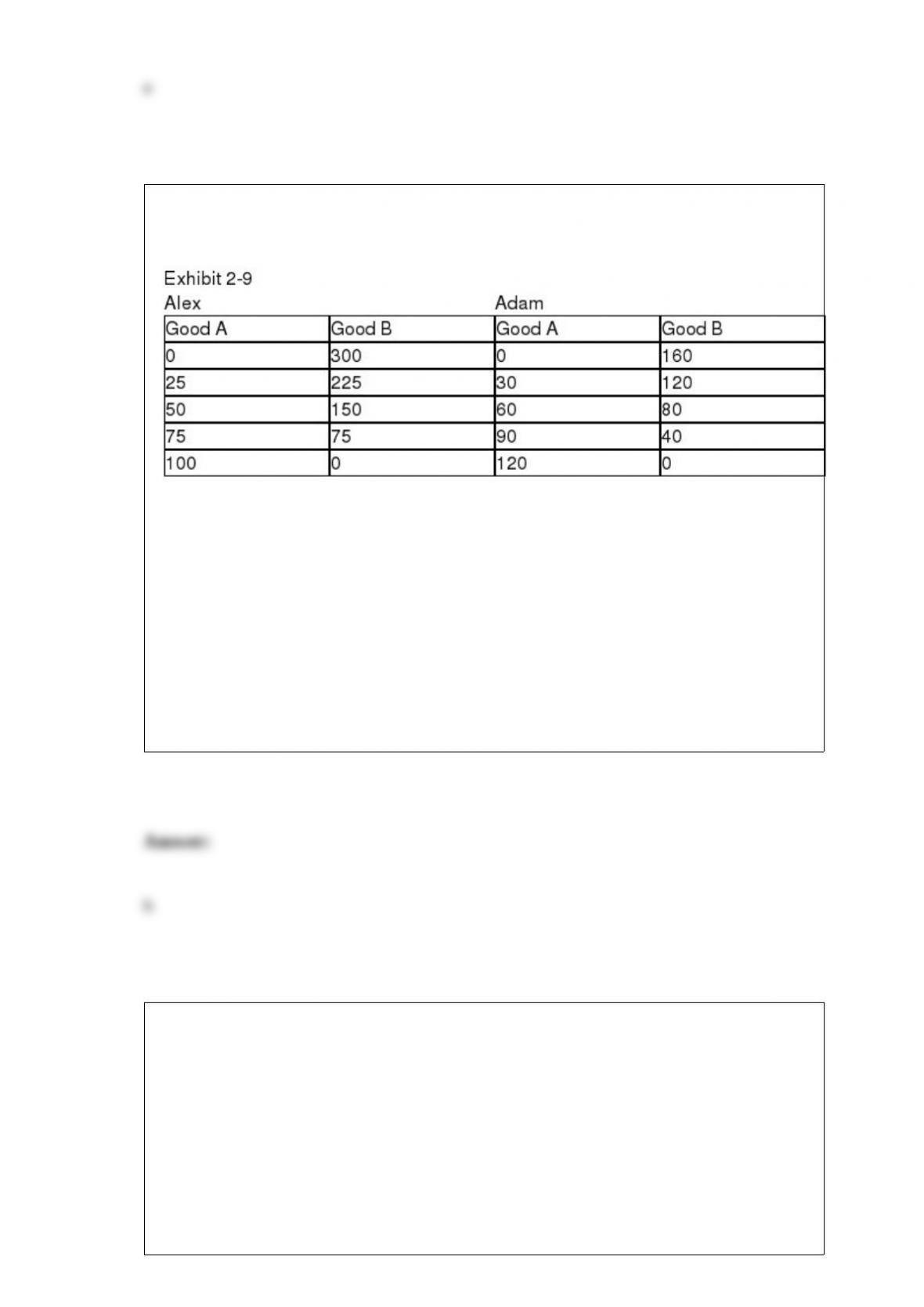
For Alex, the opportunity cost of producing one unit of good B is ____________ unit(s)
of good A.
a. 3.00
b. 0.33
c. 0.75
d. 1.33
If total revenue does not change as a result of a rise in the price of a given good, it
follows that demand is
a. perfectly elastic.
b. perfectly inelastic.
c. unit elastic.
d. inelastic.

e. elastic.
The supply of loanable funds depends most directly on
a. investment expenditures.
b. people’s saving and newly created money.
c. bond and stock activity.
d. the profits of firms.
If supply is inelastic, it follows that
a. a rise in price will not change quantity supplied.
b. a fall in price will not change quantity supplied.
c. consumers will pay 100 percent of any tax placed on sellers.
d. quantity supplied always changes more than price changes.
e. none of the above