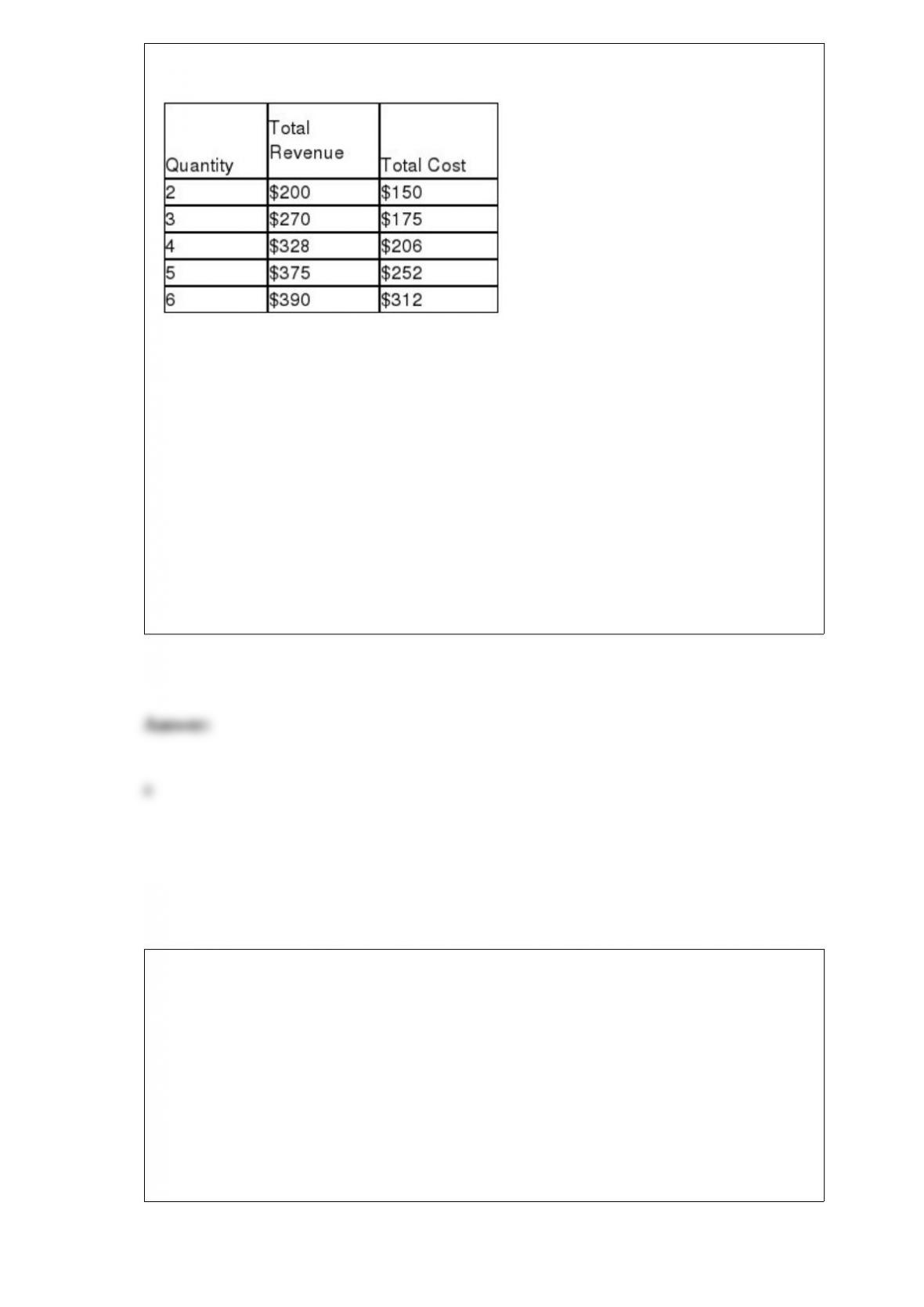
Exhibit 24-8
Assuming that total fixed costs are $80, the average variable cost of producing 5 units
of output is
a. $34.40.
b. $50.40.
c. $10.67.
d. $38.67.
e. There is not enough information given to answer this question.
A shift of the supply curve for farm products to the right in a price inelastic region of
the demand curve for farm products
a. reduces price and total revenue.
b. increases price and reduces total revenue.
c. reduces price and increases total revenue.
d. increases prices and total revenue.
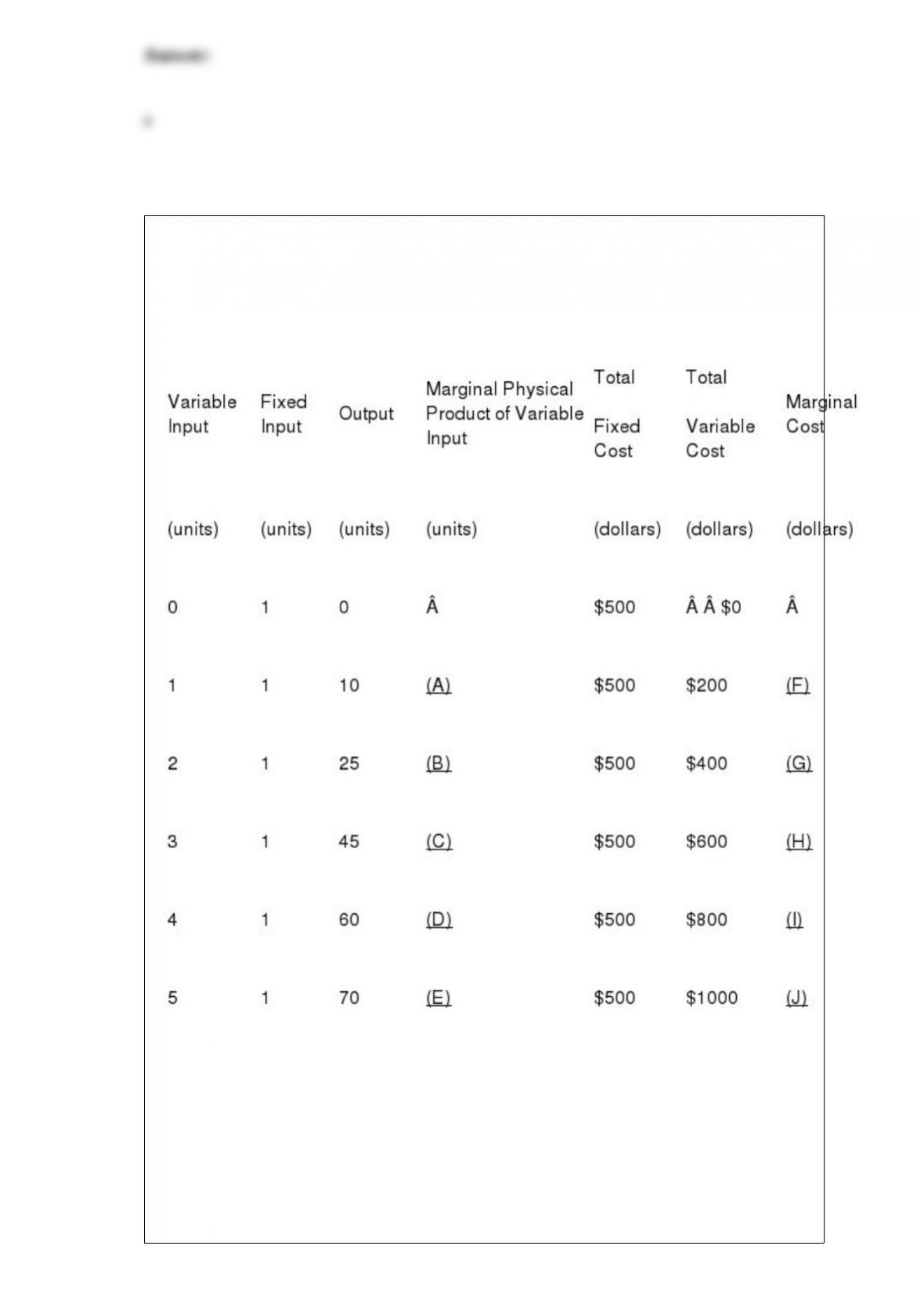
Exhibit 22-3
The marginal cost figures in blanks (I) and (J), respectively, are
a. $5.33 and $10.00.
b. $1.33 and $2.00.
c. $1.33 and $1.43.

d. $13.33 and $20.
e. none of the above
One of the arguments in favor of trade restrictions is the foreign export subsidies
argument.
a. True
b. False
Which of the following situations is clearly and unambiguously descriptive of a positive
externality?
a. Jack feels better after his daily walk.
b. Joriel studies harder than anyone in his class.
c. Professor Gomez gave an unannounced quiz to her history class yesterday.
d. The President of the United States yesterday signed a legislative act that is very
popular in the country.

e. none of the above
The monopolistic competitor has a __________ elastic demand curve than the
monopolist, largely because it faces __________ substitutes for the product it produces
and sells.
a. less; more
b. more; fewer
c. more; more
d. less; fewer
Logrolling
a. is vote trading among elected officials.
b. eliminates the influence of special interest groups.
c. puts downward pressure on federal spending.
d. b and c
e. all of the above
A PPF is bowed outward as a result of
a. constant opportunity costs.

b. increasing opportunity costs.
c. decreasing opportunity costs.
d. scarcity.
e. choice.
As a result of an agricultural price support,
a. quantity demanded is greater than quantity supplied.
b. quantity supplied is greater than quantity demanded.
c. fewer exchanges are made.
d. a and c
e. b and c
A price floor (set above the equilibrium price) on rice will
a. force otherwise profitable farmers out of business.
b. result in a shortage of rice.
c. result in a surplus of rice.
d. clear the market for rice.
e. both a and b

For Alex, the opportunity cost of producing one unit of good A is ____________ unit(s)
of good B.
a. 3.00
b. 0.33
c. 0.75
d. 1.33
Which of the following statements is false?
a. A firm minimizes costs by buying factors in the combination at which the
MPP-to-price ratio for each is the same.
b. Marginal productivity theory states that firms in competitive or perfect product and
factor markets pay factors their marginal revenue products.
c. Marginal factor cost equals the wage rate for a factor price taker.
d. The lower the elasticity of demand for the product labor produces, the higher the
elasticity of demand for labor.

Cross elasticity of demand measures the responsiveness of the
a. demand for one good to changes in the demand for another good.
b. demand for one good to changes in the price of another good.
c. quantity demanded of one good to changes in the quantity demanded of another
good.
d. quantity demanded of one good to changes in the price of another good.
e. b and d
At a price of $15 each, Marta buys 4 books per month. When the price increases to $20,
Marta buys 3 books per month. Luz says that Marta’s demand for books has decreased.
Is Luz correct?
a. Yes, Luz is correct.
b. No, Luz is incorrect. Marta’s demand has increased.
c. No, Luz is incorrect. Marta’s quantity demanded has decreased, but her demand has
stayed the same.
d. No, Luz is incorrect. Marta’s quantity demanded has increased, but her demand has
stayed the same.
e. No, Luz is incorrect. Marta’s quantity demanded has decreased and her demand has
increased.
Which of the following statements is true?
a. A person who buys a bond always pays the face value for the bond.
b. If a corporation issues a bond and Dennis buys it, Dennis becomes one of the owners
of the corporation.

c. A stockholder of Firm X is one of the owners of Firm X.
d. The owner of the bond receives periodic payments equal to its coupon rate times the
price he paid for the bond.
If a perfectly competitive firm and a single-price monopolist face the same demand and
cost curves, then the competitive firm will produce a
a. greater output and charge a lower price than the monopolist.
b. greater output but charge the same price as the monopolist.
c. greater output and charge a higher price than the monopolist.
d. smaller output and charge a lower price than the monopolist.
e. smaller output and charge a higher price than the monopolist.
According to the Coase theorem, externalities
a. must usually be internalized by taxation or subsidy.
b. can be internalized by the market under certain conditions.
c. result when firms fail to maximize profits.
d. cannot be internalized if property rights are assigned.
e. are not relevant to the issue of market failure.
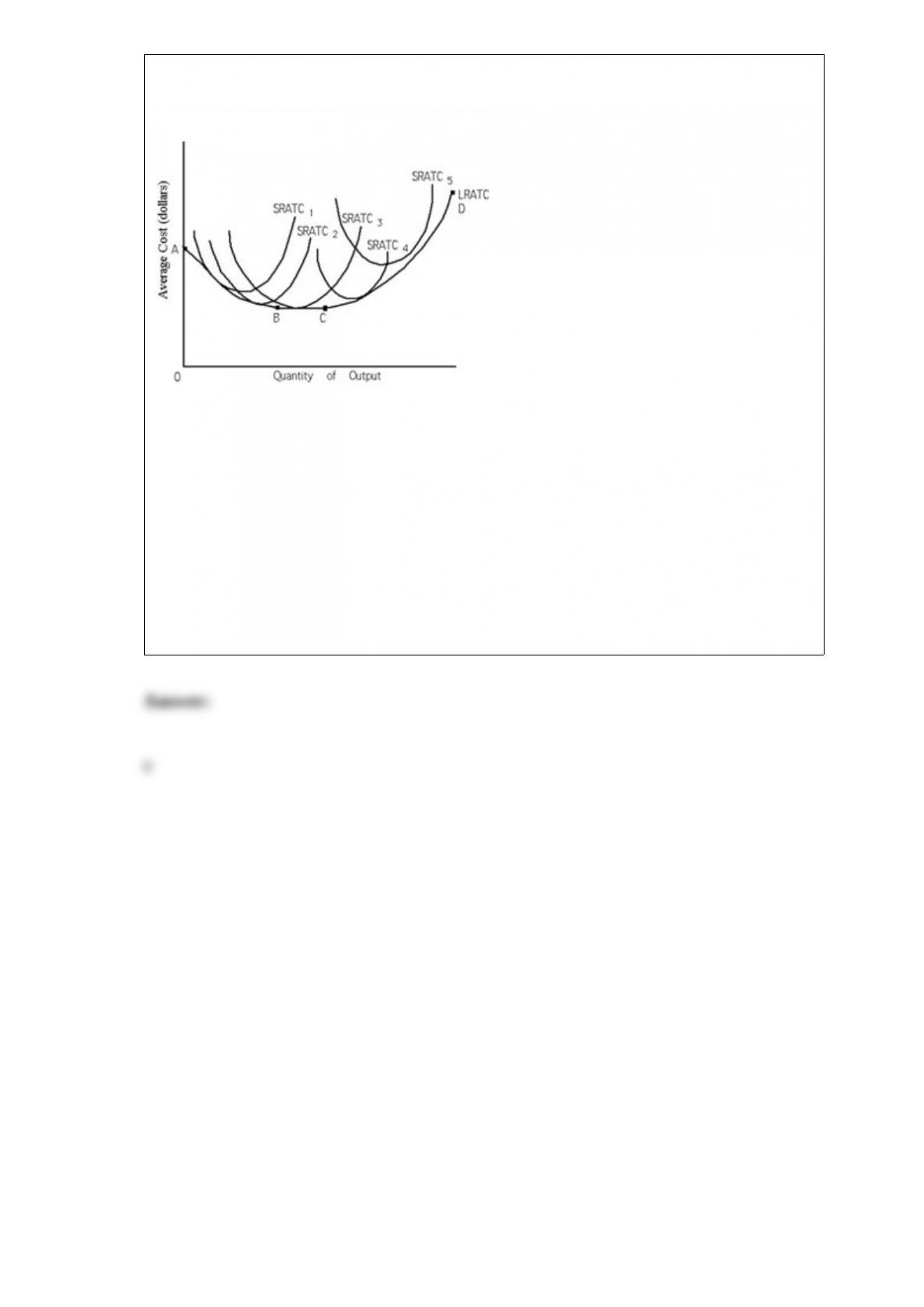
Exhibit 22-5
Diseconomies of scale are present
between
a. points A and B.
b. points A and C.
c. points B and C.
d. points B and D.
e. points C and D.