
In August 1988, the Los Angeles Kings hired Wayne Gretzky for $15 million in cash.
The hockey team’s decision must have been based on the expectation that
a. Gretzky’s opportunity cost will exceed $15 million.
b. Gretzky’s marginal revenue product will equal or exceed $15 million.
c. the team’s total revenue will equal $15 million.
d. Gretzky’s marginal revenue product will rise in the long run.
If the fluctuations in the economy’s real growth rate from year to year are caused
primarily by variations in the rate at which aggregate demand increases, then data
would show
a. a cyclical relationship between inflation and unemployment.
b. a direct relationship between inflation and unemployment.
c. an inverse relationship between inflation and unemployment.
d. no relationship between inflation and unemployment.
Figure 4-10
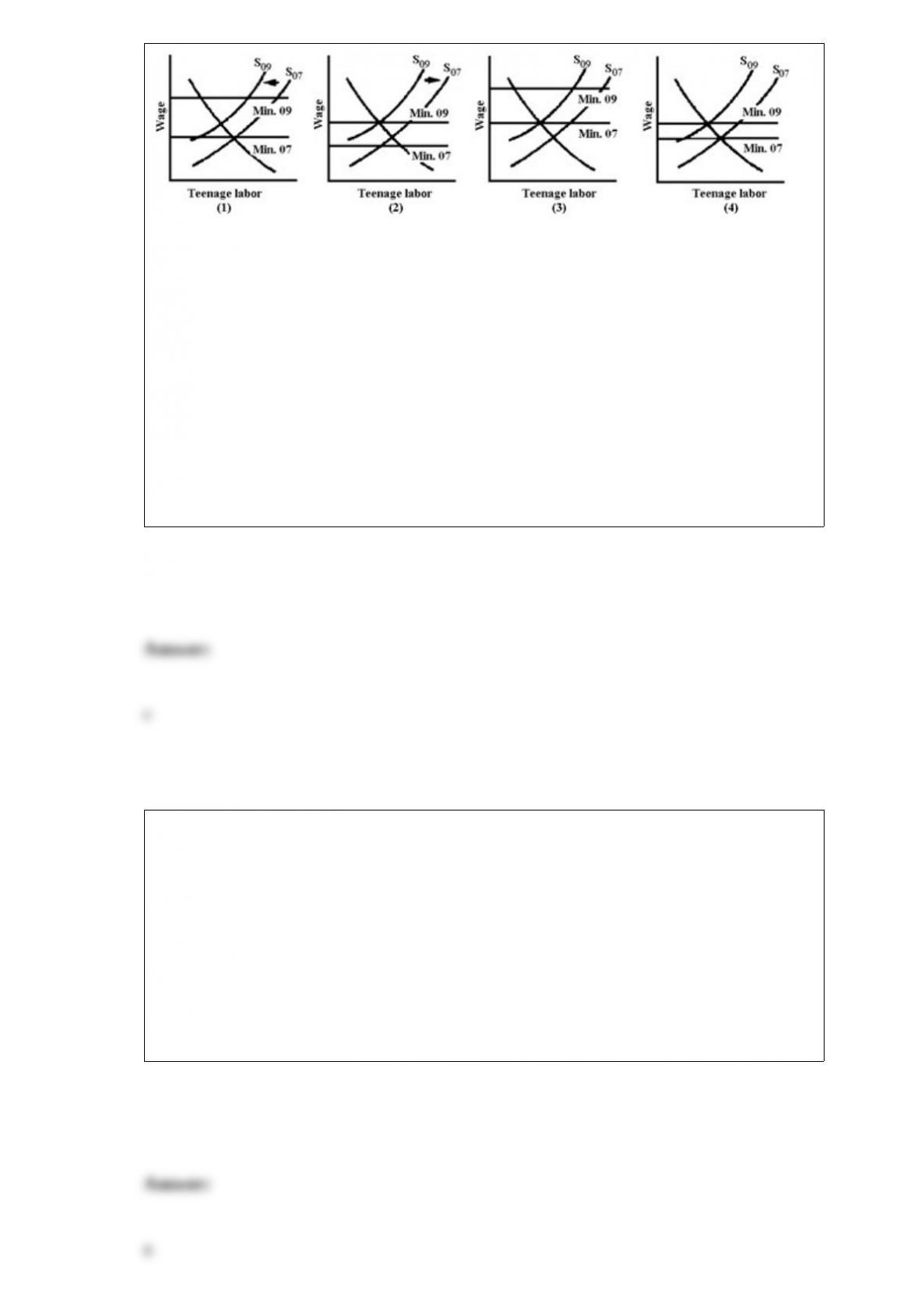
The rising minimum wage allegedly has reduced the quantity demanded of teenage
labor. However, demographics slightly reduced the supply of teenage labor. The U.S.
Department of Labor reported that teenage unemployment is an increasing problem.
Which graph in Figure 4-10 is consistent with these facts?
a. 1
b. 2
c. 3
d. 4
The shape of the production possibilities frontier in Figure 3-1 implies that
a. some resources are better suited for producing wheat than for producing barley.
b. the opportunity cost of producing more wheat falls as wheat production rises.
c. the farmer’s technology is not subject to the principle of increasing costs.
d. the financial cost of producing wheat is higher than the financial cost of producing
barley.

Individuals cannot buy unemployment insurance for themselves. The most likely reason
for this is
a. moral hazard.
b. imperfect information.
c. a culture of poverty.
d. the free-rider problem.
A proponent of supply-side economics would advocate
a. increasing income taxes on saving.
b. reducing corporate income tax.
c. increasing capital gains tax.
d. increasing personal income tax.
Tax loopholes
a. reduce the progressivity of the federal income tax.

b. encourage particular patterns of behavior.
c. include exemption of interest earned on municipal bonds.
d. All of the above are correct.
In a famous series of commercials, the International Ladies’ Garment Workers Union
(ILGWU) urged buyers to “look for the union label” and to avoid buying clothes not
made by ILGWU members. Through the commercials, the ILGWU tried to attain its
goals by
a. restricting the number of ILGWU members.
b. featherbedding.
c. raising the marginal revenue products of ILGWU members.
d. creating lower prices for goods made by ILGWU members.
Income is to money as
a. short story is to novel.
b. video is to digital photo.
c. song is to symphony.

d. entree is to dessert.
If personal taxes are increased by $10 billion, we can expect that consumers will reduce
a. spending by $10 billion.
b. spending by more than $10 billion.
c. spending by less than $10 billion.
d. saving by $10 billion.
e. saving by more than $10 billion.
A Keynesian economist would expect a supply-side tax cut to shift
a. only the aggregate supply curve outward.
b. only the aggregate demand curve outward.
c. both the aggregate demand and aggregate supply curves outward.
d. the aggregate supply curve outward and the aggregate demand curve inward.

All inferior goods have upward-sloping demand curves.
a. True
b. False
Industries, where economies of scale dictate that only a few firms produce, will be
efficient if the markets in which they sell are
a. perfect.
b. contestable.
c. close to each other.
d. protected from entry.
What type of cost is not relevant to the process of research and development or
invention in general?

a. fixed cost
b. marginal cost
c. variable cost
d. social cost
From 2007 to 2008, the Federal Reserve System reduced interest rates, the price which
borrowers pay. As a result, economists expected that the quantity of money supplied
would
a. increase.
b. decrease.
c. not change.
d. Uncertain-economic theory has no answer to this question.
What does macroeconomic theory predict as the main economic effect of a reduction in
the budget deficit?
a. lower real interest rates
b. a drop in the exchange rate
c. an increase in net exports
d. All of the above are correct.
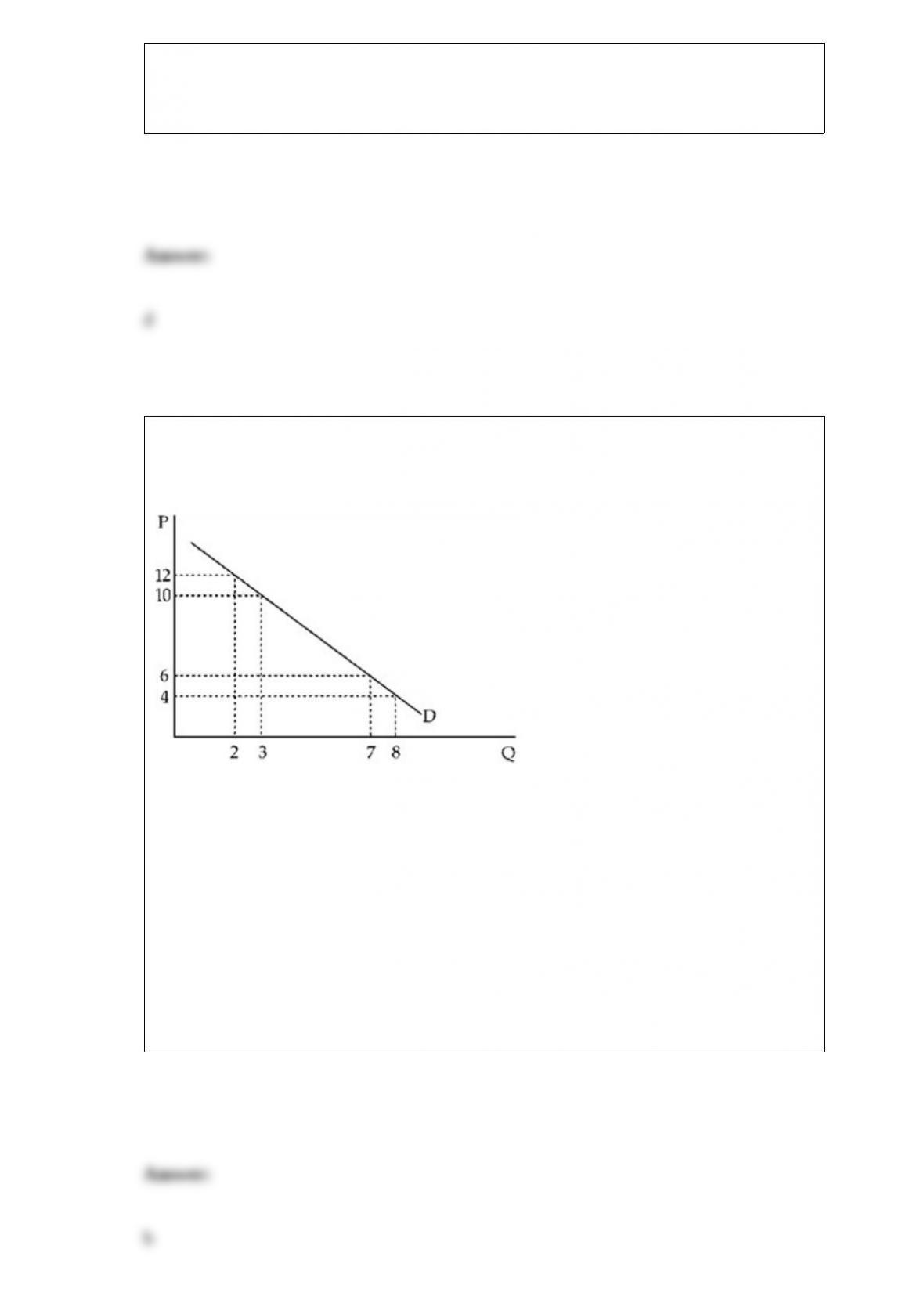
Figure 6-2
In Figure 6-2, the price elasticity of demand (dropping all minus signs) is ____ between
P = 4 and P = 6 than between P = 10 and P = 12 because between the lower set of prices
the percentage change in price is ____.
a. smaller; smaller
b. smaller; greater
c. greater; smaller
d. greater; greater
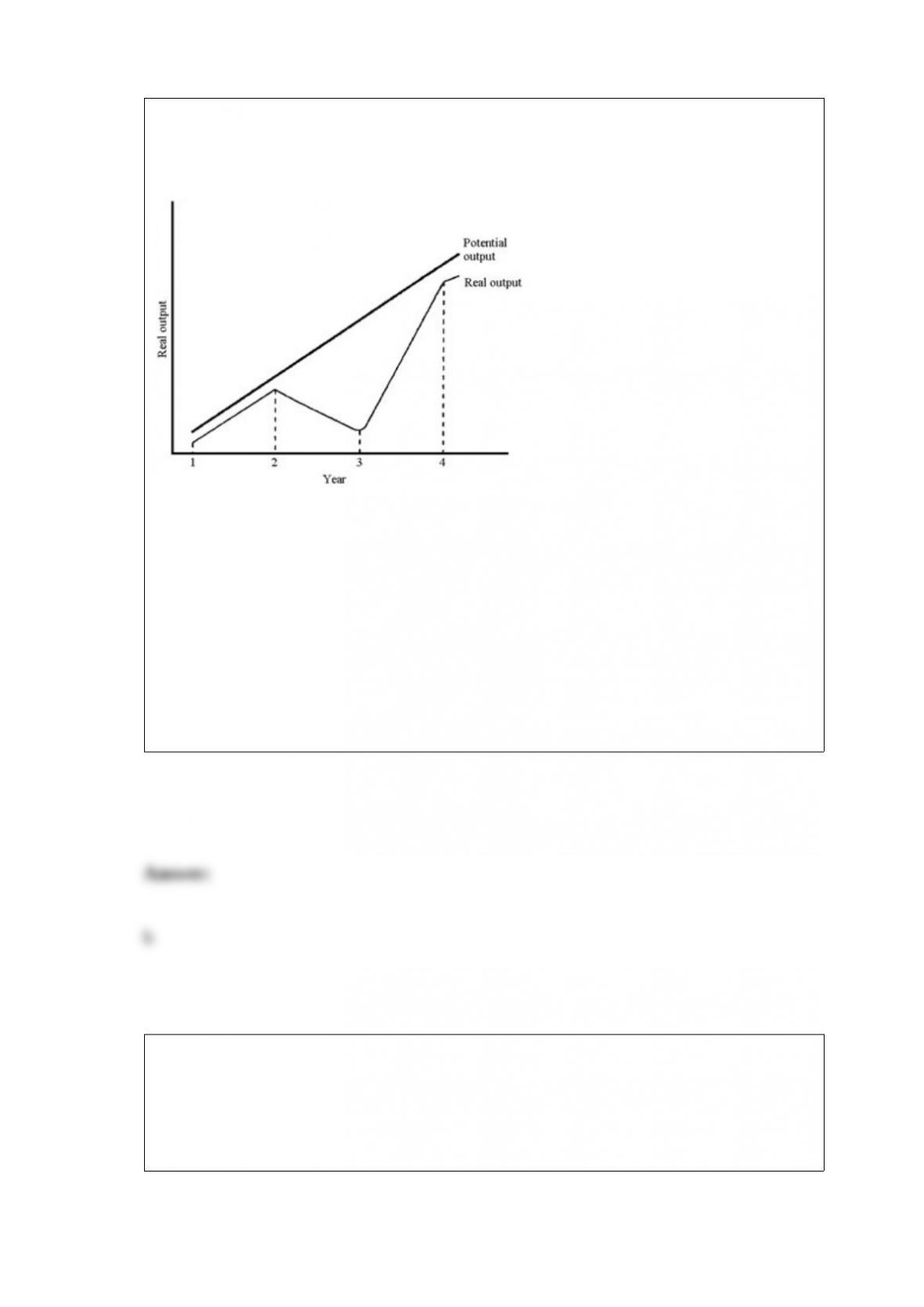
Figure 5-1
Figure 5-1 plots potential and real output for a hypothetical economy. Based on this
graph, the recession occurred
a. between years 1 and 2.
b. between years 2 and 3.
c. between years 3 and 4.
d. after year 4.
A private good is characterized by excludability and depletability.
a. True
b. False

The Fed conducts an open market purchase of Treasury bills of $10 million. If the
required reserve ratio is 0.10, what change in the money supply can be expected using
the oversimplified money multiplier?
a. $100 million
b. $10 million
c. 0
d. −$10 million
e. −$100 million
If demand is unit elastic, revenue
a. and price rise and fall together.
b. rises as price falls.
c. falls as price rises.
d. remains constant as price rises or falls.

If deficit spending causes an increase in economic activity, it may “crowd in” some
potential investment spending.
a. True
b. False
Which of the following is a valid reason to consider government regulation?
a. Seeking some social objective that markets do not achieve.
b. Fear that capitalism will prove too productive.
c. Desire on the part of government to be useful.
d. Requests for protection from an industry.
e. All of the above.
A shift in the supply curve of bicycles resulting from higher steel prices will lead to
a. higher prices of bicycles.

b. lower prices of bicycles.
c. a shift in the demand curve for bicycles.
d. larger output of bicycles.
e. no change in the price of bicycles.
Which of the following statements is correct?
a. The “law” of diminishing marginal utility implies that demand curves slope upward
and to the right.
b. If the price of a good falls, the utility-maximizing consumer will assure that marginal
utility rises.
c. If the price of a good falls, the consumer will purchase more of the good in order to
maximize total utility.
d. MU and demand have different underlying consumer behavior assumptions.
The clearest sign of economic growth is a(n)
a. increase in nominal GDP.
b. increase in real GDP.

c. decrease in nominal GDP.
d. increase in nominal GDP.
Abstract economic theory can be used by academicians, but not by politicians or
business people.
a. True
b. False
An employee of Macro.com Corporation is paid $5,000 a month, which she spends
regularly throughout the month until she has a zero balance in her checking account at
the end of the month. If the corporation changes to a semi-monthly payroll schedule,
how will the employee’s average cash balance change? Assume she does not change her
spending pattern when she is now paid twice a month.
a. It changes from $5,000 to $2,500 per month.
b. It changes from $2,500 to $1,250 per month.
c. It changes from $1,250 to $625 per month.
d. It changes from $500 to $250 per month.

Real GDP per capita in the U.S. grows over time.
a. True
b. False
The economy’s self-correcting mechanism ensures that neither recessionary nor
inflationary gaps will be eliminated eventually.
a. True
b. False
On May 12, 2011 the U.S. dollar was worth 0.70 euros. How many dollars did it take to
buy one euro?
a. 0.70

b. 1.43
c. 1.70
d. 2.70
International capital flows strengthen
a. monetary policy and have no effect on fiscal policy.
b. monetary policy but weaken fiscal policy.
c. monetary and fiscal policy.
d. fiscal policy but weaken monetary policy.