An entry barrier exists when firms in an industry charge the lowest price possible for
their products.
An economic model is a complex version of reality used to analyze real-world
economic situations.
The productivity slowdown experience in the United States from the mid-1970s to the
mid-1990s was actually a global phenomenon.
A doctor pursuing the interests of his patients rather than his own interests is an
example of the principal-agent problem.
If the rate of inflation in the United States exceeds the rate of inflation in Great Britain
we would expect the U.S. dollar to depreciate in value against the British pound.
The values of real GDP and real GNP are almost the same in countries where a
significant fraction of domestic production takes place in foreign-owned firms.
An increase in the inflation rate increases employment only if the increase in inflation is
unexpected.
In a free market there are virtually no restrictions, or at best few restrictions, on how a
good or service can be produced or sold.
If the demand for labor is unchanged, population growth will increase the supply of
labor and increase the equilibrium wage.
For developed countries like the United States, GDP will always exceed GNP.
If, for a product, the quantity supplied exceeds the quantity demanded, the market price
will fall until
A) the quantity demanded exceeds the quantity supplied. The market will then be in
equilibrium.
B) quantity demanded equals quantity supplied. The equilibrium price will then be
lower than the market price.
C) all consumers will be able to afford the product.
D) quantity demanded equals quantity supplied. The market price will then equal the
equilibrium price.
If households and firms decide to hold less of their money in checking account deposits
and more in currency, then the money supply
A) will not change.
B) will increase.
C) will decrease.
D) may increase or decrease.
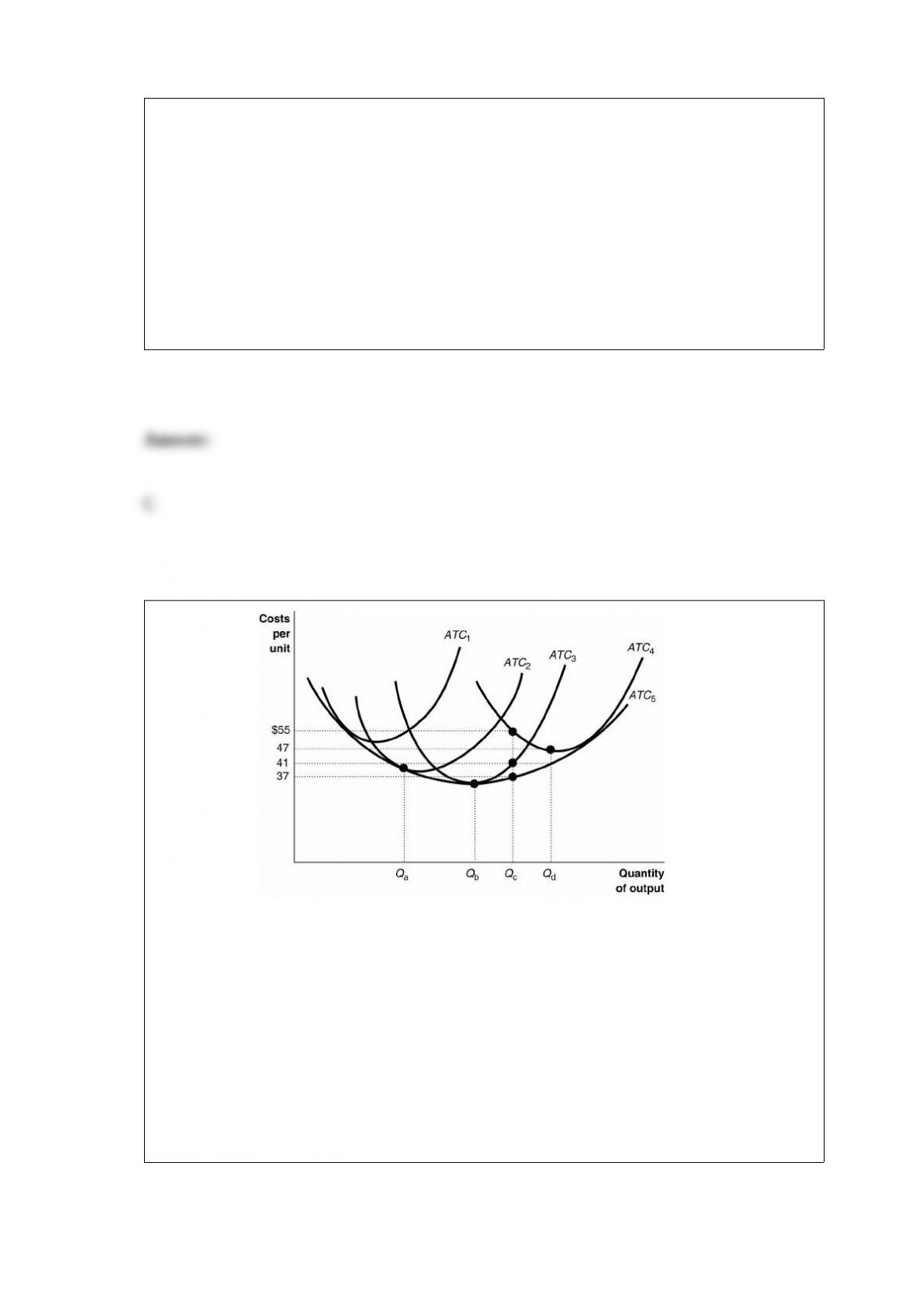
Figure 11-10
Identify the minimum efficient scale of production.
A) Qa
B) Q
C) Qc
D) Qd

A policy that offers parents a tax reduction based on how much they are saving for their
children’s college education should ________ the equilibrium level of loanable funds
and ________ the rate of long-term growth.
A) decrease; increase
B) increase; decrease
C) decrease; decrease
D) increase; increase
How will contractionary monetary policy in Japan affect the demand for the yen and the
supply of the yen in the foreign exchange market?
A) The demand for the yen will fall, and the supply of the yen will increase.
B) The demand for the yen will increase, and the supply of the yen will fall.
C) The demand for the yen will fall, and the supply of the yen will fall.
D) The demand for the yen will increase, and the supply of the yen will increase.
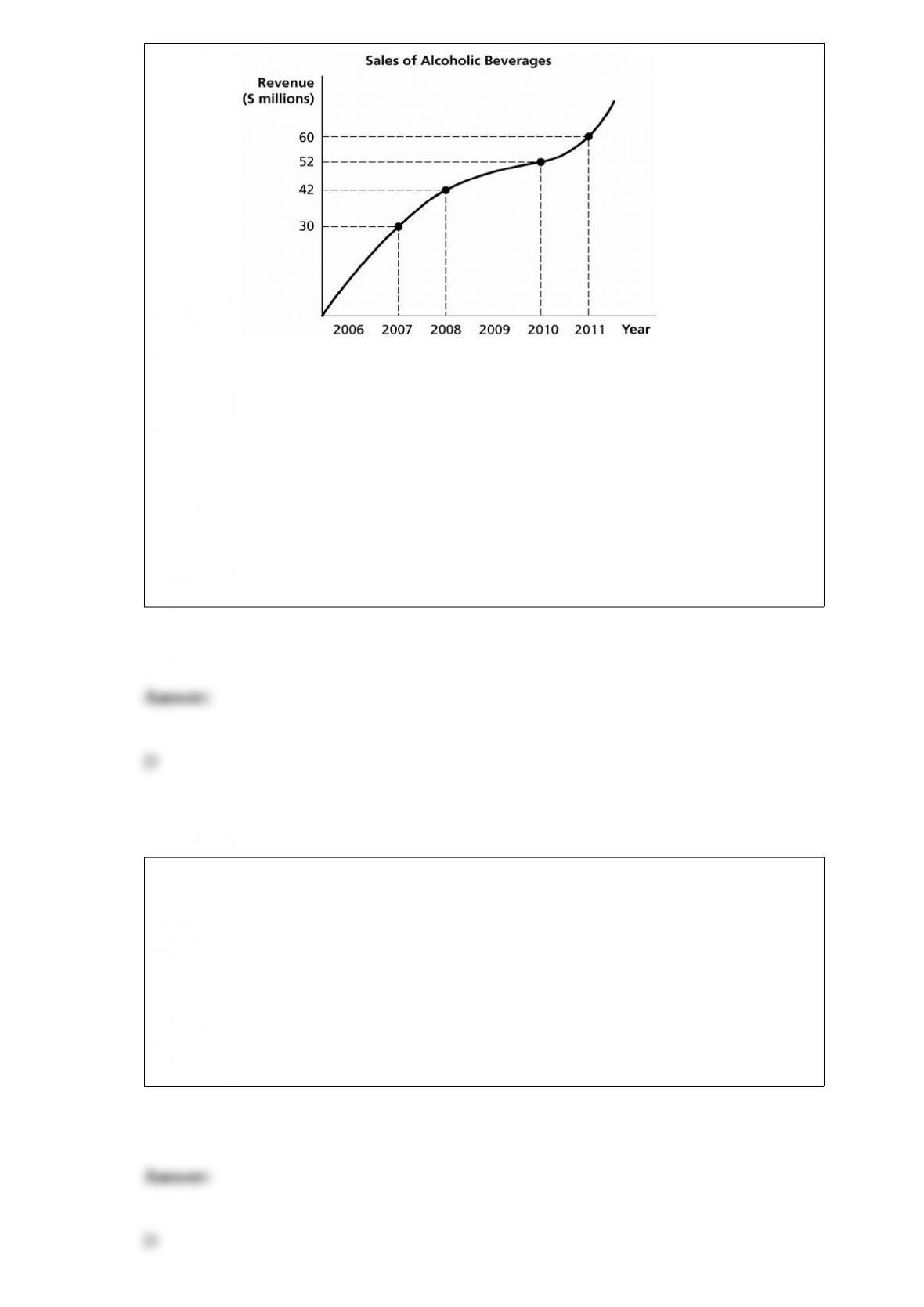
Figure 1-1
Using the information in the figure above, calculate the percentage change in sales of
alcoholic beverages between 2008 and 2011.
A) 23.1%
B) 23.8%
C) 30%
D) 42.9%
Which of the following isnot an example of rent seeking behavior?
A) competition for subsidies
B) lobbying the government to impose tariffs on certain imported products
C) competition for the exclusive right to import a product
D) engaging in aggressive advertising that slams a competitor’s product

________ save a ________ of their income. This ________ capital in their economy
and raises economic growth.
A) Developing countries; large proportion; decreases
B) Developing countries; small proportion; increases
C) High-income countries; large proportion; increases
D) High-income countries; small proportion; increases
The ability to exercise control over one’s own resources within the confines of the law
refers to
A) the free market.
B) one’s property rights.
C) entrepreneurship.
D) having an absolute advantage.
Suppose that nominal GDP in 2013 was less than real GDP in 2013. Given this
information, we know for certain that
A) the price level in 2013 was greater than the price level in the base year.
B) the price level in 2013 was less than the price level in the base year.
C) real GDP in 2013 was less than real GDP in the base year.
D) real GDP in 2013 was greater than real GDP in the base year.
If a monopolistically competitive firm breaks even, the firm
A) is earning an accounting profit and will have to pay taxes on that profit.
B) is earning zero accounting and zero economic profit.
C) should advertise its product to stimulate demand.
D) should expand production.
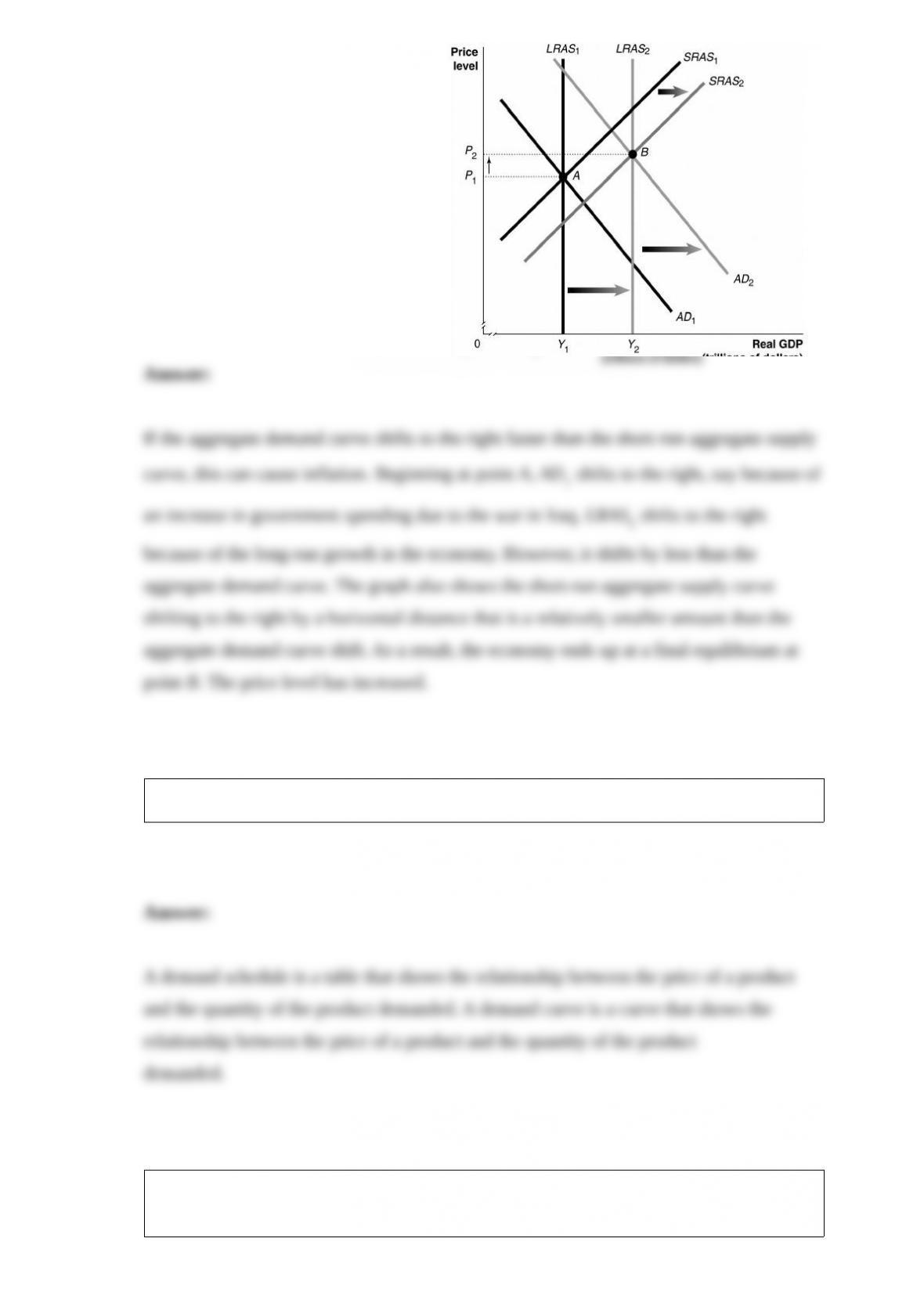
Use the dynamic model of aggregate demand and supply to illustrate a situation where
the economy is growing but experiencing inflation in the long run.
What is the difference between a demand schedule and a demand curve?
Suppose Veronica sells teapots in the perfectly competitive teapot market. Her output
per day and her costs are as follows:
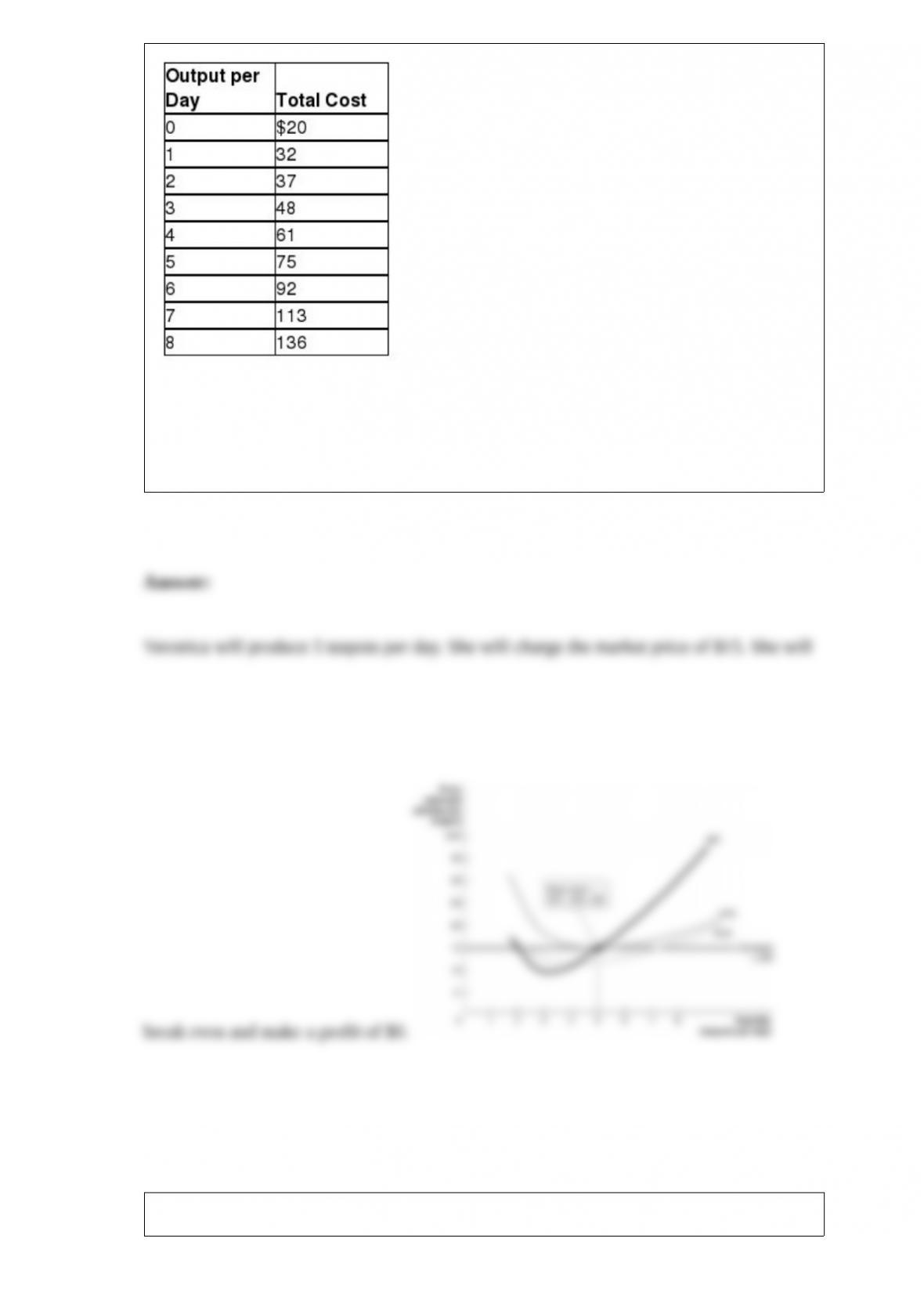
Suppose the current equilibrium price in the teapot market is $15. To maximize profit,
how many teapots will Veronica produce, what price will she charge, and how much
profit (or loss) will she make? Draw a graph to illustrate your answer. Your graph
should include Veronica’s demand, ATC, AVC, MC, and MR curves, the price she is
charging, the quantity she is producing, and the area representing her profit (or loss).
What does it mean to say that workers and firms have rational expectations?
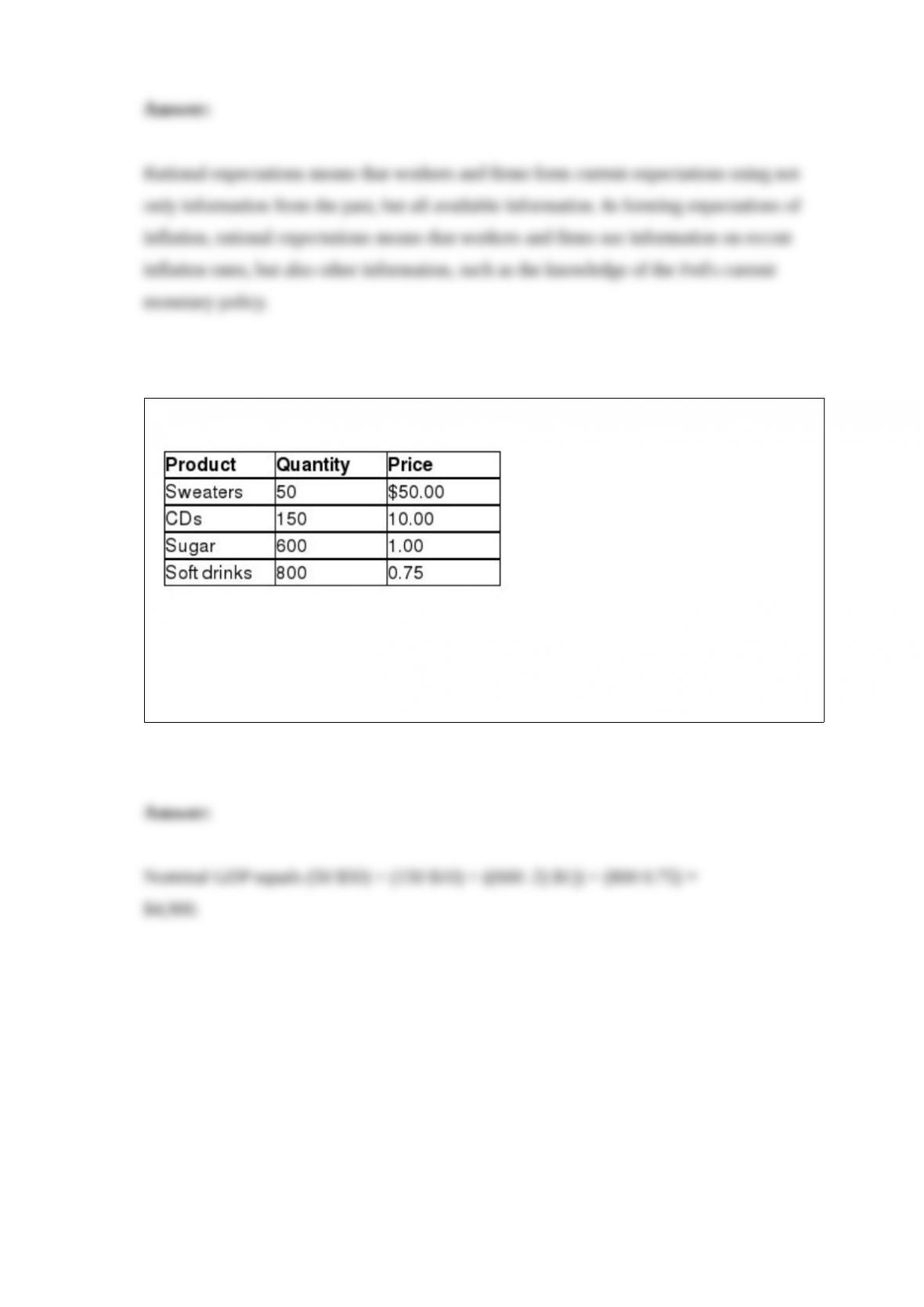
Table 19-8
Suppose that a simple economy produces only four goods and services: sweaters, CDs,
sugar, and soft drinks. Assume one half of the sugar is used in making the soft drinks
and the other half of the sugar is purchased by households. Calculate nominal GDP for
this simple economy.