
In the long run the relevant cost is total cost.
If it costs Vijay $150 to design 5 websites and $175 to design 6 websites, then $175 is
the marginal cost of producing the 6th website.
Marginal benefit is the total benefit to a consumer from consuming one more unit of a
good or service.
The market demand curve facing a monopolist is more elastic than the market demand
curve facing a monopolistic competitor.

The natural rate of unemployment is the rate that exists when the economy is producing
at potential GDP.
If government increases taxes by the same amount it increases government spending,
there will be no effect on aggregate demand: the increase in government spending is
offset by an equal decrease in consumption spending by households.
The income effect of a price change refers to the change in the quantity demanded of a
good that results from a change in purchasing power as a result of the price change.
The inflation rate measures the percentage increase in the price level from one year to
the next.

Examining the conditions that could lead to economic growth is an example of
macroeconomic topic.
A consumer’s utility-maximizing combination of goods is given by the bundle that
corresponds to the highest point on his indifference curve.
In the long run, all of a firm’s inputs are variable.
When negative externalities exist, the competitive market supply curve does not include
all of the costs borne by members of society.
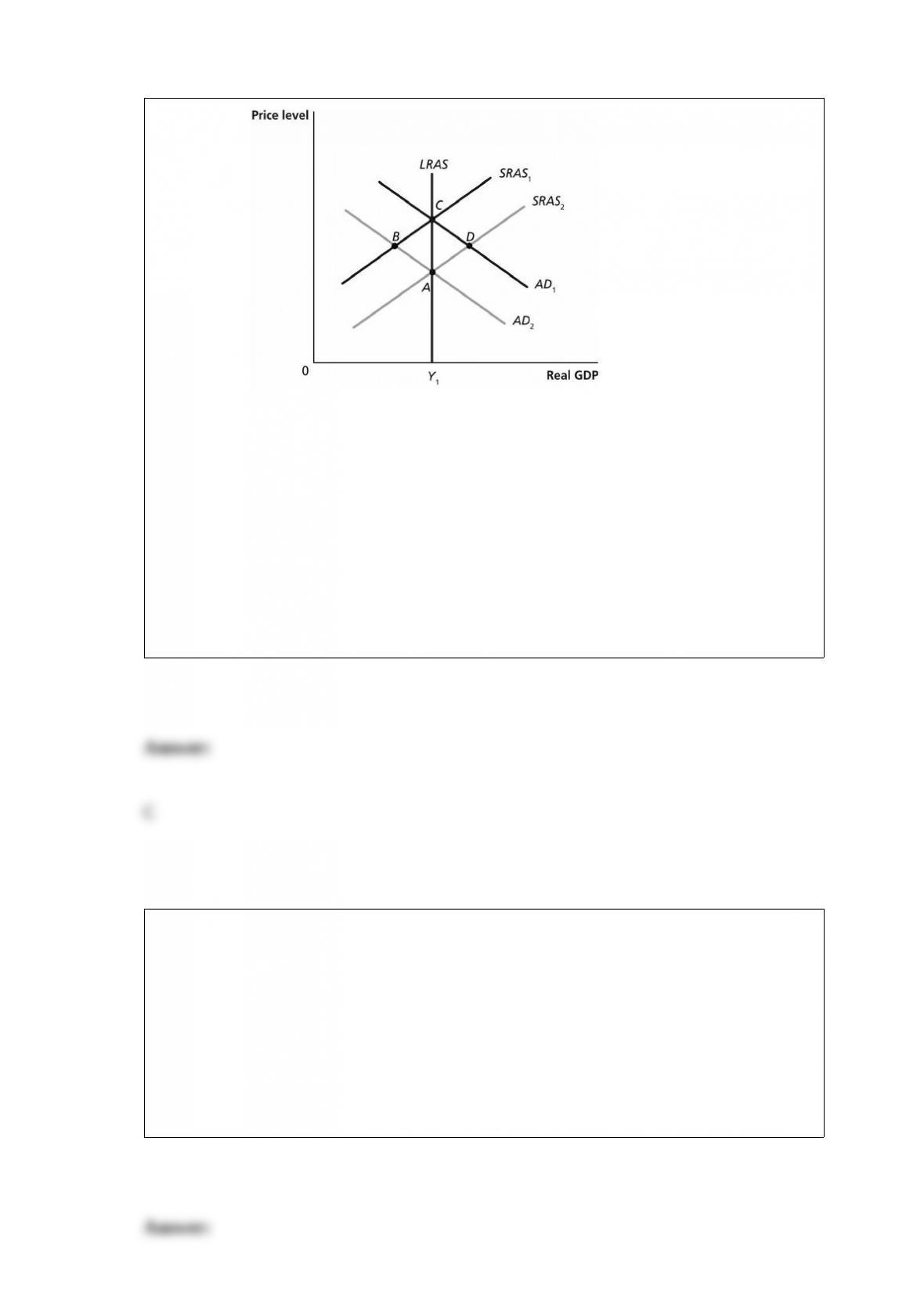
Figure 13-3
Suppose the economy is at point A. If government spending increases in the economy,
where will the eventual long-run equilibrium be?
A) A
B) B
C) C
D) D
Which of the following describes a situation in which the person is hurt by inflation?
A) a retiree whose pension is adjusted for inflation
B) a person who borrows money during a period when inflation is under-predicted
C) a person who lends money during a period when inflation is over-predicted
D) a person paid a fixed income during an inflationary period

Which of the following best describes supply-side economics?
A) Labor productivity affects aggregate supply.
B) Education affects labor productivity which affects aggregate supply.
C) Education affects the incentive to work, save, and invest and, therefore, aggregate
supply.
D) Tax rates, particularly marginal tax rates, affect the incentive to work, save, and
invest and, therefore, aggregate supply.
From 1983-2013, net exports for the United States
A) grew and then declined.
B) were negative.
C) were positive.
D) increased as exports rose above imports.
Which of the following is a normative statement about economic growth?

A) Economic growth is associated with higher labor productivity growth.
B) Economic growth increases GDP per capita.
C) Economic growth hurts developing countries.
D) Foreign direct investment stimulates economic growth.
To decrease the money supply, the Federal Reserve could
A) lower the discount rate.
B) raise income taxes.
C) raise the required reserve ratio.
D) conduct an open market purchase of Treasury securities.
When an investor buys a corporate bond, the ________ the bond is a loan to the
corporation.
A) interest on
B) face value of
C) coupon payment on
D) dividend payment on
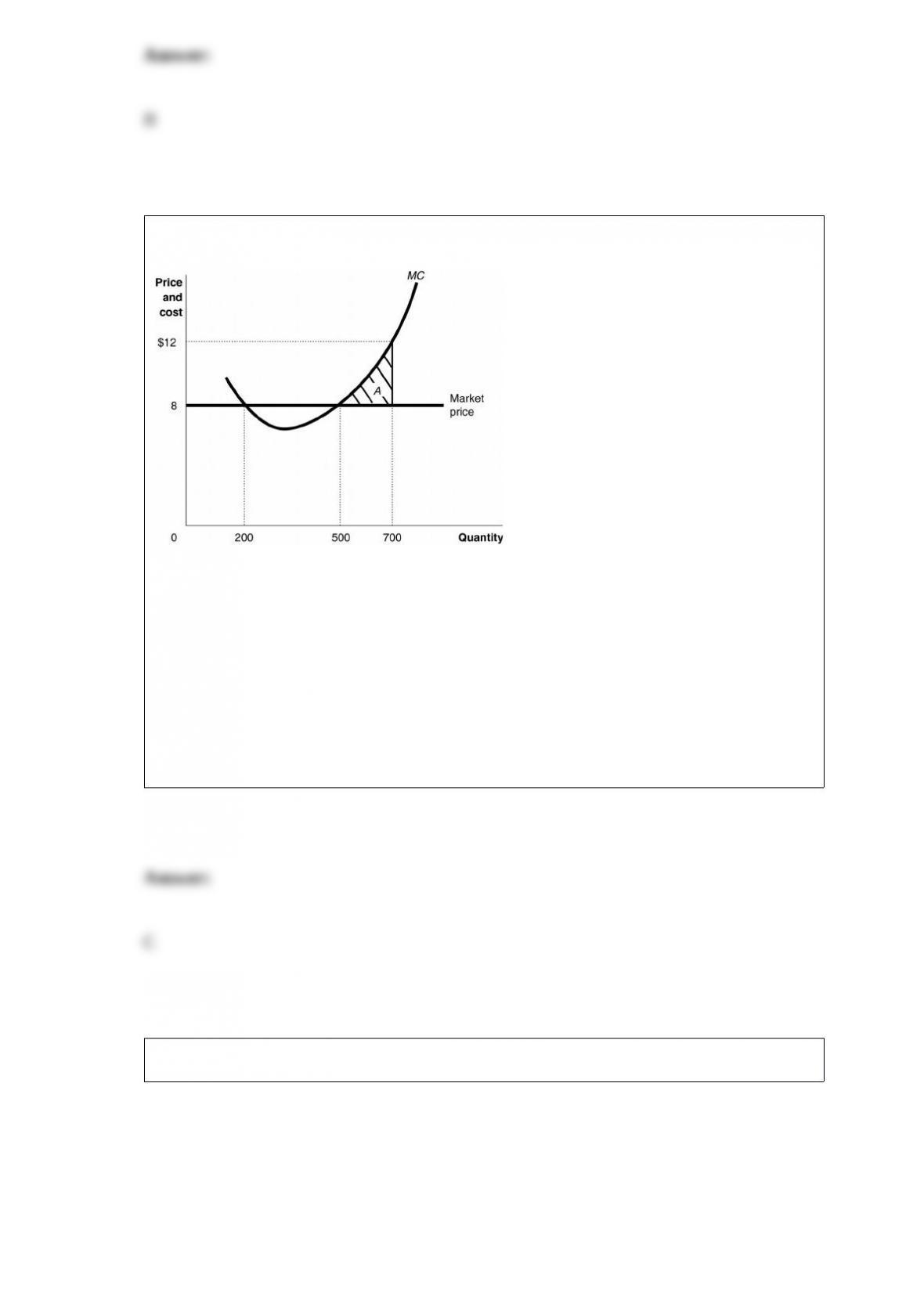
Figure 12-1
If the firm is producing 700 units
A) it is making a profit.
B) it is making a loss.
C) it should cut back its output to maximize profit.
D) it should increase its output to maximize profit.
Figure 13-4
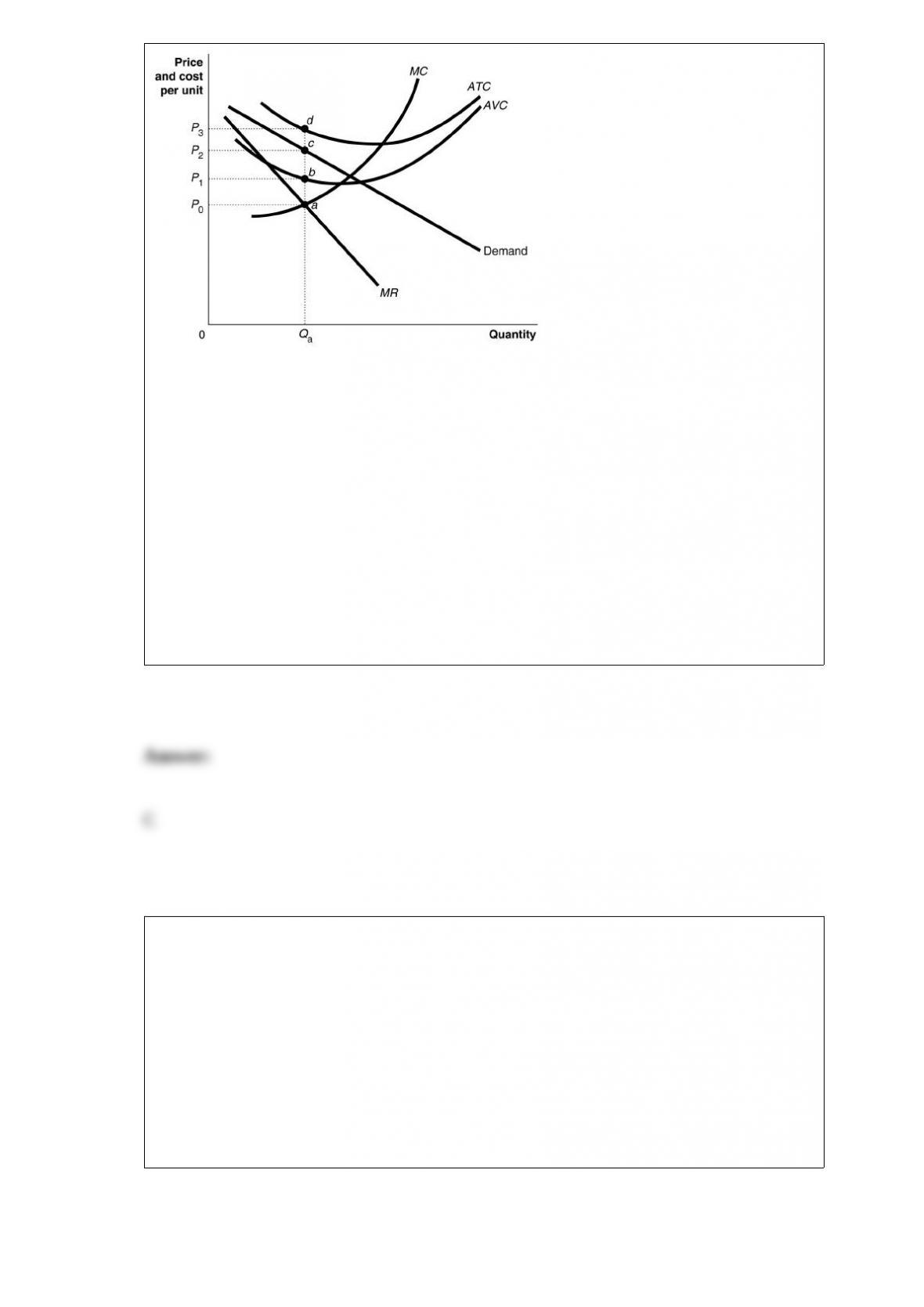
Figure 13-4 shows short-run cost
and demand curves for a monopolistically competitive firm in the market for designer
watches.
What is the area that represents the total revenue made by the firm?
A) 0P0aQa
B) 0P1bQa
C) 0P2cQa
D) 0P3dQa
If the Fed lowers its target for the federal funds rate, this indicates that
A) the Fed is pursuing an expansionary monetary policy.
B) the Fed is pursuing a contractionary monetary policy.
C) the Fed is attempting to combat inflation.
D) the Fed is concerned that the growth in aggregate demand will exceed potential
GDP.

Assuming a fixed amount of taxes and a closed economy, calculate the value of the
government purchases multiplier, the tax multiplier, and the balanced budget multiplier
if the marginal propensity to consume equals 0.5.
Wally, Vijay, Sandra and Consuela make up a software development team at Javasoft.
The firm is considering implementing one of two incentive compensation schemes. In
scheme A, each programmer receives an annual bonus if he or she meets all individual
programming deadlines. In scheme B, members of the team share equally in a joint
bonus if the team meets all of its product delivery deadlines. All four employees are
equally talented but Wally is a slacker who does as little work as he can get away with.
Which scheme might team members prefer? Which scheme will management prefer?

Explain the economic idea that “people respond to incentives.”
What is the ceteris paribus condition?
Briefly describe changes in life expectancy, average height, and infant mortality in the
United States since 1850.
In Michael Porter’s five competitive forces model, what do the competitive forces
determine?
How effective is discount policy as compared to open market operations in managing
the money supply? Explain how The Federal Reserve uses discount policy today.
Explain why the timing of fiscal policy may be more difficult than the timing of
monetary policy.