
When the growth rates of actual and potential GDP diverge, they usually diverge
because
a. actual GDP growth equals potential GDP growth.
b. actual GDP growth falls below potential GDP growth.
c. potential GDP growth rates fall below actual GDP growth rates.
d. potential GDP growth rates fluctuate while actual GDP growth rates remain stable.
____ is a school of economic thought which uses equation of exchange to analyze the
macro economic data.
a. Mercantilism
b. Monetarism
c. Supply side economics
d. Keynesianism
Wages will tend to be high in labor markets where supply is relatively high and demand
is relatively weak.
a. True

b. False
Which of the following has proved to be spectacularly false, at least recently?
a. as an expansion proceeds, people will hold no more cash
b. as an expansion proceeds, banks will hold no more excess reserves
c. the oversmplified money multiplier formula is predicated on two critical assumptions
d. All of the above are false.
The official definition of the money supply that includes coins, paper money, travelers’
checks, conventional checking accounts, and other checkable deposits at banks and
savings institutions is called ____.
a. M1
b. M2
c. M3
d. L

For most industrial nations, health-care costs have increased faster than the rate of
inflation.
a. True
b. False
A unit-elastic demand curve will be concave toward the origin.
a. True
b. False
Structural unemployment arises when
a. marginal productivity of labor becomes zero.
b. there is a cyclical change in the economy.
c. jobs are eliminated by changes in the economy.

d. people change their jobs.
A study of the U.S. price level and real GDP from 1972 to 2007 reveals a clear upward
march toward higher prices and greater output. What explains this?
a. Both the aggregate demand curve and the aggregate supply curve have shifted to the
left year after year.
b. Both the aggregate demand curve and the aggregate supply curve have shifted to the
right year after year.
c. The aggregate supply curve has shifted to the right while the aggregate demand curve
has shifted to the left.
d. The aggregate supply curve has shifted to the left while the aggregate demand curve
has shifted to the right.
The salary of an athlete like Peyton Manning is in part a reward for his unique
ability-something economists call economic rent.
a. True
b. False

MPP is the additional output that results from a one-unit increase in use of the input.
a. True
b. False
Saving is a leakage in the sense that
a. saving is lost to the economy and ultimately leads to stagnation.
b. the financial system often makes negative profits.
c. it often accompanies a trade deficit.
d. consumers spend less than their total income.
Marginal analysis is useful in economics, but not in other areas of life.

a. True
b. False
Which of the following is true?
a. A nation cannot have a comparative advantage in the production of every good.
b. A nation cannot have an absolute advantage in the production of every good.
c. A nation can have a comparative advantage in the production of every good, but not
an absolute advantage.
d. A nation can have a comparative advantage in the production of a good only if it also
has an absolute advantage.
e. A nation cannot have an absolute advantage in the production of a good unless it also
has a comparative advantage.
For the typical student, taking an introductory course in economics should
a. turn the student into an economist.
b. teach the student solutions to most social problems.
c. teach the student how to answer complex social questions.

d. help the student learn to make rational decisions.
e. All of the above are correct.
Economists generally prefer to deal with emissions of pollutants
a. with direct controls.
b. by encouraging people not to pollute.
c. by subsidizing the installation of pollution-control equipment.
d. by taxing emissions.
Figure 20-2

Which of the following explains the movements in Figure 20-2?
a. an increase in U.S. imports
b. a decrease in U.S. exports
c. an increase in U.S. exports
d. a decrease in U.S. net exports
Improvements in the level of technology will generally shift the production function
downward.
a. True
b. False

It is imperative that banks maintain a reputation for safety in order that
a. regulators can reduce their efforts.
b. bank runs can be reduced or prevented.
c. customers will not be afraid to ask for loans.
d. stockholders can earn a high rate of return.
In Macronesia, the MPC is approximately .80. If disposable income changes from 1,000
billion pukas to 1,500 billion pukas, then consumption will change by a(n)
a. decrease of 500 billion pukas.
b. increase of 500 billion pukas.
c. increase of 400 billion pukas.
d. increase of 800 billion pukas.
By enjoying more consumer goods today, the economy spurs growth in future consumer
goods.
a. True
b. False

A progressive tax is one in which the fraction of income paid in taxes rises as a person’s
income increases.
a. True
b. False
An economy is operating with optimum efficiency if
a. the price of the product is greater than marginal cost.
b. the production of more of commodity A entails the production of less of commodity
B.
c. marginal cost of output is greater than marginal utility of output.
d. an increase in output would result in a decrease in average cost per unit.

Labor productivity is calculated by dividing GDP by
a. population.
b. the price level.
c. capital stock
d. labor force.
In contrast to the post-World War II period, before 1940 the government
a. actively intervened in the economy for stabilization purposes.
b. used aggregate demand management to avoid recessions.
c. rarely intervened in the economy to influence inflation or unemployment rates.
d. used government ownership to guarantee full employment.
If the interest rate on borrowing falls,
a. the demand curve for loans will shift out.
b. the discounted value now of money to be received in the future will fall.
c. some previously unprofitable prospective investments will become profitable.

d. All of the above are correct.
Firm A’s motive in filing an antitrust suit against Firm B may be
a. to seek court protection against genuinely unfair practices by Firm B.
b. to seek financial compensation for damages caused by Firm B.
c. to create an expensive nuisance for Firm B.
d. All of the above are correct.
A supply schedule shows
a. the “market potential” for a product.
b. how much producers are willing and able to sell at different prices.
c. possible combinations of output under different conditions.
d. how much consumers would like to buy at different prices.
e. All of the above are correct.
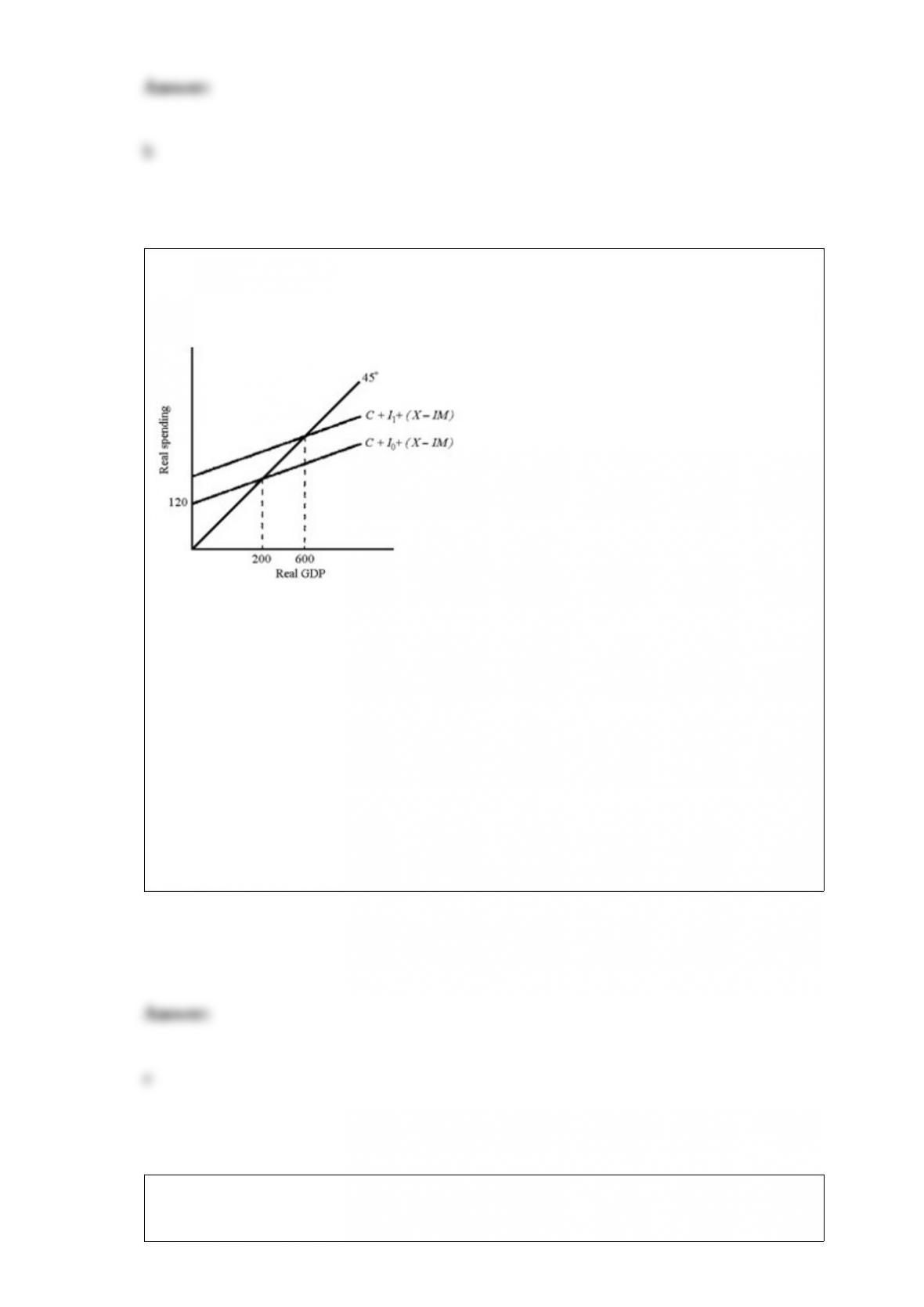
Figure 9-5
If the shift in the C + I + (X − IM) in Figure 9-5 was caused by a 80 dollar increase in
investment, then the multiplier is
a. 0.
b. 2.
c. 3.
d. 4.
e. 5.
California passed a law called “Proposition 2 1/2” that limited property taxes to 2.5
percent of property value. Naturally this reduced taxes on many properties, and

apartment landlords had more money at the end of the year at given rents. This windfall
could be called an economic rent only if
a. we push the definition of economic rent too far.
b. the supply of rental units can be expanded.
c. the supply of rental units is fixed.
d. competitors can build housing at costs that yield the return that was earned before the
tax cut.
A firm is generally more interested in marginal profits than in total profits.
a. True
b. False
From 1973 to 1995, productivity of labor in the U.S.
a. declined because of reduced capital formation.
b. declined because of slower technological improvement.
c. increased because of expanded technological improvement.
d. increased because of expanded technological improvement.
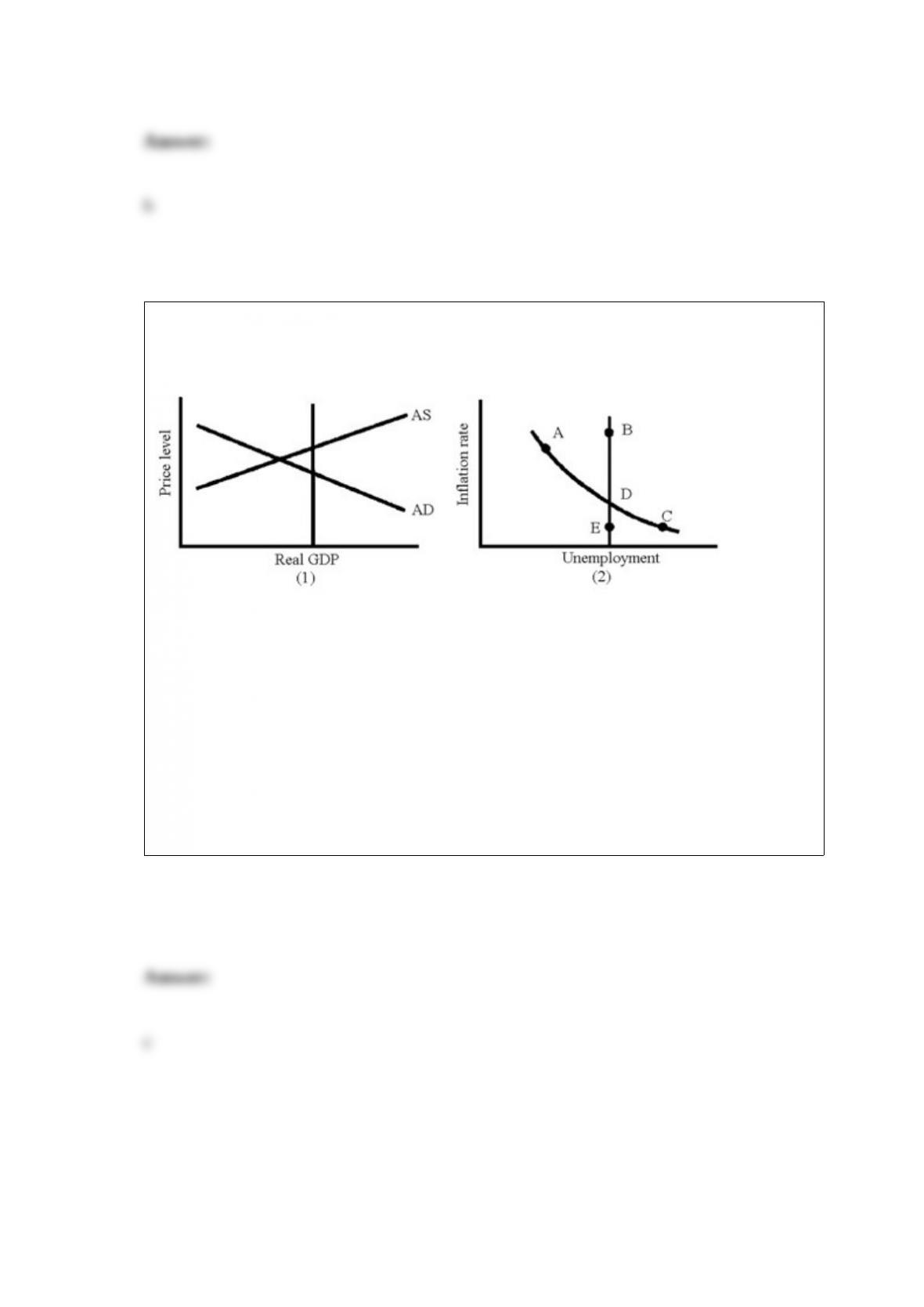
Figure 17-2
Given the situation in graph (1) in Figure 17-2, what movement would be expected in
graph (2) from the economy’s self-correcting mechanism?
a. A to B
b. A to D
c. C to E
d. D to C