
Linesha, a college student working part-time receives a wage increase. An avid movie
buff, she increased her purchases of Blu-ray discs and reduced her purchases of DVDs.
Based on this information
A) DVDs and Blu-ray discs are substitutes.
B) Blu-ray discs are normal goods and DVDs are inferior goods.
C) DVDs and Blu-ray discs are normal goods.
D) the cross-price elasticity between DVDs and Blu-ray discs is negative.
Suppose that domestic investment in Canada is 10.7% of GDP, and Canadian national
savings is 13% of GDP. What is Canada’s foreign investment as a percentage of GDP?
A) 1.15%
B) 2.3%
C) 15.3%
D) 23.7%
Table 1-3

Santiago runs a comic book store in the town of East Arbor. He is debating whether he
should extend his hours of operation. Santiago figures that his sales revenue will
depend on the number of hours the store is open as shown in the table above. He would
have to hire a worker for those hours at a wage rate of $18 per hour. What is Santiago’s
marginal benefit if he decides to stay open for two hours instead of one hour?
A) $40
B) $50
C) $120
D) $190
During which of the following time periods did inflation remain above 5 percent every
year?
A) 1990 through 1999
B) 1973 through 1982
C) 1968 through 1971
D) 1958 through 1962

If the price of chewing gum is represented by equation P = 25 – 0.5 QD, then the
corresponding quantity of chewing gum demanded is represented by the equation
A) QD = 2P – 0.5.
B) QD = 0.5P + 25.
C) QD = 50 – 2P.
D) QD = -5 + 10P.
A firm using a two-part tariff faces a tradeoff because
A) the only way to increase the fixed-fee portion of the price is to lower the per-unit
portion of the price.
B) the only way to increase total revenue is to lower per-unit profit.
C) any increase in consumer surplus must be offset by a decrease in producer surplus.
D) the smaller the variation between the parts of the price, the greater the deadweight
loss generated by the pricing scheme.

Figure 13-2
Ceteris paribus, an increase in productivity would be represented by a movement from
A) SRAS1 to SRAS2.
B) SRAS2 to SRAS1.
C) point A to point B.
D) point B to point A.
If the BLS counted persons that are on active military service in the totals for
employment, the labor force, or the working-age population, this would
A) decrease the measured unemployment rate.
B) decrease the measured labor force participation rate.
C) decrease the number of persons in the labor force.
D) decrease the number of persons in the working-age population.
Collusion is
A) common among monopoly firms.
B) an agreement among firms to charge the same price or otherwise not to compete.
C) necessary for firms to raise money by borrowing from investors or from banks in
order to fund research and development required to develop new products.
D) legal under U.S. antitrust laws if the intent is to increase competition.
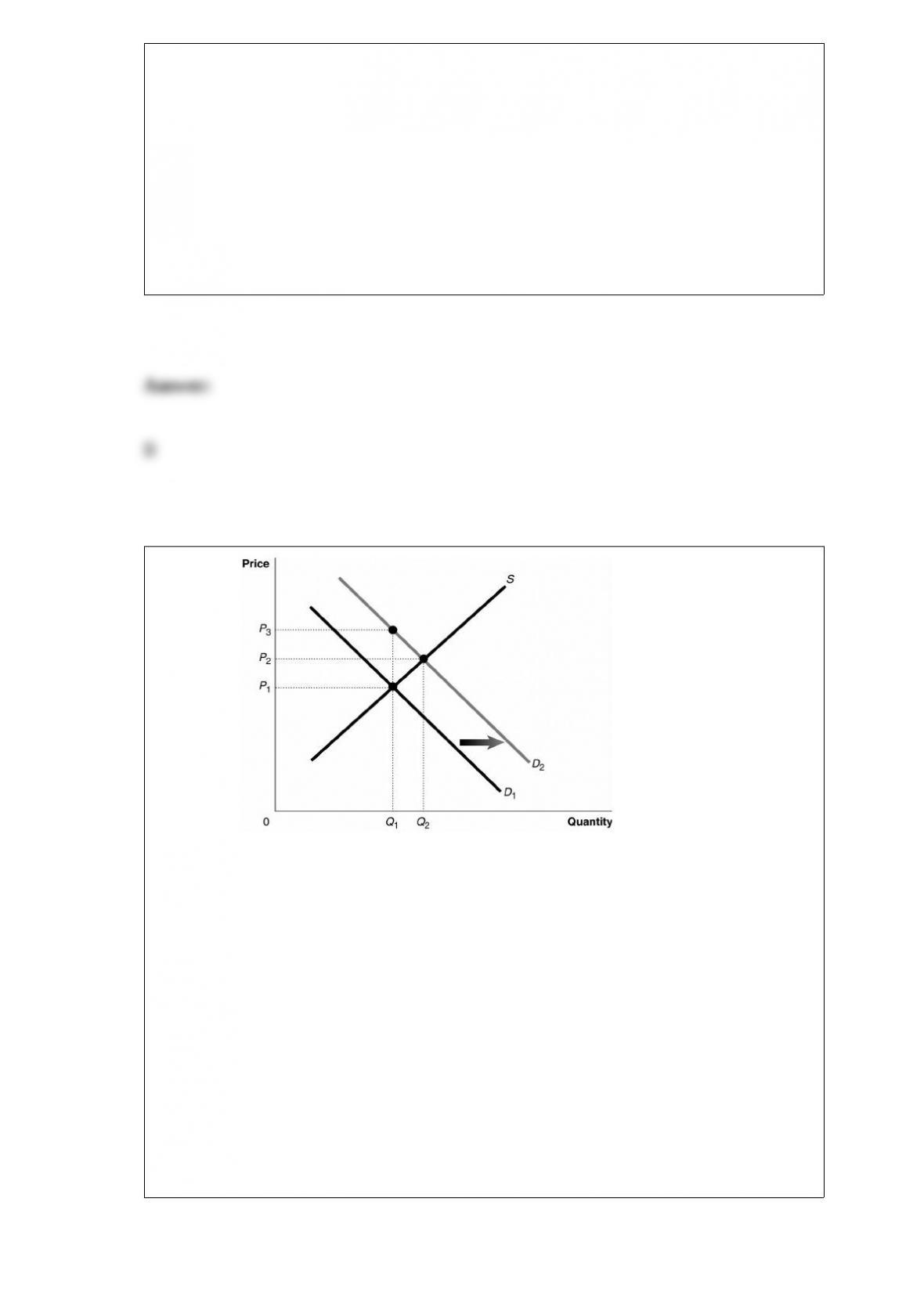
Figure 5-5 Figure 5-5 shows a
market with an externality. The current market equilibrium output of Q1 is not the
economically efficient output. The economically efficient output is Q2.
Suppose the current market equilibrium output of Q1 is not the economically efficient
output because of an externality. The economically efficient output is Q2. In that case,
the diagram shows
A) the effect of a subsidy granted to producers of a good.
B) the effect of an excess demand in a market.
C) the effect of a positive externality in the consumption of a good.
D) the effect of a negative externality in the consumption of a good.