
What is economic profit?
A) gross revenue minus explicit costs
B) gross revenue minus implicit costs
C) gross revenue minus explicit and implicit costs
D) the same as accounting profit
Which of the following would explain why accounting profit might be greater than
economic profit?
A) A firm has implicit costs as well as explicit costs.
B) A firm has only explicit costs.
C) A firm’s net income is greater than its accounting profit.
D) A firm’s net income is less than its accounting profit.
Table 12-4
Refer to Table 12-4. Given the consumption schedule in the table above, the marginal

propensity to consume is
A) 0.5.
B) 0.6.
C) 0.75.
D) 0.8.
If firms and workers have rational expectations, including knowledge of the policy
being used by the Federal Reserve
A) expansionary monetary policy is especially effective.
B) expansionary monetary policy is ineffective.
C) expansionary monetary policy is effective in the short run, but not the long run.
D) expansionary monetary policy is effective in the short run and the long run.
According to the real business cycle model,
A) increases in aggregate demand raise GDP.
B) increases in aggregate demand lower GDP.
C) increases in aggregate demand do not affect GDP.
D) increases in aggregate demand lower the price level.
In a typical year, ________ new firms open in the United States.
A) more than 600,000
B) more than 1 million
C) less than 200,000
D) approximately 125,000
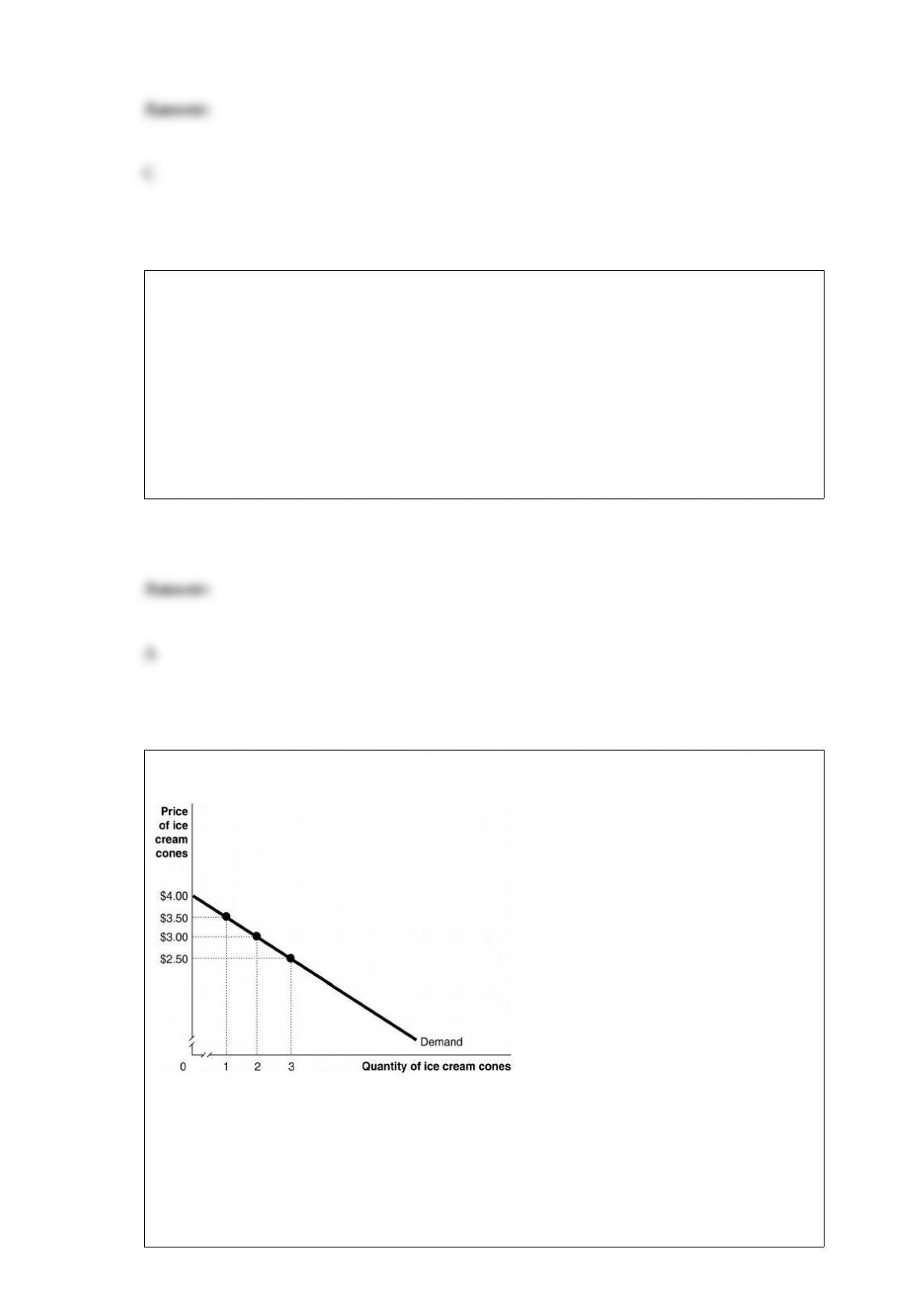
Figure 4-1
Figure 4-1 shows Kendra’s demand curve for ice-cream cones.
Refer to Figure 4-1. If the market price is $3.00, what is Kendra’s consumer surplus?
A) $6.50
B) $5.50

C) $2.50
D) $0.50
How are corporate profits taxed in the United States?
A) Earnings are taxed first by state sales taxes and then as corporate profits at the
Federal level.
B) Earnings are taxed first as personal income then as corporate profits at the Federal
level.
C) Earnings are taxed first as corporate profits then as personal income after dividends
are paid.
D) Corporate profits are not taxed at all.
An economic growth model
A) explains changes in nominal GDP per capita in the long run.
B) explains changes in real GDP per capita in the long run.
C) explains changes in nominal GDP per capita in the short run.
D) explains changes in real GDP per capita in the short run.

________ of unemployment during ________ make it easier for workers to ________
wages.
A) High levels; a recession; accept lower
B) Low levels; an expansion; accept lower
C) Low levels; a recession; negotiate higher
D) High levels; an expansion; negotiate higher
In the 1960s, many economists and policy makers considered the trade-off between
inflation and unemployment revealed in the Phillips curve to be permanent. This belief
was challenged by ________, who argued that there is no trade-off between inflation
and unemployment and the long run.
A) Robert Lucas and Thomas Sargent
B) Finn Kydland and Edward Prescott
C) Paul Samuelson and James Tobin
D) Milton Friedman and Edmund Phelps

If there is a change in the ability of a firm to produce a given level of output with a
given level of inputs, we say there is
A) human capital investment.
B) technological change.
C) an increase in labor productivity.
D) a movement along a given per-worker production function.
Which of the following is a normative economic statement?
A) The price of milk is too high.
B) The current high price of milk is the result of reduced worldwide supply.
C) When the price of milk rises, the quantity of milk purchased falls.
D) When the price of milk rises, the cost of milk-based products rises.
If the quantity of nail polish supplied is represented by the equation QS = -3 + 2P then
the corresponding price of nail polish is represented by the equation
A) P = 0.5QS + 1.5.
B) P = 2QS + 6.
C) P = 2QS – 6.

D) P = 1.5 – 0.5QS.
If one U.S. dollar could be exchanged for one Canadian dollar in 1970, and one U.S.
dollar can now be exchanged for 1.13 Canadian dollars, which of the following is true?
A) The U.S. dollar lost value against the Canadian dollar.
B) The Canadian dollar lost value against the U.S. dollar.
C) The Canadian dollar gained value against the U.S. dollar.
D) Both A and C are true.