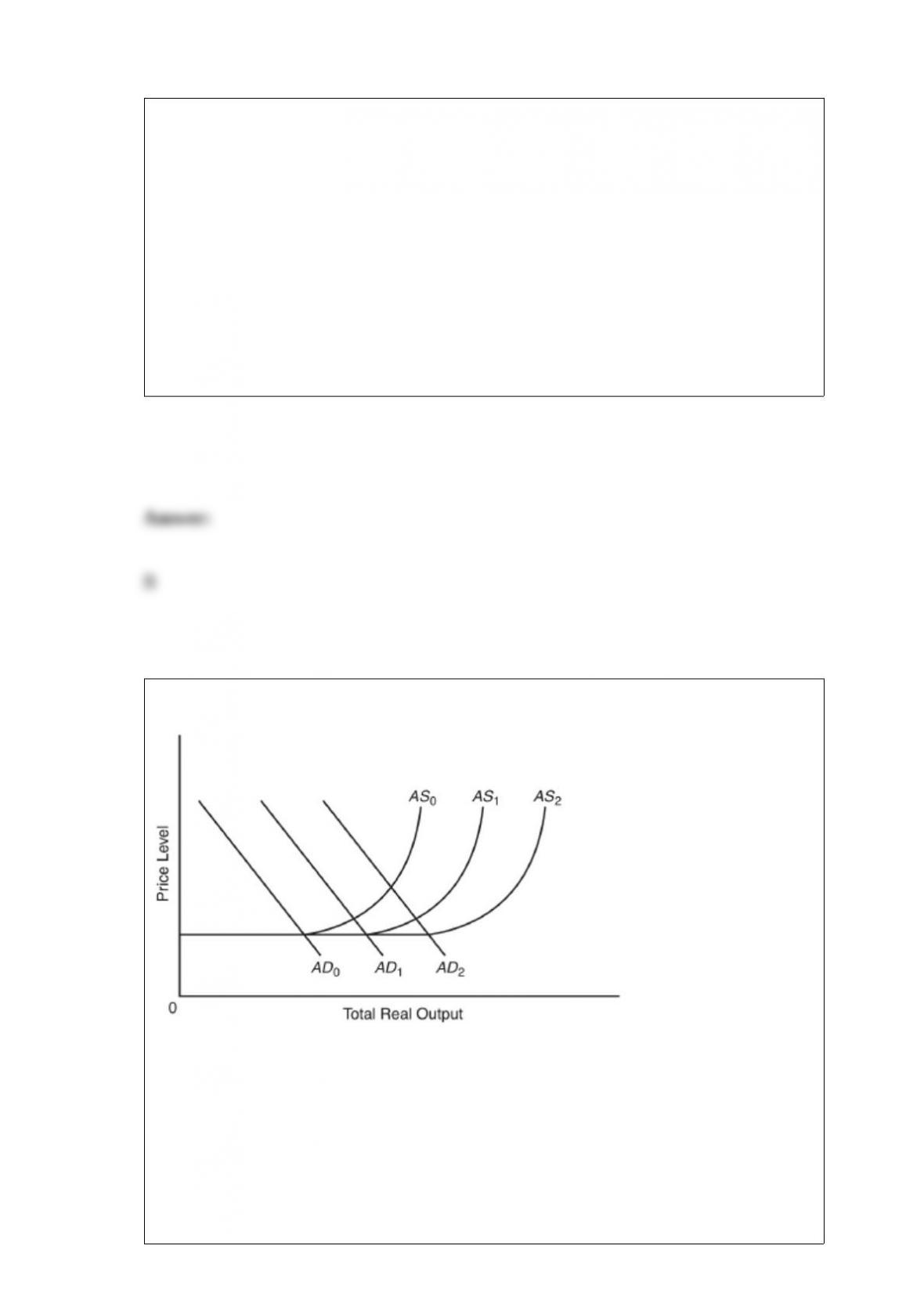
Leftward shifts in the aggregate supply curve are expected to
a. reduce real output and raise unemployment.
b. increase real output but raise the price level.
c. increase the price level unless the money supply is allowed to increase to bring down
prices.
d. leave output and employment unchanged when the aggregate demand curve
intersects the aggregate supply curve’s vertical range.
e. reduce output but leave the price level unchanged if the economy is at full
employment.
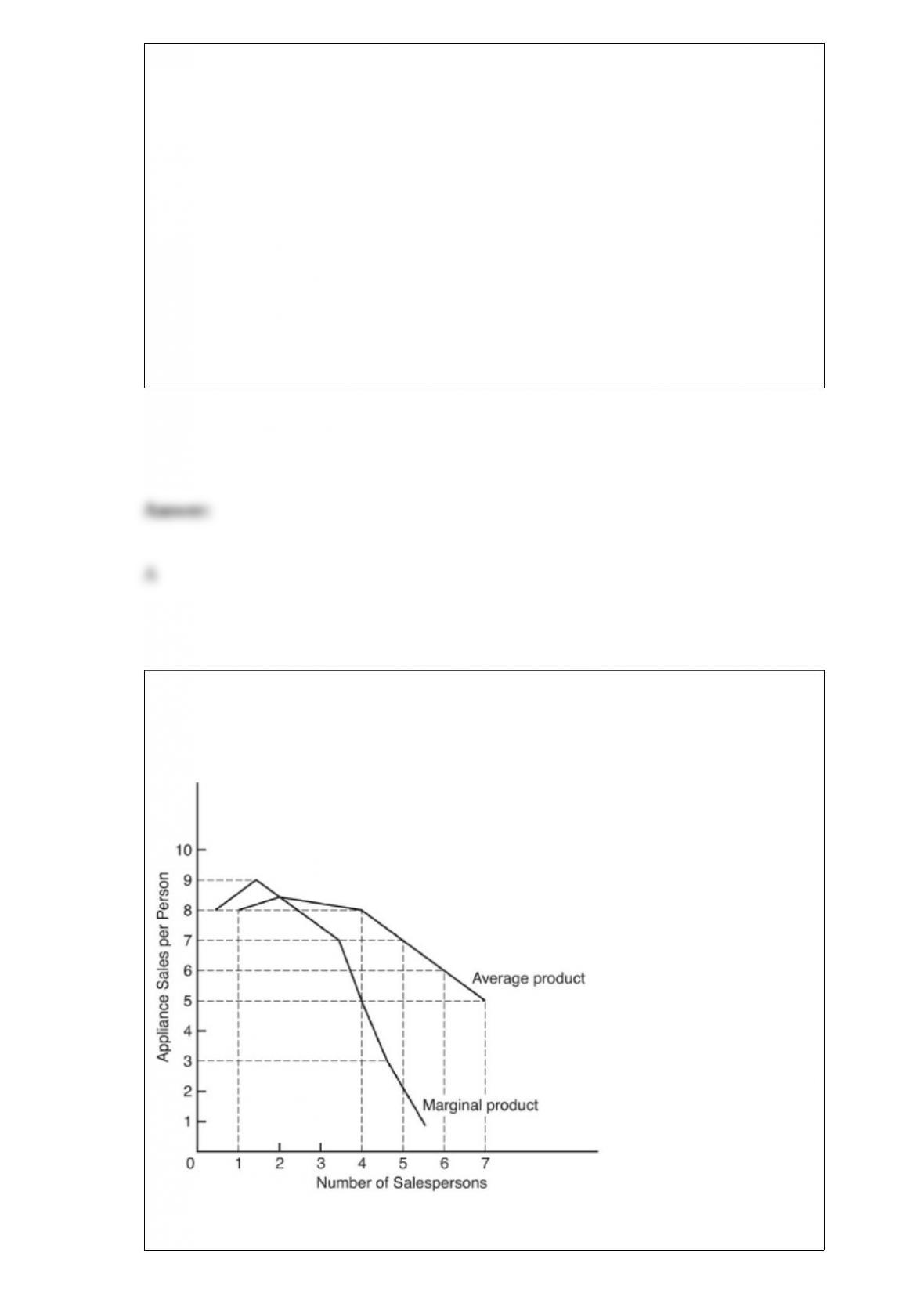
The following questions are based on the following diagram illustrating the weekly
average and marginal products for salespersons in the appliance department of a large
department store:
If the number of salespersons were increased from four to five, the number of

appliances sold per week would
a. increase.
b. decrease.
c. remain unchanged.
d. decrease at first and then increase.
e. most likely change but how is uncertain.
Keeping the marginal productivity of capital constant while investment in plant and
equipment expands requires
a. a slowdown in the growth rate.
b. a decrease (shift to the left) in the marginal productivity of capital schedule.
c. a falling rate of return on investment.
d. that the productivity of existing technology be exhausted before investing in
something new.
e. continued development of new technologies, products, and processes.
One reason for rejecting the argument that inequality of income lessens total consumer

satisfaction (because an extra dollar given to a poor man provides him with more extra
satisfaction than the loss of a dollar taken away from a rich man) is that
a. the rich and the poor have the same capacity to gain enjoyment from income.
b. interpersonal comparisons of satisfaction do not rest on scientific grounds.
c. poor people spend their incomes on consumption, whereas the rich invest theirs in
capital.
d. arguments based on considerations of positive economics cannot be used to make
ethical judgments.
e. the rich are more deserving than the poor.
As output increases, average total cost eventually rises because
a. average fixed cost increases at a faster rate than average variable cost.
b. average variable cost will eventually increase at a faster rate than that at which
average fixed cost declines.
c. marginal cost is offset by fixed cost.
d. of a declining rate of increase in total cost.
e. increases in average total cost offset increases in average variable cost.

On a Keynesian-style aggregate supply curve, expansionary fiscal and monetary
policies result in increases in real GDP, employment, and the price level when the
economy operates in the ________ range.
a. horizontal
b. coincident
c. intermediate
d. vertical
e. optimal
Unanticipated inflation clearly imposes a cost on
a. everyone, because it reduces money incomes.
b. employees working under contracts with cost-of-living increase clauses.
c. borrowers.
d. lenders.
e. foreigners, because our exports cost more.
The monetarist views of economic stabilization policy gained significant support during

the late
a. 1930s.
b. 1940s.
c. 1950s.
d. 1960s.
e. 1970s.
Country A must have an absolute advantage over country B in the production of a good
when it
a. is able to produce the good for itself.
b. imports the good from country B.
c. imports inputs to produce the good from country B.
d. decides to export the good to country B.
e. can produce a unit of the good with less resources than country B.
Luxuries are distinguished from necessities by the

a. high cross elasticity of demand of the former and the low cross elasticity of the latter.
b. high income elasticity of the former and the low income elasticity of the latter.
c. fact that luxuries have high prices and necessities have low ones.
d. sign of the cross elasticity of demand.
e. number of substitutes available for each.
Government health care programs such as Medicare and Medicaid are justified on the
basis of the notion that the government has a responsibility to ensure
a. that markets remain competitive.
b. a fairer or more desirable distribution of income.
c. full employment with stable prices.
d. that fraud is prevented.
e. the elimination of external economies.
A decrease in the money supply
a. shifts the aggregate demand curve to the left.

b. shifts the aggregate demand curve to the right.
c. shifts the aggregate supply curve to the left.
d. shifts the aggregate supply curve to the right.
e. affects neither the aggregate demand nor the aggregate supply curve, only the interest
rate.
The rate of return for an asset that costs $200,000 and promises to pay $40,000 net per
year forever to its owner is ________ percent.
a. 10
b. 15
c. 20
d. 25
e. 100
In an economy with a GDP of $3,000 billion and a capital-output ratio of three, an
increase in this year’s full-employment GDP of $30 billion means that last year’s
intended investment must have increased by ________ billion.
a. $10

b. $30
c. $90
d. $100
e. $1,000
A significant feature of many collective bargaining contracts in the late 1980s was the
a. negotiation of wage settlements that encouraged supply-side inflation.
b. emergence of many more closed shop agreements.
c. rejection of two-tier wage structures.
d. decertification of national unions in favor of local representation.
e. ease with which labor unions agreed to concessions.
If this same bank has its legal reserve requirement raised to 18 percent, it
a. need not do anything since it still has sufficient legal reserves to meet this new
requirement.
b. must take steps to increase its demand deposits by making new loans from its

reserves.
c. should discourage new demand deposit accounts until its legal reserves are increased.
d. must either sell securities or not renew loans as they come due.
e. should buy government securities to increase the money supply.
Since World War I, the highest unemployment rates in the United States occurred
during the
a. 1930s.
b. 1950s.
c. 1960s.
d. 1970s.
e. 1980s.
Under which condition is the checkoff legal?
a. the worker must agree in writing
b. there must be a closed shop
c. there must be a yellow dog contract
d. the union must have sufficient funds to cover the check

e. the union must mandate it as a condition of membership
A notable movement in the direction of deregulation of industry in the United States
occurred during
a. the 1930s.
b. World War II.
c. the late 1940s and early 1950s.
d. the early 1960s.
e. the late 1970s and early 1980s.
A basic objection to increased public works spending when serious unemployment
appears likely to develop is that
a. such spending would lead to a budget deficit.
b. such spending would lead to a decline in GDP.
c. all public works projects are wasteful.
d. there is a long lag between authorizing a program and actually spending the money.
e. stabilization policy is more important than the long-run desirability of public works.

The severity of the 1982 recession has been attributed to
a. the Reagan administration’s tax cut.
b. the Federal Reserve System’s tight monetary policies undertaken by Chair Paul
Volker.
c. the large deficits in our balance-of-payments accounts.
d. the OPEC-sponsored oil embargo.
e. a rapidly falling price level caused by large federal budget deficits.
Wage and price controls have been proposed primarily as a means for dealing with
a. severe recessionary conditions.
b. decreases in the price level.
c. income policies.
d. situations resulting from irresponsible decreases in the money supply.
e. supply-side inflation.

The Harrod-Domar growth model
a. expresses the growth rate of GDP as a function of the proportion of GDP saved,
divided by the capital-output ratio.
b. indicates that full-employment GDP will grow faster as the capital-output ratio in the
economy rises.
c. requires the capital-output ratio to grow if the economy is to increase to its
full-employment GDP.
d. expresses the rate of growth of GDP as an inverse function of the savings rate.
e. indicates that full-employment GDP will grow only if the savings rate declines while
the capital-output ratio increases.
In free markets, the price system encourages producers to meet consumers’ wants
because
a. it signals to producers which goods are profitable.
b. producers have the public interest in mind.
c. it allows the government to direct firms to the best production technique.
d. it rewards consumers for the resources they bring to the marketplace.
e. consumers are generally willing to pay more than the actual price.

A consumer buying food and clothing is in equilibrium when the marginal
a. utilities of food and clothing equal the total utilities of food and clothing.
b. utility of the last dollar spent on food equals the marginal utility of the last dollar
spent on clothing.
c. utilities of both goods are the same.
d. utilities of both goods are the greatest.
e. utility of food equals the price of food and the marginal utility of clothing equals the
price of clothing.
On a Keynesian-style aggregate supply curve, increases in aggregate demand produce
the greatest inflationary pressure when the economy operates in the ________ range.
a. horizontal
b. coincident
c. intermediate
d. vertical
e. optimal

Under which of the following aggregate supply conditions does an increase in the
money supply have the LEAST impact on real GDP?
a. an aggregate supply curve shifting to the right
b. a vertical aggregate supply curve
c. an upward-sloping aggregate supply curve
d. a horizontal aggregate supply curve
e. an aggregate supply curve shifting up
An economy operating inside its production possibilities curve is most likely
a. at full employment.
b. using resources inefficiently.
c. being forced to give up the production of one good to get more of another good.
d. facing a bowed-in curve.
e. producing no capital goods.

Under which of the following systems does appreciation and depreciation of a country’s
currency occur?
a. the gold standard
b. the multinational exchange standard
c. fixed exchange rates
d. flexible exchange rates
e. equation of exchange rates
The calculation of marginal revenue is bestdescribed by which of the following
equations if R(q) equals total revenue for a given level of output (q)?
a. marginal revenue = R(q) ´ R(q ” 1)
b. marginal revenue = R(q) + R(q ” 1)
c. marginal revenue = R(q)/R(q ” 1)
d. marginal revenue = R(q) ” R(q ” 1)
e. marginal revenue = [R(q) + R(q ” 1)]/R(q)
Which of the following would be LEASTlikely to contribute to income inequality in the
United States?
a. differences in the amount of education and training people receive
b. perfectly competitive, homogeneous resource markets
c. differences in inherited wealth
d. the possession of unique abilities and skills
e. monopoly power
The next question is based on the following figure:
In its reaction to financial crises in October 1987 and August 1998, the Fed
a. did nothing, allowing natural market forces to correct the conditions.
b. decreased the money supply while promoting an increase in demand to strengthen
prices.
c. created and expanded the duties of the Long-Term Capital Management Corporation

to oversee foreign lending.
d. ensured that adequate liquidity was available to minimize the real impact of these
shocks.
e. raised interest rates to encourage more people to save rather than speculate with their
money.
The idea that an economy experiencing considerable unemployment and government
deficit spending may increase output, which in turn may increase investment, is called
the crowding-________ effect.
a. out
b. through
c. over
d. in
e. under
The higher the tax rate, government spending unchanged, the
a. higher the level of intended spending.
b. lower the equilibrium level of GDP.

c. higher the amount of consumption.
d. lower the 45-degree line.
e. higher the amount of disposable income.