
The production function shifts upward as the capital stock increases.
a. True
b. False
A profit-maximizing monopolist
a. is just as socially efficient as a perfectly competitive firm in allocating resources to
production since she, too, seeks the largest return on his investment.
b. produces an output level at which marginal utility exceeds marginal cost.
c. produces more output than a perfectly competitive industry.
d. always produces in the inelastic region of his demand curve.
The corporate income tax is
a. an indirect tax.
b. a regressive tax.
c. the second largest source of revenue for the federal government.
d. a direct tax.

Input-output analysis is rarely used because
a. it requires tremendously complex calculations.
b. it requires large amounts of data.
c. market economies can instead rely on the price mechanism to organize production.
d. All of the above are correct.
According to the theory of rational expectations, the government can influence output
a. with appropriate fiscal and monetary policy.
b. in the short run, but not in the long run.
c. without affecting the price level.
d. only by making unexpected changes in aggregate demand.

An inflationary gap exists when consumers and businesses are demanding more output
than the economy is capable of producing at full employment.
a. True
b. False
Which of the following observations is true?
a. State governments are the shareholders of the Fed.
b. The Fed chairman is appointed for a ten year term.
c. FOMC decisions largely determine short-term interest rates.
d. Member banks proportionately share all of Federal Reserve’s profits.
Cost minimization requires that a firm equate the ratio of marginal products of inputs to
the ratio of input prices.
a. True
b. False

From the beginning of 2007, the value of the U.S. dollar
a. dropped sharply against major currencies.
b. increased mildly against major currencies.
c. remained stable relative to major currencies.
d. fluctuated with no major trend against major currencies.
When the price of a commodity falls, we can expect
a. total utility will fall.
b. marginal utility of the last unit purchased will fall.
c. marginal utility of the last unit purchased will rise.
d. purchases will fall because of a change in marginal utility.
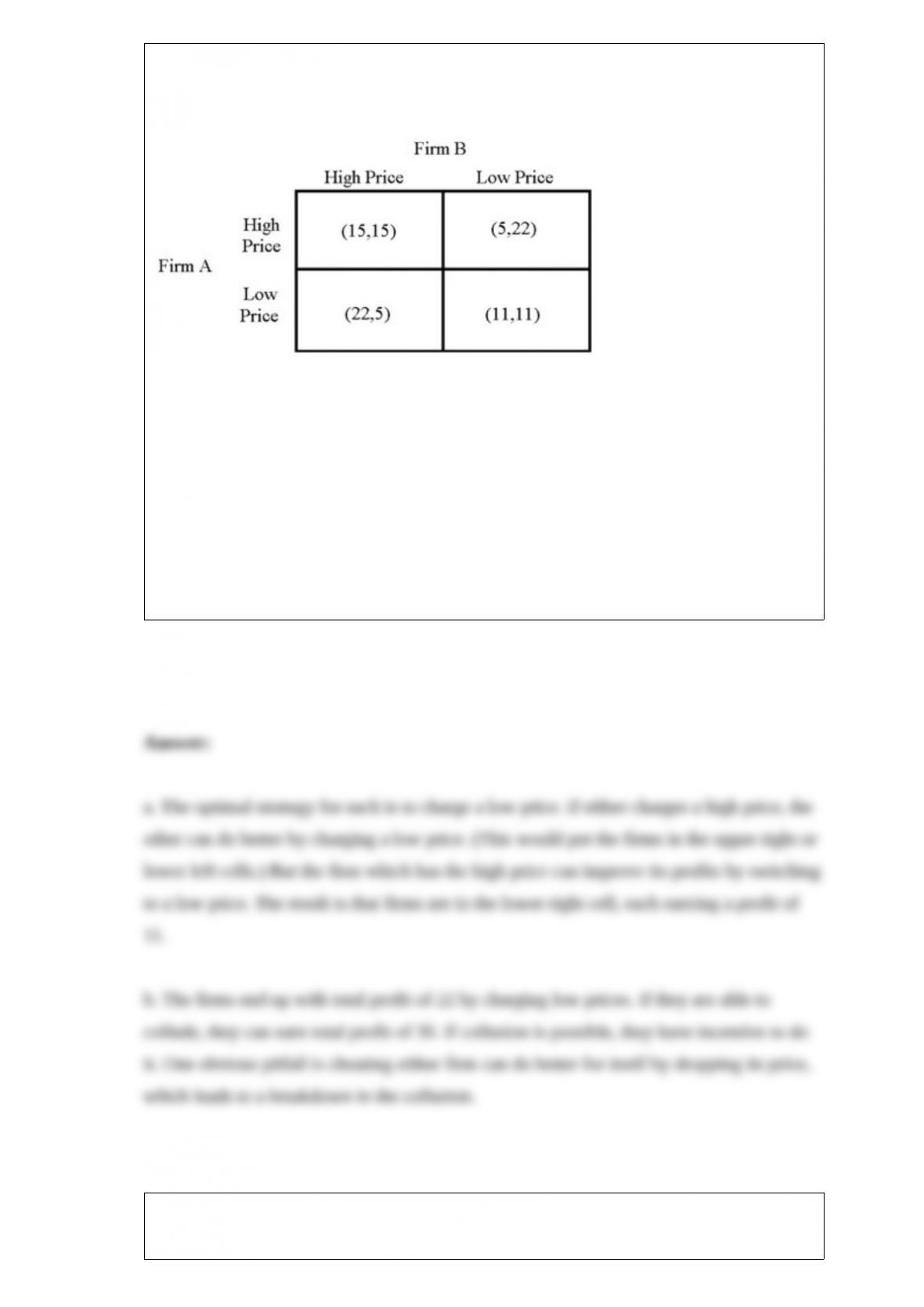
Figure 12-4
The above matrix (Figure 12-4) displays the possible profit results of two firms, A and
B, from following two different possible strategies: charging a high price and charging
a low price. In each cell, the first number is the profit of firm A, and the second number
is the profit of firm B.
a. Assume that collusion is not possible. Determine the optimal strategy for each firm.
Explain why it is the best strategy to follow.
b. Based on your answer to a., explain why firms collude. What are the pitfalls of
collusion?
Distribution is a major question to be answered by any economic system.

a. True
b. False
If the Fed’s monetary policy causes a substantial decrease in interest rates, what is the
most likely impact on velocity?
a. It will decrease.
b. It will increase.
c. It will remain constant.
d. Velocity is unrelated to interest rates.
The marginal revenue product of an input is the marginal physical product times the
price per unit of output under perfect competition.
a. True
b. False
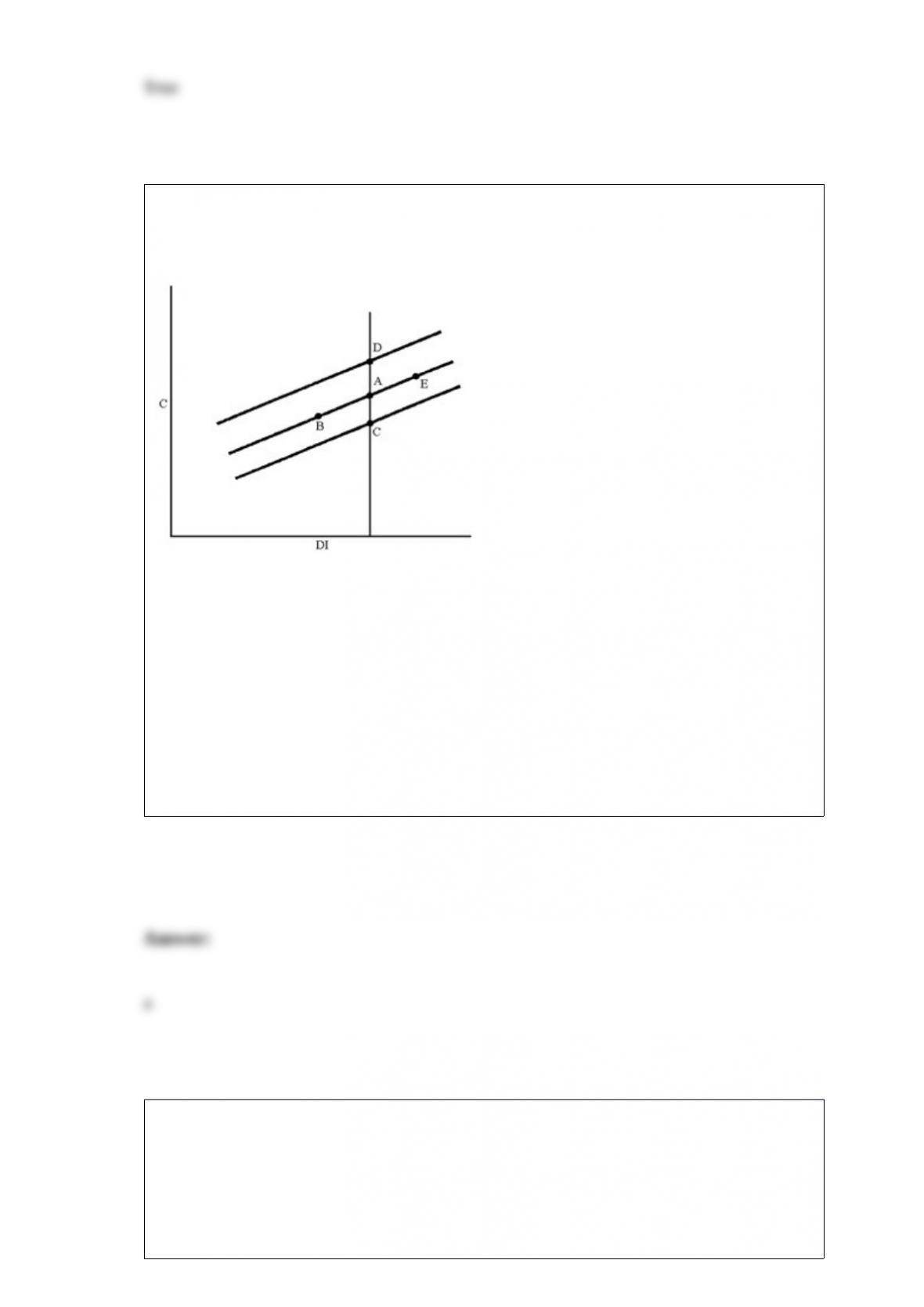
Figure 8-2
In Figure 8-2, which of the following moves can be explained by a decrease in
disposable income?
a. E to B
b. A to C
c. A to D
d. B to E
Now, about ____ percent of American married-couple families have two or more wage
earners.
a. 35
b. 50

c. 60
d. 90
Free market economies have led to
a. high growth rates but low efficiency.
b. high efficiency and low growth rates.
c. high growth rates and high efficiency.
d. low growth rates and low efficiency.
What is true of stock exchanges in the United States?
a. There are two major stock exchanges in New York, several smaller regional
exchanges across the nation, and over-the-counter trading via NASDAQ.
b. The New York Stock Exchange is the only stock exchange in the United States.
c. There are only two stock exchanges, NYSE and AMEX.
d. There are only three stock exchanges, NYSE, AMEX, and NASDAQ.

Universal service may require making a service available in small communities where
the limited scale of operations may make costs extremely high.
a. True
b. False
The continued position of the United States as the world’s economic leader is:
a. assured
b. predictable
c. automatic
d. uncertain
If the Fed raises the reserve requirement on deposits from 15 percent to 20 percent,

what would happen to the money supply?
a. It would decrease.
b. It would increase.
c. It would remain unchanged.
d. It depends on the value of interest rates.
The official dividing line between the poor and nonpoor is called the
a. life threshold.
b. life edge.
c. poverty line.
d. beginning line.
A market system solves the
a. “what” and “how” decisions but not the “to whom.”
b. “what” and “to whom” decisions but not the “how.”
c. “how” and “to whom” decisions but not the “what.”

d. “what,” “how,” and “to whom” decisions.
The notion of opportunity cost can be represented graphically by the
a. area inside the production possibilities frontier.
b. slope of the production possibilities frontier.
c. vertical distance from the horizontal axis to the production possibilities frontier.
d. horizontal distance from the vertical axis to the production possibilities frontier.
e. sum of the horizontal and vertical distances to the production possibilities frontier.
Elaine values the utility of her first cup of coffee at $1; a second cup, $.75; and a third
cup, $.50. If Elaine drinks three cups of coffee for breakfast, her total utility is equal to
a. $.50, the value of her last cup of coffee.
b. $1.00, the value of her first cup of coffee.
c. marginal utility.
d. $2.25.
e. $1.50.

Because smoking causes illness and disability to smokers, society must maintain more
health-service capacity than it would need in the absence of smoking. Since the cost of
maintaining this capacity is covered to a substantial degree by health insurance, even
nonsmokers must pay higher premiums. Also, smokers hurt nonsmokers as a result of
“passive smoke.” The Rand Corporation estimates these costs to be 29 cents per pack of
cigarettes. Cigarette taxes average 37 cents per pack. Based on the economist’s
definition of efficiency, it follows that
a. cigarette taxes are too high, and cigarette production is lower than the efficient
amount.
b. cigarette taxes should be increased until external costs are zero.
c. since the tax exceeds the marginal cost, we have a better than efficient outcome.
d. we are overconsuming cigarettes.
A monopolist will stop production when MR equals MC.
a. True
b. False

Which of the following is true for a profit-maximizing competitive firm in the long run
but not a monopolist?
a. MC = MR
b. MC = P
c. AR = P
d. Q > 0
In practice, taxes on emissions of pollutants have been found to
a. be ineffective in encouraging firms to pollute less.
b. significantly reduce pollution by taxed firms.
c. be less reliable in reducing pollution than direct controls on pollution.
d. cause failures of the pricing system.

What is the usual response of firm to an increase in the price of what they sell?
a. An increase in output.
b. An increase in hiring factors of production.
c. An increase in the profit level of the firm.
d. An increase in employment at the firm.
e. All of the above.