
1) A change in the price of an input will usually:
A.shift a firm’s cost curves.
B.cause the firm to alter the combination of inputs it employs.
C.induce the firm to change its level of output.
D.do all of these.
2) a constant-cost industry is one in which:
a.resource prices fall as output is increased.
b.resource prices rise as output is increased.
c.resource prices remain unchanged as output is increased.
d.small and large levels of output entail the same total costs.
3) if the demand for farm products is price inelastic, a good harvest will cause farm
revenues to:
a.increase.
b.decrease.
c.be unchanged.
d.either increase or decrease, depending on what happens to supply.
4) Answer the next question based on the following consolidated balance sheet for the
commercial banking system. Assume the required reserve ratio is 25%. All figures are
in billions of dollars.
(a)What is the amount of excess reserves in this commercial banking system?
(b)What is the maximum amount that the money supply can be expanded?
(c)If the reserve ratio fell to 25%, what is now the maximum amount that the money
supply can be expanded?

5) According to monetarists, a fiscal deficit will be associated with an increase in real
output:
A.regardless of the character of accompanying changes in M or V.
B.only if it is accompanied by an increase in the demand for money.
C.only if it is accompanied by an increase in the supply of money.
D.only if it is financed by selling government bonds to the public.
6) if someone produced too much of a good, this would suggest that:
a.rational choice cannot be applied to many economic decisions.
b.the good was produced to the point where its marginal cost exceeded its marginal
benefit.
c.certain goods and services such as education and health care are inherently desirable
and should be produced regardless of costs and benefits.
d.the good was produced to the point where its marginal benefit exceeded its marginal
cost.
7) normal profit is:
a.determined by subtracting implicit costs from total revenue.
b.determined by subtracting explicit costs from total revenue.
c.the return to the entrepreneur when economic profits are zero.
d.the average profitability of an industry over the preceding 10 years.
8) if all discrimination in the united states were eliminated, the economy would:
a.have a less concave production possibilities curve.
b.produce at some point closer to its production possibilities curve.
c.be able to produce at some point outside of its production possibilities curve.
d.produce more consumer goods and fewer investment goods.
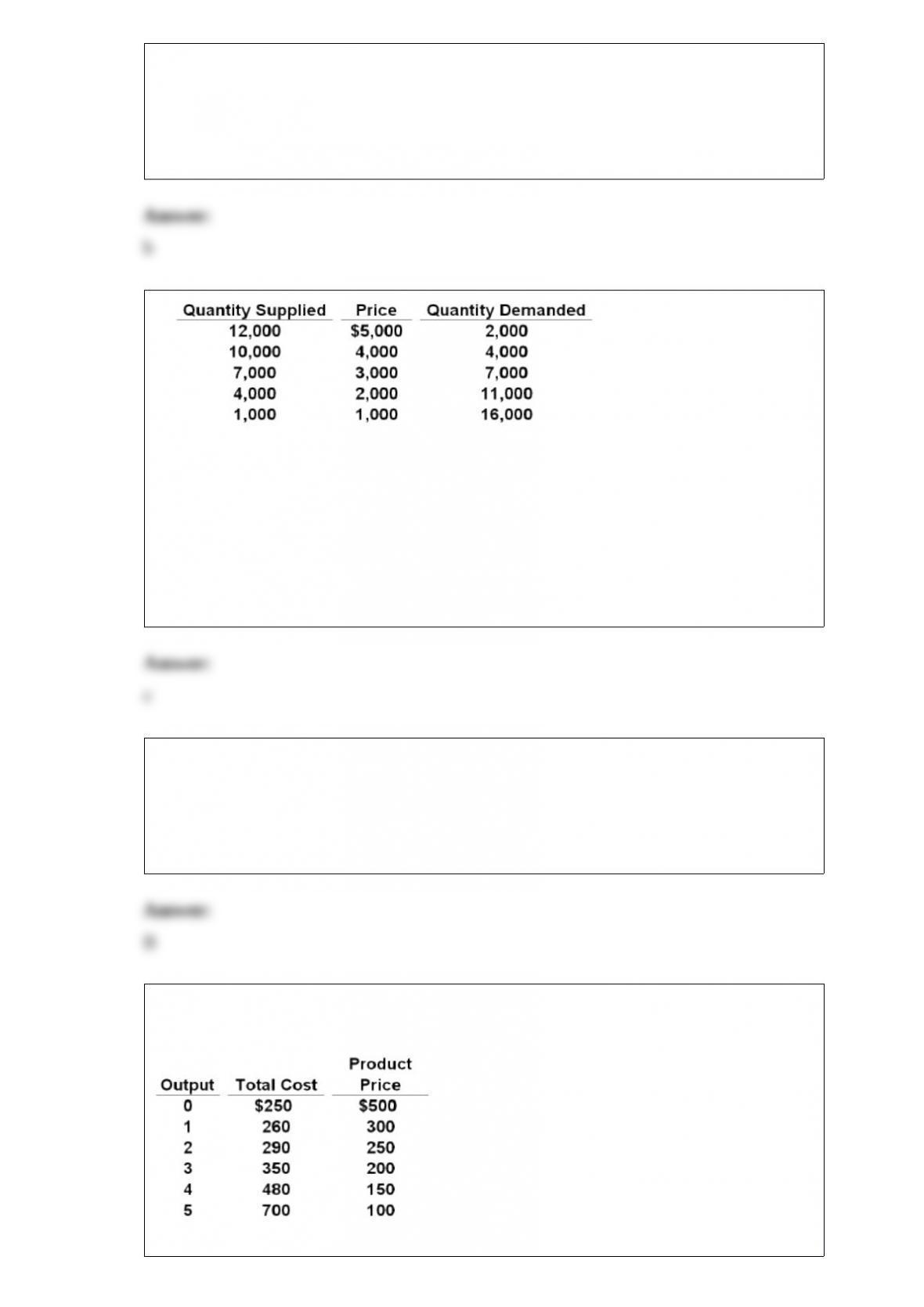
9)
refer to the above supply and demand data for a certain elective surgical procedure. if
suppliers provide the quantity of health care demanded and insurance pays 50 percent
of the remaining equilibrium price after a $1000 deductible is satisfied, the quantity of
health care consumed will be:
a.4,000.
b.7,000.
c.11,000.
d.16,000.
10) The demographic transition concept suggests that:
A.effective birth control is the primary prerequisite of DVC income growth.
B.income growth must first occur before DVC birth rates will decline.
C.children are economic assets in the IACs, but economic liabilities in the DVCs.
D.the IACs will have higher birth rates than the DVCs.
11) the following information for a pure monopolist:
at its profit-maximizing output, the above nondiscriminating monopolist:

a.incurs a loss.
b.earns an economic profit of $250.
c.earns a normal profit of $250.
d.earns an economic profit of $150.
12) Answer the next four questions on the basis of the following table which shows the
rankings of the public goods by three voters: A, B, and C.
(a)What will be the choice between more police protection and more fire protection?
(b)What will be the choice between more schools and more police protection?
(c)What will be the choice between more fire protection and more schools?
(d)What do the rankings in the table indicate about choices made under majority rule?
13) Jack and Jill have identical skills and training but Jill earns higher wages in her job.
Which of the following reasons would best explain why Jill earns more than Jack?
A.Jack has a chronic illness and would lose health care coverage if he changed jobs.
B.Jill suffers from gender discrimination in the workplace.
C.Jack has better access to information about available jobs in his field.

14) The principle that under some circumstances majority voting fails to make
consistent choices reflecting the community’s underlying preference is best
demonstrated by the:
A.paradox of voting.
B.concept of logrolling.
C.median-voter model.
D.Coase theorem.
15) implicit and explicit costs are different in that:
a.explicit costs are relevant only in the short run.
b.implicit costs are relevant only in the short run.
c.the latter refer to non-expenditure costs and the former to out-of-pocket costs.
d.the former refer to non-expenditure costs and the latter to out-of-pocket costs.
16) Which of the following Gini ratios indicates the lowest degree of income
inequality?
A.0.71
B.0.55
C.0.31
D.0.45