1) When a commercial bank has excess reserves:
A.it is in a position to make additional loans.
B.its actual reserves are less than its required reserves.
C.it is charging too high an interest rate on its loans.
D.its reserves exceed its assets.
2)
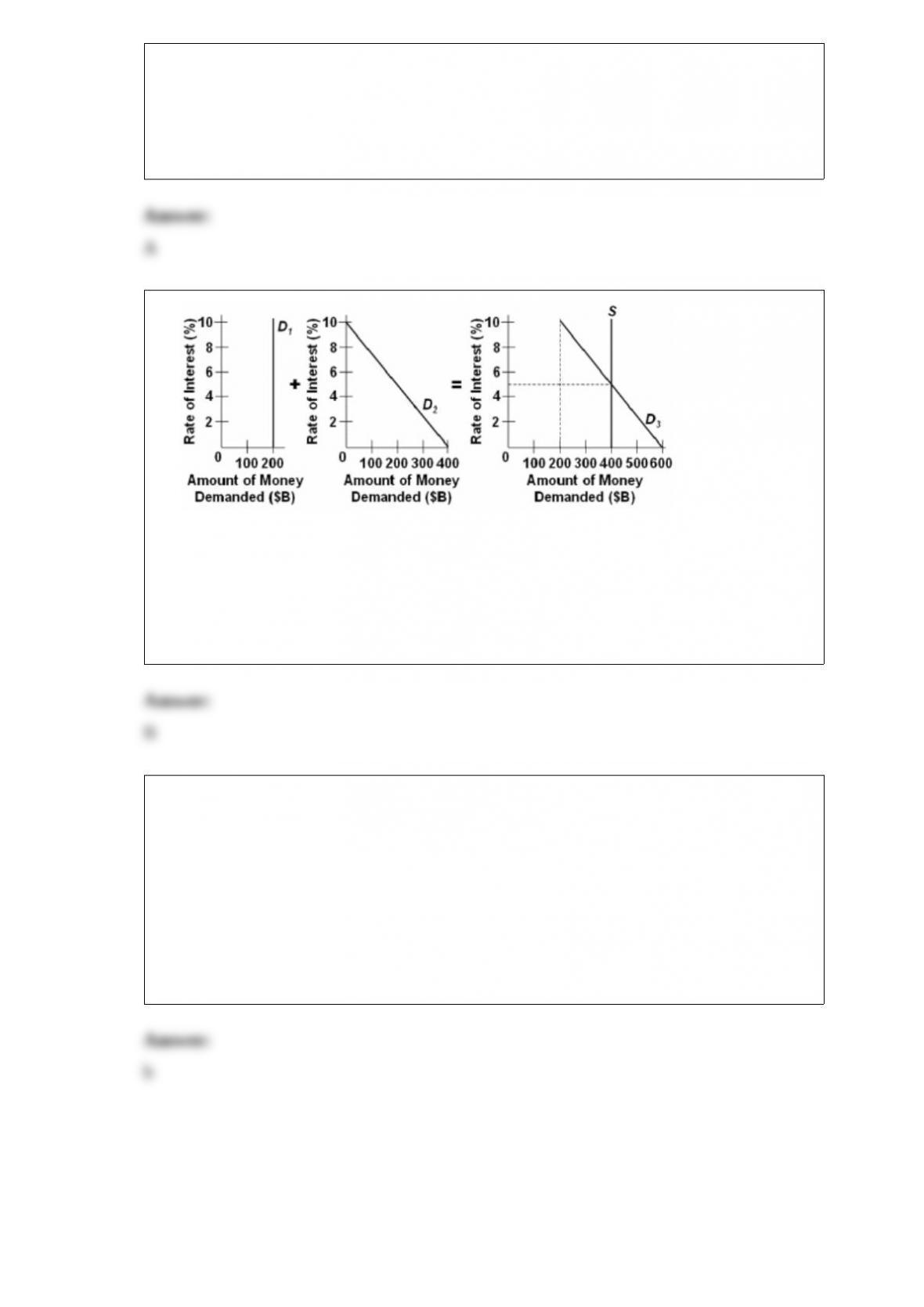
Refer to the above market for money diagrams. If the Federal Reserve increased the
stock of money, the:
A.S curve would shift leftward and the equilibrium interest rate would rise.
B.S curve would shift rightward and the equilibrium interest rate would fall.
C.D3would shift leftward and the equilibrium interest rate would fall.
D.D3curve would shift leftward and the equilibrium interest rate would rise.
3) it takes a considerable amount of time to increase the production of pork. this implies
that:
a.a change in the demand for pork will not affect its price in the short run.
b.the short-run supply curve for pork is less elastic than the long-run supply curve for
pork.
c.an increase in the demand for pork will elicit a larger supply response in the short run
than in the long run.
d.the long-run supply curve for pork is less elastic than the short-run supply curve for
pork.
4)
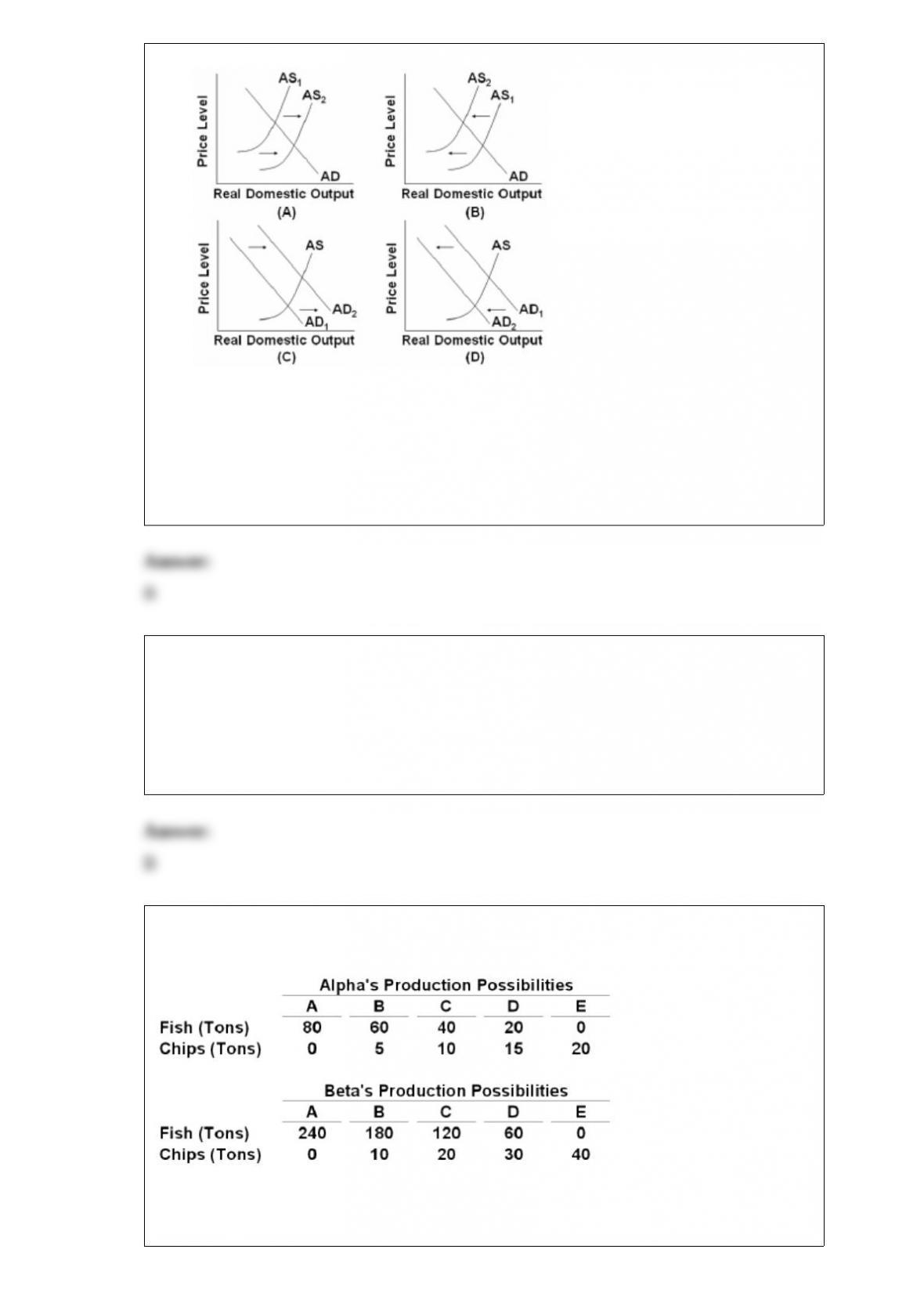
Which of the above diagrams best portrays the effects of a dramatic increase in energy
prices?
A.A
B.B
C.C
D.D
5) Other things equal, the slope of the aggregate expenditures schedule will increase as
a result of:
A.a decline in the size of the inflationary gap.
B.an increase in the MPC.
C.an increase in the MPS.
D.a decline in the general price level.
6) The following production possibilities data for two countries, Alpha and Beta, which
have populations of equal size.
Refer to the above data. Beta:
A.should specialize in catching fish and trade with Alpha for chips.
B.should specialize in producing chips and trade with Alpha for fish.
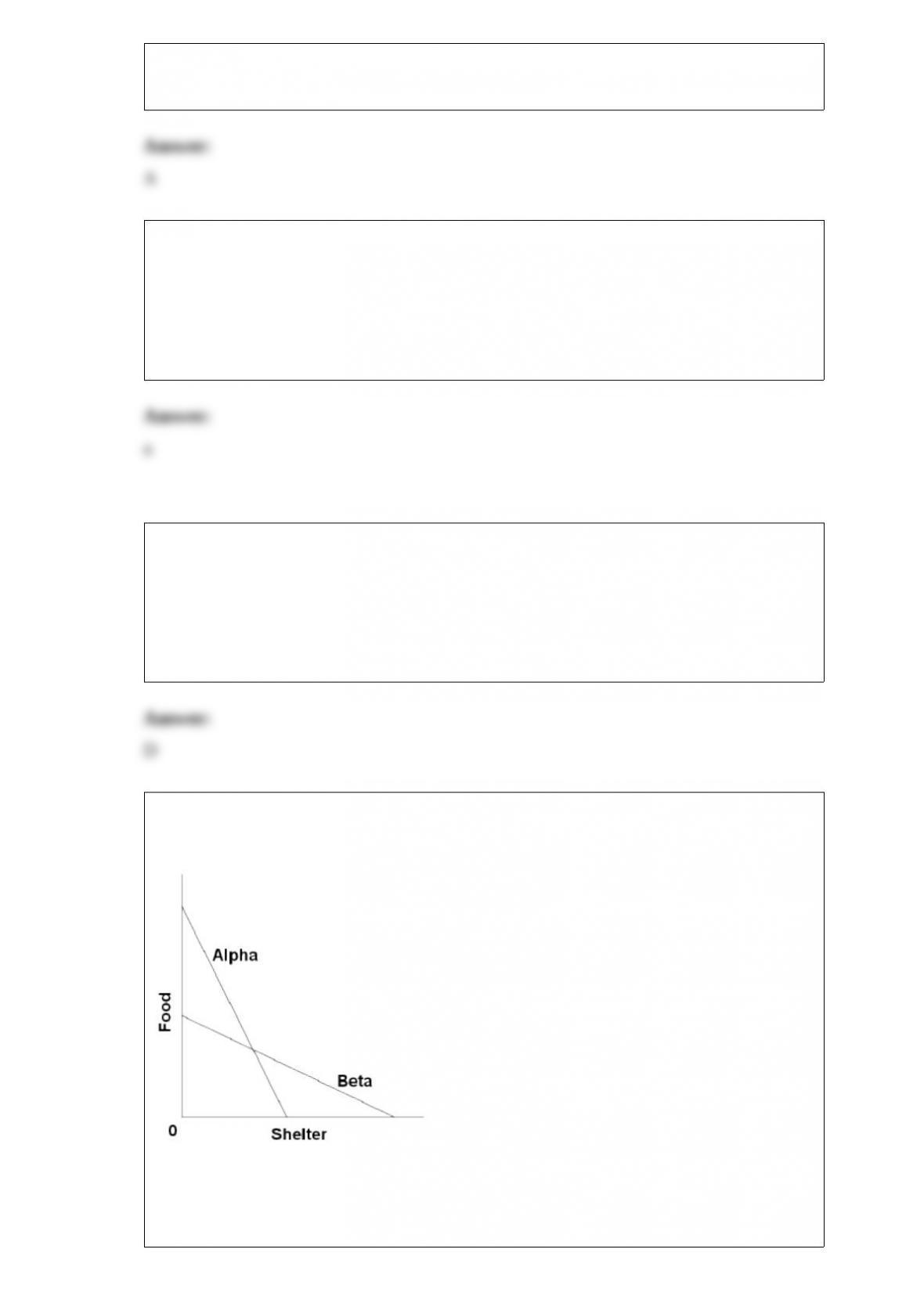
C.will not realize gains from specialization and trade.
D.will export both fish and chips to Alpha.
7) excludability:
a.is a characteristics of private goods, but not of public goods.
b.applies only where external benefits exceed external costs.
c.suggest there are certain economic functions from which government must be
excluded.
d.is a fundamental characteristic of public goods.
8) The idea that freely floating exchange rates equate the purchasing power of national
currencies is called:
A.the equation of exchange.
B.the balance of payments.
C.Say’s Law.
D.the purchasing power parity theory.
9)
in the figure above are two linear production possibilities curves for countries alpha and
beta. we can conclude that:
a.different value systems make it impossible to compare opportunity costs in the two
countries.
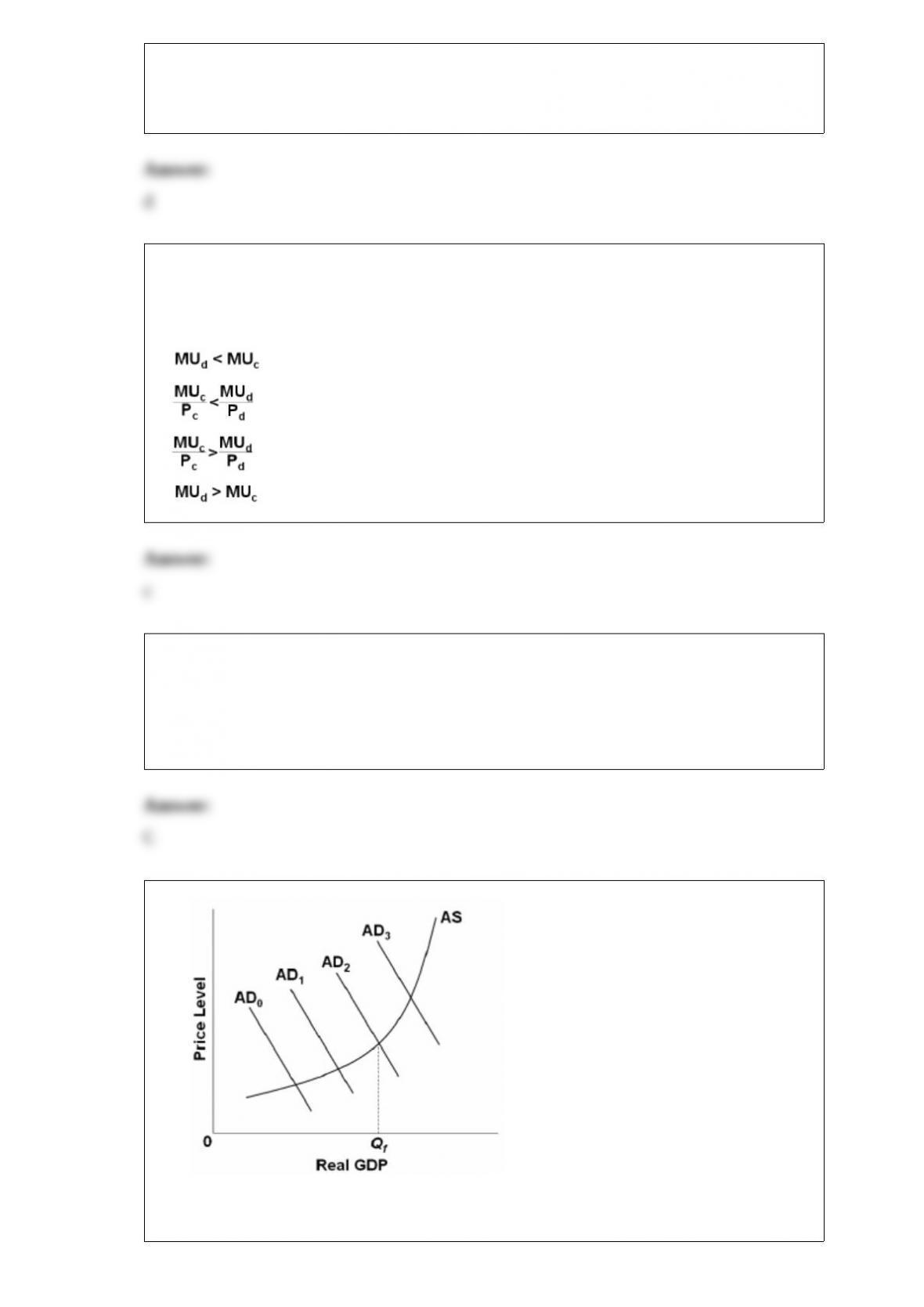
b.the opportunity cost of shelter is greater in beta than it is in alpha.
c.the opportunity cost of food is greater in alpha than it is in beta.
d.the opportunity cost of shelter is greater in alpha than it is in beta.
10) assume muc and mud represent the marginal utility that a consumer gets from
products c and d, the respective prices of which are pc and pd. the consumer will
increase his total utility from a specific money outlay by spending more on c and less
on d if initially:
a.
b.
c.
d.
11) All but which one of the following are cash transfer programs?
A.TANF
B.Supplemental Security Income (SSI)
C.low-rent public housing
D.Social Security
12)
Refer to the above diagram, in which Qf is the full-employment output. If the
economy’s current aggregate demand curve is AD0, it would be appropriate for the

government to:
A.reduce government expenditures and taxes by equal-size amounts.
B.reduce government expenditures or increase taxes.
C.increase government expenditures or reduce taxes.
D.reduce unemployment compensation benefits.