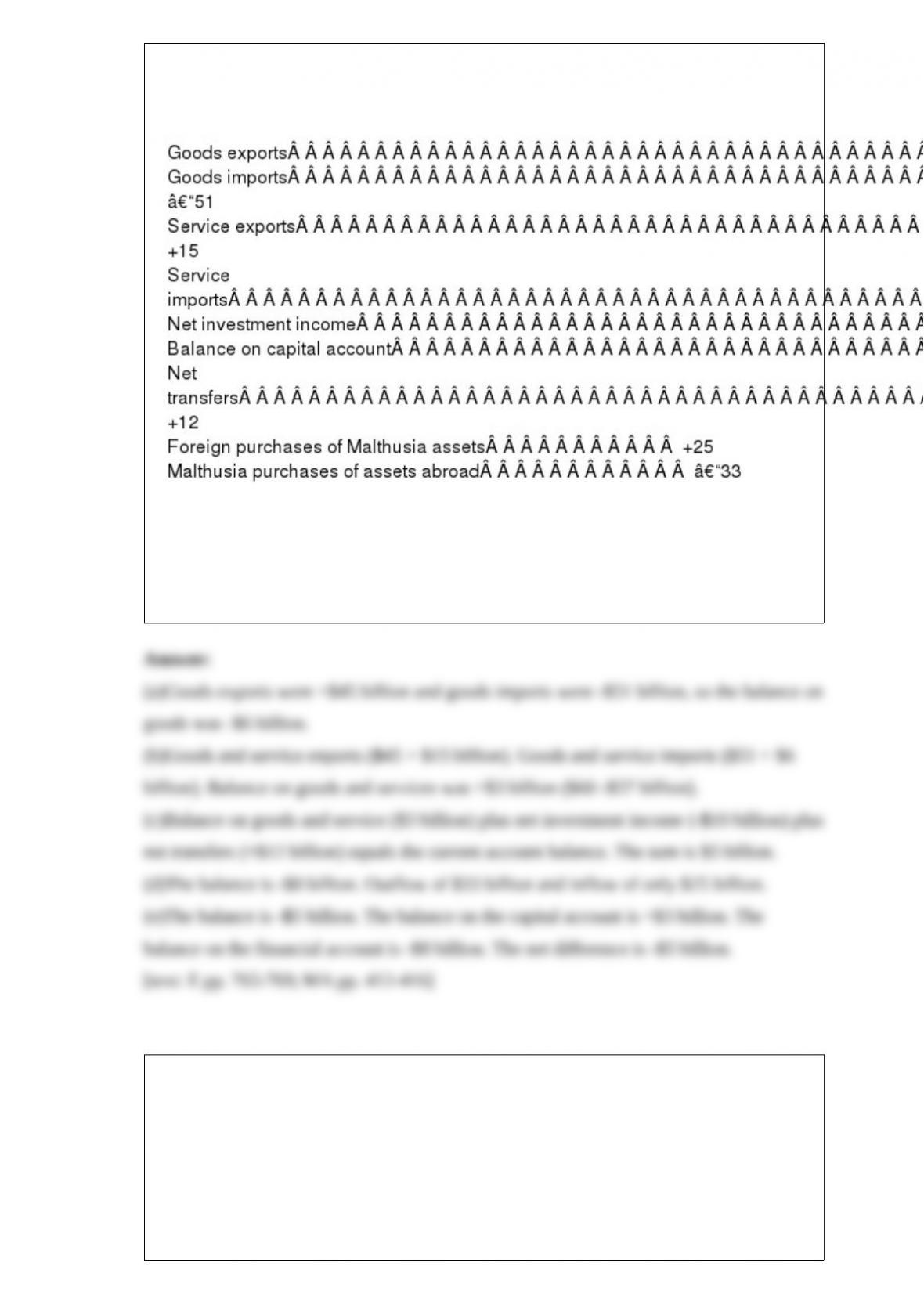
1) Answer the next five questions on the basis of the following hypothetical data for a
nation Malthusia. All numbers are in billions of dollars.
(a)What was the balance on goods?
(b)What was the balance on goods and services?
(c)What was the balance on the current account?
(d)What is the balance on the financial account?
(e)What is the balance on the capital and financial account?
2) In deriving the aggregate demand curve from the aggregate expenditures model we
note that:
A.the real-balances effect is irrelevant to both models.
B.a change in the price level will have no impact on the aggregate expenditures
schedule.
C.an increase (decrease) in the price levels shifts the aggregate expenditures schedule
upward (downward).
D.an increase (decrease) in the price level shifts the aggregate expenditures schedule

downward (upward).
3) Suppose population A, consisting of Al, Bob, Curt, Doris, and Ellie, receive annual
incomes of $5,000, $2,500, $1,250, $750, and $500, respectively.
Refer to the above information. What percentage of total income is received by the
richest quintile?
A.50
B.5
C.25
D.20
4)
In long-run equilibrium there will be no economic profit in a purely competitive static
economy because:
A.barriers to entry will prevent profit from arising.
B.there will be no uncertainty, no innovations, and no monopoly.
C.there will be no need for professional managers and therefore no profit rewards will
be needed.
D.the marginal revenue product of capital will be zero.
5) The individual firm in a purely competitive labor market faces:
A.a perfectly elastic labor supply curve and a downsloping labor demand curve.
B.a perfectly elastic labor demand curve and an upsloping labor supply curve.
C.labor demand and labor supply curves both of which are perfectly elastic.
D.a downsloping labor demand curve and an upsloping labor supply curve.
6)
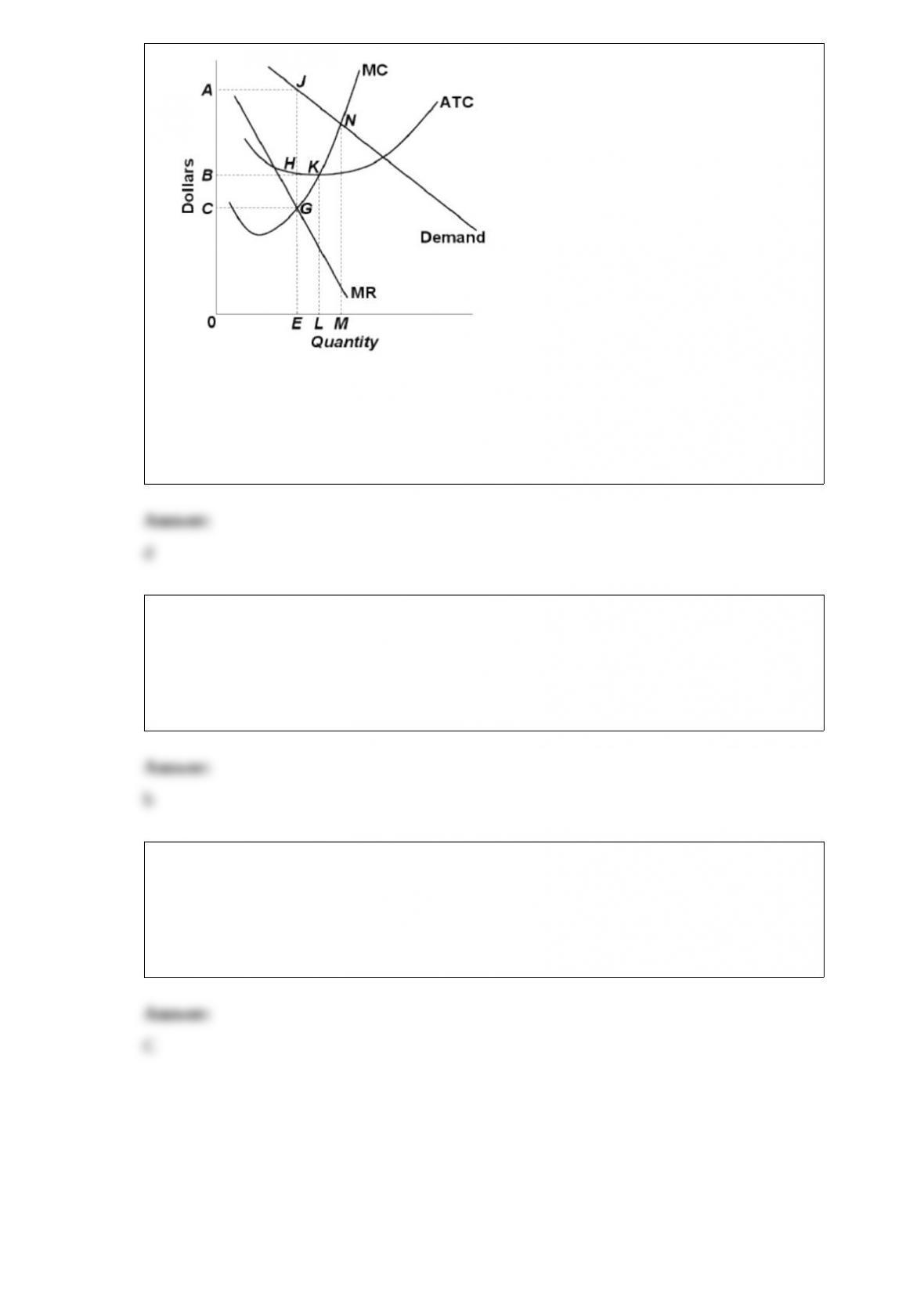
refer to the above diagram. at the profit-maximizing level of output, total cost will be:
a.nm times 0m
b.0aje
c.0cgc
d.0bhe
7) a demand curve:
a.shows the relationship between price and quantity supplied.
b.indicates the quantity demanded at each price in a series of prices.
c.graphs as an upsloping line.
d.shows the relationship between income and spending.
8) Critics of social regulation argue that it:
A.causes deflation.
B.violates the due process clause of the U.S. constitution.
C.is a relatively greater burden for small firms than for large firms.
D.improves allocative efficiency.
9)
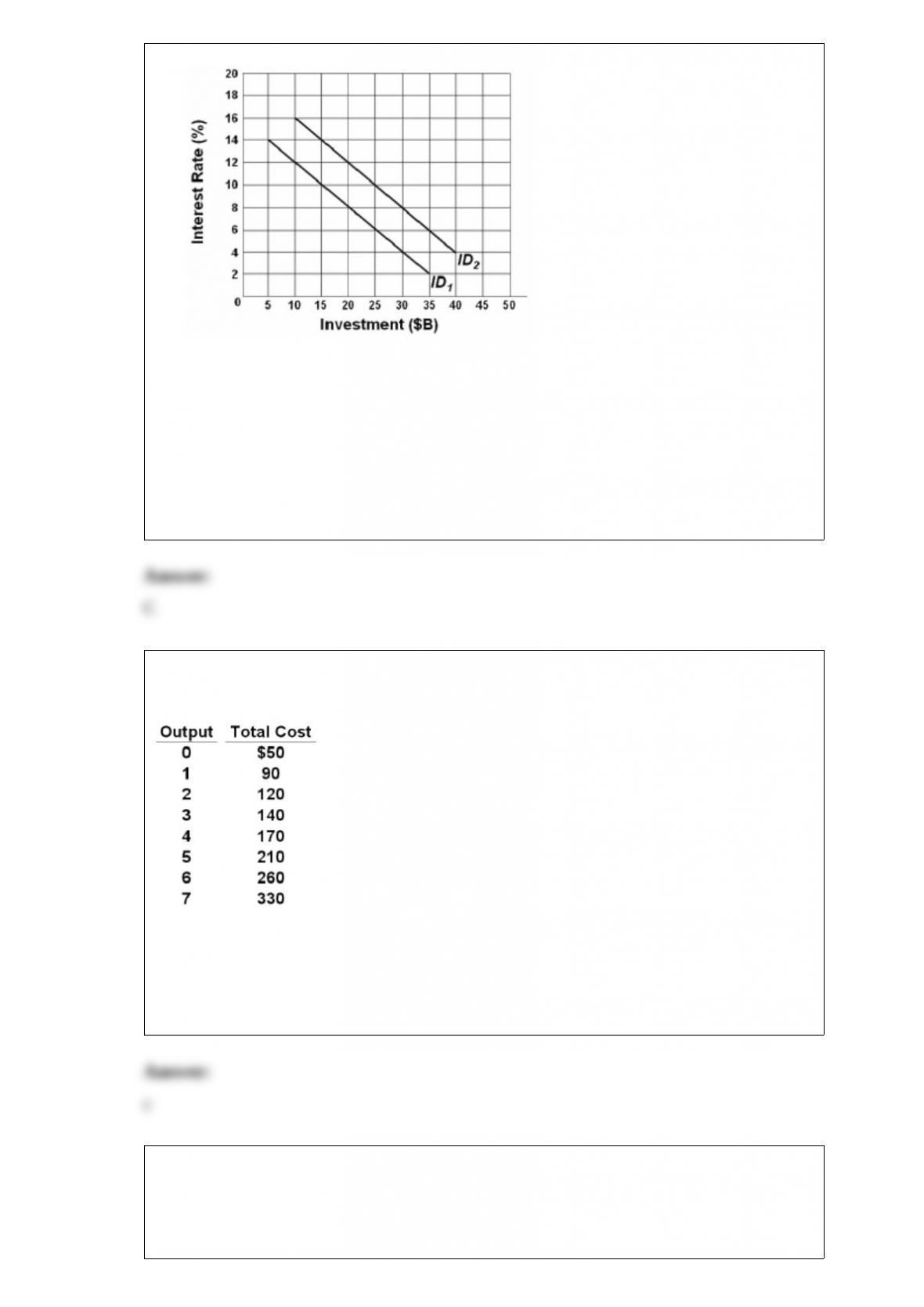
Refer to the above diagram. Initially assume that the investment demand curve is ID1.
The crowding-out effect of a large public debt would be shown as a(n):
A.shift of the investment demand curve from ID1 to ID2.
B.leftward shift of the investment demand curve.
C.increase in the interest rate from 4 percent to 6 percent and a decline in investment
spending of $5 billion.
D.increase in the interest rate from 6 percent to 8 percent and a decline in investment
spending of $40 billion.
10) the following cost data for a purely competitive seller:
refer to the above data. if product price is $45, the firm will:
a.shut down.
b.produce 4 units and realize a $120 economic profit.
c.produce 5 units and realize a $15 economic profit.
d.produce 6 units and realize a $100 economic profit.
11) Wage differentials may result from all the following except:
A.differences in the nonmonetary aspects of various occupations.
B.differences in the education and skills of workers.
C.geographic and sociological immobilities of workers.

D.the tendency of qualified workers to move from lower pay jobs to higher pay jobs.
12) copyrights and trademarks are examples of:
a.capital goods.
b.human capital.
c.property rights.
d.public goods.
13) Firms whose central business is to offer security advice and buy and sell individual
stocks and bonds for clients are known as:
A.thrifts.
B.pension fund companies.
C.securities firms.
D.insurance companies.
14) The graphical relationship between the price level and the amount of real GDP that
businesses will offer for sale is known as the:
A.aggregate demand curve.
B.investment supply curve.
C.investment demand curve.
D.aggregate supply curve.
15) Suppose that a union successfully negotiated a 10 percent wage increase and the
quantity of labor demanded increased by 10 percent. We can conclude that:
A.the labor demand curve must have independently shifted to the right.
B.labor demand is highly elastic.
C.the coefficient of labor demand elasticity is less than 1.
D.labor demand is unit-elastic.