
For the Minnie Mice Company, the elasticity of demand is “6, and the
profit-maximizing price is 30. If MC is marginal cost and AVC is average variable cost,
then:
a. MC = 25.
b. AVC = 25.
c. MC = 30.
d. AVC = 36.
e. MC = 36.
The demand for health club services is Q = 100 ” 2P, and the marginal cost of providing
these services is MC = “110 + 2Q. If a two-part tariff pricing system is used, what is the
optimal price and quantity combination?
a. P = 18 and Q = 64.
b. P = 199 and Q = 52.
c. P = 26 and Q = 162.
d. P = 162 and Q = 26.
e. None of the above.

The cross-price elasticity of demand is defined as the:
a. percentage change in the quantity demanded of a good divided by the percentage
change in the good’s price.
b. percentage change in the quantity demanded of a good divided by the percentage
change in a different good’s price.
c. percentage change in a good’s price divided by the percentage change in a different
good’s price.
d. change in the quantity demanded of a good divided by the change in its price.
e. change in the quantity demanded of a good divided by the change in income.
If the perfectly competitive market demand for gym shoes is given by QD = 100 ” P and
the market supply is given by QS = 10 + 2P, then the equilibrium price and quantity will
be:
a. P = 50 and Q = 50.
b. P = 40 and Q = 90.
c. P = 40 and Q = 60.
d. P = 30 and Q = 70.
e. P = 25 and Q = 75.

Where long-run average cost equals short-run average cost:
a. short-run average cost is minimized.
b. long-run average variable cost equals short-run average variable cost.
c. long-run average cost equals long-run marginal cost.
d. long-run average cost is minimized.
e. long-run marginal cost equals short-run marginal cost.
If a coin were weighted so that heads had three times the chance [P(H)] of coming up as
tails [P(T)], the probability distribution would be given by:
a. P(H) = 0.67 and P(T) = 0.33.
b. P(H) = 1 and P(T) = 3.
c. P(H) = 0.5 and P(T) = 0.5.
d. P(H) = 0.75 and P(T) = 0.25.
e. P(H) = 1 and P(T) = 0.33.
The most frequently used method for estimating demand functions is:

a. market experiments.
b. consumer interviews.
c. regression analysis.
d. focus groups.
e. casual introspection.
If duopolists engage in price competition, the result is:
a. always zero profits.
b. always zero profits unless the firms produce differentiated products.
c. always zero profits unless the two goods are perfect substitutes.
d. always zero profits unless the two firms collude.
e. never zero profits.
Which of the following would a manager NOT use to create market inefficiencies?
a. Establishing a brand name.
b. Sophisticated pricing strategies.

c. Diversification efforts.
d. Output decisions.
e. Building market entry barriers.
If labor is on the vertical axis and capital is on the horizontal axis, the slope of an
isocost line is given by:
a. “PL / PK.
b. “PK / PL.
c. “PKPL.
d. “MPL / MPK.
e. “MPK / MPL.
Whenever average profit is less than marginal profit:
a. average profit declines with increases in output.
b. marginal profit decreases with increases in output.

c. marginal profit increases with increases in output.
d. average profit is maximized.
e. average profit increases with increases in output.
Toy Productions makes toy trucks from steel according to Q = 50 + 100S ” 0.5S2. If
steel costs $49 and toy trucks sell for $7, the optimal level of steel usage is:
a. 50
b. 43
c. 100
d. 93
e. 133
A person who has a utility function (with income on the horizontal axis and utility on
the vertical axis) that is linear is:
a. risk-averse.
b. risk loving.
c. risk-neutral.

d. irrational.
e. always sad.
A game has two players. Player 1 chooses between two options, and then player 2, with
the knowledge of what player 1 chose, chooses between two options. If this were
depicted in a decision tree, how many forks would there be?
a. 2
b. 3
c. 7
d. 12
e. 24
The difference between game trees and decision trees is:
a. that game trees are not useful in strategic situations.
b. that decision trees describe actions that depend on the behavior of rivals.
c. that game trees have interactive payoffs.

d. that decision trees are a function of many individuals and the state of nature.
e. none of the above.
El Niño wind patterns affected the weather across the United States during the winter of
1997″1998. Suppose the demand for home heating oil in Connecticut is given by Q =
20 ” 2Phho + 0.5Png ” TEMP, where Q is the quantity of home heating oil demanded,
Phho is the price of home heating oil per unit, Png is the price of natural gas per unit,
and TEMP is the absolute difference between the average winter temperature over the
past 10 years and the current average winter temperature. If the current price of home
heating oil is $1.20, the current price of natural gas is $2.00, and the average winter
temperature this year is 40 degrees compared to 28 degrees over the past 10 years, the
price elasticity of demand for home heating oil is:
a. “0.09.
b. “0.36.
c. “1.2.
d. “2.
e. none of the above.
If a monopolist faces a constant-elasticity demand curve given by Q = 400P “2 and has
total costs given by TC = 0.625Q2, its profit-maximizing level of output is:

a. 0
b. 2
c. 4
d. 6
e. 8
Managers may choose to pursue goals other than maximization of a firm’s value. This is
referred to as the problem.
a. slacker’shirking
b. neuropathy
c. generation X
d. principal”agent
e. none of the above
Assume that the utility function of wine for a certain consumer is given by TU = 96Q ”
3Q2. If wine is free, to maximize utility, the amount the consumer should consume is:

a. 6 bottles of wine.
b. 16 bottles of wine.
c. 90 bottles of wine.
d. 93 bottles of wine.
e. unknown; there is insufficient information to determine this.
Fred has a utility function U = 10P5 and also has an investment opportunity that will
pay 25 with probability 0.4 and 100 with probability 0.6. What is the certainty
equivalent of this opportunity?
a. 64
b. 70
c. 80
d. 83.7
e. None of the above.
Firms that produce similar, slightly differentiated products are called a(n):
a. oligarchy.

b. oligopoly.
c. cabal.
d. cartel.
e. product group.
The quotient rule of differentiation is:
a. Y = U(X) / W(X) dY/dX = (W dU/dX ” U dW/dX) / W 2.
b. Y = U(X) / W(X) dY/dX = (W dU/dX ” U dW/dX) / W.
c. Y = U(X) / W(X) dY/dX = [(W dU/dX) / (U dW/dX)] / W 2.
d. Y = U(X) / W(X) dY/dX = [(W dU/dX)(U dW/dX)] / W 2.
e. Y = U(X) / W(X) dY/dX = [(W dU/dX)(U dW/dX)] / W.
A person who is risk-neutral has a utility function (with income on the horizontal axis
and utility on the vertical axis) that, as income increases:
a. is horizontal.
b. is vertical.

c. has constant, positive slope.
d. is curved down.
e. is curved up.
Along a demand curve with unitary elasticity everywhere, total revenue:
a. increases as output increases.
b. decreases as output increases.
c. remains constant as output increases.
d. increases and then decreases as output increases.
e. decreases and then increases as output increases.
A regression of the average temperature in July as a function of the average temperature
in January across cities yielded the following: July temperature = 20 + 2.0 ´ January
temperature, Prob > F = .03, R2 = .64, and RMSE = 20. If a city has an average
temperature of 40 degrees in January, what does this regression say about its likely July
temperature?
a. The July estimate is 100 degrees, and since the F-statistic has only a 3% chance of
being so large if the January temperature did not affect the July temperature, we would
be confident in this estimate.
b. The July estimate is 100 degrees, and since the R2 says that variation in the January
temperature explains 64% of the variation in the July temperature, we would be
confident in this estimate.
c. Since the F-statistic has only a 3% chance of being so large if the January
temperature did not affect the July temperature and the R2 is so high, there is a serial
correlation problem that invalidates any inferences we might draw from the regression.
d. The July estimate is 100 degrees, and since the RMSE equals 20, normal statistical
confidence intervals would allow for most temperatures from 60 to 140 degrees.
Although the point estimate of 100 degrees is our best estimate, we must accept that the
actual temperature might be quite different; we would not have confidence in this
estimate.
e. Since the F-statistic has only a 3% chance of being so large if the January
temperature did not affect the July temperature and the R2 is so high, there is a
multicollinearity problem that invalidates any inferences we might draw from the
regression.
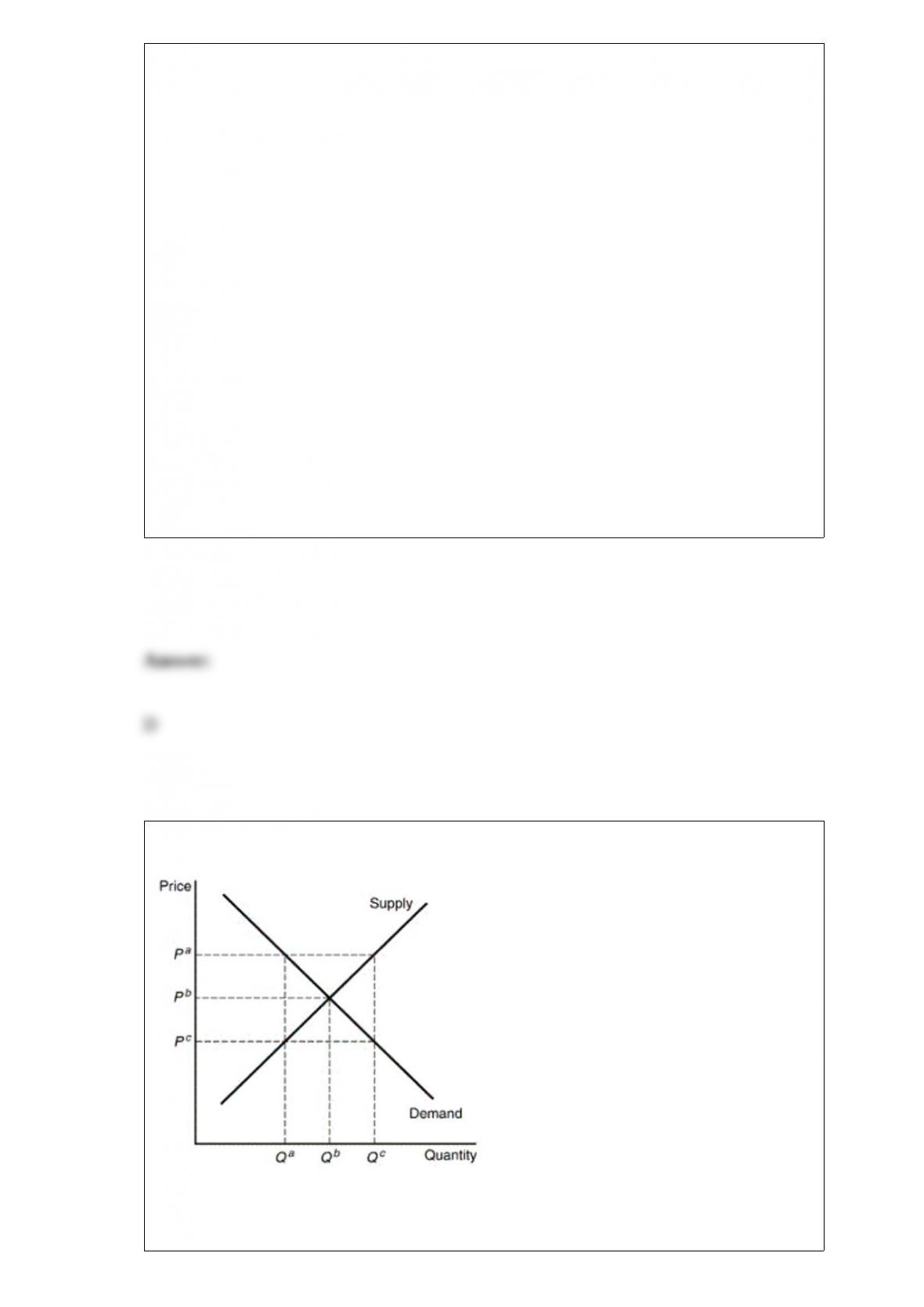
In the following figure, there will be an excess demand at any price:
a. below Pa.

b. below Pb.
c. other than Pb.
d. above Pb.
e. above Pc.
The difference between accounting and economic profit is:
a. caused by confusion over tax laws.
b. the value of owned resources in their next best alternative use.
c. the result of superior training received by accountants.
d. proportionately very small for owner-managed firms.
e. a decreasing function of interest rates.
Use the following profit function (per worker) for the Blue Delta Faucet Company to
answer this question.
P(e) = 40e ” (2e2 + 100)
Note that P = firm profits and e = worker-hours per day. Assume that effort is observed
perfectly. At this profit-maximizing level of effort for the firm, profits per worker will

be:
a. $40.
b. $100.
c. $300.
d. $400.
e. none of the above.
Suppose that Wilma’s utility function is given by
U(E) = 100 ” 2E2,
where E = Wilma’s work effort in producing homemade dinners, measured in hours per
day. Given her utility function, Wilma has an incentive to supply:
a. maximum effort, because working hard is important to her.
b. maximum effort, because she is afraid of getting fired.
c. minimum effort, because she knows she will get fired under any circumstances.
d. minimum effort, because her utility decreases as effort increases.
e. maximum effort, because she can increase her salary by working harder.

A monopsonist faces a market labor supply curve w = 40 + 2L, where w is the wage rate
and L is the number of workers employed. If the firm’s labor demand curve is w = 200 “
L, what is the optimal wage rate and quantity of labor employed?
a. w = 146.7 and L = 53.3.
b. w = 168 and L = 32.
c. w = 104 and L = 32.
d. w = 40 and L = 160.
e. w = 32 and L = 168.
Leisure Enterprise’s total cost of producing speedboats is given by TC = 10Q3 ” 4Q2 +
25Q + 500. On the basis of this information, the marginal cost of producing the 25th
speedboat is:
a. $1,700.
b. $6,050.
c. $18,575.
d. $18,775.
e. $19,075.

A representative firm with long-run total cost given by TC = 2,000 + 20q + 5q2 operates
in a competitive industry where the market demand is given by QD = 10,000 ” 40P. The
long-run equilibrium output of the industry will be:
a. 1,200 units.
b. 1,800 units.
c. 2,200 units.
d. 2,600 units.
e. 3,200 units.
A player in a game theoretic model is:
a. anyone working for a firm that is operating strategically.
b. a decision-making entity at a firm involved in a strategic game.
c. a firm that is operating as a perfect competitor.
d. a monopolist who produces a unique product with no close substitutes.
e. a stockholder at a firm involved in a strategic game.
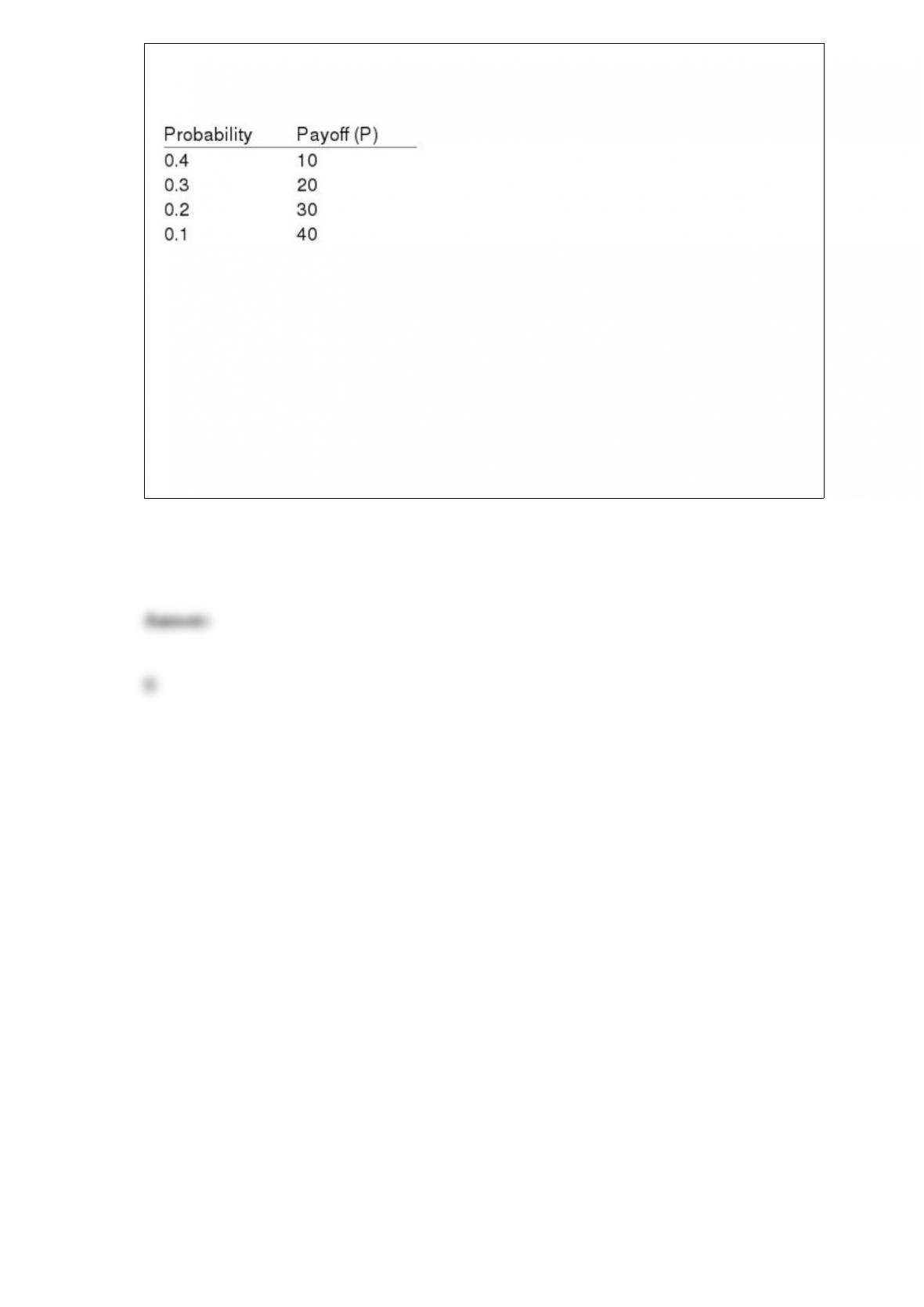
An investor has utility function U = 10 + 5P ” 0.02P2. What is the expected utility of
the following investment option?
a. 20
b. 100
c. 102
d. 114
e. None of the above.