
A competitive firm will shut down its operations in the short run when the market price
falls below its
a. marginal revenue.
b. marginal cost.
c. average cost.
d. average variable cost.
Which of the following will cause equilibrium output in a market to increase?
a. A decrease in firms’ variable costs.
b. An outward shift of the demand curve.
c. Entry of more firms into the market.
d. All of the above.
Firms in monopolistic competition resemble monopolies in that both types of firms
a. earn positive economic profits in the long run.
b. charge prices higher than their marginal costs.

c. possess barriers to entry that keep potential rivals out of the market.
d. produce their output so that their average cost is minimized.
Variable Cost of Production
The following questions refer to the following table which shows a firm’s variable costs
of production.
For what levels of output does the firm experience diminishing marginal returns?
a. For all levels of output.
b. For the first, second, and third units of output.
c. Beyond the third unit of output.
d. For the fifth and all subsequent units of output.
The phenomenon whereby labor decreases in response to a decrease in the wage rate is
called
a. the substitution effect.

b. the scale effect.
c. derived demand from a change in wage.
d. the factor regressivity of labor.
A principal-agent problem occurs when
a. people are “fooled” by high absolute wages offered by employers.
b. insurance increases people’s willingness to take risks.
c. an employer cannot fully monitor the employee’s work.
d. a highly productive worker is unable to earn any rent.
Game Matrix III
The following questions refer to the game matrix below. Each firm has a choice of
advertising, Ads, or not advertising, No ad. The profits each gets depend upon which it
chooses.

The Nash equilibrium is to be found where
a. neither firm advertises.
b. Firm A advertises, Firm B does not.
c. Firm A does not advertise but Firm B does.
d. both firms choose to advertise.
The first step in economic analysis is to
a. explore how the equilibrium changes if the constraints change.
b. make explicit assumptions about the desirability and the cost of various alternatives.
c. apply the equimarginal principle to the problem being considered.
d. determine how agents’ constraints are interrelated.

When will the substitution effect of a wage increase cause a fall in the amount of labor
employed?
a. Always.
b. When labor is not a regressive factor.
c. When labor and capital are substitutes in production.
d. When labor and capital are complements in production.
Consider the Prisoners’ Dilemma game, and suppose one player confesses but the other
player does not confess. This outcome is
a. a Nash equilibrium.
b. Pareto optimal.
c. a Pareto improvement over the outcome where both players confess.
d. Pareto-inferior to the outcome where neither player confesses.
Assume that the supply curve is horizontal because marginal cost is constant at $10.
John, Robert, and Jimmy each value one compact disc at $20 but only Jimmy and John
value a second compact disc (Jimmy at $5 and John at $15). It follows that the optimal
number of compact discs sold in this market is
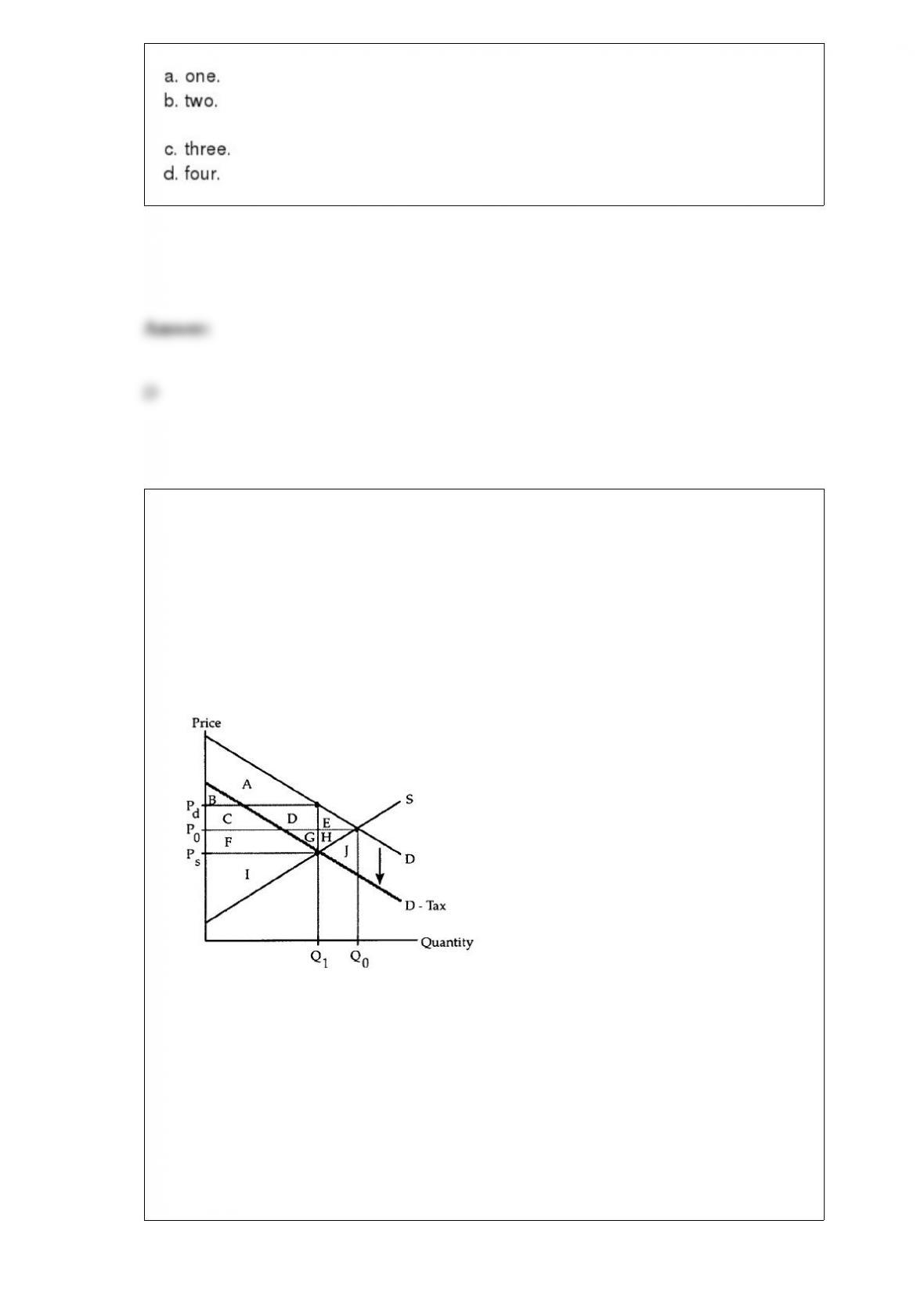
Sales Tax
The following questions refer to the accompanying diagram which shows the effects of
a sales tax imposed on consumers. The initial price and quantity are P0 and Q0,
respectively. After the tax is imposed, the equilibrium quantity is Q1, firms receive the
price Ps, and consumers pay the price Pd.
Area C + D + F + G
a. the total value that consumers receive from their purchases.
b. the tax revenue collected by the government.
c. the fall in producers’ surplus.
d. the deadweight loss due to the tax.

Which of the following is a positive economic statement?
a. A minimum wage is good because it guarantees workers a decent living.
b. A tax on the rich is bad because it discourages innovation and investment.
c. A tax on the poor is not fair because the poor already have it hard enough.
d. A cartel has an incentive to reduce its quantity and increase its price.
Senior citizen and student discounts on tickets at movies theaters are examples of
a. First-degree price discrimination.
b. Second-degree price discrimination.
c. Third-degree price discrimination.
d. A two-part tariff.

Marginal Cost of Production
The following questions refer to the following table which shows a firm’s marginal cost
of production.
Suppose the firm has $20 in fixed costs. Its total cost of producing 4 units of output is
a. $29.
b. $33.
c. $56.
d. $42.
If the price of goods X and Y change proportionally, then which of the following is
true?
a. The budget line will not change because the prices have changed proportionally.
b. It is not clear what happens to the budget line because too many factors have
changed.
c. It will appear as if the budget line has shifted even though income has not changed.
d. It will appear as if the budget line pivoted and the slope will change because prices
changed.

When a Clarke tax is used to finance a public good, each person’s tax equals
a. the amount that he is willing to pay for the good.
b. the difference between the value he places on the public good and its cost.
c. the cost of the public good minus the value that other people claim to receive from it.
d. everyone else’s tax, with the sum equaling the cost of producing the public good.
A market with demand Q = 100 – 3P is currently in equilibrium with 40 units being
sold. It follows that the current price elasticity of demand
a. is zero.
b. is -1.5.
c. is -6.
d. cannot be calculated with the information given.

Which of the following is not classified as a capital input?
a. A John Deere factory.
b. A Hewlett-Packard laser printer.
c. A cement mixer.
d. 500 shares of General Motors stock.
Why do private markets tend to undersupply nonrivalrous goods?
a. Because free riders will refuse to pay for these goods.
b. Because the tragedy of the commons will reduce their value to zero.
c. Because people have an incentive to understate their preferences for these goods.
d. Because the efficient price for these goods is zero.
Which of the three stages of economic analysis would include consideration of how
each individual’s actions affect the options available to others?
a. The first.
b. The second.

c. The third.
d. None, this is not part of economic analysis.
GA 400 is a state highway that runs through part of Atlanta,GA. In order to travel on
one portion of GA 400, drivers are required to pay a toll. It follows that section of GA
400 will exhibit non-rivalry in consumption if
a. the road is congested.
b. the road is not congested.
c. the toll is decreased.
d. the the toll is completely removed.
Which of the following would not be an example of a nonproductive activity creating
social losses?
a. Accountants seeking methods of tax avoidance for their clients.
b. Lawyers engaged in litigation that would transfer money from one group to another.
c. Lawyers hired to assist two parties in writing a contract.
d. Lobbyists seeking laws that would transfer public lands to private parties without any
payment.

Consider a firm that produces peanut butter. An increase in the price of peanuts will
cause the firm to lower its output because
a. fixed costs will rise.
b. marginal cost will rise.
c. the price of peanut butter will rise.
d. marginal revenue will fall.
When are demanders satisfied and suppliers unsatisfied?
a. Never-neither suppliers nor demanders are ever completely happy with the market
price.
b. Whenever the market price is above its equilibrium level.
c. When the market price is relatively low, because then demanders can buy all they
want but suppliers cannot make a profit.
d. When rises in supply cause a fall in the equilibrium price of the good.
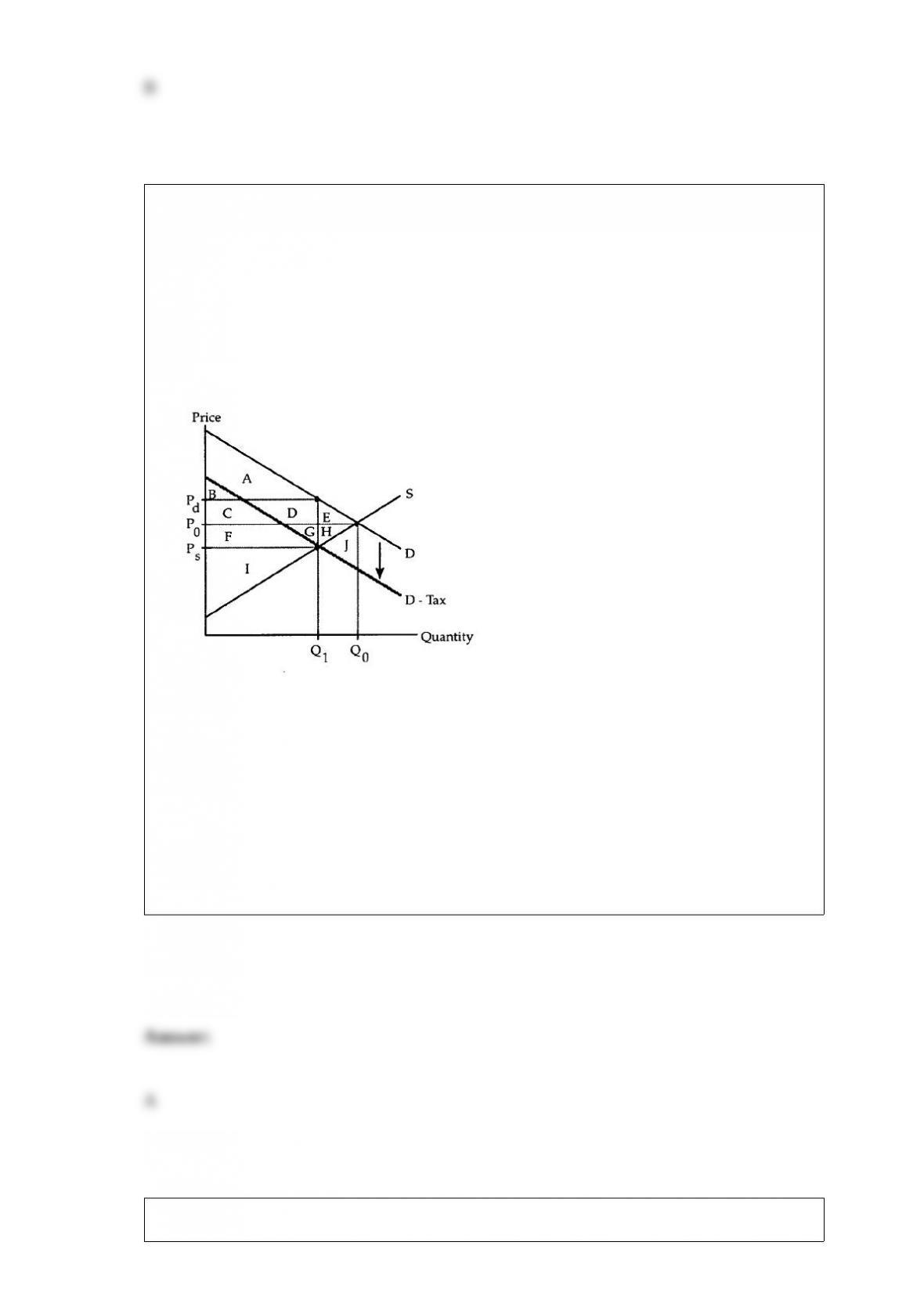
Sales Tax
The following questions refer to the accompanying diagram which shows the effects of
a sales tax imposed on consumers. The initial price and quantity are P0 and Q0,
respectively. After the tax is imposed, the equilibrium quantity is Q1, firms receive the
price Ps, and consumers pay the price Pd.
After the tax is imposed, consumers’ surplus is equal to
a. area A + B.
b. area B.
c. area B + C.
d. area A + B + C + D + E.
A monopoly’s marginal revenue curve is always

a. is always above the demand curve.
b. identical to that of a perfectly competitive firm.
c. twice as steep as the demand curve.
d. none of the above.
According to Gary Becker’s “Rotten Kid theorem,” a child will be deterred from
stealing from his siblings
a. as long as he fears that his parents will punish him.
b. when parents are altruistic and treat their children equally.
c. only if the probability of being caught is sufficiently large.
d. if he inherits the “altruistic gene” from his parents.
Policy B will be judged to be better than another by the Pareto criterion when
a. Policy B is preferred unanimously.
b. Policy B would win a majority of votes.
c. there is no deadweight loss associated with Policy B.

d. any fair minded person would recognize that Policy B is fair and equitable.
In order to practice third degree price discrimination all of the following conditions
must hold except that the firm
a. has monopoly power.
b. is able to exercise control over resales.
c. is willing to sell more to each customer at lower prices.
d. charges a lower price to groups with more elastic demand.
According to the efficiency criterion, when a policy creates both winners and losers, it
will be preferred to the status quo as long as the winners’ gains outweigh the losers’
losses.

The main problem in the Prisoners’ Dilemma is that the players involved fail to agree on
an outcome that would be mutually beneficial.
An economic model is robust if it provides results that are testable and verifiable.
Define the terms legal incidence and economic incidence. When the legal incidence of a
tax is changed, how does this affect the economic incidence of the tax? Why does this
result occur?

In both the short-run and the long-run, a monopoly is guaranteed to earn positive
profits.
While it is an interesting outcome, the Prisoners’ dilemma is of little importance in
economics since few people end up in jail.
To make the most accurate predictions about a stock’s future price, one must look at
both the past pattern of prices and the current price of the stock.

The Invisible Hand Theorem shows that competitive markets create the maximum
possible social gain, even when all interactions among the markets are taken into
account.
As long as labor is not a regressive factor, a higher wage will cause a firm to produce
less output in the long run.
All baskets of labor and capital capable of producing a given level of output are
technologically efficient.
The unit isoquant represents all possible ways of producing one unit.

If the real interest rate is 5% and the inflation rate is 3% then the real growth rate in
your purchasing power is 8%.
Estimates of the price elasticity of demand depend, in part, on the units used to measure
price and quantity.
When people have identical tastes, social gain can be created from a common property
by imposing a Pigovian tax on entrants.

A Paasche price index makes price changes seem better for the consumer than they
really are.
The substitution and income effects of a wage increase both cause consumption to rise.
When faced with two portfolios that offer the same expected return, a risk-averse
investor prefers the one with the higher standard deviation.
When the actual market price is below its equilibrium level, suppliers are satisfied but
demanders are not.

An increase in the price of compact discs would shift the demand curve for DVD
players to the left.
A technological advance that reduces firms’ variable costs will lead to higher profits in
the long run of a perfectly competitive industry.