
The share of GDP taken by taxes is considerably higher in the United States than in
other countries.
a. True
b. False
In March 2015, many college students bet on the NCAA finals in dorm gambling pools.
This is an example of
a. real vs. nominal GDP.
b. the assumed value of household production.
c. underground economic activity.
d. the implicit value of leisure time.
e. a “bad” versus a “good.”
Higher rates of productivity growth are most closely associated with higher rates of
a. consumer spending.
b. investment spending.
c. government spending.
d. import spending.
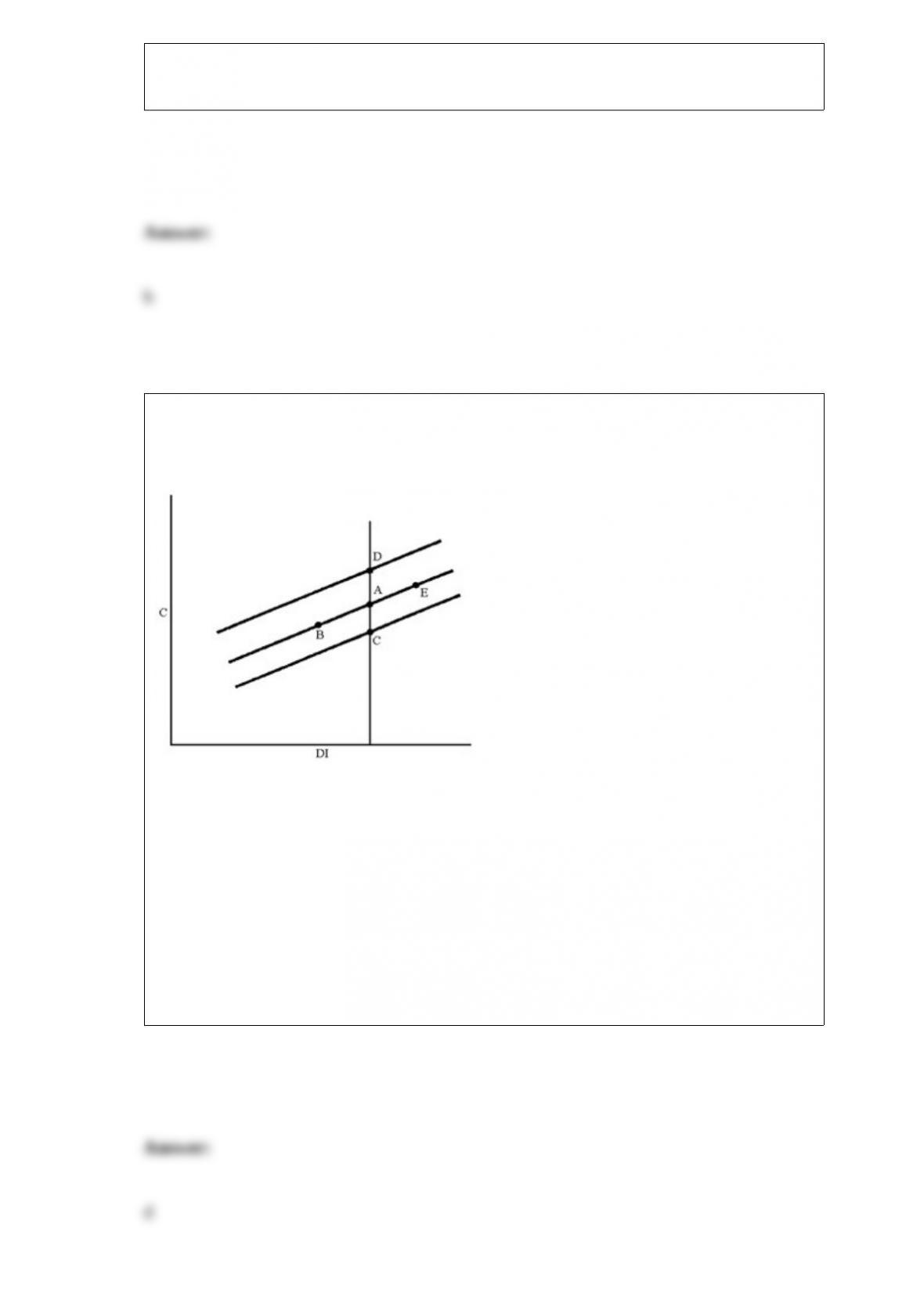
Figure 8-2
In Figure 8-2, which of the following moves can be explained by an increase in
government transfer payments?
a. A to B
b. A to C
c. A to D
d. A to E

A decrease in AS will trigger more inflation under which of the following conditions?
a. AD is relatively steep.
b. AD is relatively flat.
c. AS is relatively steep.
d. AS is relatively flat.
An efficient tax is one that raises the desired tax revenue but creates the least possible
a. total burden.
b. excess burden.
c. tax incidence.
d. tax shifting.
The theory of the kinked demand curve is used to explain
a. bizarre corporate behavior.
b. sales maximization.

c. the maximin criterion.
d. sticky prices in oligopolies.
If stock prices follow a random walk,
a. speculation in the stock market destabilizes prices.
b. a stock’s past performance is not a good indicator of its future performance.
c. rumors, news, and other “signals” have no effect on stock prices.
d. the stock market does not participate in channeling resources toward firms with high
stock prices.
If supply increases, the equilibrium price will rise and the equilibrium quantity will fall.
a. True
b. False

An increase in the price level causes the aggregate supply curve to shift to another
supply schedule.
a. True
b. False
The equilibrium level of GDP is the level at which
a. aggregate demand exceeds output.
b. aggregate demand equals output.
c. aggregate demand is less than output.
d. inventories are being depleted to meet demand.
Table 10-1
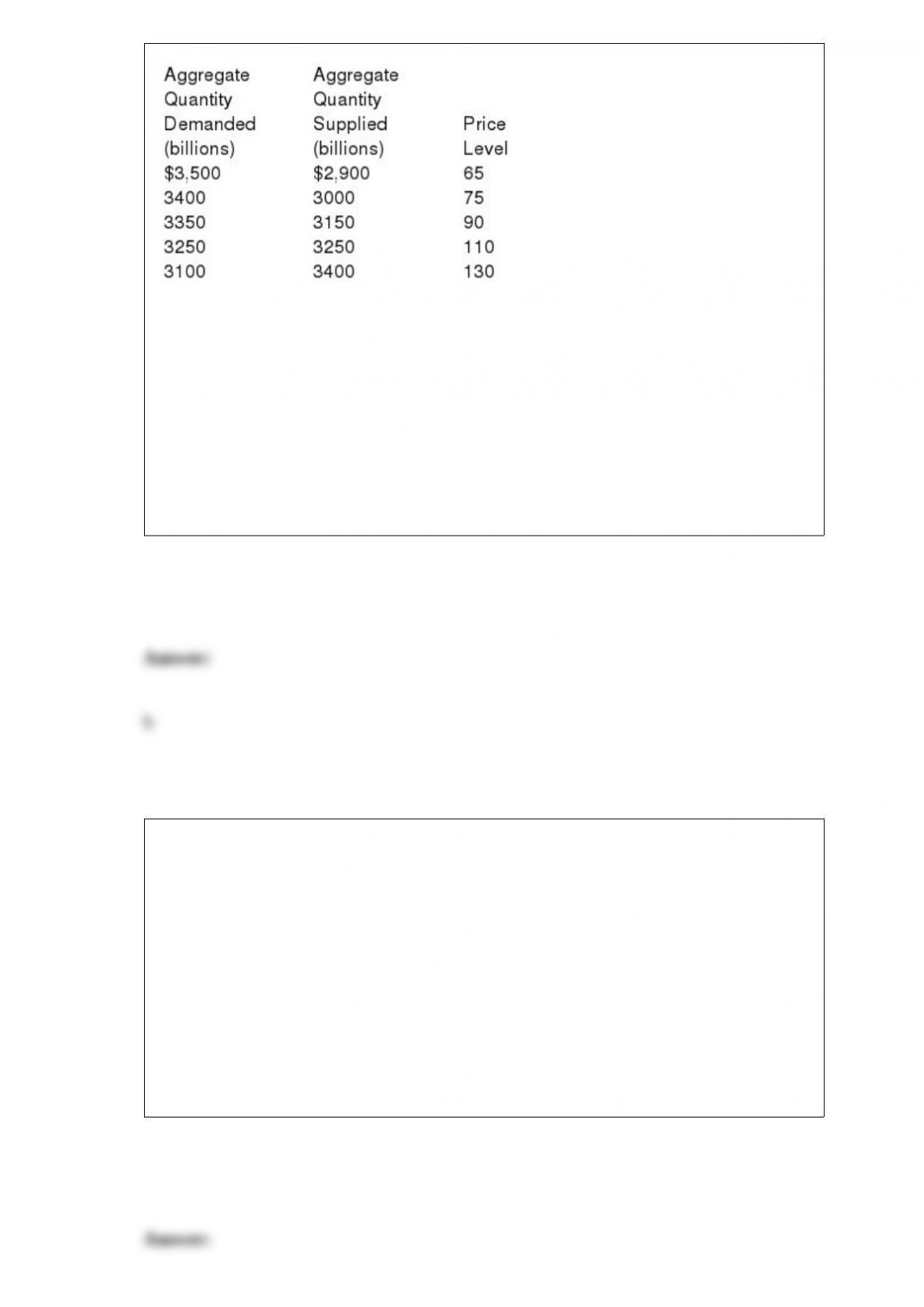
In Table 10-1, what is the equilibrium level of real output and the equilibrium price?
a. $3,100 real output and a price of 75
b. $3,250 real output and a price of 110
c. $3,350 real output and a price of 90
d. $3,400 real output and a price of 75
When residents surrounding an airport complain about noise from aircraft landings and
takeoffs, the relevant economic analysis is that of
a. externalities.
b. equality-efficiency trade-off.
c. comparative advantage.
d. the cost decrease of the service sector.
e. the cost disease of personal services.
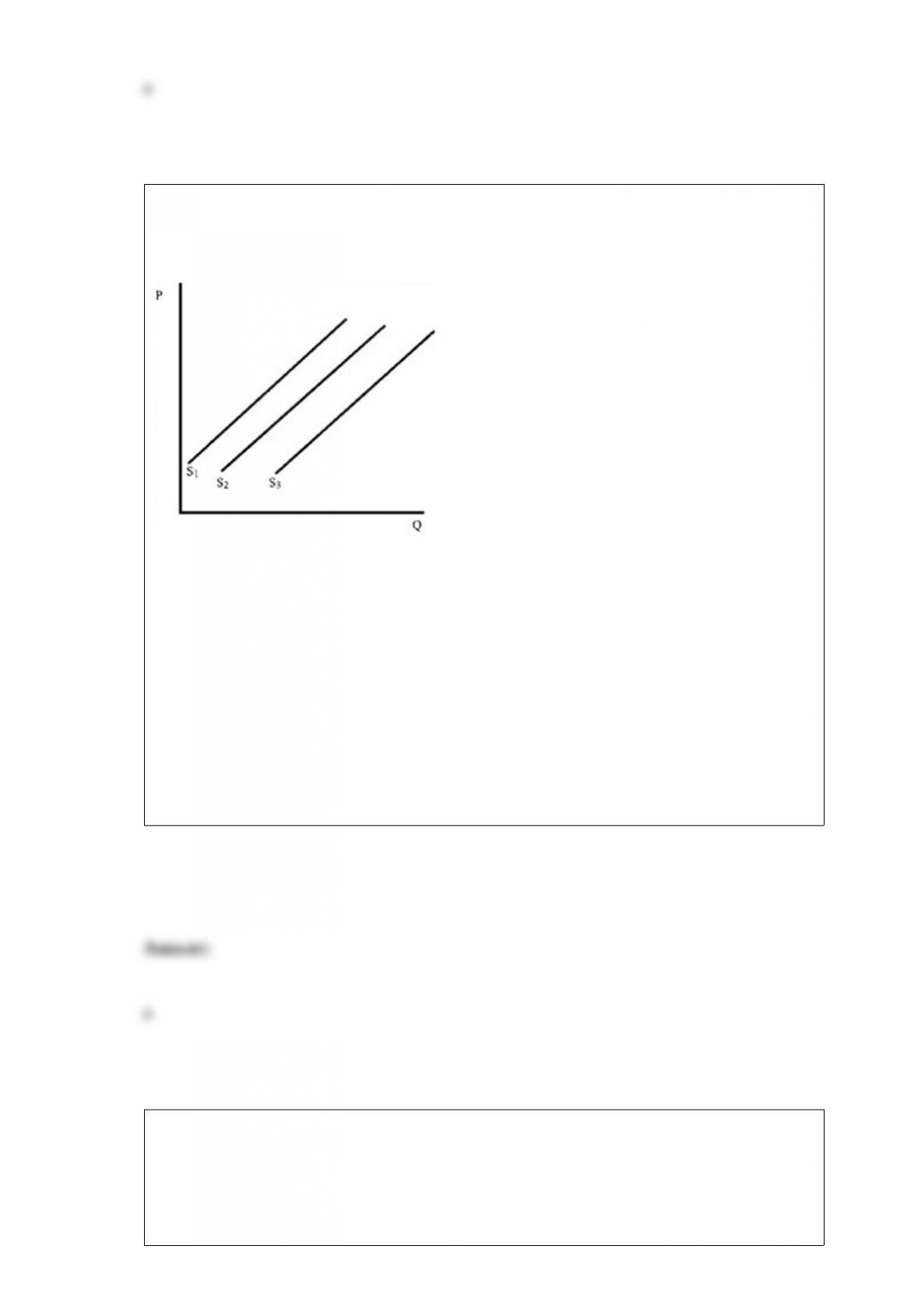
Figure 4-16
Assume that Figure 4-16 shows the supply of orange juice. A decrease in the wage rate
paid to workers in the orange juice industry will shift supply from
a. S1 to S2.
b. S2 to S1.
c. S3 to S2.
d. S3 to S1.
If one country has an absolute advantage in every commodity, there is no reason for it
to trade.
a. True

b. False
A firm in a perfectly competitive industry
a. is unaffected by the entrance of new firms into the industry, since entering firms
affect only the prices they themselves receive.
b. always produces more output in the long run than in the short run.
c. may choose a different output in the long run than in the short run.
d. earns economic profit in the long run but not in the short run.
Melissa purchases shares in a government bond mutual fund. Is this included in the
aggregate demand component “Investment”?
a. Yes, if it is a domestic mutual fund.
b. Yes, if the purchase is made out of current income.
c. No, unless the funds are deposited in a domestic financial institution.
d. No, it would never be included.
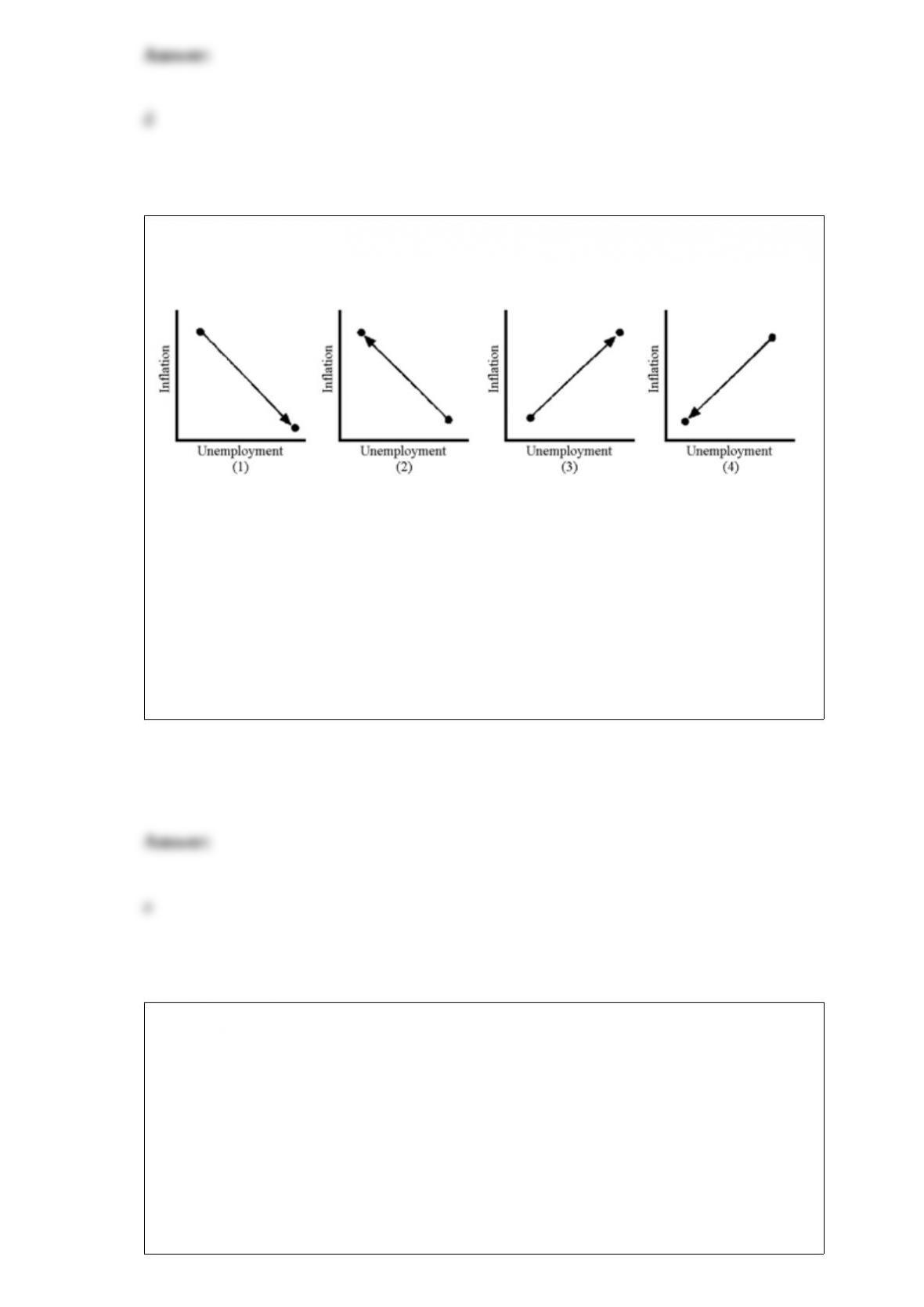
Figure 17-4
Which panel in Figure 17-4 shows what happened in 2007-2009?
a. 1
b. 2
c. 3
d. 4
The required reserve ratio is 10 percent, but banks actually keep 20 percent on reserve.
The actual money multiplier will be
a. 10.
b. 9.
c. 5.
d. 2.

e. 1.
Each Federal Reserve district bank is a corporation owned by
a. the member banks in the district.
b. the people of the United States.
c. the U.S. Department of the Treasury.
d. federal securities owners.
To decrease the money supply, the Fed purchases government securities, which
decreases government spending.
a. True
b. False

In contrast to Argentina in 2001, the United States debt is less of a burden because the
U.S. debt is
a. an obligation to pay over a longer period of time.
b. owed entirely to U.S. citizens and banks.
c. an obligation to pay in domestic currency.
d. an obligation to pay in foreign currency.
Price decreases always increase economic efficiency.
a. True
b. False
According to the process of creative destruction, at first the entrepreneur will be able to
sell her product for
a. a low price because it is not well known.
b. a high price because there is no competition.
c. a fair price because these are contestable markets.

d. at a price of zero until the market is created.
If a bank has $1,000,000 in reserves and checking deposits of $3,000,000, what is the
bank’s reserve position if the required reserve ratio is 20 percent?
a. The bank has $500,000 of required reserves and $500,000 of excess reserves.
b. The bank has $600,000 of required reserves and $400,000 of excess reserves.
c. The bank has $400,000 of required reserves and $600,000 of excess reserves.
d. The bank has $200,000 of required reserves and $800,000 of excess reserves.
An example of peak pricing is charging
a. more for long-distance phone calls in the daytime.
b. less for electricity at night.
c. more for public transportation in rush hours.
d. All of the above are true.

Most checkable deposits are insured up to $250,000 by
a. state banking commissions.
b. the Federal Reserve Board.
c. U.S. Department of the Treasury.
d. the Federal Deposit Insurance Corporation.
Define the following terms and explain their importance to the study of
macroeconomics:
a. velocity
b. equation of exchange
c. monetarism
d. automatic stabilizer
Decreasing aggregate demand to eliminate an inflationary gap often creates the problem
of
a. unemployment.
b. increasing real GDP.
c. increasing inflation.
d. increasing the labor force.
The distinction between M1 and M2 is based on
a. portability-the ease with which an asset can be moved.

b. divisibility-the ease with which an asset can be used to make smaller payments.
c. liquidity-the ease with which an asset can be converted into cash.
d. storability-how long an asset will retain its value.
Gladys agrees to lend Kay $1,000 for one year at a nominal rate of interest of 5 percent.
At the end of the year prices have actually risen by 7 percent.
a. Gladys earns extra real income.
b. Kay loses extra real income.
c. Kay receives extra real income.
d. Neither party gains or loses if the loan is repaid.
Price leadership is an example of explicit collusion by oligopolies.
a. True
b. False

An investor in an index fund earning 12.3% per year would see an investment of
$10,000 increase to approximately ____ in 25 years.
a. $11,000
b. $48,000
c. $54,000
d. $170,000