
Which of the following is false?
a. Even if a corporation is not currently issuing bonds, you could still buy a bond
directly from the corporation.
b. Bonds that are rated AAA from Standard and Poor’s have received the highest rating
possible.
c. A bond that is rated in the D categoryindicates that the bond issuer cannot pay off the
bond.
d. It is possible to buy a bond from someone who purchased and still holds the bond he
bought from the corporation at an earlier date.
The free-rider problem arises if goods are
a. nonrivalrous in consumption.
b. rivalrous in consumption.
c. nonexcludable.
d. excludable.
e. a and d
If an asymmetry of information is removed and laborers’ preferences change against
employment in a labor market, it would __________ employment and __________ the
wage at the equilibrium in the market.
a. increase; raise
b. increase; lower
c. decrease; raise
d. decrease; lower
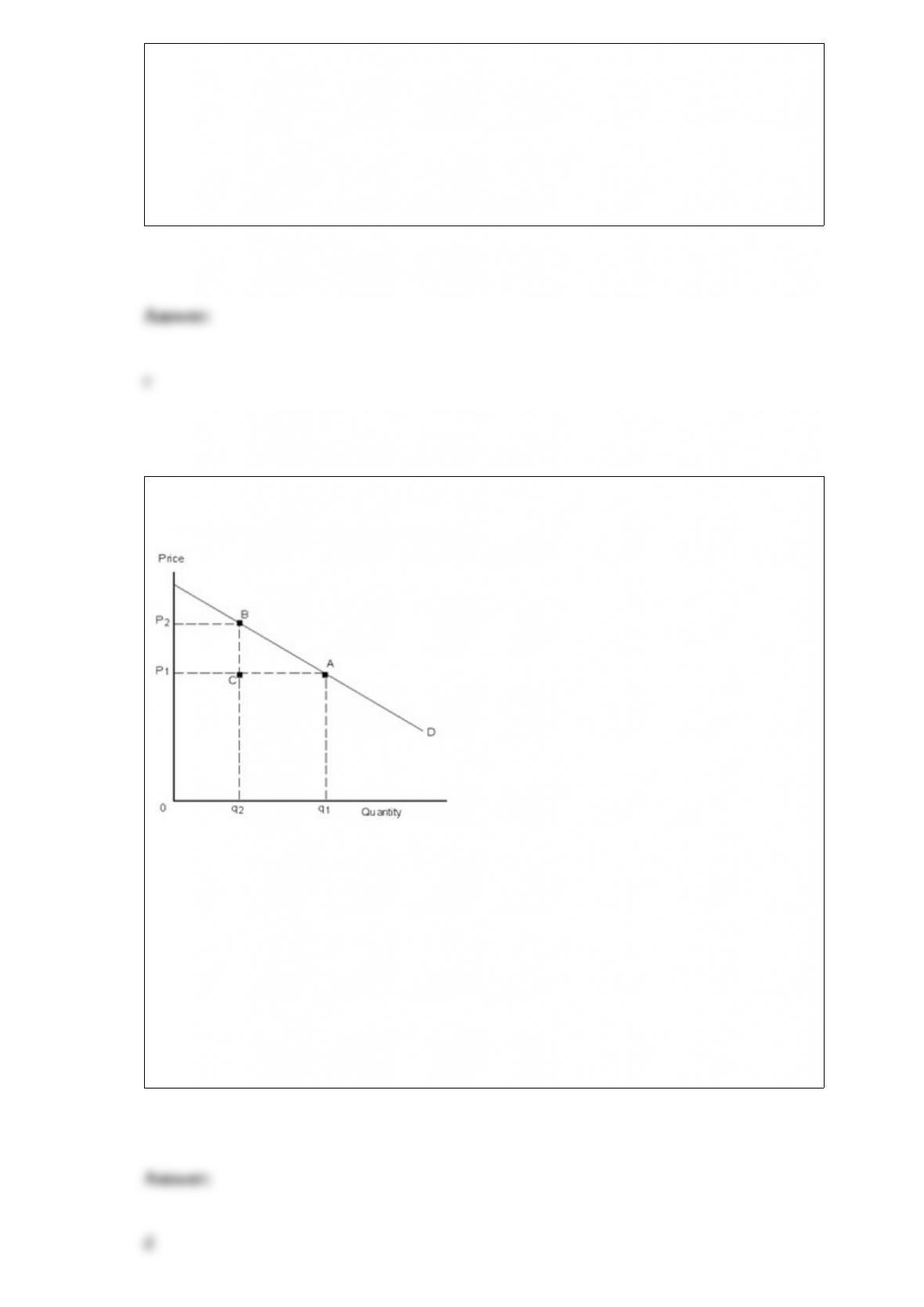
Exhibit 24-5
What area represents lost revenue when price goes from P2 to P1?
a. CBA
b. 0P1Cq2
c. q2CAq1
d. P1P2BC

If $1 is equal to 120 yen, then 1 yen is equal to approximately
a. $1.20
b. $0.94
c. $0.83
d. $0.0083
e. none of the above
Which of the following statements is true?
a. The supply curve for land is upward sloping in the short run, but is perfectly inelastic
in the long run.
b. The supply curve for land is upward sloping in the short run, but is perfectly elastic
in the long run.
c. The supply curve for land is upward sloping when considering a small portion of the
total amount of land, but is perfectly inelastic when considering the total amount.
d. The supply curve for land is upward sloping when considering the total amount of
land, but is perfectly inelastic when considering a small portion of the total amount.
A “devaluation” occurs when

a. the official price of a currency is raised.
b. the official price of a currency is lowered.
c. a nation’s currency depreciates under a flexible exchange rate system.
d. a nation’s currency appreciates under a flexible exchange rate system.
e. none of the above
If the top four firms account for $85 billion in sales and total industry sales are $250
billion, it follows that the four-firm concentration ratio is
a. 0.34.
b. 0.66.
c. 1.34.
d. 1.66.
Opportunity cost is the value of
a. the best (or most highly valued) forfeited alternative.
b. the chosen alternative.

c. a free good.
d. all forfeited alternatives.
When the ratio of income to poverty for a family is
a. greater than 1.00, the family is not considered to be living in poverty.
b. greater than zero, the family is not considered to be living in poverty.
c. between 1.00 and 1.25, the family is considered to be “near poor.”
d. a and b
e. a and c
Suppose that labor is mobile between countries A and B.If the relative demand for
goods rises in country A, then labor can flow from ______________.It may be possible
in this situation for countries A and B to __________________ which would help
to___________________.
a. country A to country B; fix the exchange rate between the two countries (or have a
common currency); eliminate the risks associated with having a flexible exchange rate.
b. country B to country A; impose trade restrictions upon one another; increase
employment in country A
c. country B to country A; fix the exchange rate between the two countries (or have a
common currency); eliminate the risks associated with having a flexible exchange rate

d. country A to country B; adopt flexible exchange rates; reduce the risk of exchange
rate fluctuations
Which of the following is false?
a. When the U.S. government imposed price ceilings on gasoline, the result was a
surplus of gasoline.
b. When the U.S. government imposed price ceilings on gasoline, the result was a
shortage of gasoline.
c. If a price ceiling is imposed below the equilibrium price in a given market, the result
is a shortage in that market.
d. First-come-first-served is a commonly used rationing device.
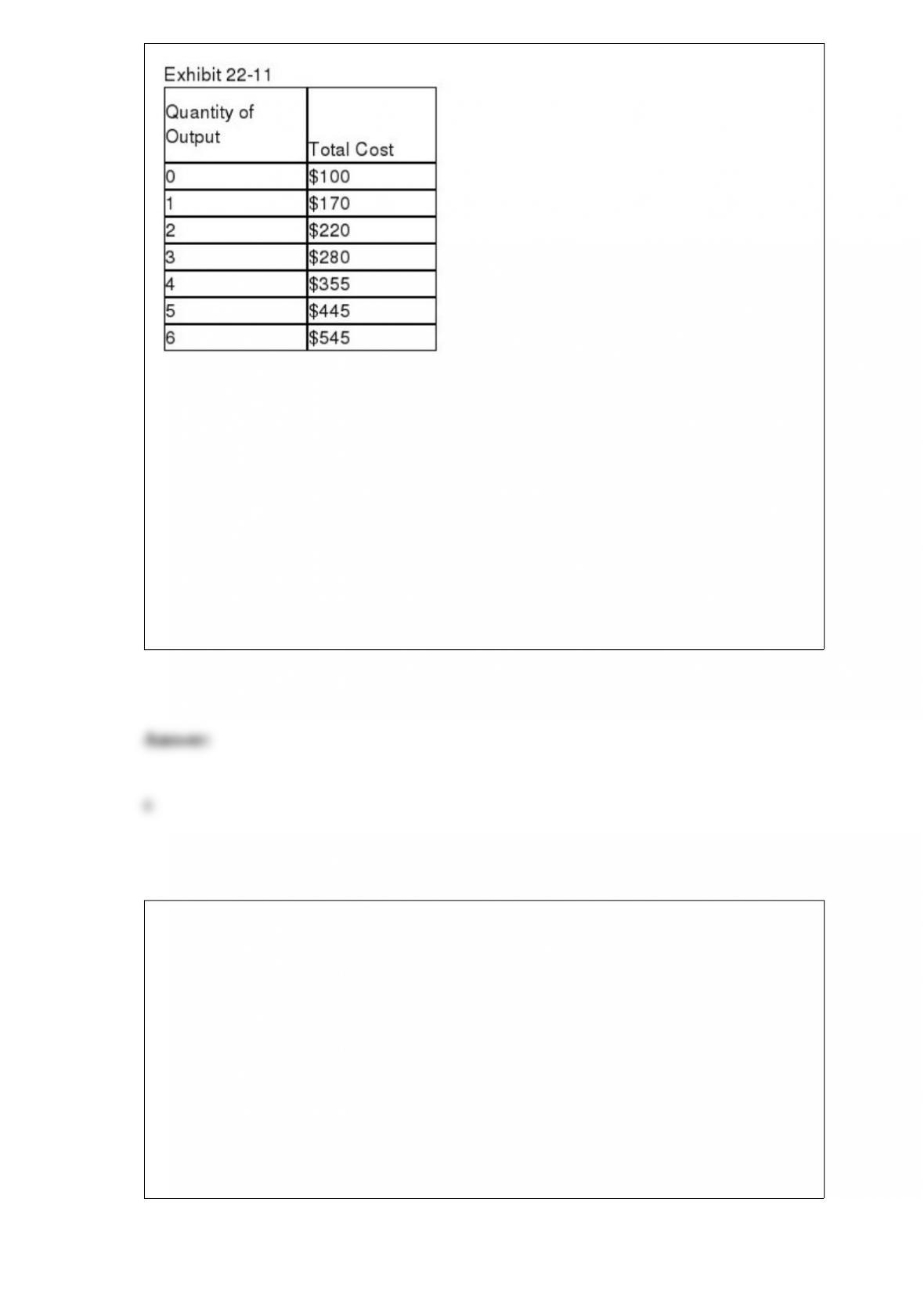
Average fixed cost at two units of output is
a. $50.
b. $60.
c. $100.
d. $110.
e. There is not enough information provided to answer this question.
Which of the following statements is false?
a. Interest would not exist in a barter (moneyless) economy because there is no money
in a barter economy.
b. The real interest rate is equal to the nominal interest rate minus the expected inflation
rate.
c. The source of monopoly profits is often high barriers to entry.
d. The nominal interest rate will equal the real interest rate only when the expected
inflation rate is zero.

Entrepreneurship is
a. the talent for organizing the use of land, labor and capital, among other things.
b. skill in influencing government regulators and legislators.
c. accumulated technical knowledge in using labor and capital.
d. knowledge of the particular natural resources to be found in a given area.