If an economy is producing on its production possibility frontier but is not producing
what people want, the economy
A) is experiencing technological advancement.
B) is producing at more than one point on the production possibility frontier.
C) is not being allocatively efficient.
D) is not being productively efficient.
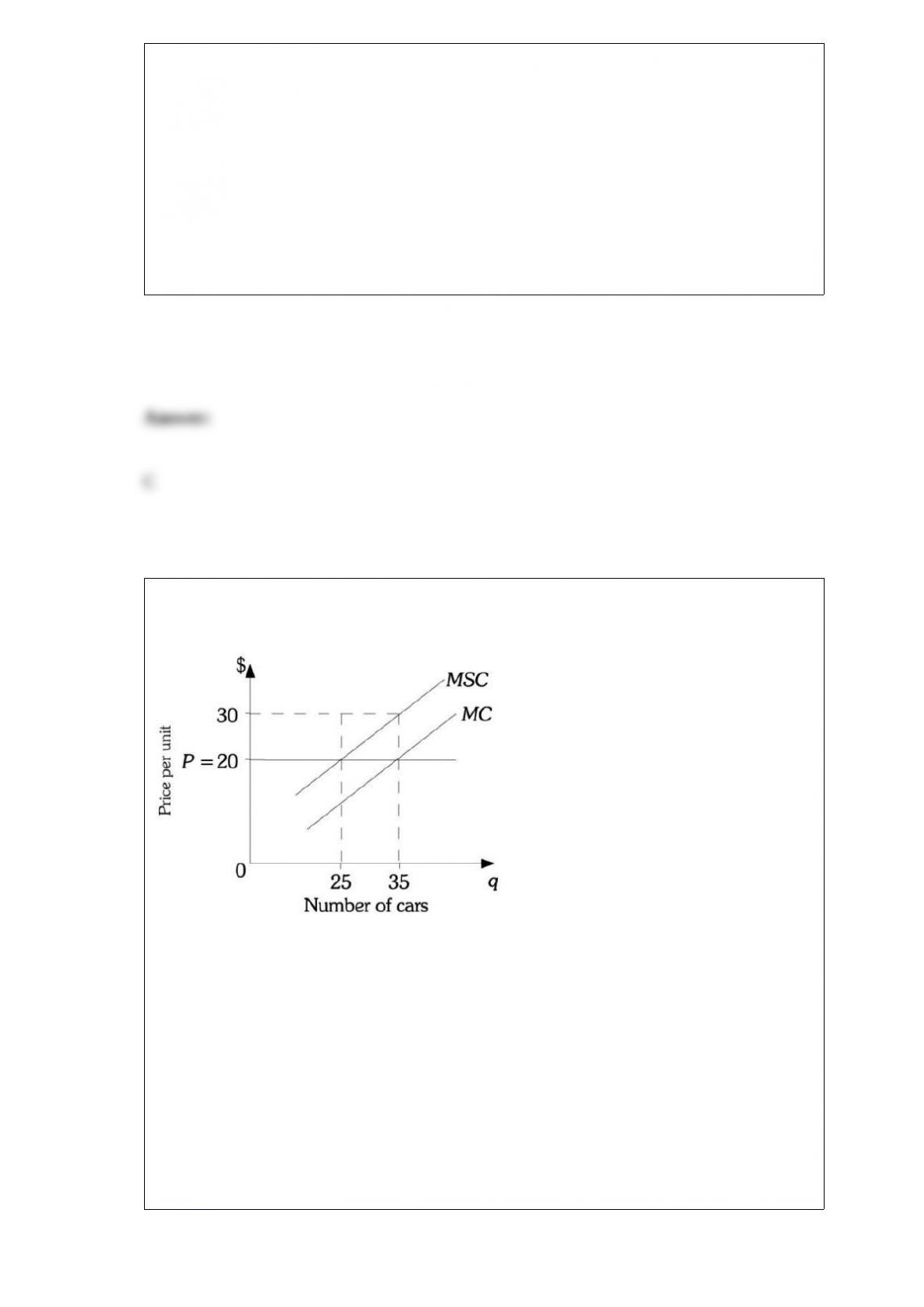
Figure 16.2
Refer to Figure 16.2. What is the total damage imposed as a result of producing the
market (unregulated) level of fertilizer?
A) $250
B) $350
C) $500
D) $700
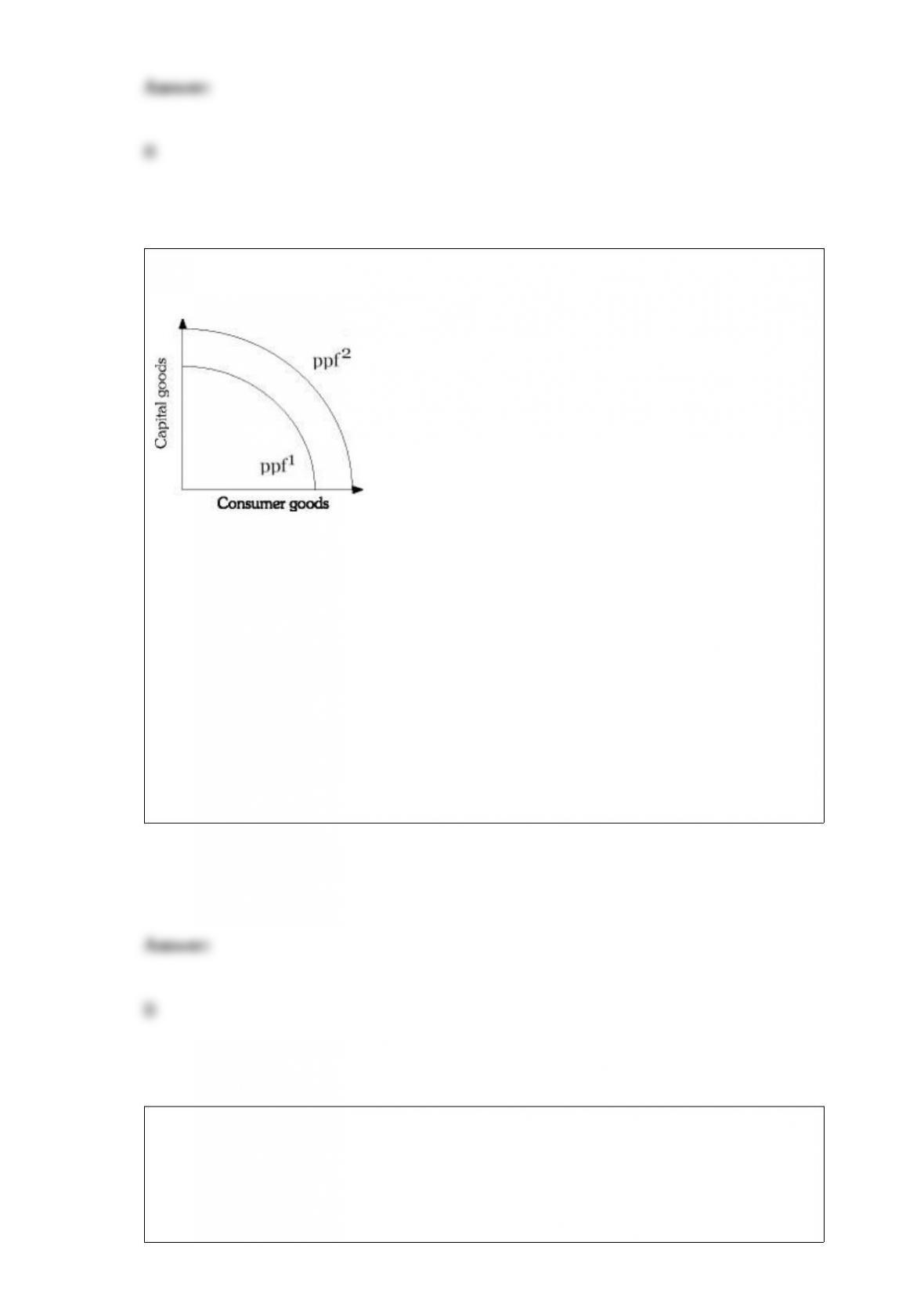
Figure 6
Refer to Figure 2.6. If the economy is at ppf1, a change in consumer preferences would be shown
by a
A) shift from ppf2 to ppf1.
B) movement along ppf1.
C) movement along ppf2.
D) shift from ppf1 to ppf2.
After subtracting all deductions and exemptions from total income, you are left with
A) taxable income.
B) marginal income.
C) standardized income.
D) the tax base.
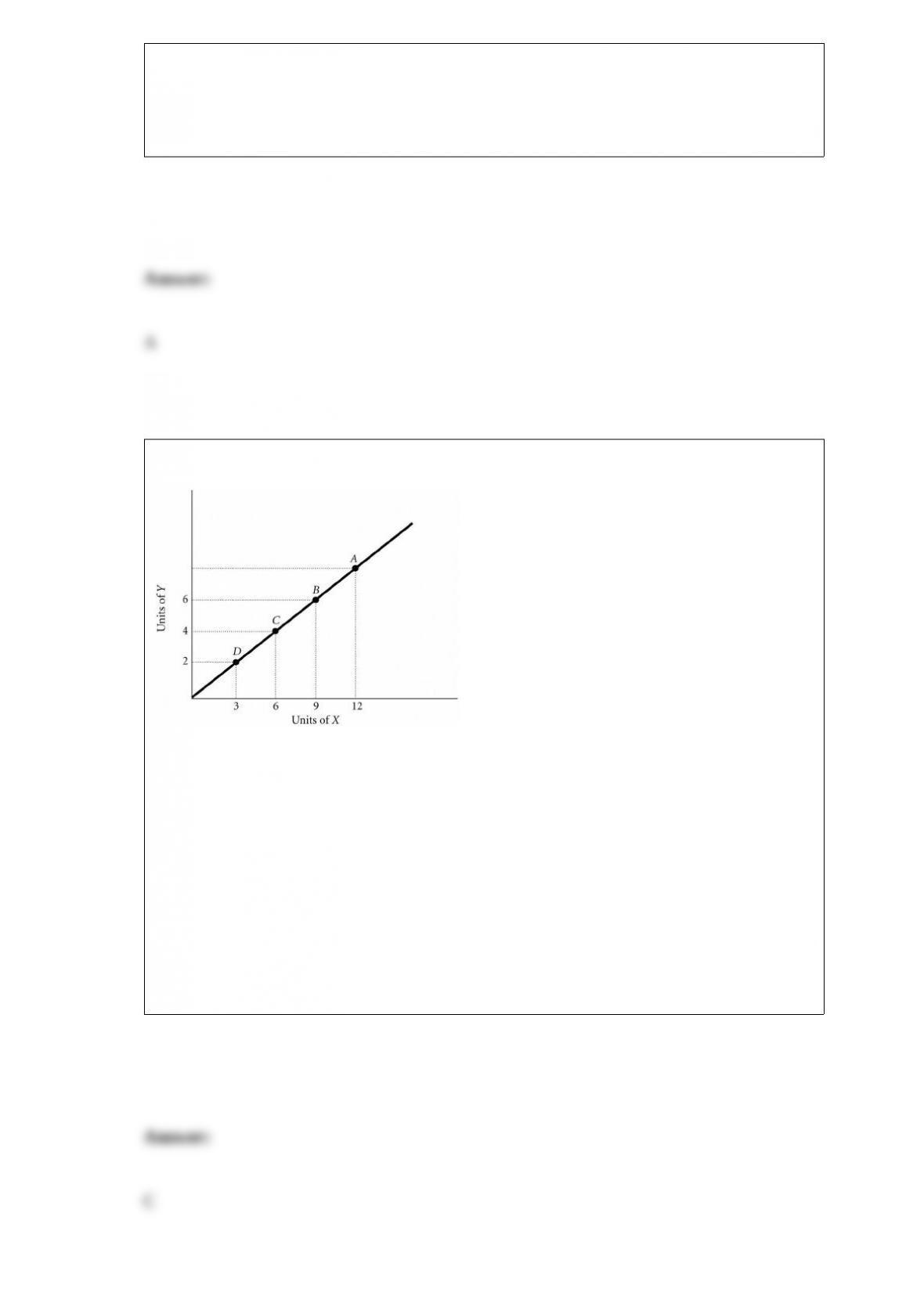
Figure 1.3
Refer to Figure 1.3. At Point A the slope of the line is 0.67, so at Point C the slope
would be
A) greater than 0.67.
B) less than 0.67.
C) equal to 0.67.
D) indeterminate from this information.
A new technology is developed for producing microwave ovens that reduces production
costs by 10%. Which of the following is the most likely consequence of this
technological change?
A) Firms will continue to operate efficiently as long as no firm adopts this new
technology.
B) Firms must adopt this new technology to remain efficient.
C) This new technology will not affect efficiency, but it will change the equilibrium
price and quantity for this industry.
D) If firms do not adopt this new technology, then the economy will remain in general
equilibrium, because firms will not change their price and output decisions.
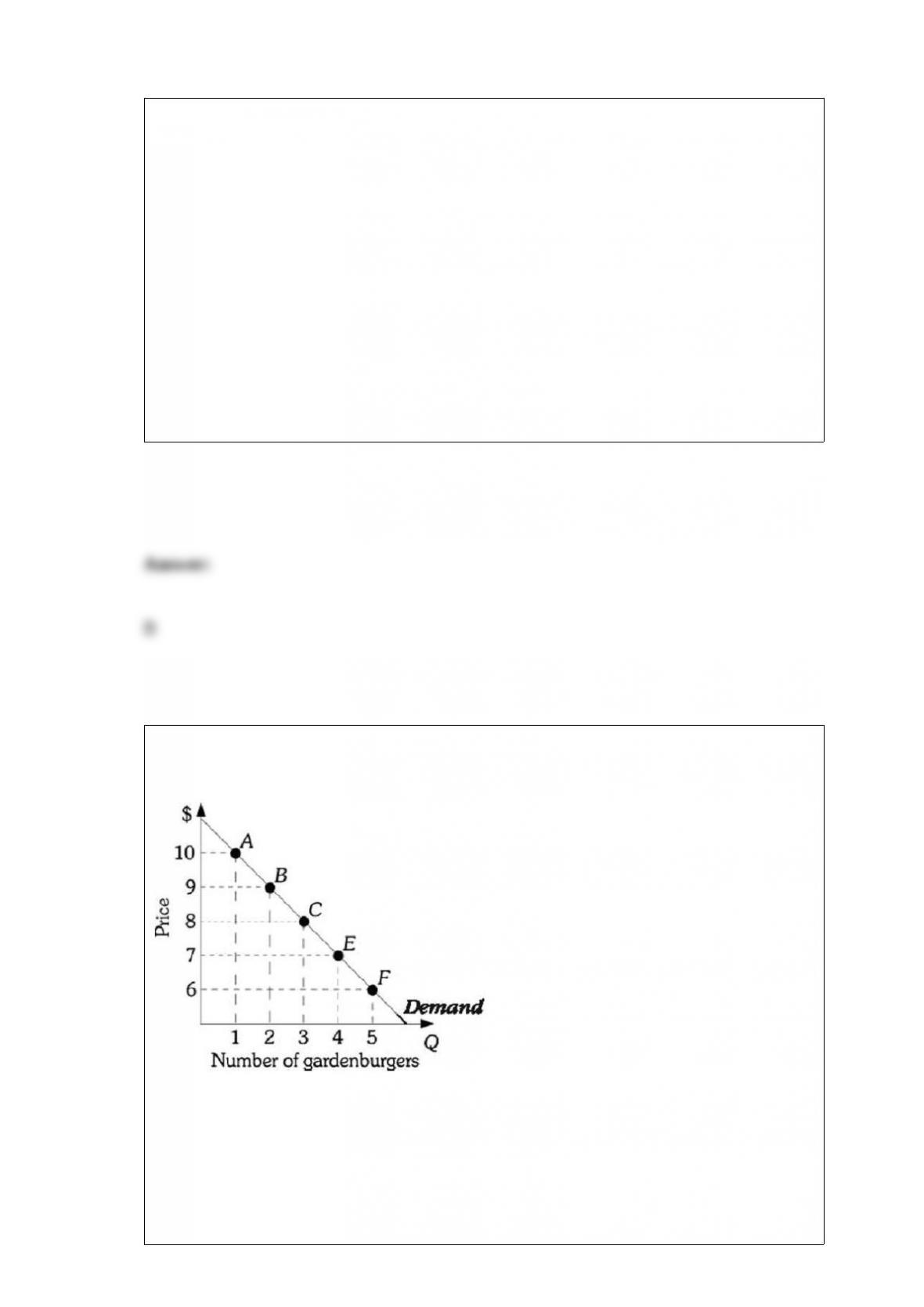
Figure 5.3
Refer to Figure 5.3. Use the midpoint formula. If the price of a gardenburger decreases
from $8 to $6, the price elasticity of demand equals ________, and demand is
________.
A) -0.57; inelastic

B) -1.75; elastic
C) -1.9; inelastic
D) -2.0; elastic
If the slope of a straight line is -3. and if Y (the variable on the vertical axis) decreases
by 6, then X (the variable on the horizontal axis) will
A) increase by 2.
B) decrease by 2.
C) increase by 18.
D) decrease by 18.
Table 9.1
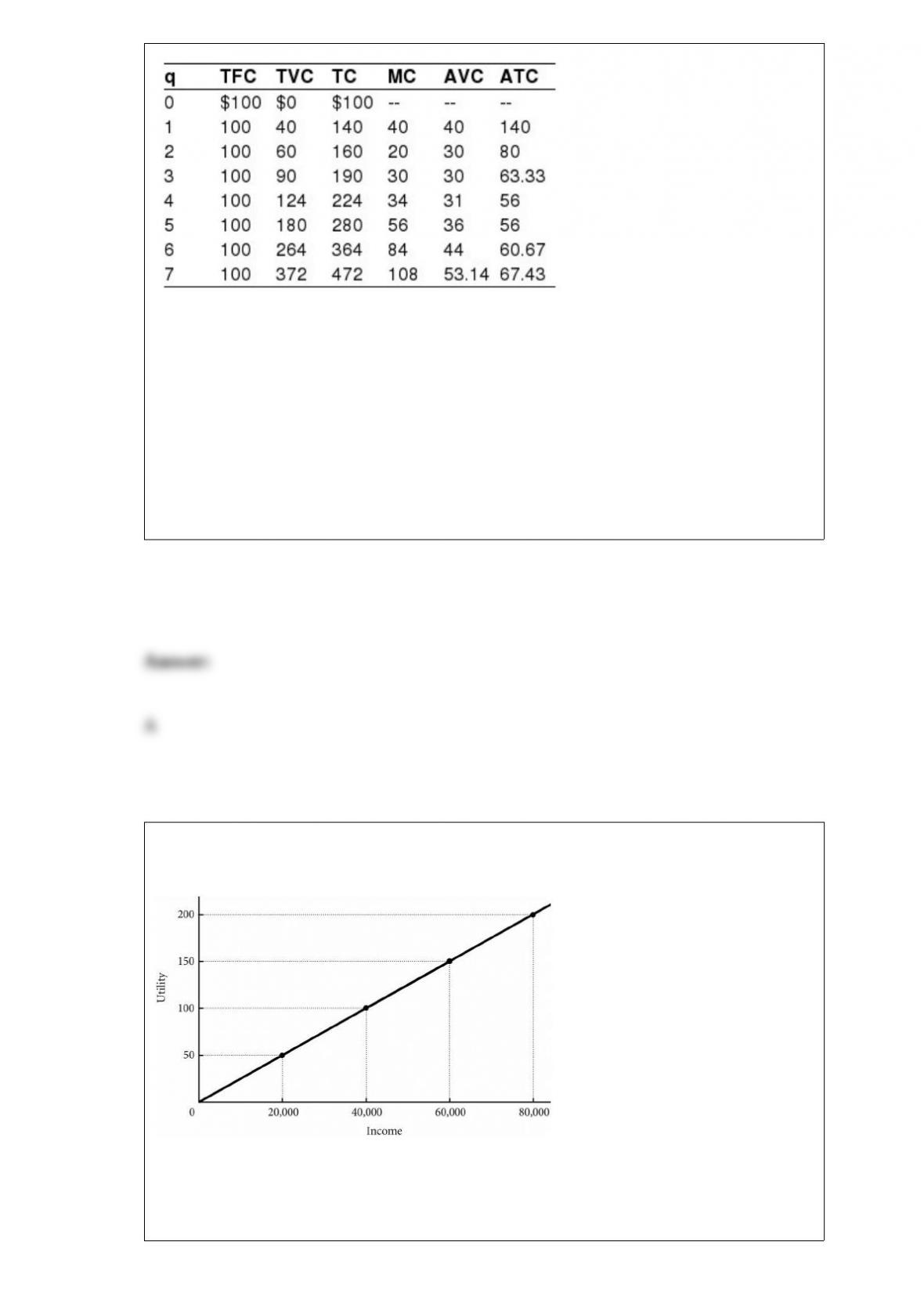
Refer to Table 9.1. If the market price is $84, then in the long run the firm will
A) operate and expand.
B) operate but not expand.
C) shut down, but not go out of business.
D) go out of business.
Figure 17.2
Refer to Figure 17.2. Sam has two job offers when he graduates from college. Sam
views the offers as identical, except for the salary terms. The first offer is at a fixed
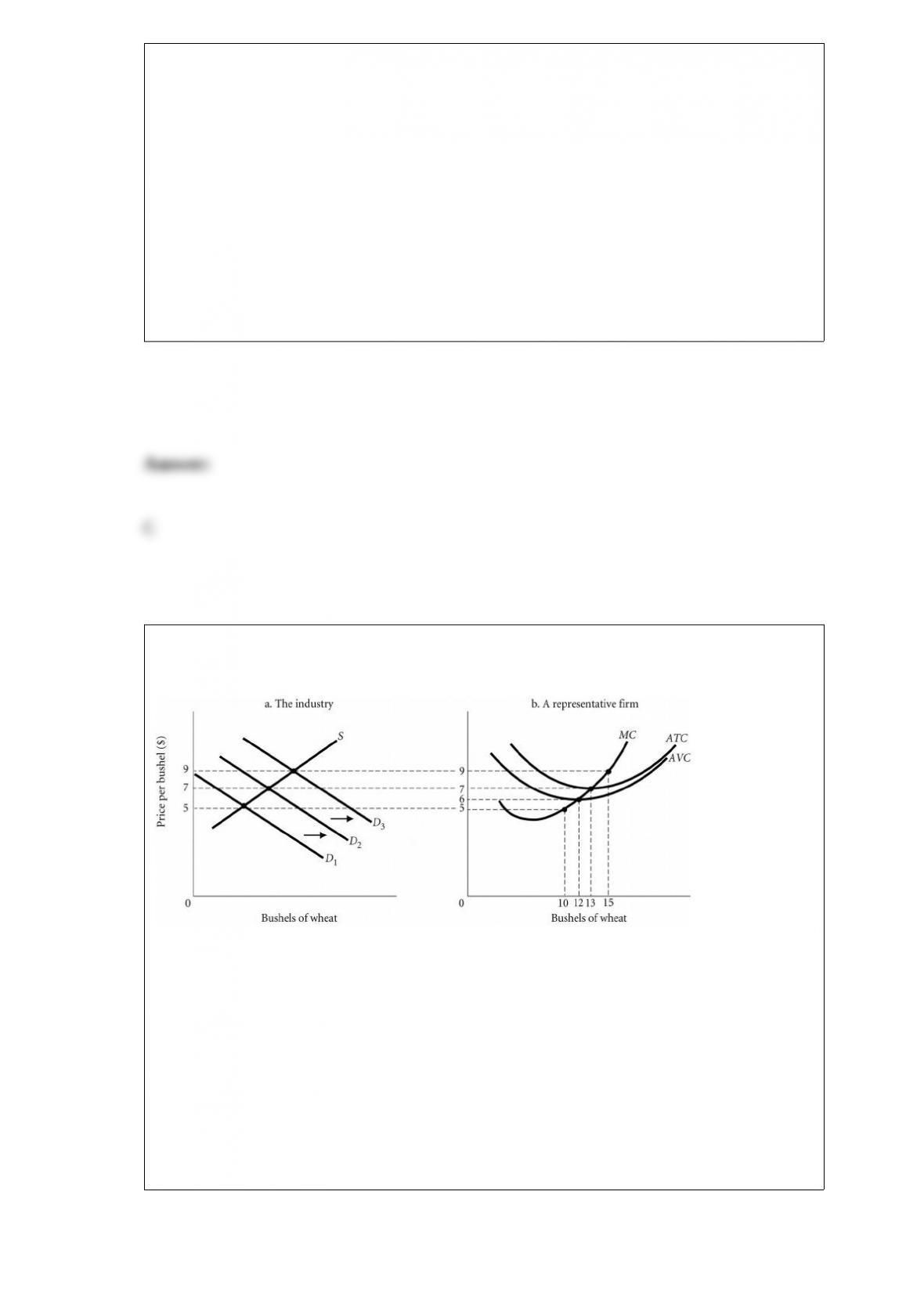
annual salary of $60,000. The second offer is at a fixed salary of $30,000 plus a
possible bonus of $60,000. Sam believes that he has a 50-50 chance of earning the
bonus. If Sam takes the offer that maximizes his expected utility and is risk neutral,
which job offer will he choose?
A) Sam will take the first offer.
B) Sam will take the second offer.
C) Sam is indifferent between the offersboth yield the same expected utility.
D) Indeterminate from the given information.
Figure 9.7
Refer to Figure 9.7. In the $6-$7 price range, the firm will
A) shut down.
B) continue to operate but at a loss.
C) break even.
D) earn a profit.

Investors put up $520,000 to construct a building and purchase all equipment for a new
restaurant. The investors expect to earn a minimum return of 10 per cent on their
investment. The restaurant is open 52 weeks per year and serves 900 meals per week.
The fixed costs are spread over the 52 weeks (i.e. prorated weekly). Included in the
fixed costs is the 10% return to the investors and $1,000 per week in other fixed costs.
Variable costs include $1,000 in weekly wages and $600 per week for materials,
electricity, etc. The restaurant charges $5 on average per meal.
Economic profit per week is
A) $400.
B) $0.
C) $600.
D) $900.
You value your economics textbook at $10. Someone else values it at $25, and that
person is willing to pay you $20 for your textbook. Would selling your textbook to this
person for $20 be Pareto efficient?
A) No, because you did not receive the maximum amount the other person would have
been willing to pay for the textbook.
B) No, the person paid you $20 for the book so his net benefit was only $5, whereas
your net benefit was $10. For this change to be Pareto efficient, each of you should
have the same net benefit.
C) Yes, because both of you are better off as a result of the trade.
D) Yes, because even though you gain from the trade and he loses, there is the potential
for you to compensate him for his loss.
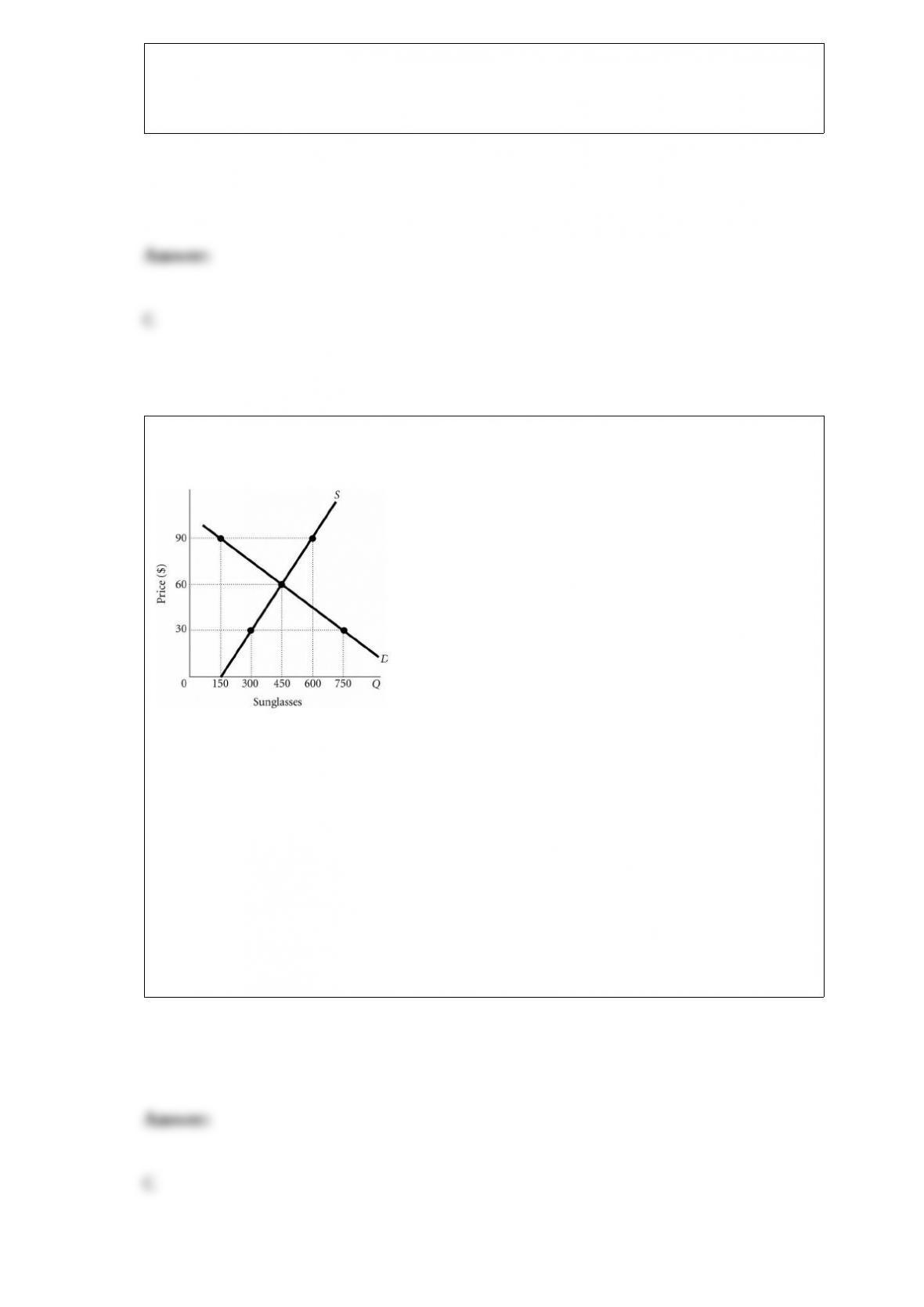
Figure 3.17
Refer to Figure 3.17. The market for sunglasses ________ at a price of $60 and a
quantity of 450 sunglasses.
A) has a surplus
B) has a shortage
C) is in equilibrium
D) cannot remain in business

Figure 20.1
Refer to Figure 20.1. Which of the following statements is true?
A) The United States has both an absolute advantage and a comparative advantage in
the production of soybeans and alfalfa.
B) The United States has an absolute advantage in the production of soybeans and
alfalfa, but a comparative advantage only in the production of soybeans.
C) The United States has an absolute advantage in the production of soybeans and
alfalfa, but a comparative advantage only in the production of alfalfa.
D) The United States has a comparative advantage in the production of both soybeans
and alfalfa, but an absolute advantage only in the production of soybeans.
Because resources are scarce, the opportunity cost of investment in capital is
A) past investment.
B) past consumption.
C) foregone present consumption.
D) future consumption.

Tom borrowed $40,000 from his parents to open a donut stand. He agrees to pay his
parents a 5% yearly return on the money they lent him. His other yearly fixed costs
equal $10,000. His variable costs equal $25,000. He sold 40,000 dozen donuts during
the year at a price of $2.00 per dozen.
Tom’s total revenue was
A) $30,000.
B) $40,000.
C) $45,000.
D) $80,000.
Figure 7.5
Refer to Figure 7.5. Diminishing marginal returns set in after the ________ worker is

hired.
A) first
B) fifth
C) eighth
D) sixteenth
Related to the Economics in Practice on page 722: By 2001, the majority of the fishing
fleet in the Indian state of Kerala had mobile phones. As a result of the introduction of
mobile phone service to this fishing industry, ________ increased and ________
decreased.
A) profits; consumer prices
B) consumer prices; productivity
C) consumer prices; competition
D) competition; profits
A firm should continue investing
A) even if the MRPK is equal to the price of capital.

B) only as long as the MRPK is less than the price of capital.
C) up to the point where the MRPK equals the price of capital.
D) only as long as the price of capital is greater than the interest rate.
Assume that Creative Ceramics can vary both capital and labor. An increase in the
amount of capital will
A) have no impact on the productivity of labor.
B) cause the firm to move down along the marginal revenue product of labor curve and
hire more labor.
C) cause the marginal revenue product of labor curve to be more inelastic.
D) shift the marginal revenue product of labor curve out to the right.
The idea that a voting scheme cannot be devised that respects individual preferences
and gives consistent, nonarbitrary results is known as
A) the impossibility theorem.
B) the independence of irrelevant alternatives.
C) logrolling.

D) Samuelson’s theory.
A farmer producing bushels of soybeans in the perfectly competitive soybean industry
is currently maximizing profits. If the market price of soybeans increases and the
farmer adjusts output to the new price, he will produce ________ soybeans and make
________ profit.
A) fewer; the same
B) fewer; less
C) more; more
D) the same bushels of; the same
The ________ principle of taxation is not often used because it is difficult to determine
the values individual taxpayers place on goods and services that are produced using tax
revenue.
A) vertical equity
B) ability-to-pay
C) benefits-received
D) horizontal equity

According to the output effect of a factor price increase, the demand for
A) the factor whose price has increased will decrease, but the demand for the other
factors will increase.
B) all factors decreases.
C) all factors increases.
D) the factor whose price has increased will increase, but the demand for the other
factors will decrease.
Compared to developing countries, developed countries tend to have ________
productivity in the agricultural sector.
A) higher
B) lower
C) equal
D) no

Assume that the price overestimates the value that society places on the flu vaccine. If
firms produce where P = MC, firms will be producing ________ the socially efficient
amount of flu vaccine.
A) exactly
B) more than
C) less than
D) sometimes more than and sometimes less than
________ income is the amount of money a household can spend during a given time
period ________ increasing or decreasing its net worth.
A) Economic; without
B) Property; while
C) Disposable; without
D) Net; while
Which assumption leads to an efficient allocation of resources among firms?
A) Factor markets are open and competitive.
B) All firms pay different prices for identical inputs.
C) Firms behave so as to minimize their profits.
D) All of the above are correct.
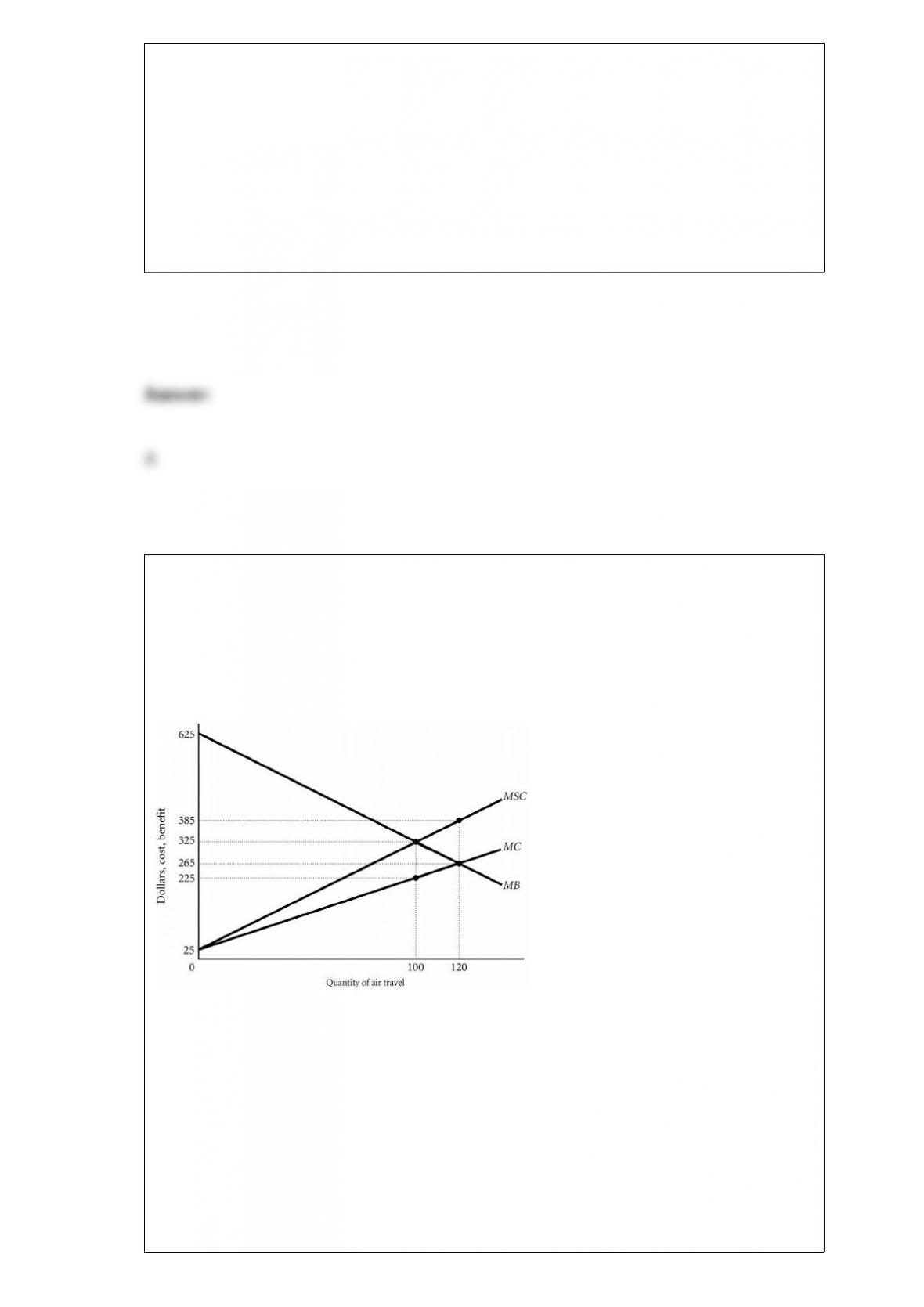
San Francisco International Airport (SFO) is located adjacent to the community of San
Bruno. The noise from air traffic negatively affects individuals living in San Bruno,
however, this cost is not considered by airlines or air travelers. The airlines feel they
have a right to use the airspace while the individuals living in San Bruno feel they have
the right to quiet. The following diagram depicts the marginal costs and marginal
benefits associated with air travel.
Figure 16.5
Refer to Figure 16.5. Suppose the government assigns property rights to ________. No
negotiations occur between the parties. The resulting level of air travel is 0 units.
A) the airlines
B) both the airlines and the residents of San Bruno in a 50-50 split
C) the residents of San Bruno

D) indeterminate from the given information.
The erroneous belief that what is true for a part is necessarily true for the whole is
referred to as the
A) fallacy of composition.
B) post hoc, ergo propter hoc fallacy.
C) ceteris paribus fallacy.
D) fallacy of inductive reasoning.
Table 2.1
Refer to Table 2.1. For Molly, the opportunity cost of designing one tattoo is
A) 1/2 of an avatar design.
B) 1 avatar design.

C) 2 avatar designs.
D) 3 avatar designs.
Perfectly competitive firms
A) sell homogeneous products.
B) are price takers.
C) are small relative to the size of the market.
D) All of the above are correct.
If the supply of labor increases, which of the following events will occur?
A) The wage rate will fall and firms will increase employment up until the point where
MRP equals the new wage rate.
B) The wage rate will fall and firms will decrease employment to the point where MRP
equals the new wage rate.
C) The wage rate will increase and firms will decrease employment to the point where
MRP equals the new wage rate.
D) The wage rate will increase and firms will increase employment up until the point
where MRP equals the new wage rate.

In the short run, as output increases,
A) the difference between average total cost and average variable cost decreases.
B) the difference between total cost and average variable cost decreases.
C) marginal cost eventually decreases.
D) All of the above are correct.
Events prior to the 1995 baseball season, including a threatened “lockout” by owners if
the players decided to end their strike, likely had a great effect on attendance at baseball
games. Consider in this scenario market attendance as a measure of quantity and ticket
prices as the measure of price.
Draw the supply and demand curves and explain why
they have the slope they do.

What is the most common measure of a firm’s capital stock, and why is it not the most
important to focus on?
Explain why it might be necessary in some circumstances for firms to pay workers
wages that are higher than the legislated minimum wage even for jobs requiring low
skills.

What is meant by capital stock?
What does the productivity of an input measure?
Define the short-run industry supply curve. Explain the two factors that can cause the
short-run industry supply curve to shift to the right.

What problems does a command economy face when it tries to determine what to
produce for the economy?
Short selling is the practice of borrowing stock then selling it with the expectation that
its price will fall further so that it can be repurchased and the stock returned to the
lender. The difference in the price sold initially and the price that it was subsequently
purchased represents profits for short sellers. Discuss the risks taken by such
individuals. What kind of risk profile do short sellers exhibit.
What is a natural monopoly?

Assume two firms have the same total costs of production. Firm A’s average variable
cost if $5 per unit and firm B’s average variable cost is $7. Both firms have an average
total cost of $8. If the current market price is $6 and remains unchanged what action
will both firms take in the short run and the long run?
Show graphically (in two separate graphs) the effects of an increase in the price of
peanut butter on the demand for peanut butter and on the demand for jelly.

Assume that yields on bonds (rate of return) begin to fall while the stock market is
booming, what should we see happen to the demand and price of stocks and why? What
can we say about the opportunity cost of holding on to bonds in this situation?
If most workers are risk adverse why do we still see many workers agreeing to contracts
where their compensation is variable like commissions for magazine salesmen or car
salesmen?
Explain how and why an all-volunteer army may actually be cheaper than an army
staffed with drafted soldiers.

Evaluate the following statement. “As the marginal product function falls it will
eventually cut the average product function where average product is rising.”
When economists refer to the “brain drain” in developing countries what do they mean?
Critically evaluate the following statement made in favor of the sub-prime loan bailout
of mortgage companies who made high interest rate loans to marginal credit-worthy
customers. “The government should do everything within its powers to prop up ailing
lenders and homeowners, just as they’ve done in the past with other troubled industries,
from airlines to savings and loans”
What is Rawlsian justice?