
Which of the following is true of debt financing?
a. Elected political officials will find debt financing attractive because it allows them to
provide voters with visible current benefits while pushing the more visible costs into the
future.
b. Debt financing is unattractive to elected political officials because voters recognize
that excessive debt will lead to the future collapse of the economy.
c. Debt financing is attractive to elected political officials because countries with a
higher debt to GDP ratio generally grow more rapidly.
d. Elected political officials will be reluctant to run budget deficits because they
recognize that taxes will have to be raised in the future to pay the interest on the larger
amount of outstanding debt.
Under the Term Auction Facility (TAF), the rate that a depository institution pays on a
loan from the Fed is determined by
a. the federal funds rate.
b. the discount rate.
c. the real rate of interest.
d. a bidding process allocating the funds to those willing to pay the highest rates.

The short-run aggregate supply curve shows the relationship between
a. the general level of prices and the quantity of goods and services purchased by all
consumers in the economy.
b. the general level of prices and the quantity of goods and services that domestic firms
will supply.
c. the interest rate and the quantity of goods and services that domestic firms will
supply.
d. the money supply and the quantity of goods and services that domestic firms will
supply.
Which of the following was true with regard to the Great Depression?
a. The policies of the New Deal brought the Great Depression to an end well before
World War II.
b. Sound economic policy was followed during this era, which makes the length and
severity of the Great Depression puzzling to economists.
c. The length and severity of the Great Depression was the result of unsound economic
policies followed by both the Hoover and Roosevelt Administrations.
d. The Great Depression was largely the result of the highly expansionary monetary
policy of the Fed during the 1930s.
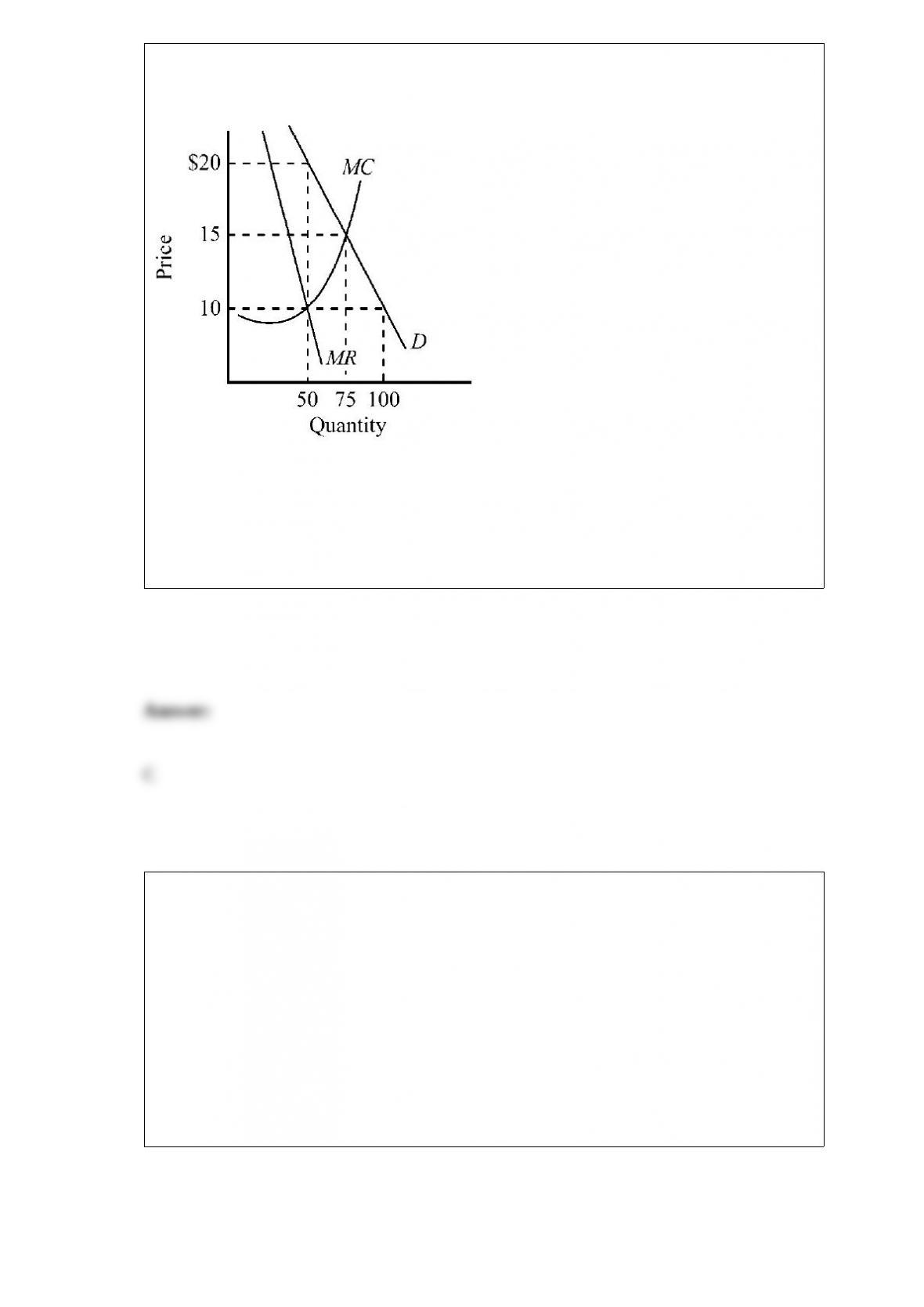
Use the figure to answer the following question(s).
Figure 11-8
The demand and cost conditions in an industry are as depicted in Figure 11-8. In the
viewpoint of economic efficiency, what would the ideal price and output be?
a. price, $10; quantity produced, 100
b. price, $15; quantity produced, 50
c. price, $15; quantity produced, 75
d. price, $20; quantity produced, 50
If national income accountants fail to make an adequate adjustment for increases in the
quality of goods and services over time,
a. real GDP will overstate the growth rate of real output.
b. the GDP deflator will underestimate inflation.
c. the GDP deflator will overestimate inflation.
d. real GDP will overstate the growth of real output, and the GDP deflator will
understate inflation.

A price-discriminating firm charges the lowest price to the group that
a. has the most elastic demand.
b. purchases the largest quantity.
c. engages in the most arbitrage.
d. is least responsive to price changes.
The General Theory of John Maynard Keynes exerted a major impact on
macroeconomics during the 20th century primarily because
a. it provided the only logically consistent view of what caused the Great Depression.
b. it provided a reasonable explanation of what went wrong during the Great
Depression and what could be done to prevent it from happening again.
c. it explained how gross domestic product could be measured and why this was
important.
d. it derived the conditions necessary for maximum efficiency of resource use and
explained how these conditions could be achieved through central planning.
As new firms enter a competitive price-searcher market, it can be expected that
a. market price will increase.
b. the output of existing firms will increase.
c. profits of existing firms will increase.
d. market demand should decrease.
e. profits of existing firms will decrease
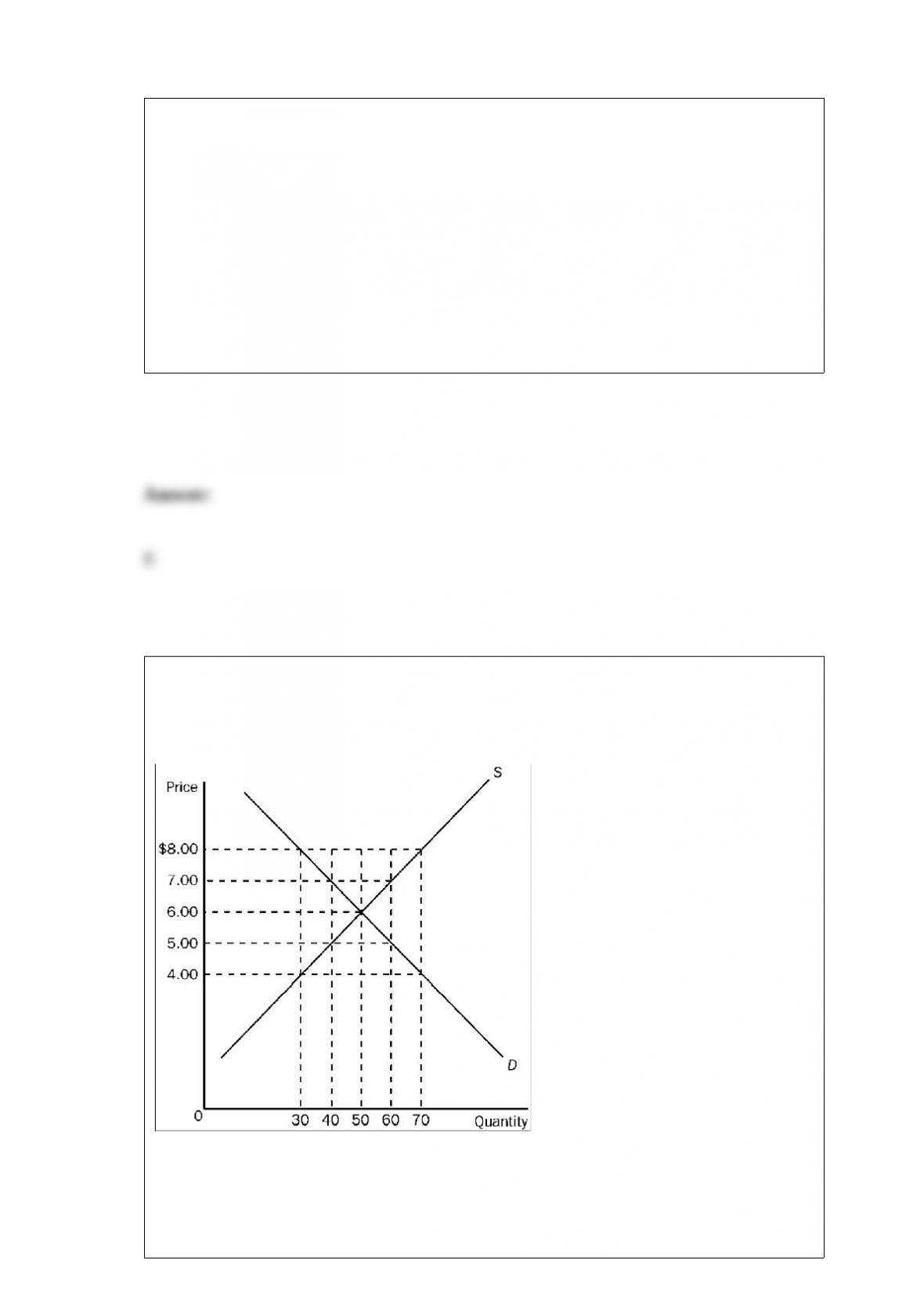
Figure 4-17
Refer to Figure 4-17. Suppose a price floor of $7.00 is imposed. As a result,
a. buyers’ total expenditure on the good decreases by $20.00.
b. the supply curve will shift to the left so as to now pass through the point (Q = 40, P =
$7.00).
c. the quantity of the good demanded decreases by 20 units.

d. the price of the good continues to serve as the rationing mechanism.
Which of the following is true of regulation?
a. Regulatory agencies often ignore the secondary effects of their actions and fail to
foresee future problems.
b. Policy-makers are hesitant to call for new regulations even when it is clear they
would help avert future crises.
c. Mortgage lending and banking have historically been unregulated and therefore
regulation in these sectors will be unpopular.
d. Past regulations have been effective at averting crises, but they are unpopular
because they reduce the profitability of the regulated industry.
Use the figure below to answer the following question(s).
Figure 9-2
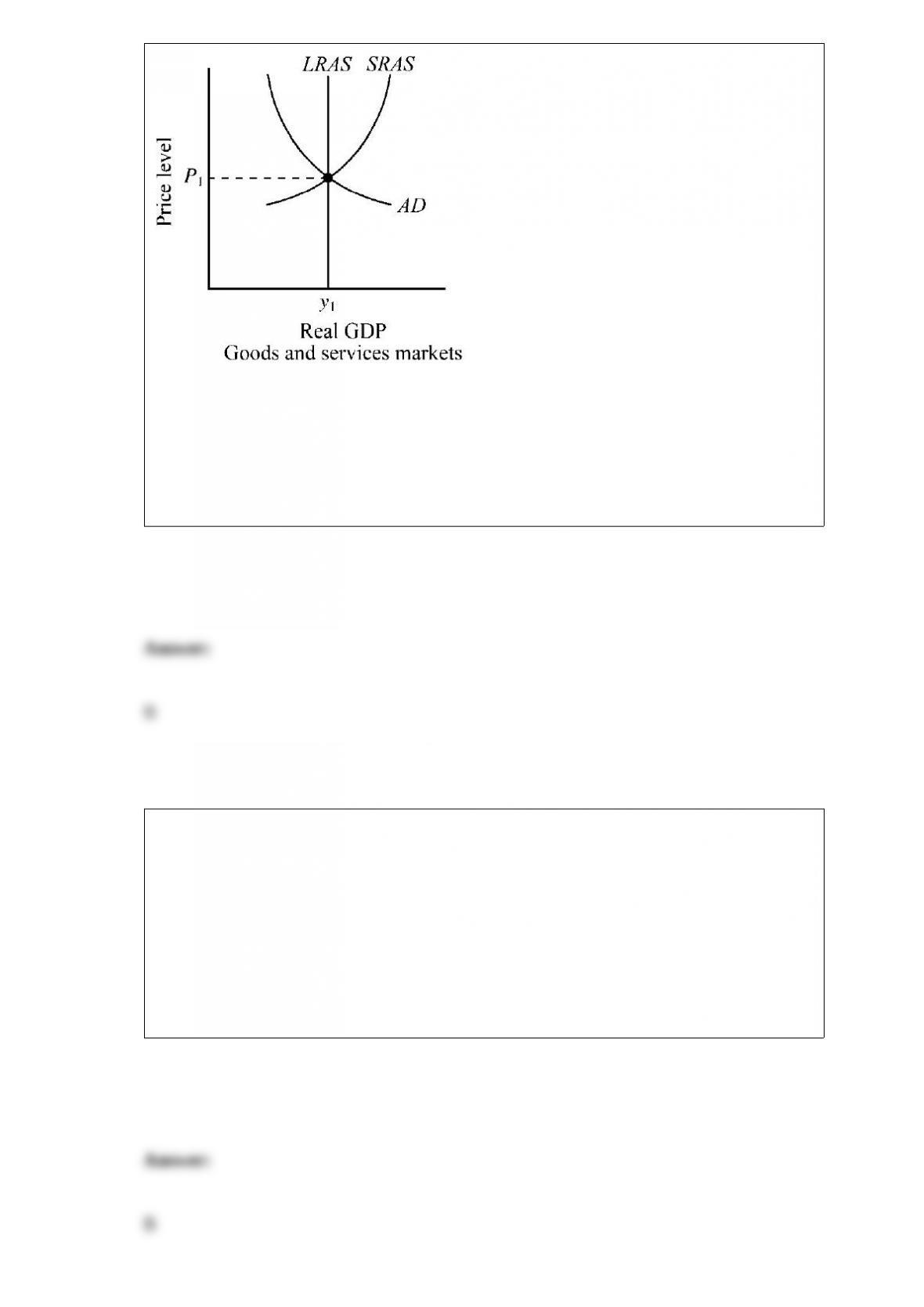
When an economy is experiencing the aggregate demand and supply conditions
depicted in Figure 9-2,
a. the actual rate of unemployment will exceed the natural rate of unemployment.
b. buyers and sellers will have correctly anticipated the level of prices P1.
c. the output y1 will not be sustainable in the future.
d. all of the above are correct.
An opinion based on personal preferences and value judgments is called
a. an objective concept.
b. a subjective concept.
c. an unintended consequence.
d. ceteris paribus.
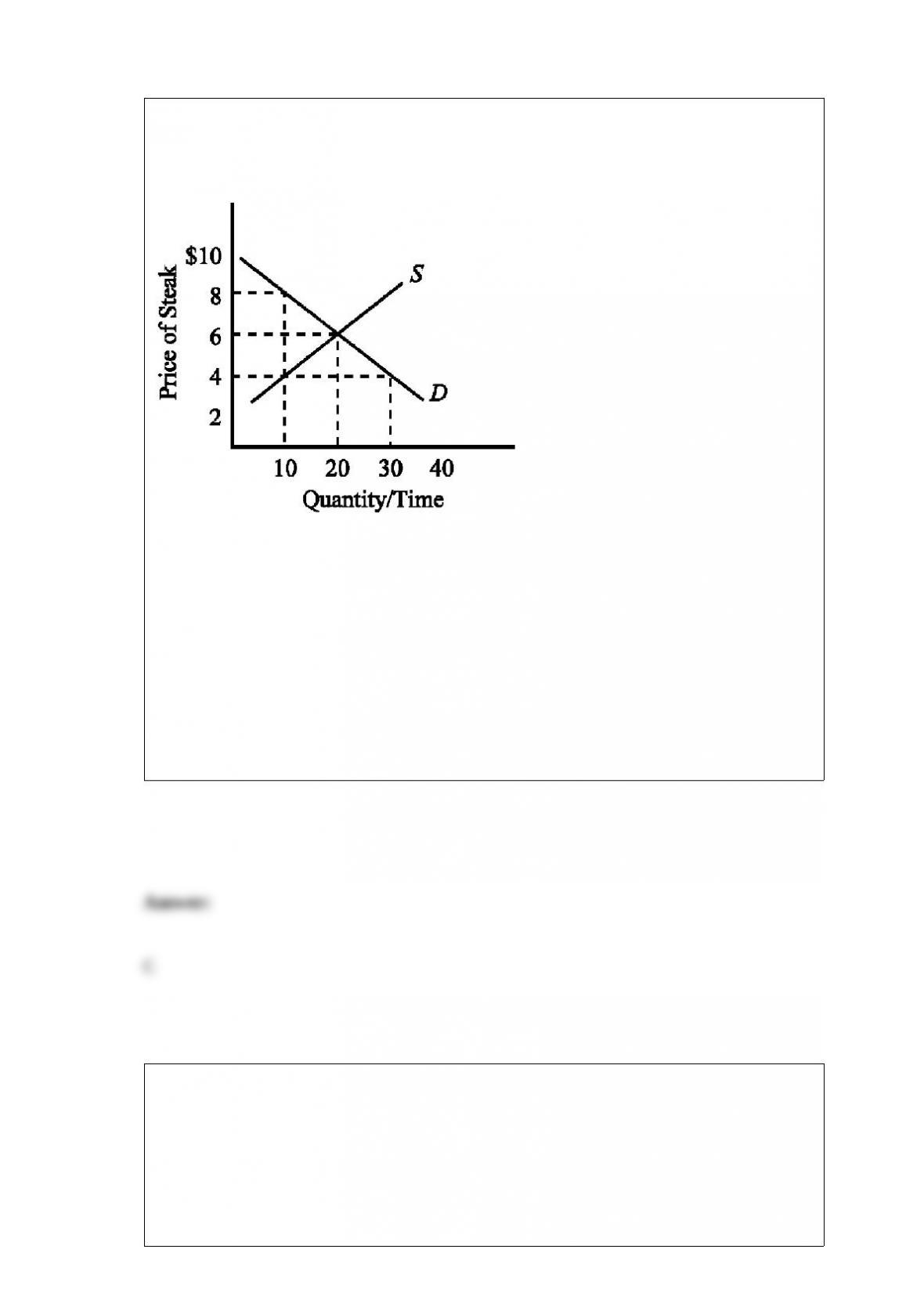
Figure 3-2
Given the supply and demand conditions illustrated in Figure 3-2, the equilibrium price
of steak is
a. $2 per pound.
b. $4 per pound.
c. $6 per pound.
d. $8 per pound.
Government spending programs that create jobs are often popular because
a. the created jobs are highly visible, while the secondary effects of lost jobs in other
areas, higher interest rates, and higher future taxes are less visible.
b. if a spending program is approved by Congress, it means that the value of what is
produced is greater than the value of the resources used to produce it.

c. the benefits of job creation are always greater than the costs. Jobs are the key to
economic progress.
d. when spending programs are funded by the government there are no secondary
effects.
Which of the following is true of government activities under a system of representative
democracy?
a. If a majority favors an activity, it must be productive.
b. If a majority opposes an activity, it must be counterproductive.
c. When voters pay in proportion to benefits received, productive activities undertaken
by the government will be favored by an overwhelming majority of voters.
d. When voters pay in proportion to benefits received, productive activities will
generally be defeated under a majority rule vote.
Under a pure flexible exchange rate system, the rate that equates demand and supply in
the exchange rate market will also lead to a balance of
a. merchandise exports and merchandise imports.
b. current account transactions.

c. capital account transactions.
d. current and capital account transactions.
If Asian economies suffer a serious economic slump, U.S. net exports will
a. increase and AD will shift rightward.
b. increase and AD will shift leftward.
c. decrease and AD will shift leftward.
d. decrease and AD will shift rightward.
Continuous rapid growth of the money supply relative to the growth of real output will
most likely lead to
a. persistent inflation.
b. low nominal interest rates.
c. high rates of real economic growth.
d. low unemployment.

What are the major sources of economic profit?
a. certainty, monopolistic competition, and inelastic supply.
b. competition, perfect information, and elasticity of market demand.
c. barriers to entry, uncertainty, and entrepreneurial alertness.
d. externalities, inflation, and size of firm.
Other things the same, the wages in an occupation are likely to be higher the more
a. dangerous the job.
b. prestigious the work environment of the occupation.
c. desirable the location of the job.
d. pleasant the working conditions.

Suppose the demand for nachos increases. What will happen to producer surplus in the
market for nachos?
a. It increases.
b. It decreases.
c. It remains unchanged.
d. It may increase, decrease, or remain unchanged.
Which of the following is a correct statement about the labor market?
a. Workers determine the supply of labor, and firms determine the demand for labor.
b. Workers determine the demand for labor, and firms determine the supply of labor.
c. Workers determine the supply of labor, and government determines the demand for
labor.
d. The forces of supply and demand, while present in the labor market, have nothing to
balance in that market.
Special-interest legislation is characterized by
a. concentrated costs and concentrated benefits
b. concentrated benefits and widespread costs
c. widespread benefits and widespread costs

d. widespread benefits and concentrated costs
e. zero costs
The persistence of budget deficits during the last several decades is not surprising
because politicians will find
a. budget surpluses more attractive than budget deficits.
b. tax increases more attractive than increases in government expenditures.
c. budget deficits more attractive than budget surpluses.
d. reductions in government expenditures more attractive than tax reductions.
Which of the following will make it more difficult for the United States to control the
growth of the federal debt in the decade ahead?
a. Debt financing makes it possible for elected political officials to provide voters with
highly visible current benefits without having to impose visible current cost in the form
of higher taxes.
b. The movement of the large baby-boom generation into the retirement phase of life
will make it more difficult to control federal spending.
c. The recent growth of the federal debt as a share of GDP will mean higher interest
costs in the future.

d. All of the above.
When members of an oligopolistic industry agree to collude, raising their product price
substantially above average cost, the passage of time (months and years)
a. is usually needed for the members to solidify their cooperation.
b. usually results in finer control of prices and markets by the group and larger profit
margins.
c. is likely to erode the agreement, as ways to cheat are developed by some participants
and new entry is encouraged by the high price.
d. seldom has any impact on the agreement, as long as the participants maintain high
profit levels as a result of the agreement.
According to the principle of marginal productivity, if
a. the product price is less than marginal revenue product (MRP), the firm is using too
little of the input.
b. the price of an input rises, the quantity demanded of the input will increase.
c. MRP is greater than product price, the firm should reduce the use of the input.
d. price of the input equals MRP, the firm is maximizing profit.

Buying shares of corporate stock tends to be more risky when
a. the stock of a single corporation is purchased.
b. the stock may have to be sold within a few months.
c. all stocks bought are in the same industry.
d. all of the above are true.
Which of the following attributes of fiscal policy will most likely be stressed by a
proponent of supply-side economics?
a. the impact of budget deficits on interest rates and aggregate demand
b. the impact of government spending on aggregate demand, output, and employment
c. the impact of marginal tax rates on the supply and productivity of resources
d. the impact of budget deficits on the rate of taxation in the future